
Table of Contents
Locking an FX rate at instruction means the conversion rate between a stablecoin and a fiat currency is fixed at the moment a treasury team submits the trade. Once locked, the agreed rate remains fixed through execution and settlement, subject to the transaction terms.
For a fintech or non-bank financial institution (NBFI) moving $500,000 or $5 million at a time, that difference determines whether the amount instructed is the amount the treasury can reliably plan around.Stablecoins have created a new way for institutions to hold and move dollar-denominated value.
Converting USDC or USDT into euros, pounds, Swiss francs, or Turkish lira at a known price remains a separate treasury challenge. Many off-ramps quote an indicative rate, then execute at whatever the market offers when the funds arrive.
Between those two moments, the rate can move.
This guide is written for CEOs, treasury leads, and operations teams at fintechs, payment service providers (PSPs), market makers, and other NBFIs managing material stablecoin and fiat liquidity. It explains how a rate is locked, what has to happen in the funds flow for the lock to hold, and what to check before trusting a provider with high-value conversions. It uses Keyrails, which provides institutional rails for stablecoin money, as a worked example.
The core idea: a locked rate is only as reliable as the infrastructure behind it. A provider with direct banking relationships, institutional FX access, and greater control over the execution path is better positioned to stand behind a rate at instruction. Each additional execution dependency creates another point between the quoted rate and final settlement that the client does not directly control.
Key Takeaways
- A rate locked at instruction fixes the stablecoin-to-fiat conversion price when the trade is submitted, so the fiat amount is known in advance.
- Slippage is a control problem, not only a cost: on a $2 million conversion, a 0.3% move is $6,000 the treasury plan did not account for.
- A locked rate depends on infrastructure: institutional FX access, direct banking relationships, and control over the settlement path support greater execution certainty.
- Keyrails provides institutional stablecoin FX locked at instruction, backed by its own SWIFT BIC (KEYRCA62), direct banking relationships, and interbank FX access.
- Check regulatory standing by entity, the currencies supported in each direction, and the full fee structure before routing high-value conversions.
Why FX Rate Certainty Matters for High-Value Stablecoin Transfers
For high-value transfers, a small rate movement becomes a large cash difference. A 0.3% move on a $2 million conversion creates $6,000 of unplanned treasury variance. When a PSP converts stablecoin receipts into local currency several times a week, those differences compound into a real treasury problem.
The treasury problem behind every conversion
Emerging-market fintechs and NBFIs often hold working capital in USDC or USDT, then need fiat to meet obligations in other currencies. Typical cases include:
- Liquidity funding: a PSP converts stablecoin balances into EUR, GBP, or TRY to fund its fiat requirements and needs to know the amount that will land.
- Inventory rebalancing: a market maker moves value between stablecoin and fiat books and needs each leg priced before it commits.
- Treasury planning: a CFO forecasts next week's fiat position and needs today's conversion to match the plan.
- Client obligations: an NBFI has quoted its own customer a price and must cover it without absorbing the gap.
In each case, the question is the same: how much fiat will actually arrive? If the answer depends on market movement after instruction, the treasury team carries risk it did not choose.
Where FX Execution Risks and Costs Arise
The final cost and certainty of an FX conversion depend on how the provider manages pricing, liquidity, and execution. Five factors are particularly important:
- Indicative quotes: The rate shown is an estimate, not a commitment. The final rate may change before the transaction is executed.
- Execution delay: Stablecoin FX is usually executed in 2 legs. Stablecoin to USD and USD to the final currency. If these legs are not simultaneously executed, the price movement in either leg will affect the final amount.
- Intermediated execution: When a provider relies on third parties to execute a trade, additional steps and dependencies can introduce pricing uncertainty.
- Volatility costs: Providers that cannot reliably lock an FX rate may add a buffer to their pricing to protect against market movements, resulting in wider spreads for clients.
- Prefunding and hedging costs: Some providers hold funds in advance and/or use hedging arrangements to manage FX risk. These additional costs may be reflected in wider spreads for clients.
For institutional treasury teams, these factors can mean unexpected costs, less predictable settlement amounts, and more difficult reconciliation. A reliable FX provider should offer not only a competitive rate, but also the infrastructure and execution controls needed to deliver it consistently.
Locked vs Floating Rates: What Happens to the Funds
The difference between a locked and a floating rate is when the price is set relative to when the money moves. With a locked rate, the price is fixed first, and the funds follow. With a floating rate, the funds move first and the price is whatever the market offers at execution.
| Rate locked at instruction | Floating or indicative rate | |
|---|---|---|
| When the price is set | When the client submits the trade | When the provider executes, after funds arrive |
| Fiat amount known | When the FX instruction is confirmed | Only after settlement |
| Who carries market movement | Rate is fixed for the agreed instruction window | Client remains exposed until execution |
| Reconciliation | Instruction matches settlement | Variance must be explained after the fact |
| Client pricing | Can be passed on with confidence | Needs a buffer to cover movement |
| What it requires from the provider | Institutional liquidity access, banking infrastructure, and disciplined execution controls | Access to a third-party price |
A simple worked example
Consider a PSP converting 1,000,000 USDC to euros to fund a week of merchant payouts.
- Locked: at instruction, the provider confirms the rate and the euro amount, net of a disclosed fee. The PSP knows exactly how many euros will land and can release payouts against that figure.
- Floating: the PSP sees an indicative rate, sends the USDC, and the trade is executed later. If the euro has strengthened by 0.25% in that window, roughly €2,250 less arrives than planned, leaving the treasury team with less fiat than it had planned against.”
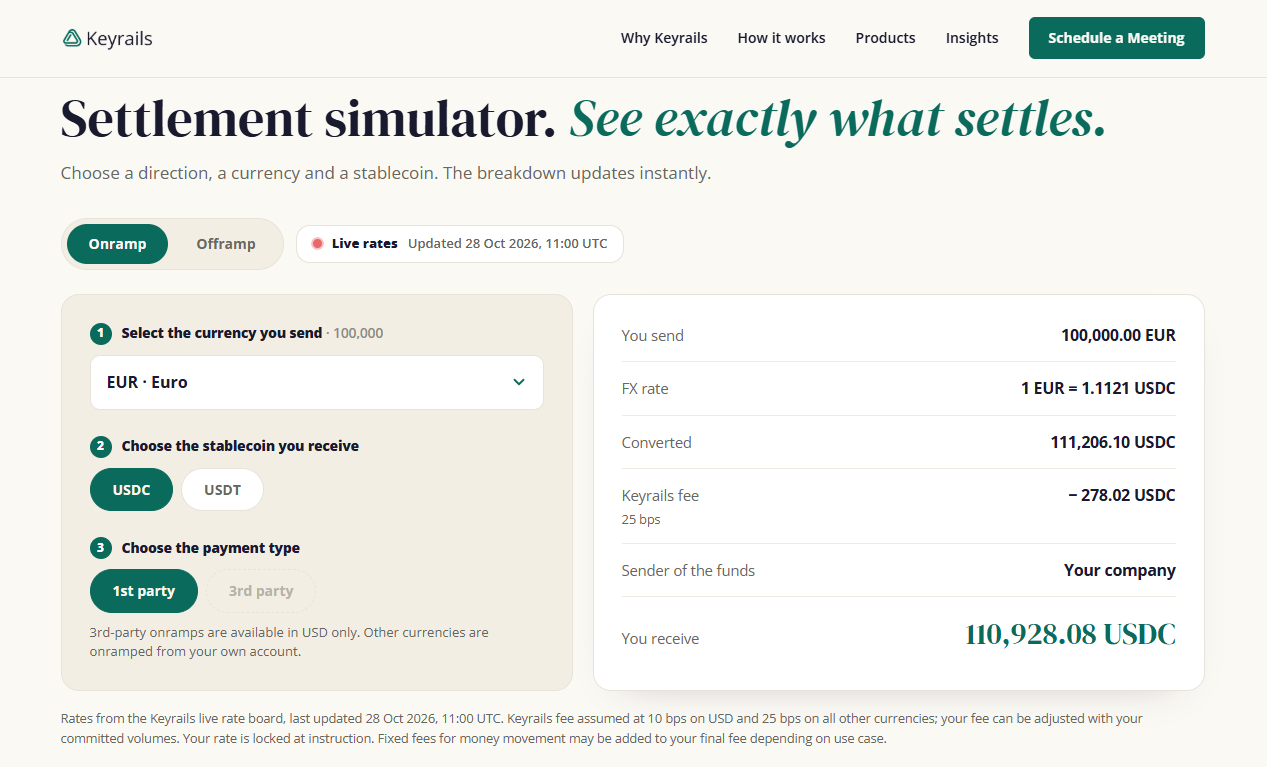
Keyrails' settlement simulator A user selects the direction, currency, and stablecoin and sees the FX rate, converted amount, disclosed Keyrails fee, and expected net amount before submitting the instruction.
How a Locked-Rate Institutional FX Transaction Works
Locking a rate is a process, not a single click. The steps below describe the funds flow for a stablecoin offramp, from USDC or USDT to a non-USD currency, through an institutional provider using an API or dashboard.
- Onboard as an institution: Complete KYB with the provider, including company documents, ownership, source of funds and the use case for the conversion. Rate locking is generally offered to verified institutional clients, not retail users.
- Register your company's fiat account: Register the bank account in your own company's name where the fiat will land. For first-party FX, fiat is settled to an account held in the client's own name, supporting a cleaner flow for compliance and reconciliation.
- Send the stablecoins: Transfer the stablecoin from your external wallet to the deposit address the provider issues for that instruction.
- Request a firm quote: Through the API or dashboard, specify the stablecoin, the target currency (for example EUR, GBP, CHF, CNY etc.) and the amount. Confirm if the quote is locked or indicative.
- Instruct the trade: Submitting the instruction simultaneously locks the rate for both legs of the stablecoin FX (Stablecoin to USD and USD to final currency). The expected fiat amount, net of disclosed fees, is then known in advance.
- Provider books the FX: The provider executes the conversion through its institutional FX infrastructure at the agreed rate. Price movement after instruction is the provider's to manage.
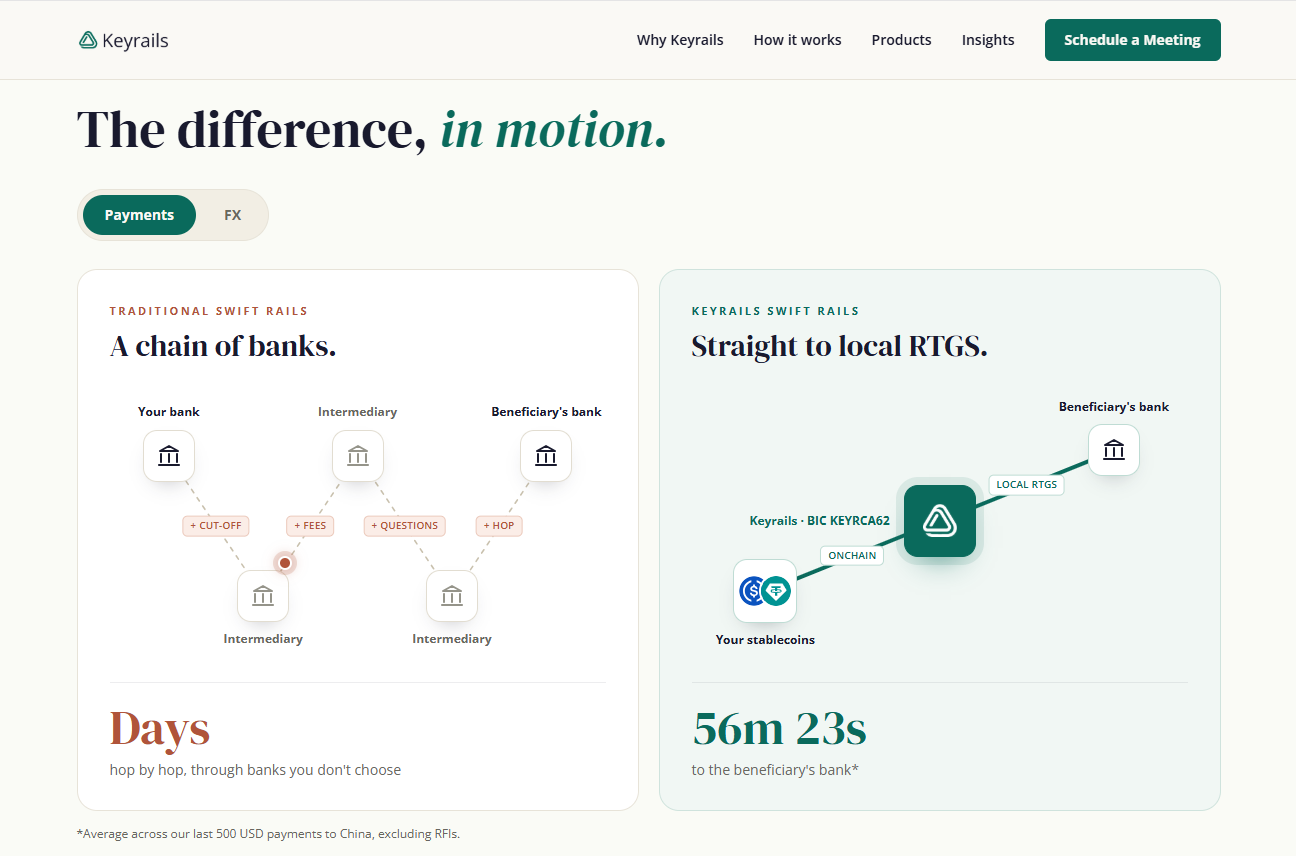
- Fiat settles to your account: The converted funds are paid to your linked bank account through the banking system. Keyrails connects to local RTGS infrastructure through its banking network and SWIFT connectivity. Effective management of local banking hours and payment cut-offs helps minimize delays, particularly for international transactions across different time zones.
- Reconcile: Match the transaction record against the amount received in your bank account. A confirmed FX rate and clear fee structure make reconciliation more predictable.
Practical tips for treasury teams
- Know the instruction window: Each currency has its own cut-off time and settlement window. Instructions must be optimized according to both.
- Separate the FX fee from fixed charges: A basis-point fee covers the conversion; payment fees may be added depending on the use case.
- Agree volume terms: Committed volumes can change the fee schedule, which matters for recurring liquidity needs.
- Automate through the API: Recurring conversions, such as daily payout funding, are easier to control when quotes and instructions run through an API and feed straight into your ledger.
The Infrastructure That Makes a Locked Rate Possible
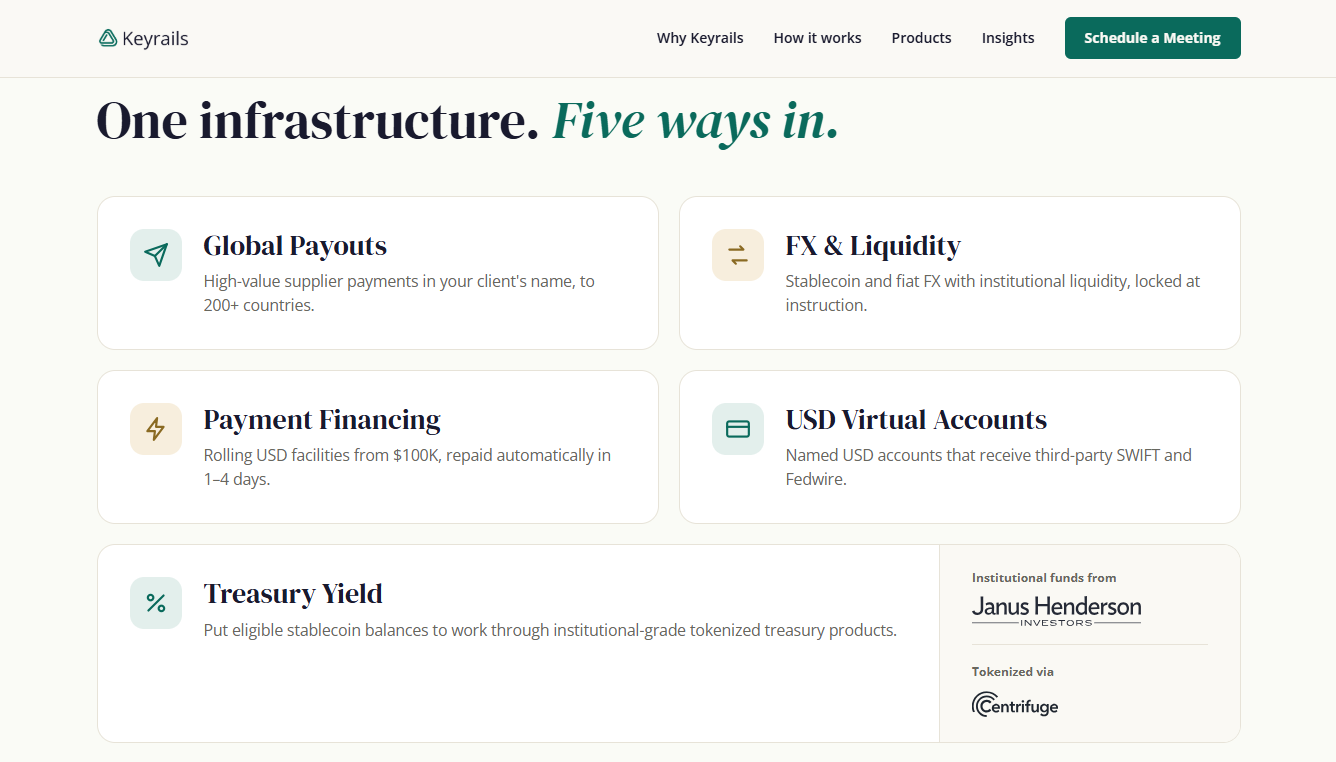
A provider can only commit to a rate at instruction if it controls the parts of the flow that set the price and move the fiat. Three capabilities matter in particular: institutional FX access, direct banking relationships, and control over the settlement path.
"Treasury teams at fintechs and NBFIs should not have to guess what will land in their account. When a client instructs a stablecoin FX trade with us, the rate is fixed at that moment. Our direct banking relationships, own SWIFT BIC and our access to interbank FX as well as local clearing & RTGS mechanisms in over 70 jurisdictions for 45+ currencies provide a more controlled and auditable path from stablecoin liquidity into the banking system. That certainty is what allows clients to plan liquidity across currencies with confidence.” — Berhan Kongel, CEO, Keyrails
Institutional FX liquidity
To honour a firm FX rate, a provider needs more than access to liquidity. It must also be able to manage market movements between the time a rate is agreed and the transaction is executed. Access to both spot markets and hedging instruments, such as forward contracts & swaps, helps providers protect agreed rates across different execution windows, including transactions involving markets in different time zones. Without these capabilities, clients may face slippage, unexpected costs, or cancelled transactions.
Keyrails' FX & Liquidity product provides stablecoin and fiat FX with institutional liquidity, locked at instruction. Keyrails combines direct banking relationships with interbank FX access to provide institutional stablecoin-to-fiat and fiat-to-stablecoin liquidity.
Direct banking relationships
The fiat leg of a stablecoin conversion has to land in the banking system. Direct banking relationships reduce reliance on borrowed banking access and give the provider greater visibility and control over the settlement process. A provider that borrows access through a partner adds a dependency it cannot fully manage.
Keyrails maintains direct relationships with its banking partners, giving institutional clients a more reliable route between stablecoin liquidity and the traditional banking system. This reduces reliance on intermediaries and provides greater visibility over how transactions are processed.
Direct clearing and an own SWIFT BIC
Keyrails operates under its own SWIFT BIC, KEYRCA62, with access to local clearing and RTGS systems across more than 70 jurisdictions and 45+ currencies. This infrastructure enables Keyrails to execute supported payments in the underlying client's name, supporting greater transparency, compliance, and faster reconciliation.
Combined with effective management of local banking hours and payment cut-offs, these capabilities provide a more controlled and predictable settlement process, particularly for transactions across different time zones.
Regulatory standing, by entity
Institutional counterparties should check which legal entity they contract with and how it is regulated. For Keyrails, the public disclosures list:
| Entity | Jurisdiction | Registration |
|---|---|---|
| Keyrails Inc. | Canada | Payment Service Provider under the Retail Payment Activities Act, registered with the Bank of Canada |
| Keyrails Inc. | Canada | Money Services Business with FINTRAC (MSB #M23573916), covering FX dealing, money transferring, dealing in virtual currencies and payment services |
| Keyrails Inc. | United States | Money Services Business with FinCEN (MSB #31000319550919) |
| Keyrails Swiss GmbH | Switzerland | Member of VQF, a self-regulatory organisation recognised under the Swiss Anti-Money Laundering Act |
Keyrails US Inc. is a Delaware technology company and does not provide financial services. Keyrails is also a certified member of the Circle Alliance Program and was named an initial partner for Mastercard's Stablecoin Security risk-intelligence solution, announced at Money20/20 USA in October 2026.
Coverage and scale
As of August 2026, Keyrails supports 45+ outgoing currencies and 15+ incoming currencies, with $10B+ in annualised TPV.
For the wider context, Keyrails CEO Berhan Kongel was one of nine executives interviewed in the Dfns Stablecoin FX report on how stablecoin FX becomes a working market. The Delos report The Great Rail Shift also covers how legacy rails and stablecoin rails are converging, with Keyrails as a case.
Due Diligence Checklist: Questions to Ask a Stablecoin FX Provider
Before routing high-value conversions through any provider, treasury and operations teams should get clear written answers to these questions.
| Question | Why it matters | What a strong answer looks like |
|---|---|---|
| Is the quoted rate firm or indicative? | Only a firm rate removes slippage | The rate is locked at instruction and confirmed in writing |
| How is liquidity sourced and execution managed? | Third-party execution reintroduces price risk | The provider can clearly explain its liquidity model, execution counterparties, and how the quoted rate is protected through settlement |
| Does the provider maintain direct banking relationships? | Borrowed access adds dependencies | Direct banking relationships supporting the relevant settlement flows |
| Can the provider execute payments in the underlying client's name? | Supports transparency, compliance, and faster reconciliation. | The underlying client can be identified as the sender on supported payments. |
| How does the provider manage fiat settlement and payment cut-offs across multiple time zones? | Banking hours and cut-offs can delay international payments, particularly across time zones. | Local clearing access without intermediaries and effective cut-off management support predictable settlement. |
| Which entity contracts with you, and where is it regulated? | Regulatory protection depends on the entity | Registrations listed by entity and jurisdiction |
| Which currencies are supported in each direction? | Coverage varies between onramp and offramp | A clear list of incoming and outgoing currencies |
| How are fees structured? | Hidden spreads undo a locked rate | A disclosed basis-point fee plus any fixed payment charges |
| Is there an API? | Manual processes do not scale | API and dashboard access for quotes, instructions and reporting |
For teams thinking about stablecoins as a treasury tool rather than only a payment method, Keyrails' essay Why Stablecoins Will Reshape Treasury Management Before They Disrupt Payments sets out the argument in more detail. Its piece Why Stablecoins Matter for Global Trade covers why bank-grade settlement still matters when value moves on-chain.
Final Thoughts
For fintechs and NBFIs that hold value in stablecoins but operate in other currencies, the conversion between stablecoin and fiat is one of the points where treasury teams need the greatest execution certainty. A rate locked at instruction turns that step from a market exposure into a known number.
The lock is only as reliable as the infrastructure behind it: institutional FX access, direct banking relationships, a controlled settlement path and clear regulatory standing by entity.”
Treasury and operations leaders evaluating stablecoin FX can review the Keyrails FX & Liquidity offering, test conversions in the settlement simulator on keyrails.com, or contact the team at enterprise@keyrails.com.
FAQs:
1. What does "rate locked at instruction" mean?
It means the FX rate between the stablecoin and the fiat currency is fixed when you submit the trade, not when the provider later executes it. The expected fiat amount, net of applicable fees, is known when the trade is confirmed. A locked FX rate means that both legs of the execution, namely stablecoin to USD and USD to final currency are locked simultaneously.
2. Can I lock a rate when converting USDT or USDC to non-USD currencies?
Yes, with providers able to offer firm institutional FX quotes for the relevant currency pair. Keyrails, for example, lets institutions trade USDC and USDT directly against supported non-USD currencies through an API and dashboard.
3. Why is a locked rate more important for high-value transfers?
Because the cost of rate movement scales with the amount. A move of a few basis points is minor on $10,000 but material on $5 million, especially when conversions repeat every week.
4. Who carries the FX risk when the rate is locked?
Once the rate is fixed for the agreed instruction window, the client is no longer exposed to ordinary market movement during that period, subject to the provider's applicable terms.
5. What is a SWIFT BIC, and why does it matter for stablecoin FX?
A SWIFT BIC identifies an institution on the SWIFT network. Keyrails operates under its own BIC, KEYRCA62, enabling it to execute supported payments on behalf of its clients, with the underlying client identified as the sender rather than Keyrails. This provides greater transparency, supports compliance, and makes reconciliation easier for institutional clients.
6. How long does a locked rate stay valid?
It depends on the provider's instruction window, the time allowed between instructing the trade and sending the stablecoins. Treasury teams should confirm this window in writing before they instruct, since it defines how long the provider holds the price.
7. What fees apply on top of a locked rate?
A locked rate is usually paired with a disclosed basis-point fee. Keyrails prices transactions on a basis-point model, tailored to the currency, transaction type, and agreed commercial terms.
8. Which currencies does Keyrails support?
As of August 2026, Keyrails supports 45+ outgoing currencies and 15+ incoming currencies. Currencies shown in its settlement simulator. Full coverage is shared in a briefing with the Keyrails team.
Disclaimer:
This article is for informational purposes only and does not constitute financial, investment, legal or tax advice. It is not an offer or solicitation to buy, sell or convert any stablecoin, digital asset or currency. Product features, fees, supported currencies, regulatory registrations and figures cited, including volumes as of August 2026, are based on information published or provided by Keyrails and may change. Stablecoin and FX transactions carry risks, and availability depends on jurisdiction, eligibility and onboarding requirements. Readers should conduct their own due diligence and consult qualified professional advisers before making any decision. Stablecoin Insider may have a commercial relationship with companies mentioned in this article.