Table of Contents
JPYC Inc. announced on August 5, 2026, that it has closed an extension of its Series B round, bringing the total to 6 billion yen, roughly $38 million. The new capital includes a 1 billion yen investment, about $6.3 million, from Tokyo-listed logistics group AZ-COM Maruwa Holdings.
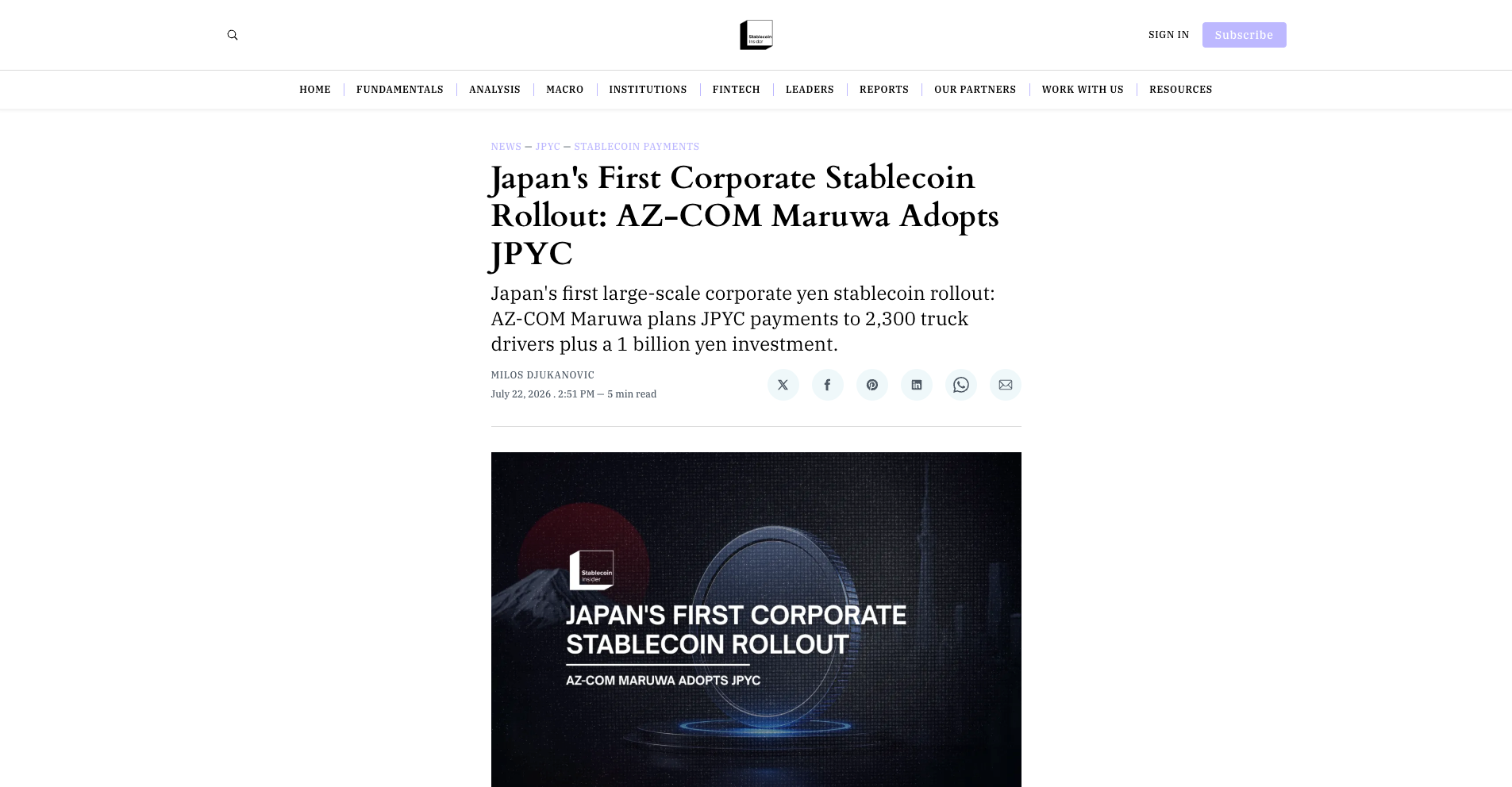
The investor is the same company that became JPYC's first major corporate user weeks earlier. AZ-COM Maruwa plans to pay fees and salaries to roughly 2,300 business partners and individual contractors, including truck drivers, using the yen stablecoin.
That sequence is the story. A logistics firm that counts Amazon Japan among its clients moved from adopting a payment rail to taking equity in the company that issues it.
JPYC said proceeds will expand its ecosystem across both traditional financial services and Web3, supporting new payment schemes that connect onchain settlement with offchain commerce.
Key Takeaways
- JPYC's extended Series B reached 6 billion yen, approximately $38 million, announced August 5, 2026.
- AZ-COM Maruwa invested 1 billion yen, about $6.3 million, as a new strategic investor.
- The logistics firm is also JPYC's first large corporate user, planning payments to roughly 2,300 partners and contractors.
- Metaplanet Ventures invested 400 million yen in March as part of the same Series B round.
- JPYC has raised roughly $106 million across seven rounds since November 2021, per Tracxn data.
What Was Announced
The extension adds approximately 1 billion yen to a round that stood near 5 billion yen when JPYC last reported it in May. The company did not disclose a valuation.
Metaplanet Ventures participated earlier in the same round, deploying 400 million yen, roughly $2.53 million, in March. The two firms have also been conducting a joint study into Bitcoin-backed tokenized credit products.
JPYC framed the use of proceeds around real-world circulation rather than product development. The company said it will expand the JPYC ecosystem across traditional finance and Web3, with funds supporting payment schemes that link onchain settlement to offchain commerce.
The issuer's position in Japan is distinctive. JPYC launched in October 2025 as the country's first stablecoin registered under the Payment Services Act, and it is currently participating in a stablecoin payment pilot with convenience store chain Lawson.
The Customer Became the Investor
AZ-COM Maruwa's investment follows its announcement of Japan's first large-scale corporate stablecoin deployment, which we covered in our AZ-COM Maruwa JPYC rollout analysis. Nikkei reported last month that the company intends to settle transportation fees and salaries with roughly 2,300 partners and contractors in JPYC.
The operational logic behind that decision explains the equity move. AZ-COM Maruwa expects fee-free stablecoin transfers to enable faster and more frequent payments than conventional bank transfers, which it sees as a practical tool for attracting subcontractors and managing driver retention in a tight labor market.
Buying equity changes the relationship from vendor to stakeholder. A company depending on a payment rail for contractor settlement has an interest in that issuer's solvency, roadmap, and regulatory standing, and an equity position converts that dependency into influence.
It also signals conviction that dollar stablecoin issuers rarely receive from industrial customers. AZ-COM Maruwa is not making a digital asset bet; it is investing in infrastructure it plans to run payroll through.
Japan's Yen Stablecoin Race
JPYC is competing against considerably larger balance sheets. SBI Group launched JPYSC in June as Japan's first trust bank-backed yen stablecoin, and megabanks MUFG, Sumitomo Mitsui, and Mizuho are jointly developing a stablecoin of their own.
Those competitors are wiring yen stablecoins into capital markets rather than payroll. The SBI partnership settling tokenized Japanese equities in JPYSC, detailed in our Ondo and SBI tokenization coverage, targets institutional settlement rather than contractor payments.

JPYC's differentiation is where it has traction. Truck driver payroll, convenience store payments, and supply chain settlement are unglamorous and closer to actual circulation than most institutional pilots have reached.
Government policy is pushing in the same direction. Japan's Basic Policy on Economic and Fiscal Management and Reform 2026, approved on July 21, explicitly outlines an onchain finance agenda, and JPYC has tied its AZ-COM Maruwa partnership to that framing.
Why This Matters for Stablecoins
Non-dollar stablecoins face a chicken-and-egg problem that dollar tokens do not. Dollar stablecoins have global demand for dollar exposure independent of any specific use case, while a yen stablecoin needs actual yen payment flows to justify existing, since Japanese residents already hold yen.
AZ-COM Maruwa's payroll deployment is exactly the kind of flow that solves it. Paying 2,300 contractors weekly or daily creates recurring, non-speculative demand for JPYC that persists regardless of crypto market conditions.
The corporate investment pattern is worth watching more broadly. If industrial companies begin taking equity in the stablecoin issuers whose rails they depend on, that changes how these businesses get funded, moving them closer to the utility-and-customer-ownership model that payment networks historically followed, a structure we examined in our stablecoin infrastructure landscape.

The scale caveat is substantial. JPYC's entire lifetime funding of roughly $106 million is a fraction of what a single US reserve fund manages, and the yen stablecoin market remains tiny against the roughly $300 billion dollar-denominated market.
Conclusion
Thirty-eight million dollars is a modest round by stablecoin standards, but the composition matters more than the total. A Tokyo-listed logistics company writing a check to the issuer whose token it plans to pay drivers with is a different signal than another venture round.
It suggests the yen stablecoin thesis is being validated by users rather than by investors betting on adoption. AZ-COM Maruwa already decided to use JPYC before deciding to fund it.
What remains unproven is whether the payroll deployment works at scale. Two thousand three hundred contractors receiving stablecoin payments is a genuine test of whether non-dollar stablecoins can serve ordinary commercial settlement, and the results will matter well beyond Japan.
FAQ:
1. How much did JPYC raise?
JPYC announced on August 5, 2026 that its extended Series B round reached a total of 6 billion yen, approximately $38 million. The extension included a new 1 billion yen investment, about $6.3 million, from AZ-COM Maruwa Holdings, and the company did not disclose a valuation.
2. Who is AZ-COM Maruwa and why did it invest?
AZ-COM Maruwa Holdings is a Tokyo-listed Japanese logistics company whose clients include Amazon Japan. It plans to use JPYC to pay transportation fees and salaries to roughly 2,300 business partners and individual contractors, including truck drivers, making it both JPYC's first major corporate user and now a strategic investor.
3. What is JPYC?
JPYC is a yen-pegged stablecoin issued by JPYC Inc., launched in October 2025 as Japan's first stablecoin registered under the Payment Services Act. The company has raised roughly $106 million across seven funding rounds since November 2021, according to Tracxn, and JPYC is currently part of a stablecoin payment pilot with convenience store chain Lawson.
4. How does JPYC compare to other Japanese stablecoins?
SBI Group launched JPYSC in June 2026 as Japan's first trust bank-backed yen stablecoin, and megabanks MUFG, Sumitomo Mitsui, and Mizuho are jointly developing their own. Those efforts target institutional and capital markets settlement, while JPYC has focused on commercial circulation through payroll, retail payments, and supply chain settlement.
5. Why do yen stablecoins matter when dollar tokens dominate?
Dollar-pegged tokens account for over 99% of stablecoin market capitalization, largely because global demand for dollar exposure exists independently of any use case. A yen stablecoin needs genuine yen payment flows to justify itself, which is why corporate deployments like paying 2,300 contractors create the recurring, non-speculative demand that non-dollar stablecoins require.
Disclaimer:
This content is provided for informational and educational purposes only and does not constitute financial, investment, legal, or tax advice; no material herein should be interpreted as a recommendation, endorsement, or solicitation to buy or sell any financial instrument, and readers should conduct their own independent research or consult a qualified professional.