

Table of Contents
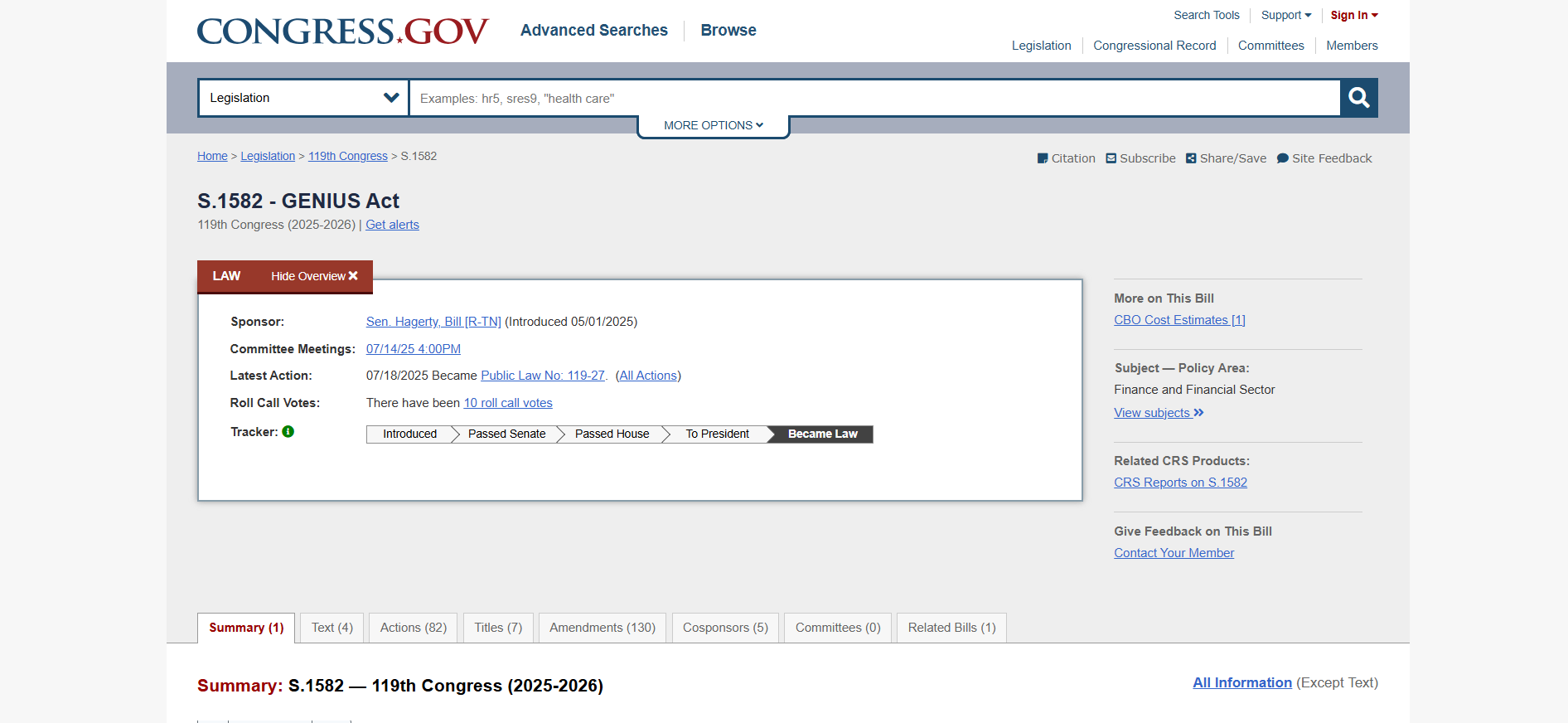
The GENIUS Act was signed into U.S. law on July 18, 2025, creating a federal framework for “payment stablecoins” and the entities allowed to issue them.
In practical terms, “GENIUS Act-compliant” is mostly an issuer-and-disclosure question: who issued the stablecoin, what reserves back it, what redemption policy applies, and what reporting is published.
At the same time, stablecoins are no longer niche infrastructure.
The IMF reports $23 trillion in stablecoin trading volume in 2024 and notes the combined market capitalization of the two largest stablecoins reached $260 billion after tripling since 2023.
Independent on-chain analytics also show scale: Chainalysis reports USDT routinely processed roughly $703 billion per month, peaking at $1.01 trillion in June 2025.
Key Takeaways
- The GENIUS Act framework centers on permitted payment stablecoin issuers, plus required reserve, disclosure, and redemption standards.
- The law contemplates monthly reserve reporting and related examination/certification mechanics.
- Reserve eligibility is constrained to high-quality categories (including short-dated Treasuries and tightly-defined repo structures), not “anything the issuer wants.”
- Migration risk is usually operational, not conceptual: wrong chain, wrong contract, address mistakes, custody workflow gaps, and reconciliation failures.
- “Passive income” generally comes from what you do with the stablecoin (lending, collateral, incentives), not from the payment stablecoin itself
What “GENIUS Act-Compliant” Means In Practice (2026 Reality)
Permitted Issuers Are The Primary Filter
GENIUS creates a regulatory perimeter around who can issue payment stablecoins and under what supervision. In 2026, a practical compliance signal starts with the issuer, not the ticker.
What you should do:
- Identify the issuer entity behind the stablecoin ticker (not just the brand).
- Look for clear evidence the issuer is operating inside the permitted framework (or a recognized foreign regime pathway, where applicable).
Reserves Must Meet Defined Categories
GENIUS requires 1:1 backing and defines categories of eligible reserve assets. This matters because it narrows “reserve drift” risk and gives you a concrete checklist to validate against issuer disclosures.
What to look for in issuer reserve reporting:
- A clear breakdown by category and maturity bands.
- Concentration risk (single custodian, single bank, single instrument type).
- Frequency and recency of updates (a consistent monthly cadence is the expectation).
Redemptions And Disclosures Are Not Optional
The GENIUS Act requires publication of a redemption policy and expects clear disclosure of fees and timing. In practice, “compliant” should map to published, checkable artifacts: a redemption policy, reserve reporting, and an issuer posture that matches the permitted issuer framework.
Practical takeaway: “Compliant” is not a marketing line. It should be supported by ongoing reporting and clear redemption terms.
Why This Migration Matters: Market Scale And Policy Pressure
Stablecoins now operate at volumes that force institutional-grade expectations.
- The IMF reports $23 trillion in stablecoin trading volume in 2024 and highlights rapid growth and geographic breadth of activity.
- TRM Labs reports stablecoins reached record levels in 2025, citing over $4 trillion in transaction volume between January 2025 and July 2025, alongside sharp growth year-over-year.
- Chainalysis quantifies sustained monthly throughput for the largest stablecoins, including USDT’s peak near $1.01 trillion in June 2025.
In parallel, GENIUS implementation is active and ongoing (proposed rules, interpretive documents, and operational expectations).
Your migration plan should assume that enforcement and expectations will mature further through 2026.

Defining Your Migration Goal And Constraints
Before moving a single token, define what “done” means.
Choose Your Target Operating Model
Pick one primary lane:
- Personal Self-Custody (hardware wallet + simple transfers)
- Priority: control and portability
- Tradeoff: you are your own security team
- Centralized Custody (exchange or regulated custodian)
- Priority: convenience, account recovery processes, compliance tooling
- Tradeoff: withdrawal limits, deposit crediting delays, counterparty risk
- Business Treasury (custodian + internal controls + accounting integration)
- Priority: governance, approvals, reporting
- Tradeoff: setup time and process complexity
Decide What “GENIUS-Aligned” Means For You
In 2026, a practical definition is:
- issuer appears to be within the GENIUS permitted framework (or recognized foreign pathway),
- reserve and redemption disclosures match GENIUS expectations,
- reserve reporting is consistent and frequent enough to be operationally trusted.
Due Diligence Checklist: How To Verify A Stablecoin Before Migrating
You are not trying to predict the future. You are trying to validate what is published today.
A) Issuer Verification (Non-Negotiable)
Collect:
- Issuer legal name and jurisdiction
- Supervisory framework indicator (federal/state qualified structure, bank subsidiary pathway, or other permitted form)
- Public statements and compliance materials that align with the permitted issuer regime (avoid relying on marketing pages alone)
B) Reserve Quality (Check The Categories, Not The Headlines)
From issuer reserve disclosures, verify whether reserves resemble GENIUS-expected categories (cash-like items, short-dated Treasuries, tightly constrained repo/reverse repo structures, and certain money market fund exposure limited to permitted underlying assets).
What to look for:
- Clear breakdowns by type and maturity
- Custody concentration and bank concentration
- A consistent reporting cadence (monthly is the baseline expectation)
C) Redemption Policy (The Real “Exit Door”)
A workable redemption policy should answer:
- Who can redeem (retail, institutional, both)
- How redemption requests are submitted
- Expected timeline and any fees
- When redemptions may be delayed or suspended, and under what authority
If any of these are vague, treat it as a material risk.
D) Misrepresentation Controls (Avoid False Safety Assumptions)
Do not assume any stablecoin is “insured” in a bank-deposit sense.
Treat any implication of government-backed insurance as an immediate red flag and validate the issuer’s language carefully.
Wallet Transfer Guide: The Safest Operational Path (With Fewer Mistakes)
Most migration losses happen for simple reasons: wrong chain, wrong contract, wrong address, or rushed execution.
The Transfer Workflow You Should Standardize
Use this for both individuals and teams:
- Confirm Chain + Token Contract
- Same ticker does not guarantee same asset.
- Confirm the exact chain and contract address from the issuer documentation or the destination platform’s supported asset list.
- Create A Destination Address Record
- Save the address in an address book.
- For businesses: require a second-person verification.
- Send A Small Test Transfer
- Treat this as mandatory.
- Wait for confirmations and the destination wallet/provider’s crediting process.
- Move In Planned Tranches
- One large transfer maximizes blast radius if something is wrong.
- Tranches let you pause if fees spike or the destination provider flags the deposit.
- Record Evidence Immediately
- Transaction hash, timestamp, amount, chain, destination, and purpose.
- For businesses: link to payroll batch, invoice, or treasury ticket.
“On-Chain Confirmed” Still Might Not Mean “Received”
Even after the blockchain shows confirmation, the recipient platform may delay crediting due to internal risk controls, compliance screening, batching/accounting processes, or manual review.
Plan for this with test sends, clear labeling, and reconciliation.
Migration Scenarios And How To Execute Each One
Scenario A: Exchange → Self-Custody
Best for individuals who want control.
Steps:
- Whitelist your hardware wallet address (if the exchange supports it).
- Do a small test withdrawal.
- Withdraw in tranches, keeping records of both the exchange withdrawal confirmation and the on-chain transaction.
Risk controls:
- Avoid copying addresses from chat apps.
- Verify the first/last characters and the QR code source.
- If using multiple networks, label the address book entry with the network name.
Scenario B: Self-Custody → Custodian (Or Business Wallet)
Best for businesses that need governance and reporting.
Steps:
- Obtain deposit instructions from the custodian (asset + chain must match).
- Confirm whether a memo/tag is required.
- Test deposit, wait for crediting, then proceed with tranches.
Risk controls:
- Use deposit addresses generated inside the custodian portal only.
- Enforce approvals for any new deposit address entry.
Scenario C: Chain A → Chain B
This is where users take unnecessary risk.
Decision rule: If you can avoid bridging, avoid it. Bridging adds smart contract, routing, and liquidity risks.
If you must change chains:
- Prefer issuer-native, officially supported deployments when available.
- Treat the move as higher-risk and minimize amount per tranche.

Passive Income With “Compliant” Stablecoins: What Is Realistic And What Is Not
Payment stablecoins are designed for payments and settlement, not as yield products.
A compliance-first approach requires that you separate “stablecoin compliance” from “yield venue risk.”
Where Yield Typically Comes From (And What You Are Actually Risking)
Common yield sources:
- Lending/Borrowing Markets (DeFi or CeFi)
- Yield is paid by borrowers (directly or via incentives).
- Risks: counterparty/default (CeFi), smart contract risk (DeFi), liquidity shocks, and rate instability.
- Liquidity Provision Incentives
- Yield comes from fees and/or incentive programs.
- Risks: peg deviations, pool design risks, and incentive programs ending.
- Treasury-Style Products (Tokenized Cash Equivalents)
- Often not payment stablecoins; they can have different access constraints and legal/structural characteristics.
- Tokenized Deposits (Bank-Linked Structures)
- These are generally distinct from payment stablecoins and may behave more like deposit products under banking frameworks.
“Compliance-First” Yield Guardrails
If your goal is passive income without breaking your migration model, use these guardrails:
- Separate operating cash from yield-seeking balances.
- Prefer transparency over headline APYs.
- Avoid maturity mismatch (instant withdrawal promises with locked liquidity underneath).
- Diversify dependencies (one wallet/venue/chain is a single point of failure).
- Do not assume issuer-level protections apply to third-party yield venues.
Documentation And Controls For Individuals And Businesses
What Individuals Should Save
- Address book entry (network-labeled)
- Transaction hash for each tranche
- Notes: date, purpose, and destination
What Businesses Should Save (Minimum Viable Audit Trail)
- Treasury policy: approved stablecoins, approved chains, approved custodians
- Due diligence packet: issuer reserve and redemption artifacts, updated on a consistent cadence
- Transfer evidence: request ticket, approvals, transaction hashes, reconciliation logs
- Accounting mapping: stablecoin wallet addresses to entities and cost centers
2026 Implementation Notes You Should Track
GENIUS implementation will continue to evolve through rulemaking and supervisory practice.
Your plan should assume that issuer disclosures and operational expectations may tighten, and you should build a repeatable due diligence review schedule (for example, monthly review aligned with issuer reserve report cadence).

Conclusion
Migrating to GENIUS Act-aligned stablecoins in 2026 is less about guessing which ticker will “win” and more about running a repeatable process: validate the issuer and disclosures, follow conservative wallet transfer steps, and separate settlement money from yield-seeking activity.
With stablecoin volumes measured in the tens of trillions annually, disciplined operations and clear documentation are now baseline requirements, not enterprise extras.
Read Next:
- 2025 Stablecoin Year-End Report
- Best Chain for Stablecoin Micropayments in 2026
- Best Stablecoin On/Off-Ramps for 2026 Compared
FAQs:
1. What Makes A Stablecoin “GENIUS Act-Compliant” In 2026?
A practical definition is that it is issued by an entity operating within the permitted issuer framework and it publishes reserve and redemption disclosures consistent with GENIUS expectations.
2. What Reserve Assets Should I Expect A Compliant Issuer To Hold?
You should expect high-quality, cash-like reserves such as short-dated U.S. Treasuries and tightly constrained repo structures, with transparent reporting by category and maturity.
3. How Do I Check If A Stablecoin Has A Real Redemption Policy?
Look for a public policy that clearly states who can redeem, the steps to redeem, timing, fees, and conditions for delays or suspensions.
4. What Is The Safest Way To Transfer Stablecoins Between Wallets?
Verify chain and contract, add the address to an address book, send a small test transfer, then migrate in tranches while saving transaction evidence.
5. Why Can Deposits Be Delayed Even After On-Chain Confirmation?
Custodial platforms may apply risk checks, compliance screening, batching, or manual review before crediting deposits.
6. Can A GENIUS-Compliant Stablecoin Pay Passive Income By Itself?
Typically, yield comes from how you deploy the stablecoin (lending, liquidity, incentives), not from the payment stablecoin itself.
7. What Is The Biggest Mistake People Make During Migration?
Rushing execution: wrong network, wrong contract, wrong address, or skipping test transfers.
Disclaimer:
This content is provided for informational and educational purposes only and does not constitute financial, investment, legal, or tax advice; no material herein should be interpreted as a recommendation, endorsement, or solicitation to buy or sell any financial instrument, and readers should conduct their own independent research or consult a qualified professional.