Table of Contents
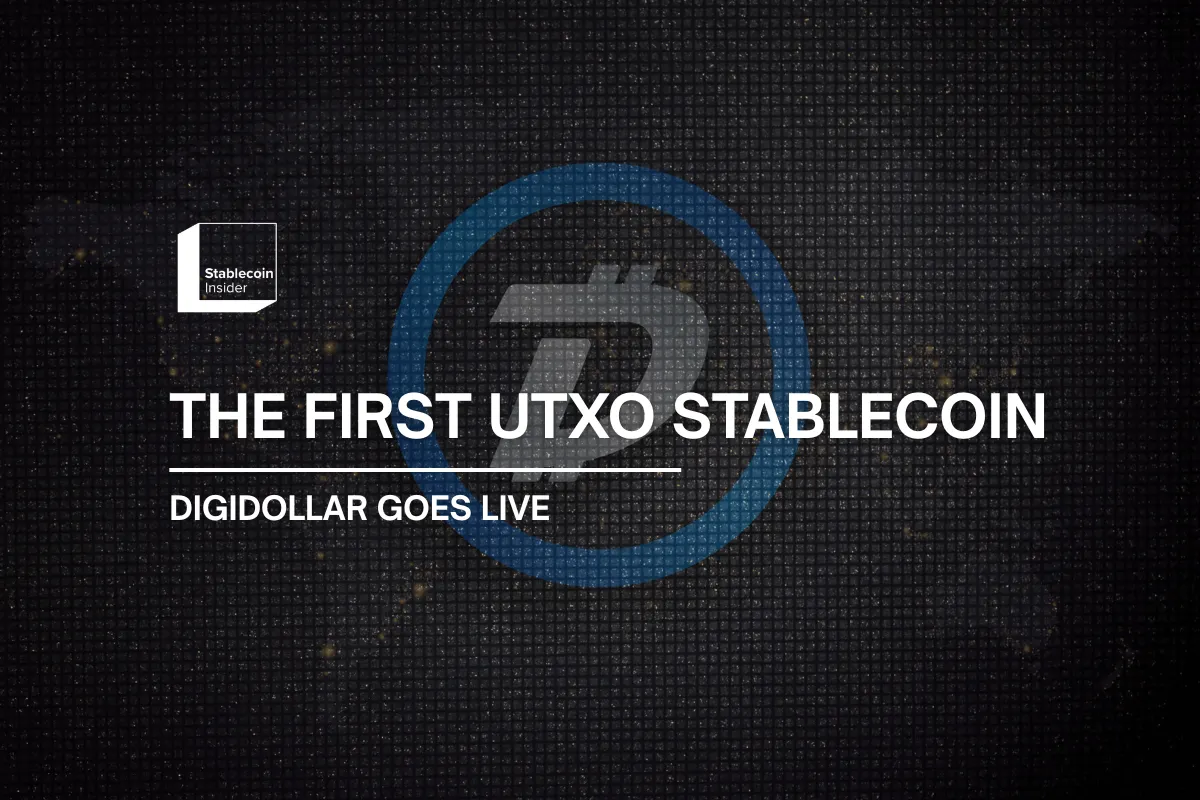
The first stablecoin ever built directly into a UTXO blockchain's protocol is now live. DigiDollar, a US dollar-pegged stablecoin native to the DigiByte network, activated on mainnet in mid-July 2026 through a miner-signaled soft fork, with CoinMarketCap reporting the milestone on July 18 as DGB rallied more than 23% on the news.
Unlike every major stablecoin in circulation, DigiDollar has no issuer. There is no company minting tokens against bank reserves and no smart contract deployed on a separate layer, because the minting, collateral, and redemption rules are enforced by DigiByte's own consensus code at the transaction level.
Users mint DigiDollar by time-locking DGB coins as collateral, with a decentralized oracle system feeding the DGB/USD price into the protocol. The design makes it a structural outlier in a market where the top tokens are liabilities of centralized companies.
DigiDollar is implemented natively within the DigiByte protocol, using UTXO scripting to enforce collateral rules directly at the transaction level rather than relying on external virtual machines or bridge-based infrastructure.
Key Takeaways
- DigiDollar activated on DigiByte's mainnet in mid-July 2026, becoming the first native stablecoin on a UTXO blockchain.
- There is no issuer and no smart contract, as minting and collateral rules live in the protocol's consensus code.
- Users mint by time-locking DGB as collateral, removing coins from circulation for the duration of the lock.
- A 35-slot oracle roster with 7-signature MuSig2 quorum feeds the DGB/USD price that governs minting.
- DGB jumped over 23% on activation, and x402 AI agent payment support followed on the same network.
What Activated and How It Works
DigiDollar shipped in the DigiByte Core v9.26 release line, which rebased the network onto a Bitcoin Core v26.2 foundation and added the stablecoin logic on top. Activation followed the BIP9 miner-signaling process used for Bitcoin soft forks, with an activation window running from May 2026 and a fixed minimum block height below which the feature could never turn on.
The minting mechanic is collateralized but deliberately different from DeFi lending protocols. A user locks DGB in a time-locked collateral position and mints DigiDollar against it, and because the collateral is time-locked rather than margin-monitored, there is no liquidation engine forcibly closing positions during price swings.
Price data comes from a purpose-built oracle system. A roster of 35 oracle slots supplies the DGB/USD feed, with 7 signatures required for consensus using MuSig2 Schnorr threshold signatures, and the feed draws on multiple exchange APIs including Binance, KuCoin, Gate.io, HTX, and Crypto.com.
The collateral design doubles as a supply mechanic for DGB itself. DigiByte has a fixed maximum supply of 21 billion coins, and every DGB locked behind a DigiDollar position leaves active circulation for the duration of the lock, tying stablecoin demand to collateral scarcity.
Why a UTXO-Native Stablecoin Is Different
Every dominant stablecoin today falls into one of two architectures. USDT, USDC, and their peers are liabilities of centralized issuers backed by offchain reserves, increasingly operating under federal charters like the one in our Circle OCC trust bank coverage, while DAI-style tokens are smart contracts running on account-based chains like Ethereum, dependent on liquidation bots and governance.
DigiDollar is a third category: consensus-level money on a UTXO chain, the transaction model Bitcoin pioneered. The rules cannot be changed by a company or a governance vote, only by the same miner-signaled upgrade process that activated the feature in the first place.
The trade-offs are real and worth naming. Protocol-level rigidity means bugs are harder to patch, an oracle roster is still a trust surface, however it is signed, and a stablecoin collateralized by a volatile small-cap asset carries depeg risk that fiat reserves do not.
The honest market context matters too. DigiByte is a legacy 2014-era network with a fraction of the liquidity of major chains, so DigiDollar's significance right now is architectural rather than economic, a working proof that UTXO chains can host native stablecoins at all.
The AI Agent Payments Angle
The activation did not arrive alone. DigiByte scheduled x402 AI agent payment support for its mainnet the following day, plugging the network into the same machine-to-machine payment standard that has been reshaping stablecoin infrastructure all month.
DigiByte founder Jared Tate has explicitly framed AI agent payments as DigiDollar's primary use case, arguing that autonomous systems transacting at high frequency need sub-cent fees and fast settlement, which the network's 15-second blocks are built for.
That places DigiDollar in a race with much larger players. Coinbase has pushed USDC as the settlement asset for agent payments on Base, as covered in our Coinbase x402 USDC coverage, and the XRP Ledger paired RLUSD with Mastercard's Verifiable Intent standard for the same market.
DigiDollar's pitch into that race is philosophical as much as technical. An AI agent settling in USDC depends on Circle, and one settling in RLUSD depends on Ripple, while an agent settling in DigiDollar depends only on a protocol, which will appeal to a specific slice of the agentic economy and be irrelevant to the enterprise slice that wants a counterparty to call.
Conclusion
DigiDollar's mainnet activation is a genuine first: a stablecoin whose entire lifecycle, from minting to redemption, runs inside a UTXO blockchain's consensus rules with no issuer anywhere in the stack. Twelve years after Bitcoin's transaction model was declared too limited for programmable money, a 2014-era Bitcoin fork shipped it.
Whether it matters commercially is a different question. DigiByte's market footprint is small, the collateral asset is volatile, and the stablecoin market is consolidating around regulated, reserve-backed issuers under frameworks like the one in our GENIUS Act rulemaking coverage, rather than moving away from them.

But as an existence proof, it lands at an interesting moment. The industry is debating how much of the stablecoin stack should depend on companies, and DigiDollar is the most complete answer yet from the other end of the spectrum.
FAQ:
1. What is DigiDollar?
DigiDollar is a US dollar-pegged stablecoin built natively into the DigiByte blockchain's protocol, activated on mainnet in mid-July 2026. It has no issuing company and no smart contract layer, because minting, collateral, and redemption rules are enforced directly by the network's consensus code, making it the first native stablecoin on a UTXO blockchain.
2. How do you mint DigiDollar?
Users mint DigiDollar by time-locking DGB coins as collateral in a protocol-level position, with a decentralized oracle feed supplying the DGB/USD price. Unlike DeFi lending protocols, there is no liquidation engine, because the time-locked collateral model does not rely on margin monitoring and forced position closures.
3. How is DigiDollar different from USDT or USDC?
USDT and USDC are liabilities of centralized companies backed by offchain reserves, while DigiDollar has no issuer at all. Its rules live in DigiByte's consensus code and can only change through miner-signaled network upgrades, though the trade-off is collateralization by a volatile asset rather than fiat reserves.
4. What secures DigiDollar's price feed?
A purpose-built oracle system with a 35-slot roster supplies the DGB/USD price, requiring 7 signatures for consensus using MuSig2 Schnorr threshold signatures. The feed draws on multiple exchange APIs, including Binance, KuCoin, Gate.io, HTX, and Crypto.com.
5. Why does a stablecoin on DigiByte matter?
Commercially it is small, but architecturally it proves UTXO blockchains can host native stablecoins without issuers, smart contracts, or bridges, with DigiByte also adding x402 AI agent payment support, DigiDollar positions itself as a fully protocol-dependent settlement option in the emerging machine-to-machine payments market.
Disclaimer:
This content is provided for informational and educational purposes only and does not constitute financial, investment, legal, or tax advice; no material herein should be interpreted as a recommendation, endorsement, or solicitation to buy or sell any financial instrument, and readers should conduct their own independent research or consult a qualified professional.