
Table of Contents
Circle opens Arc to the public on September 16, 2026, moving the network from a private mainnet that has run with more than 100 institutional and ecosystem builders. Arc is a Layer 1 built for stablecoin payments, tokenized assets, and institutional settlement, with USDC as the native gas token. The date has held since Circle confirmed it on August 5.
The launch matters less for the technology than for who is running it. Eleven institutions join Circle as founding validators, including BlackRock, DTCC, Visa, Mastercard, and ICE. That is a genesis validator set drawn almost entirely from traditional finance rather than from crypto infrastructure operators.
Circle has said a product suite will be unveiled at launch, covering a composable app framework, AI-assisted contract tooling, and infrastructure for issuing and managing tokenized real-world assets. The network is permissioned at the validator layer and permissionless for deployment.
Jeremy Allaire said the network rests on the premise that the global financial system "deserves a blockchain network it can trust."
Key Takeaways
- Arc public mainnet opens September 16, 2026, after a private mainnet phase.
- Eleven founding validators join Circle, including BlackRock, DTCC, Visa, and Mastercard.
- USDC is the native gas token, so fees are denominated in dollars.
- BlackRock is expected to deploy its BUIDL fund on Arc.
- DTCC tokenization of DTC-custodied assets is targeted for H2 2027.
The Validator Set Is the Story
Alongside Circle, the founding cohort is BlackRock, DTCC, Galaxy, Global Payments, ICE, Mastercard, MoneyGram, SBI, Standard Chartered, Sumitomo Corporation, and Visa. Four of those names are systemic market infrastructure rather than participants. That composition is the argument Circle is making about what institutional settlement requires.
The trade-off is explicit in Circle's own materials. Arc runs a permissioned validator set, and Circle selects who validates. Anyone can deploy contracts and transact, but block production stays with known institutions.
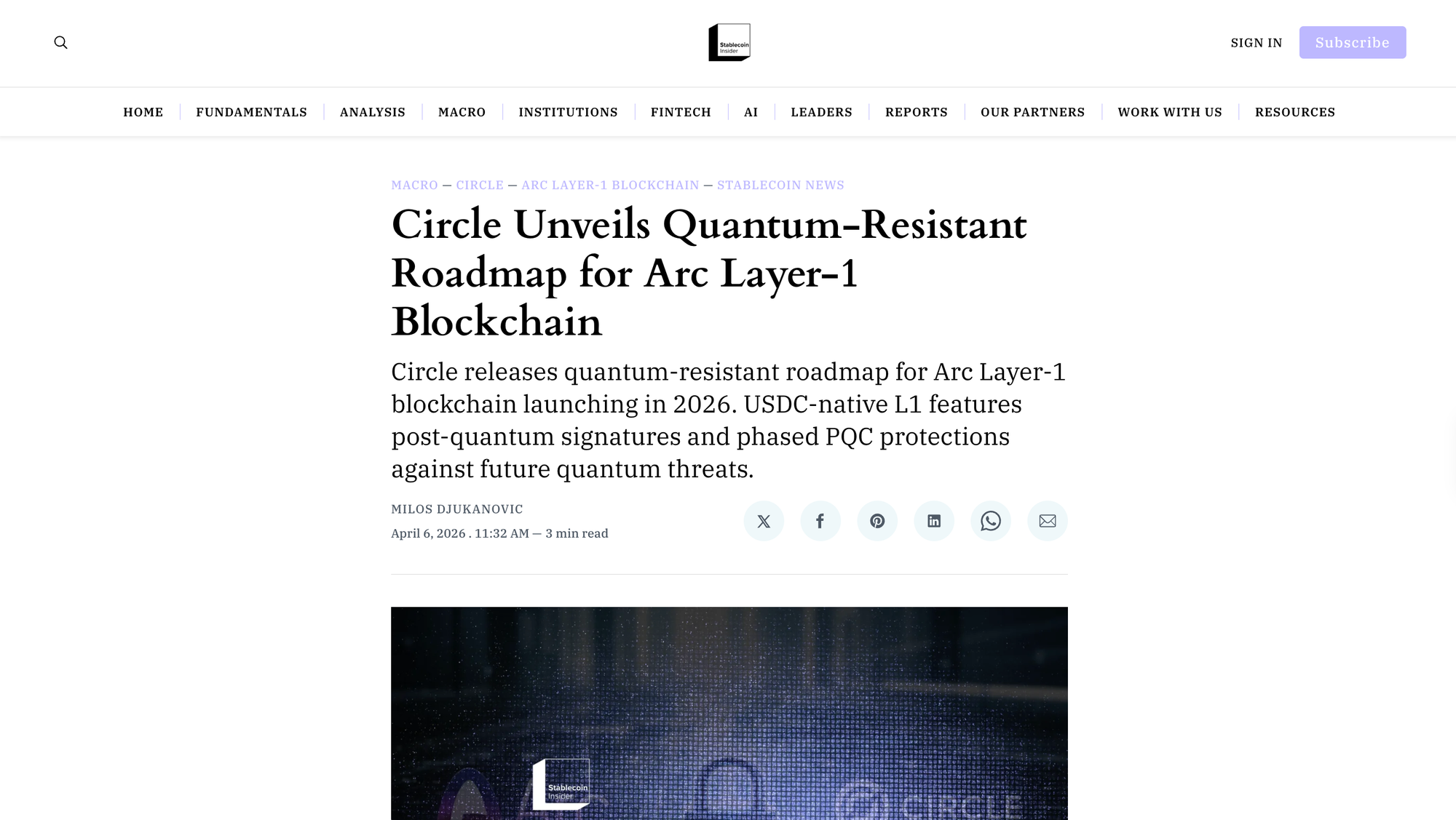
Consensus runs on Malachite with deterministic finality under 500 milliseconds, and execution is EVM-compatible. The technical choices were set out earlier in the year, including the post-quantum roadmap covered in our piece on the Arc Layer 1 design.
What Is Expected on Day One
Circle has named three categories of launch participants. DeFi protocols and capital allocators include Aave, Aerodrome, FalconX, Galaxy, GSR, Keyrock, Morpho, Nonco, Uniswap, and XFX. Stablecoin payment providers include Rain, Thunes, and Wirex.
Exchanges and wallet providers listed are Binance Wallet, Chainlink, Fireblocks, Kraken, Ledger, MetaMask, Uniswap Labs, and Upbit. Circle's phrasing is that these are expected to be live, not confirmed as live. Uniswap has said publicly it is ready on day one.
Circle has cited more than 500 million testnet transactions and close to three million wallets ahead of the launch. Those figures describe a test environment with no real value at stake. What the network does with real assets under real load is the open question.
Why Circle Needs Arc
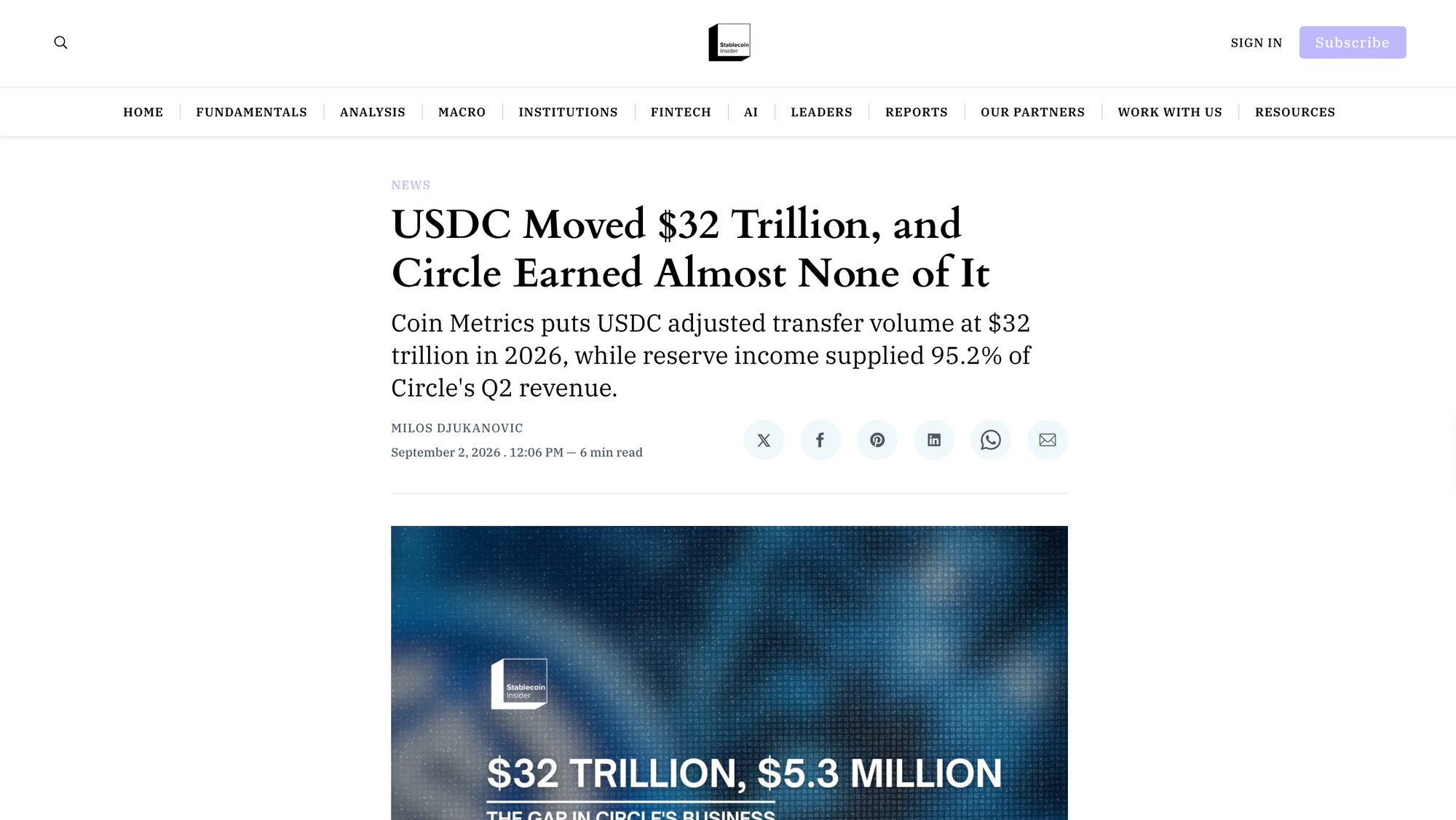
The commercial logic sits in Circle's revenue mix. Reserve income supplied 95.2% of the company's second-quarter revenue, while transaction revenue came to $5.3 million. USDC settled roughly $32 trillion in adjusted transfer volume during 2026, almost none of which generated fees for the issuer.
Arc is the attempt to build a fee surface on that activity. If USDC settlement migrates onto a chain Circle operates, the gas layer becomes a revenue line that does not depend on interest rates. That dependency is the structural problem we set out in our report on USDC reserve income.
Whether that works depends entirely on migration. Volume currently sits on Ethereum, Base, and Solana, and moving institutional flows is slow even when the economics favour it.
The Institutional Roadmap Runs Past Launch
BlackRock is expected to deploy BUIDL, its tokenized institutional liquidity fund, using Arc's native USDC integration for subscription and redemption in one onchain environment. DTCC is collaborating with Circle to enable tokenization of DTC-custodied assets on Arc beginning in the second half of 2027. BNY and Standard Chartered are exploring custody, stablecoin access, and FX and repo infrastructure.
The gap between tomorrow and H2 2027 is the point worth holding onto. The validator list is live infrastructure, but the largest stated use cases sit eighteen months out.
What Has Not Been Confirmed
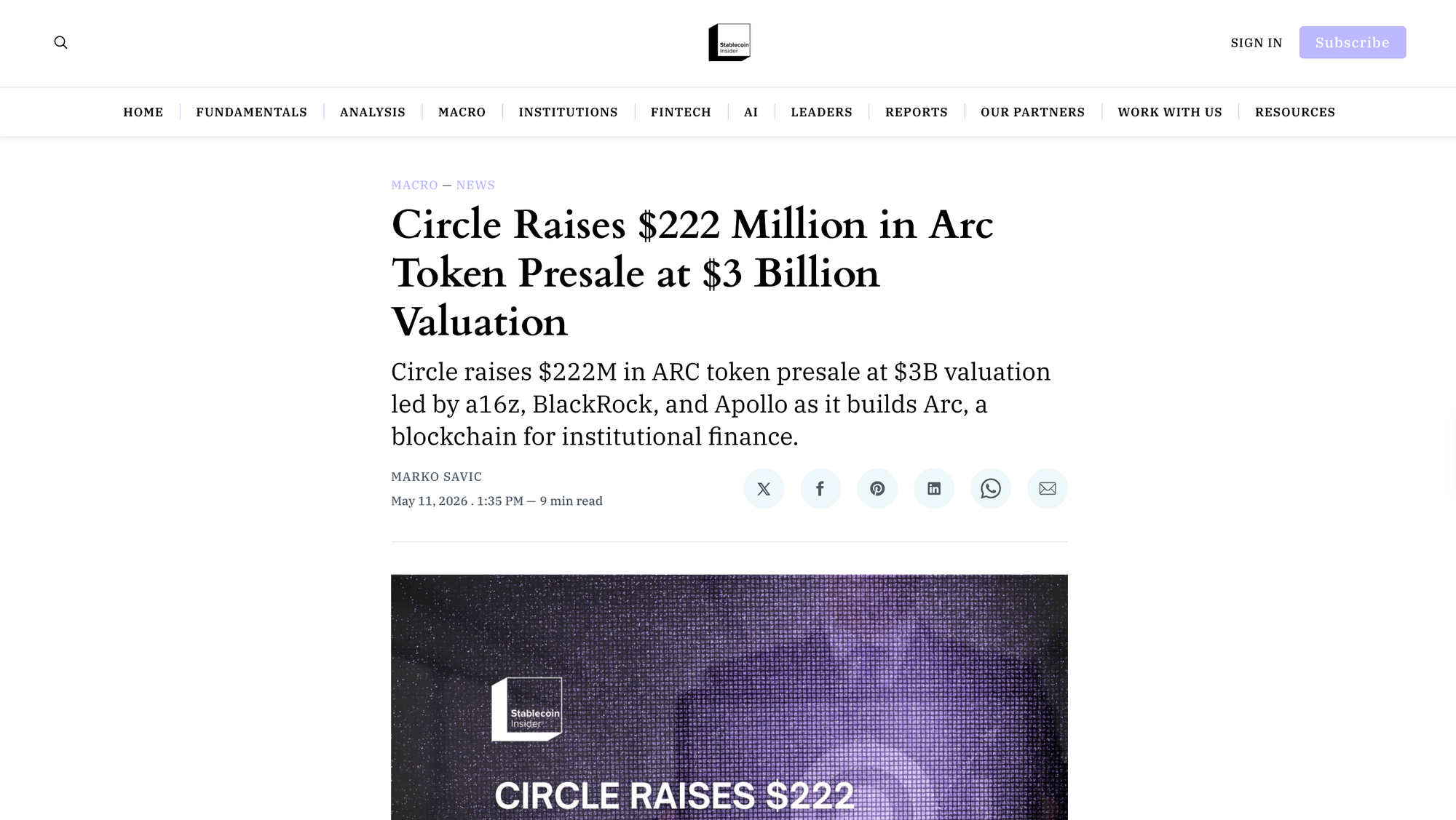
The mainnet launch and the ARC token are separate events. Circle has published an ARC token whitepaper describing it as a coordination asset for the network, and raised $222 million in a presale at a $3 billion fully diluted valuation in May, led by Andreessen Horowitz. No token generation or trading date has been confirmed, which we covered at the time in our report on the ARC token presale.
The launching entity is Arc Network Services LLC rather than Circle directly. Circle's own disclaimer states that Arc has not been reviewed or approved by the New York State Department of Financial Services or any other regulatory authority. It also notes that transacting on Arc depends on obtaining USDC to pay gas.
What to Watch
Three things separate a functioning launch from an announcement. How many of the named day-one participants are actually live, whether validators are independently operating nodes rather than running Circle-managed infrastructure, and what real-value throughput looks like in the first week.
The timing also sits directly against the Senate's CLARITY Act cloture vote on September 15. A compliance-first, permissioned chain built by a US-listed issuer is exposed to whichever way federal market structure resolves. The two events landing a day apart is coincidence, but the dependency is not.
FAQs:
1. When does Circle's Arc mainnet launch?
Arc's public mainnet opens on September 16, 2026. Circle confirmed the date on August 5, 2026, alongside the founding validator announcement, after running a private mainnet with more than 100 ecosystem and institutional builders.
2. Who are Arc's founding validators?
Eleven institutions join Circle as founding validators: BlackRock, DTCC, Galaxy, Global Payments, ICE, Mastercard, MoneyGram, SBI, Standard Chartered, Sumitomo Corporation, and Visa. The validator set is permissioned, meaning Circle selects who can produce blocks.
3. What is the gas token on Arc?
USDC is Arc's native gas token, so transaction fees are denominated in dollars rather than in a volatile asset. Circle's own disclaimer notes that the ability to transact on Arc depends on obtaining and using USDC to pay those fees.
4. Is the ARC token launching with the mainnet?
No. The mainnet launch and any token generation event are separate. Circle has published an ARC token whitepaper and completed a $222 million presale at a $3 billion fully diluted valuation in May 2026, but no trading or distribution date has been confirmed.
5. What is BlackRock doing on Arc?
BlackRock is expected to deploy BUIDL, its tokenized institutional digital liquidity fund, on Arc using the network's native USDC integration. The stated aim is to let institutional investors subscribe, redeem, and deploy fund assets within a single onchain environment.
Disclaimer:
This content is provided for informational and educational purposes only and does not constitute financial, investment, legal, or tax advice; no material herein should be interpreted as a recommendation, endorsement, or solicitation to buy or sell any financial instrument, and readers should conduct their own independent research or consult a qualified professional.