Table of Contents
Washington, D.C. - April 17, 2026.
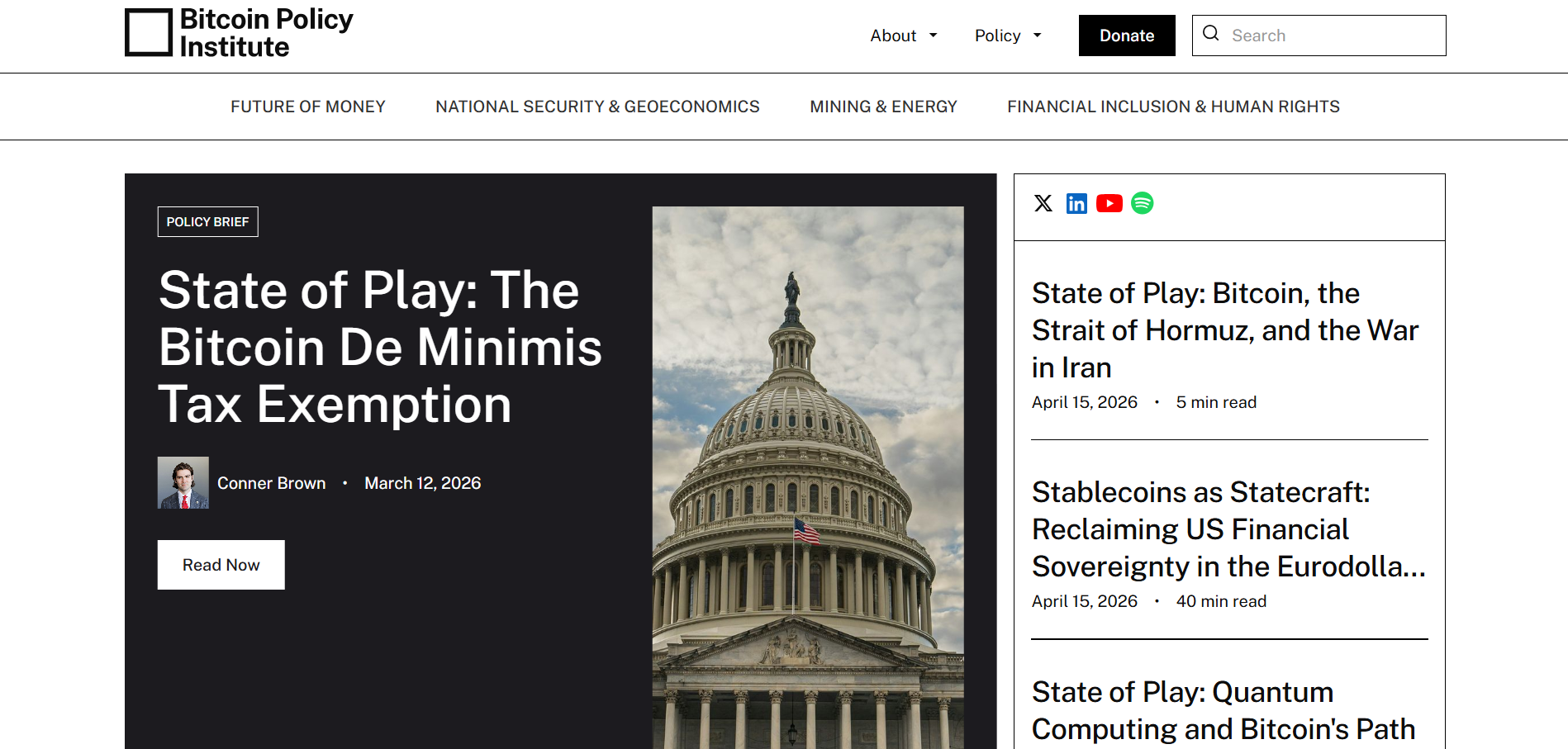
The Bitcoin Policy Institute (BPI) has published a bold new policy framework titled Stablecoins as Statecraft: Reclaiming US Financial Sovereignty in the Eurodollar Market, urging the United States to harness regulated stablecoins to reassert control over the global dollar system and achieve “stablecoin supremacy.”
Key Takeaways
- The BPI calls for regulated U.S. stablecoins to become the cornerstone of American financial power, shrinking offshore dollar risks and countering China’s digital yuan.
- The plan shifts global dollar demand onshore, strengthening Treasury markets and restoring U.S. oversight without increasing sovereign debt.
- Five practical strategies offer a roadmap to turn stablecoins into tools of economic statecraft, ensuring long-term U.S. leadership in digital finance.

Authored by BPI Visiting Fellow Nik Bhatia and released April 15, the paper arrives amid growing international competition in digital finance.
It positions compliant U.S. stablecoins, backed 100% by Treasuries or insured deposits under the GENIUS Act signed in July 2025, as a strategic tool to shrink the unregulated $12–15 trillion offshore Eurodollar market, reduce systemic risks, and blunt China’s advances in digital currency infrastructure.
The proposal argues that the current Eurodollar system allows foreign banks to create dollar credit outside U.S. oversight while relying on the Federal Reserve as a backstop during crises. Stablecoins, by contrast, keep reserves onshore, channeling demand for U.S. Treasuries directly back to American markets without expanding sovereign debt held abroad.
“Stablecoins give the United States a policy instrument it has never had: a way to meet global dollar demand, strengthen governance over its currency, [and] project American financial architecture into markets that legacy banking has never reached,” the paper states.
It frames the initiative as essential economic statecraft in an era when China’s digital yuan pays interest and its mBridge platform processes cross-border settlements across dozens of countries.
The Five Strategies for Stablecoin Supremacy
The BPI outlines a practical five-point agenda to turn regulated stablecoins into a cornerstone of U.S. financial power:
- Harden GENIUS Act implementation by establishing a backstop architecture, including committed repo lines with primary dealers and a pathway to Federal Reserve Standing Repo Facility access. This would make U.S.-compliant stablecoins more reliable and attractive than offshore alternatives.
- Export stablecoins instead of Eurodollar deposits for international trade settlement. The move would pull Treasury demand onshore and eliminate the offshore credit multiplier that currently expands dollar liabilities beyond U.S. regulatory reach.
- Develop a fee-and-rewards framework that lets regulated stablecoins compete with interest-bearing Eurodollar deposits and China’s digital yuan, without violating the GENIUS Act’s statutory prohibition on paying interest.
- Address DeFi credit-multiplication risks through smart-contract-level restrictions and enforcement chokepoints. The goal is to prevent unregulated protocols from recreating the Eurodollar-style credit expansion on blockchain rails.
- Preserve foreign currency sovereignty by supporting local monetary systems alongside stablecoin adoption. This ensures the strategy promotes shared economic development rather than financial coercion.
Taken together, the recommendations aim to extend U.S. oversight over offshore dollar flows, strengthen the Treasury market, and position American stablecoins as the preferred global settlement rail, without increasing the Federal Reserve’s balance sheet or issuing additional sovereign debt to foreign governments.
Conclusion
As competition intensifies from China’s digital yuan, Europe’s MiCA-regulated euro stablecoins, and other challengers, the Bitcoin Policy Institute’s “Stablecoin Supremacy” proposal offers a forward-looking roadmap for policymakers.
By treating stablecoins as instruments of economic statecraft rather than mere payment tools, the United States can reclaim governance over the dollar system it created, mitigate long-standing vulnerabilities exposed by the Triffin Dilemma, and secure leadership in the next era of international finance.
Implementation of these strategies could reshape global capital flows for decades to come.
Read Next:
- Stripe, Tempo, and x402: How Machine Payments Are Reshaping Internet Commerce in 2026
- Cobo Launches Adoption Clearing Layer (ACL)
- Société Générale-FORGE Partners with Consensys
FAQs:
1. What is the Bitcoin Policy Institute’s “Stablecoin Supremacy” proposal?
It is a new policy paper released April 15, 2026, that outlines how the U.S. can use regulated stablecoins to regain control of offshore dollar markets and achieve dominance in the global stablecoin sector.
2. Why does the proposal matter for U.S. financial leadership?
It addresses the $12-15 trillion Eurodollar market that operates beyond U.S. regulation while relying on American backstops. Stablecoins under the GENIUS Act keep reserves onshore, reducing systemic risk and countering rivals like China’s digital yuan.
3. What are the five key strategies in the proposal?
The strategies focus on strengthening GENIUS Act rules with liquidity backstops, exporting stablecoins for trade, creating competitive fee/rewards models, limiting DeFi credit risks, and respecting foreign monetary sovereignty.
4. How does the plan position the U.S. against China?
It aims to make U.S. stablecoins more attractive and reliable than China’s interest-bearing digital yuan and mBridge system by keeping dollar infrastructure under American governance.
5. When was the proposal released and who wrote it?
Visiting Fellow Nik Bhatia authored the paper for the Bitcoin Policy Institute, with coverage and updates appearing across major outlets on April 16–17, 2026.
Disclaimer:
This content is provided for informational and educational purposes only and does not constitute financial, investment, legal, or tax advice; no material herein should be interpreted as a recommendation, endorsement, or solicitation to buy or sell any financial instrument, and readers should conduct their own independent research or consult a qualified professional.