
Table of Contents
Stablecoins moved over $35 trillion in annual transaction volume, surpassing both Visa and Mastercard with a staggering 115% year-over-year increase.
The Best Stablecoin Payment APIs are no longer just crypto curiosities, they're reshaping global finance at unprecedented speed.
Indeed, what began as crypto-native trading tools have evolved into the backbone of global payments. With transaction volumes reaching a record $33 trillion in 2025 (up ~72% from 2024) and continuing strong momentum into 2026, stablecoins offer compelling advantages over traditional payment rails.
Furthermore, stablecoin payment processors maintain fees between 0.2-1%, drastically undercutting the typical 3-5% charged by credit cards. Meanwhile, stablecoin payment gateways are transforming high-risk payment operations by slashing settlement times from days to mere seconds.
The market signals are unmistakable. The global stablecoin ecosystem is projected to reach £41.68 billion by 2031, growing at a 9.4% CAGR between 2025-2031.
Additionally, 90% of financial institutions are now actively pursuing stablecoin adoption. For developers looking to capitalize on this shift, selecting the right integration partner is critical.
We've analyzed the leading stablecoin payment APIs to identify which solutions deliver the strongest developer experience, lowest fees, fastest settlement, and most robust feature sets for 2026 implementation.
Whether you're building a high-risk payment gateway, e-commerce checkout, or cross-border settlement system, our technical assessment will help you make an informed integration decision.
Key Takeaways
Stablecoins have revolutionized global payments with $35 trillion in annual volume, surpassing Visa and Mastercard while offering developers powerful APIs to build next-generation financial applications.
- Crossmint provides a full-stack stablecoin API, combining payments, wallets, on/offramps, and tokenization in one platform.
- Bridge.xyz leads enterprise integration with Stripe's $1B backing, offering comprehensive orchestration, custodial wallets, and Visa-powered virtual cards for seamless stablecoin-to-fiat operations.
- Fee structures vary dramatically across providers - FreeBnk offers industry-low 0.07% fees while traditional exchanges like Coinbase Pro charge 0.00%-0.50% maker/taker fees.
- Specialized APIs serve distinct use cases - TokenView excels in on-chain analytics, MuralPay handles bulk cross-border payments, while Circle provides gasless USDC transactions.
- Geographic and regulatory compliance matters - Some APIs like CoinSwitch Pro focus on specific regions (India), while others like Binance face jurisdiction restrictions.
- Free options exist for testing and analytics - Stablecoin Stats API offers zero-cost market data, while CoinSwitch Pro provides free API access with initial zero trading fees.
The stablecoin payment infrastructure is rapidly maturing, with 90% of financial institutions actively pursuing adoption.
Crossmint API
Crossmint has established itself as the leading full-stack stablecoin payment API in 2026, offering far more than basic payment processing.
Designed as a complete financial backend, it enables businesses to seamlessly integrate wallets, global payments, fiat conversions, and tokenization into a single unified API.
Rather than exposing developers to fragmented blockchain tooling, Crossmint abstracts the complexity while still delivering fast, programmable, and compliant stablecoin transactions at scale.
Crossmint Key Features
Crossmint’s API suite is built around end-to-end stablecoin orchestration, enabling developers to:
- Move funds globally using stablecoins with instant, multi-chain settlement
- Embed programmable wallets for users, businesses, or AI agents
- Convert fiat to stablecoins and back via onramps and offramps in 160+ countries
- Manage treasury operations with secure, API-controlled wallets
- Issue tokens and digital assets using API or no-code tooling
- Enable AI agents to hold funds and transact autonomously via cards or crypto rails
A key differentiator is its unified infrastructure approach: wallets, payments, compliance, and tokenization are all accessible through one platform, eliminating the need to stitch together multiple vendors.
Crossmint Pros and Cons
Pros:
- Comprehensive infrastructure covering wallets, payments, and tokenization in one API
- Instant settlement and automated routing across multiple blockchains
- Strong compliance footprint (MiCA-ready, SOC 2 Type II, GDPR, full U.S. coverage)
- Built-in support for AI-native use cases and agentic payments
- Scales to enterprise needs with high reliability SLAs
Cons:
- Broader scope means more complex integration compared to simple payment APIs
- May be overkill for businesses that only need basic checkout or payment acceptance
- Advanced features (e.g., orchestration, tokenization) require deeper technical implementation
Crossmint Pricing
Crossmint uses a usage-based pricing model tailored to enterprise and developer needs. While exact pricing depends on volume and features, it typically includes:
- Transaction-based fees for stablecoin transfers and conversions
- On/offramp fees for fiat ↔ stablecoin operations
- Tiered pricing based on scale and infrastructure usage
- Custom enterprise pricing for high-volume or specialized deployments
Businesses can optimize costs by consolidating multiple financial operations (wallets, payments, compliance) into a single provider rather than paying separate vendors.
Crossmint Best Use Cases
Crossmint is particularly well-suited for:
- Building neobanks or fintech apps with embedded stablecoin wallets
- Cross-border payments and remittances with instant settlement
- Global treasury management using stablecoins
- AI agent platforms that require autonomous financial capabilities
- Tokenization platforms issuing digital assets or credentials
- Payroll, UBI programs, or large-scale payout systems leveraging stablecoins
Its flexibility makes it a strong choice for teams that need a programmable, global financial layer rather than a narrow payments-only API.
Bridge.xyz API
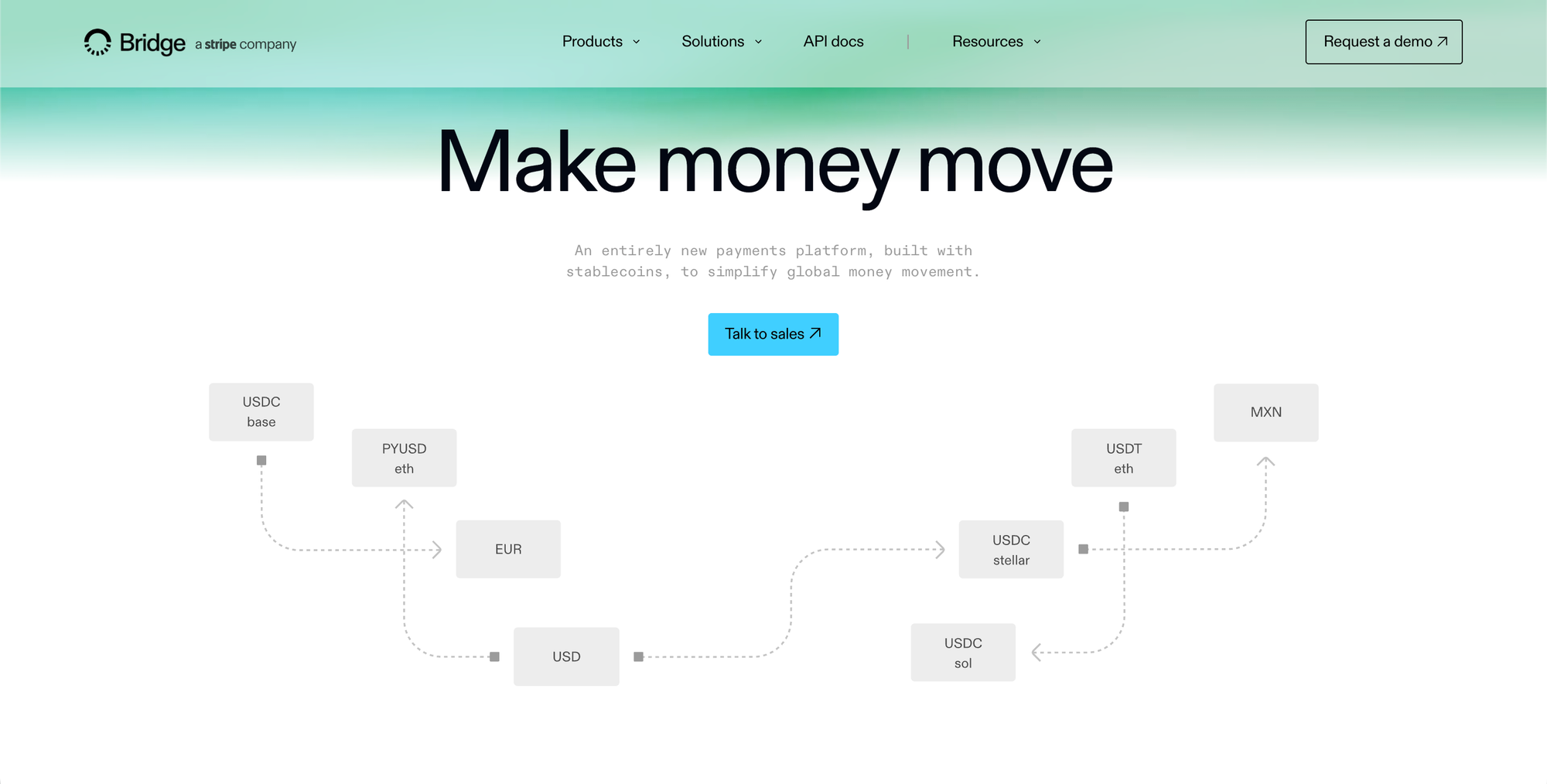
First and foremost, Bridge.xyz has positioned itself as an infrastructure powerhouse for stablecoin integration, especially since its $1 billion acquisition by Stripe. This stablecoin payment API delivers comprehensive tools that abstract away blockchain complexities while maintaining the speed and security benefits of digital assets.
Bridge.xyz Key Features
Bridge.xyz's orchestration API serves as its standout offering, enabling developers to:
- Move funds globally via fiat rails, stablecoins, or supported digital assets
- Provision custodial wallets for secure stablecoin balances
- Issue virtual USD, EUR, and MXN accounts with local bank details
- Launch branded stablecoins or utilize USDB to earn rewards
- Enable Visa-powered virtual card spending from stablecoin balances
Notably, the platform handles all on-chain plumbing, gas management, and reserve infrastructure, allowing developers to focus on application development rather than blockchain intricacies.
Bridge.xyz Pros and Cons
Pros:
- Settlement in seconds for cross-border transactions any day of the week
- No incremental minting, burning, or conversion fees between USDB and other stablecoins
- Robust security with on-chain/off-chain validations and whitelisted accounts
- Operates under Stripe's regulatory umbrella with MSB registration and multiple U.S. MTLs
Cons:
- Developer fees limited to 2 decimal places precision for fixed amounts
- Custom developer fee percent requires 5 digits maximum precision
- Fee structure complexity varies between fixed amount and flexible amount transfers
Bridge.xyz Pricing
The stablecoin payment processor employs a unique pricing model where developers can collect optional custom, per-transaction fees from users. These are structured as:
- Fixed amount fees: Specified in USD with up to 2 decimal places precision
- Percentage-based fees: Required for flexible amount transfers
- Global fees: Applied across all liquidation addresses
- Custom override fees: Available for specific addresses
Fees are automatically withheld from customer transactions and paid out monthly on the 5th to configured external accounts.
Bridge.xyz Best Use Cases
This stablecoin payment gateway excels in:
- Treasury management automation, as demonstrated by Meow implementation
- Emerging market commerce, exemplified by Starlink adoption
- Global card issuance backed by stablecoin balances
- Custom stablecoin issuance with branded tokens backed by U.S. Treasury reserves
- Cross-border payment facilitation with instant settlement and reduced FX costs
Stablecoin Stats API
The Stablecoin Stats API stands out as a specialized analytics tool in the stablecoin ecosystem, offering developers a direct line to crucial market intelligence. Unlike transaction-focused solutions, this API delivers comprehensive monitoring capabilities across major stablecoin networks.
Stablecoin Stats API Key Features
Designed for data-driven applications, the Stablecoin Stats API provides:
- Comprehensive Stablecoin Coverage: Detailed statistics on major stablecoins including USDT, USDC, DAI, TUSD, PAX, GUSD, and USDS
- Rich Market Metrics: Real-time tracking of circulating supply, market capitalization, trading volume, and 24-hour percentage changes
- Historical Time-Series Data: Access to historical summaries dating back to 2018 for trend analysis and research
- Multiple Data Endpoints: Structured access to live summaries, tickers, historical data, and customizable date ranges
- Exchange-Level Insights: Granular visibility into ticker pairs across multiple exchanges with quote volumes and pricing
The API's structured endpoints facilitate seamless integration of stablecoin analytics into market monitoring applications, research platforms, and trading systems.
Stablecoin Stats API Pros and Cons
Pros:
- Zero authentication requirements for immediate integration
- Comprehensive visibility across multiple stablecoin ecosystems
- Well-documented endpoints with clear response structures
- Support for visualization tools enabling dashboard development
- Full historical data access with customizable date ranges
Cons:
- Early development status with potential endpoint changes
- Unspecified request frequency limitations
- Limited to analytical functions without transaction capabilities
- Covers only seven stablecoin symbols currently
Stablecoin Stats API Pricing
In contrast to commercial stablecoin payment processors, the Stablecoin Stats API operates on a completely free model with no authentication barriers. This pricing approach removes financial obstacles for developers building analytics tools, market monitors, or research platforms.
Stablecoin Stats API Best Use Cases
Given its analytical focus, this API is particularly valuable for:
- Market analysis platforms requiring continuous stablecoin metric updates
- Research tools tracking supply-demand dynamics across stablecoin ecosystems
- Risk management systems monitoring stablecoin stability and volume trends
- Trading strategy development utilizing historical stablecoin data
- Portfolio management applications requiring stablecoin market intelligence
The platform functions primarily as a specialized intelligence layer for stablecoin monitoring versus a full-fledged payment infrastructure, making it an essential companion tool for developers already utilizing transaction-oriented stablecoin payment APIs.
MuralPay API
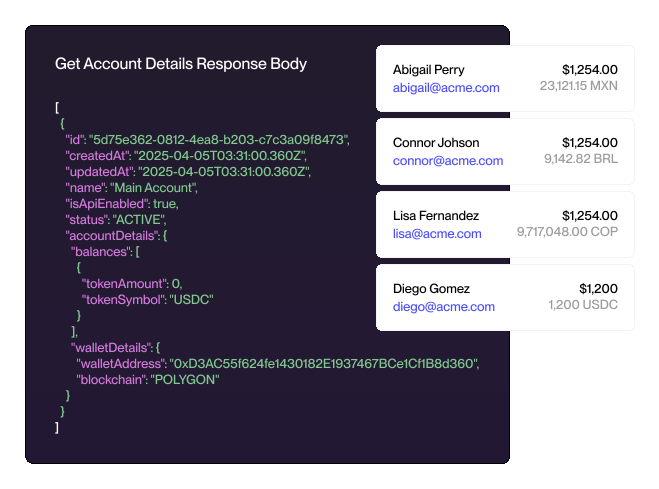
Image Source: Mural Pay
Designed specifically for high-volume global transactions, MuralPay operates as a specialized stablecoin payment API facilitating rapid cross-border settlements. The platform has gained recognition for streamlining international payment operations through blockchain technology.
MuralPay API Key Features
MuralPay distinguishes itself through several core capabilities that address traditional payment friction points. The API supports batch payment functionality for processing thousands of recipients in a single transaction, dramatically simplifying high-volume payments. Moreover, the platform enables transactions with established stablecoins like USDC and USDT, known for their stability compared to other cryptocurrencies.
The API architecture includes CSV upload support, multi-currency transactions, and account-based approval flows for secure authorization. Consequently, developers gain access to a robust infrastructure supporting virtual accounts, on/off-ramps, and workflow integration.
MuralPay API Pros and Cons
Pros:
- Instant settlements completed in seconds rather than days
- Reduction in average transaction costs by up to 50% compared to traditional cross-border methods
- Support for operations across 170+ countries with adaptation to local payment rails
- Comprehensive security features including multi-factor authentication and complete audit trails
Cons:
- Primarily focused on Americas region, potentially limiting global coverage
- Requires integration of KYC/KYB protocols for certain transactions
- Documentation for API versioning could be improved based on industry standards
MuralPay API Pricing
MuralPay employs a transparent fee structure that explicitly avoids common pain points such as bounce-backs or lost wires. According to documentation, the platform maintains "low fees" specifically designed for high-risk payment scenarios.
MuralPay API Best Use Cases
This stablecoin payment processor excels primarily in scenarios requiring high-volume international payments. Opera News successfully implemented the platform to facilitate "hassle-free payments to thousands of writers around Africa every month". Accordingly, the API performs exceptionally well for:
- Treasury operations requiring automated bulk payments
- Financial institutions managing cross-border transactions
- Businesses with global contractor networks
- Fintech platforms seeking stablecoin integration without blockchain expertise
- Organizations requiring real-time transaction monitoring and compliance tools
The platform's ability to handle significant transaction loads while maintaining security makes it particularly suitable for complex payment workflows across regulated industries.
TokenView API
TokenView API emerges as a critical player in the blockchain analytics space, offering developers deep visibility into stablecoin movements across multiple chains. First of all, this API distinguishes itself through comprehensive on-chain monitoring capabilities targeted at stablecoin lifecycle events.
TokenView API Key Features
The platform's core strength lies in its ability to track granular stablecoin activities:
- Multi-chain monitoring across Omni, Ethereum, and Tron networks
- Comprehensive stablecoin support for USDT, USDC, HUSD, sUSD, TUSD, PAX, GUSD, BUSD, and PYUSD
- Lifecycle event tracking including minting, burning, issuing, redeeming, freezing, and unfreezing actions
- Real-time data delivery synchronized with block confirmations for immediate insights
- Historical analytics enabling trend analysis and market intelligence
Due to its specialized focus on stablecoin behaviors, TokenView enables developers to gain critical market intelligence while shortening information gaps in trading and analysis scenarios.
TokenView API Pros and Cons
Pros:
- High performance infrastructure recognized as an early stablecoin API provider
- Synchronous data delivery matching block confirmation timing
- Well-structured data formats optimized for counting and analytical grouping
- RESTful API architecture enabling straightforward integration
Cons:
- More focused on analytics than transaction processing
- Limited to three blockchain networks
- Requires technical knowledge to properly interpret on-chain signals
- Documentation could be more comprehensive for advanced use cases
TokenView API Pricing
TokenView implements a frequency-based pricing structure starting with a 3-day free trial offering 300 requests per minute. Subsequently, paid plans range from $118 for a 1-month subscription to customized enterprise solutions. For developers requiring higher volumes, a significant discount of 15.9% applies to longer-term commitments.
TokenView API Best Use Cases
The stablecoin payment API excels primarily in:
- Real-time alerting systems for stablecoin minting and burning events
- Index creation leveraging historical stablecoin circulation data
- Market analysis tools providing insights into stablecoin behavior
- Arbitrage opportunity identification through transaction monitoring
- Blockchain wallet applications requiring stablecoin balance verification
Therefore, TokenView serves as a vital intelligence layer for applications needing visibility into on-chain stablecoin movements rather than a direct payment processor.
CoinAPI
CoinAPI stands as a market data powerhouse in the crypto space, offering developers access to data from over 17,938 assets across more than 339 exchanges. As a one-stop solution for crypto market data, this platform delivers critical capabilities essential for stablecoin transaction monitoring and analytics.
CoinAPI Key Features
At its core, CoinAPI delivers both historical and real-time data through multiple protocols:
- Dual API Architecture with REST and WebSocket support, eliminating repetitive data polling
- Complete Order Book Visibility including L2/L3 tracking of individual order changes
- WebSocket DS Mode providing direct, per-exchange connections that minimize routing overhead for latency-sensitive applications
- Normalized Metadata with consistent timestamps and UTC alignment
- S3-Compatible Flat Files for bulk historical datasets, enabling backtesting and analytics
In essence, the platform functions as a unified data layer across 370+ exchanges, normalizing complex data streams for immediate application.
CoinAPI Pros and Cons
Pros:
- Extensive exchange coverage integrating data from 380+ venues across spot, derivatives, and DEX
- High performance infrastructure with publicly promised 99.9% uptime
- Flexible integration options via multiple protocols (REST, WebSocket, FIX) with SDKs across languages
- Unified data model reducing friction when combining data across venues
Cons:
- Significant expense with entry pricing at $79 monthly for only 1,000 daily requests
- Heavy infrastructure requirements for processing tick-level and order-book data
- Documentation clarity issues reported by some users
- Daily request limitations affecting high-frequency trading applications
CoinAPI Pricing
The platform offers tiered subscription plans:
- Startup: $79.00 monthly with 1,000 REST credits daily
- Streamer: $249.00 monthly including 10,000 REST credits daily
- Pro: $599.00 monthly providing 100,000 REST credits daily
- Enterprise: Custom pricing with tailored SLAs
- Free Credits: $25.00 in API credits available for testing before commitment
CoinAPI Best Use Cases
This solution excels primarily for developers requiring:
- Normalized cross-chain stablecoin volume and transfer data
- Real-time stablecoin flow tracking and anomaly detection
- Research-grade data for academic stablecoin analysis
- Stablecoin treasury management with clean historical datasets
- Trading algorithms requiring millisecond-level quote frequency
Even though the focus remains primarily on data provision rather than transaction processing, CoinAPI serves as a vital intelligence layer for stablecoin payment applications requiring market-wide visibility.
CoinSwitch Pro API
CoinSwitch Pro API emerges as a robust solution for developers seeking multi-exchange cryptocurrency trading capabilities, including extensive stablecoin integration. Launched as an answer to growing demand from Indian traders, this stablecoin payment API delivers automation capabilities that operate continuously in volatile markets.
CoinSwitch Pro API Key Features
The API's architecture focuses on comprehensive trading functionality:
- Automated 24/7 Trading enabling algorithmic execution regardless of time zones
- Leverage Options extending up to 1:25 for amplified trading positions
- Diverse Asset Coverage spanning 250+ coins and 430+ leveraged contracts
- Advanced Order Types including Market, Limit, and Stop-Limit for precise execution
- Arbitrage Finder identifying cross-exchange opportunities
- User-Friendly Endpoints providing access to advanced market data
Beneath the surface, CoinSwitch Pro delivers real-time market data and charts essential for informed trading decisions. The platform also incorporates industry-standard security protocols, prominently featuring two-factor authentication to safeguard assets.
CoinSwitch Pro API Pros and Cons
Pros:
- Faster execution capturing 100% of market opportunities versus 50% with manual trading
- Round-the-clock automated trading eliminating time-based restrictions
- Lower transaction fees improving margin potential
- Responsive 24/7 support system for immediate technical assistance
Cons:
- Limited geographic focus primarily serving Indian crypto traders
- Learning curve for developers unfamiliar with API trading environments
- Requires technical knowledge for effective strategy implementation
CoinSwitch Pro API Pricing
In stark contrast to most competitors, CoinSwitch Pro offers free API access. Even more remarkably, the platform provides zero trading fees as an introductory offer. For new users specifically, a full commission rebate applies to all trades executed via API during the first 30 days.
CoinSwitch Pro API Best Use Cases
This stablecoin payment gateway excels within several specialized contexts:
- Custom Trading Strategy Development with algorithmic execution
- High-Frequency Trading leveraging faster execution speeds
- Arbitrage Exploitation across multiple exchanges under one account
- 24/7 Market Participation through automated execution
- Portfolio Management Tools requiring programmatic control
Naturally, the ability to automate trades while removing emotional decision-making makes this API particularly valuable for developers building precision-focused stablecoin trading applications.
Iron.xyz API
Recently acquired by MoonPay in a high-profile deal, Iron.xyz delivers a comprehensive stablecoin payment infrastructure that bridges traditional finance with blockchain technology. The acquisition strengthens MoonPay's enterprise stablecoin market position, offering business-critical payment tools under a unified framework.
Iron.xyz API Key Features
At its core, Iron.xyz functions as a turnkey solution enabling developers to implement global stablecoin payments within days. The platform's architecture encompasses essential components including on/offramps, payment processing, wallet provisioning, and virtual account management. Appropriately designed for maximum interoperability, the system allows smooth transitions between fiat currencies and stablecoins.
Iron.xyz API Pros and Cons
Pros:
- Instant, low-cost stablecoin payment acceptance
- Real-time treasury management capabilities
- Access to yield-bearing assets like US Treasury bonds
- Backed by MoonPay's established fintech infrastructure
Cons:
- Limited public documentation on technical specifications
- Integration complexity for non-blockchain native developers
- Recently acquired, raising questions about future product roadmap
Iron.xyz API Pricing
Following the MoonPay acquisition, pricing details remain primarily unpublished. The stablecoin payment processor emphasizes cost efficiency as a core value proposition, ultimately positioning itself as an enterprise-grade solution.
Iron.xyz API Best Use Cases
This stablecoin payment gateway excels for:
- Enterprise treasury operations requiring immediate cross-border settlements
- Financial platforms serving multiple global markets
- Businesses needing virtual account infrastructure in multiple currencies
The API targets a diverse ecosystem of financial institutions including payment service providers, fintech platforms, banks, remittance services, and treasury operations. Given that the founding team includes veterans from regulated European financial institutions and DeFi projects, Iron.xyz combines traditional finance expertise with blockchain innovation.
Binance API
Binance API represents the programmatic gateway into the world's largest cryptocurrency exchange, offering developers direct access to a robust stablecoin payment infrastructure. The API serves as the backbone for businesses seeking enterprise-grade crypto payment processing capabilities.
Binance API Key Features
Binance's developer toolkit delivers comprehensive endpoints for exchange data, market pricing, account management, and wallet operations. The platform offers advanced functionalities including:
- Execution Algorithm API for automated trading strategies
- Fund Account services mirroring traditional finance capabilities
- Comprehensive stablecoin support across major networks
Binance API Pros and Cons
Pros:
- Seamless integration with Binance's massive user ecosystem
- Support for multiple major stablecoins
- Competitive fee structures specifically calibrated for high-volume merchants
- Strong liquidity and market-making capabilities
Cons:
- Subject to regulatory restrictions in certain jurisdictions
- Operational dependency on Binance's regulatory status
- Limited enterprise-level customization options
- May necessitate Binance account for optimal integration
Binance API Pricing
Binance offers free API access with usage policies including rate limitations and data caching requirements. Institutional clients can access premium API services with elevated usage thresholds and enhanced features.
Binance API Best Use Cases
Fundamentally, the API excels for businesses with global customer bases, enterprises already leveraging Binance services, and merchants requiring robust high-volume processing capabilities. The platform's extensive documentation and algorithmic trading support make it particularly valuable for sophisticated stablecoin payment operations.
Coinbase Pro API
Coinbase Pro API enables developers to programmatically trade cryptocurrencies, offering a substantial advancement over its standard counterpart with more sophisticated features and endpoints. This developer interface stands as a gateway to one of America's most regulated cryptocurrency exchanges, providing critical infrastructure for stablecoin payment solutions.
Coinbase Pro API Key Features
The platform delivers robust API capabilities allowing seamless integration with existing systems. Developers gain access to automated trading functionalities, custom application development tools, and comprehensive market data. The interface prioritizes intuitive design while maintaining the technical depth required for quantitative trading operations.
Coinbase Pro API Pros and Cons
Pros:
- Intuitive interface with high usability ratings among developers
- Full regulatory compliance within US markets
- Exceptional liquidity for major stablecoin pairs
- Superior feature set versus standard Coinbase API
Cons:
- Fee structure remains higher for retail investors versus institutional clients
- Cryptocurrency selection requires expansion to match market leaders
- Customer support response times fall below industry standards
- Initial complexity presents challenges for novice developers
Coinbase Pro API Pricing
Fees adhere to a maker/taker structure calculated on 30-day USD trading volume. Taker fees range from 0.04% to 0.50%, whereas maker fees span from 0.00% to 0.50%. Monthly costs scale from USD 0.00 to USD 50,000.00 depending on volume.
Coinbase Pro API Best Use Cases
Ultimately, this stablecoin payment gateway excels in institutional trading environments, automated strategy deployment, and enterprise-grade payment processing where regulatory compliance remains paramount.
Kraken API
Kraken API delivers institutional-grade cryptocurrency trading infrastructure with specific optimizations for stablecoin transactions. This RESTful interface stands as a crucial tool for developers requiring programmatic access to one of Europe's dominant exchanges, commanding over 35% market share.
Kraken API Key Features
The API architecture encompasses multiple access protocols including FIX 4.4, WebSockets for asynchronous data, and REST endpoints for synchronous operations. Developers can leverage comprehensive endpoints for market data, order management, and account operations while enjoying promised uptime exceeding 99%. Authentication occurs via HTTP requests with signed credentials, enabling granular permission controls for enhanced security.
Kraken API Pros and Cons
Pros:
- Free API access with robust documentation
- Default rate limits of one call per second
- Historical data access via OHLC endpoints
- Competitive fees for high-volume traders
Cons:
- Customer support response times below industry standards
- Lacking a dedicated test environment
- Multiple fee schedules increasing complexity
Kraken API Pricing
Although API access itself costs nothing, trading fees apply based on volume and asset type. For stablecoin transactions specifically, purchases using USD or other stablecoins incur a 0.9% fee, whereas stablecoin purchases using other cryptocurrencies command 1.5%.
Kraken API Best Use Cases
The platform excels primarily for algorithmic trading operations, market data applications, and high-frequency stablecoin arbitrage scenarios requiring institutional-grade reliability.
FreeBnk API
FreeBnk API delivers a unified infrastructure that bridges stablecoins with traditional banking across 70+ countries, setting itself apart with significantly lower transaction fees than industry norms. This enterprise-grade solution caters to financial institutions seeking seamless integration options without sacrificing compliance standards.
FreeBnk API Key Features
The platform's architecture centers around several core capabilities:
- Dual authentication combining API key and JWT for enhanced security
- Role-based access control enabling granular team permissions
- Multi-asset support for USDC, USDT, BTC across multiple chains
- Real-time webhooks providing instant transaction notifications
FreeBnk API Pros and Cons
Pros:
- Industry-leading fee reduction from 0.40% to 0.07% versus competitors
- Enterprise-grade compliance handling KYC/KYB natively
- Wider geographic coverage spanning 70+ countries
- Instant settlement with programmable payment options
Cons:
- Newer ecosystem compared to established providers
- Limited public case studies demonstrating large-scale implementations
FreeBnk API Pricing
The platform maintains transparent pricing with fees ranging from 0.40% down to 0.07%, positioning it as the most cost-effective option among major providers. This creates substantial savings, plus users receive upfront conversion rates before transactions.
FreeBnk API Best Use Cases
The API excels primarily for:
- Banks requiring enterprise-grade stablecoin infrastructure
- Fintechs and PSPs building cross-border settlement solutions
- Treasury teams implementing automation workflows
- White-label implementations for payment service providers
MoonPay API
MoonPay functions as a versatile integration platform for Web3 applications, featuring robust API infrastructure now backed by a strategic partnership with Mastercard for stablecoin payments. The company's acquisition of Iron expands its stablecoin capabilities, positioning it as an enterprise-ready solution for developers.
MoonPay API Key Features
MoonPay's technical architecture offers developers a comprehensive suite designed for seamless Web3 integration:
- On-ramp and off-ramp services enabling fiat-to-crypto and crypto-to-fiat conversions
- Cross-chain token swap functionality with minimal fees
- NFT purchasing capability using debit/credit cards across 40+ blockchains
- Webhook implementation for real-time order updates
- API-driven stablecoin infrastructure through Iron acquisition
MoonPay API Pros and Cons
Pros:
- Extensive integration network spanning 500+ crypto platforms with 15M+ users
- Partnership with Mastercard enabling stablecoin payments at 150 million merchant locations
- Pre-selection of currency, transaction amounts, and wallet address increases conversions by 6%
- Multi-entry point integration capability proven to increase transaction volume 2x
Cons:
- Requires adherence to specific integration requirements for production API keys
- Custom theming needed as users are 20% more likely to complete verification with branded interfaces
- Partners with payment method selectors must regularly update their apps for new payment methods
MoonPay API Pricing
No published standard pricing model exists in the factual keypoints, nonetheless MoonPay's business model enables partners to benefit from transaction volume increases without explicit fee structures.
MoonPay API Best Use Cases
MoonPay excels chiefly in digital asset platforms requiring fiat on/off-ramp services, simultaneously serving enterprise stablecoin payment needs via its Iron infrastructure. The platform supports transactions for crypto wallets, obviously targeting the approximately 20 million wallets making monthly stablecoin transactions worldwide.
Circle API
Circle stands at the forefront of stablecoin infrastructure, providing developers with powerful tools to build cross-chain applications centered around USDC. This robust stablecoin payment API offers comprehensive solutions for businesses seeking to modernize payment systems with digital currencies.
Circle API Key Features
Circle's developer platform delivers essential tools including wallet management, smart contract monitoring, and cross-chain operations. The API enables businesses to create secure, frictionless wallets tailored specifically to applications. Importantly, developers can deploy pre-audited smart contracts without extensive blockchain expertise. The platform further allows users to pay gas fees directly in USDC—eliminating the need to acquire or convert native tokens.
Circle API Pros and Cons
Pros:
- Enables gasless transactions directly in USDC
- Provides unified USDC balance across multiple blockchains
- Offers end-to-end tooling with audited templates
- Supports secure cross-chain USDC transfers with 1:1 capital efficiency
Cons:
- Limited public documentation on implementation complexity
- Requires technical blockchain knowledge for optimal integration
- API authentication requirements may present initial hurdles
Circle API Pricing
Circle implements a "free to launch, pay-as-you-go" model for both wallet and smart contract functionalities.
Circle API Best Use Cases
The API excels primarily for financial institutions integrating USDC into existing platforms, as demonstrated by Corpay's implementation enabling direct USDC access through its platform. Additionally, it serves businesses seeking automated minting and redemption capabilities, alongside cross-border payment facilitation with instant settlement.
Comparison Table
| API | Core Strength | Key Features | Pricing Model | Best For |
|---|---|---|---|---|
| Crossmint | Full-stack infrastructure | Payments, wallets, on/offramps, tokenization, AI agent support | Usage-based, enterprise tiers | Fintechs, neobanks, AI platforms |
| Bridge.xyz | Orchestration + card rails | Custodial wallets, fiat accounts, Visa cards, stablecoin issuance | Custom dev fees (fixed + %) | Global payments, card issuance |
| MuralPay | Bulk cross-border payouts | Batch payments, 170+ countries, CSV workflows | Low-fee model | High-volume payouts, remittances |
| Circle | USDC-native infrastructure | Gasless USDC, wallets, cross-chain transfers | Pay-as-you-go | USDC-based apps, fintech |
| FreeBnk | Low-cost payments | Multi-asset support, compliance, global coverage | 0.07%–0.40% fees | Cost-sensitive fintechs |
| Iron.xyz | Enterprise payment rails | On/offramps, treasury, virtual accounts | Custom / not public | Enterprise treasury |
| Binance API | Liquidity + exchange access | Trading, wallets, stablecoin support | Free API + trading fees | High-volume merchants |
| Coinbase Pro API | Regulated trading | Market data, trading, liquidity | 0.00%–0.50% fees | US-compliant trading |
| TokenView | On-chain analytics | Stablecoin tracking, lifecycle events | Subscription-based | Analytics, monitoring |
| Stablecoin Stats API | Free market data | Supply, volume, historical data | Free | Research, dashboards |
Conclusion
Stablecoins have decisively outpaced traditional payment infrastructure, with over $35 trillion in annual transaction volume—making the choice of the right API a critical decision for developers and businesses aiming to tap into this growth.
Across this guide, we’ve covered 14 leading stablecoin payment APIs, each optimized for different layers of the stack, from payments and wallets to analytics and trading.
Crossmint emerges as a leading full-stack infrastructure provider, offering a unified API for payments, wallets, on/offramps, and tokenization, effectively replacing the need for multiple vendors in complex financial applications.
Meanwhile, Bridge.xyz stands out for orchestration and card-based spending, while tools like Stablecoin Stats API provide valuable market intelligence without transaction capabilities. MuralPay remains a strong choice for high-volume cross-border payouts, and TokenView delivers deep on-chain visibility.
Ultimately, the right choice depends on your architecture and use case. Teams building end-to-end fintech products or AI-native applications may favor Crossmint’s all-in-one approach, while those prioritizing compliance and USDC-native flows might lean toward Circle or MoonPay.
For trading and liquidity access, APIs from Coinbase Pro, Binance, or Kraken remain strong contenders. Cost-sensitive teams, on the other hand, may find FreeBnk’s low-fee structure particularly compelling.
The broader trend is clear: stablecoins are rapidly becoming the backbone of global value transfer. With continued institutional adoption and projections pointing to massive market expansion by 2031, developers who integrate this infrastructure early will be best positioned to benefit.
Regardless of the API you choose, the core advantages remain consistent, near-instant settlement, significantly lower costs than legacy rails, and fully programmable money movement.
That combination is fundamentally reshaping how payments, finance, and digital economies operate.
FAQs
What are the key advantages of using stablecoin payment APIs?
Stablecoin payment APIs offer faster settlement times, lower transaction fees compared to traditional methods, and enable programmable functionality for cross-border payments and treasury management.
Which stablecoin payment API is best for enterprise-level integration?
Bridge.xyz, backed by Stripe's $1 billion acquisition, stands out as a comprehensive solution for enterprise-level integration, offering features like cross-chain orchestration and Visa-powered virtual cards.
How do stablecoin payment API fees compare to traditional payment methods?
Stablecoin payment API fees are significantly lower, ranging from 0.07% (FreeBnk) to 0.50% (some exchanges), compared to the typical 3-5% charged by credit cards.
Are there free options available for testing stablecoin payment APIs?
Yes, some providers offer free options for testing. For example, Stablecoin Stats API provides zero-cost market data access, while CoinSwitch Pro offers free API access with initial zero trading fees.
How important is regulatory compliance when choosing a stablecoin payment API?
Regulatory compliance is crucial when selecting a stablecoin payment API. Some providers like Binance face jurisdiction restrictions, while others like Circle and MoonPay offer enterprise-grade infrastructure with strong regulatory compliance features.