
Table of Contents
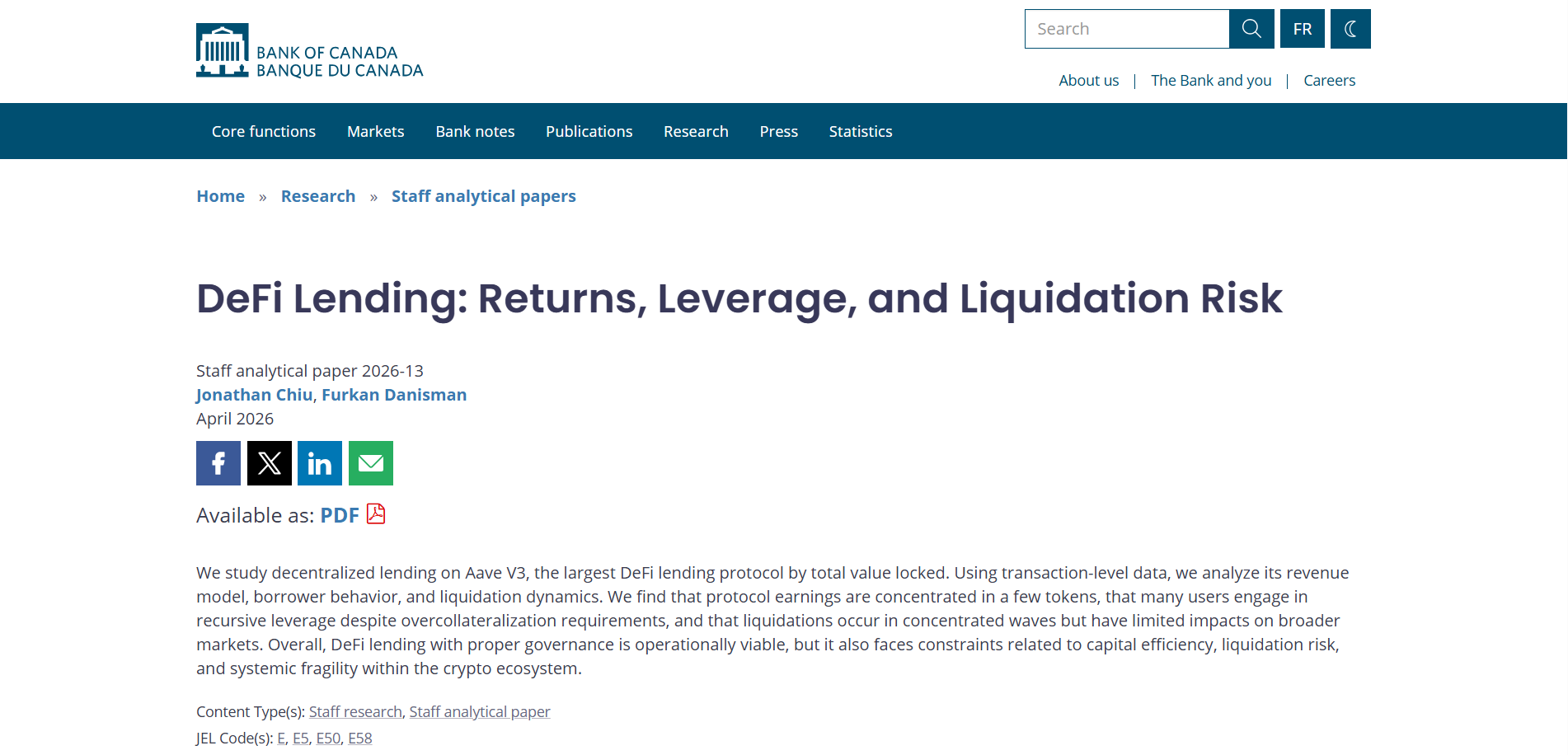
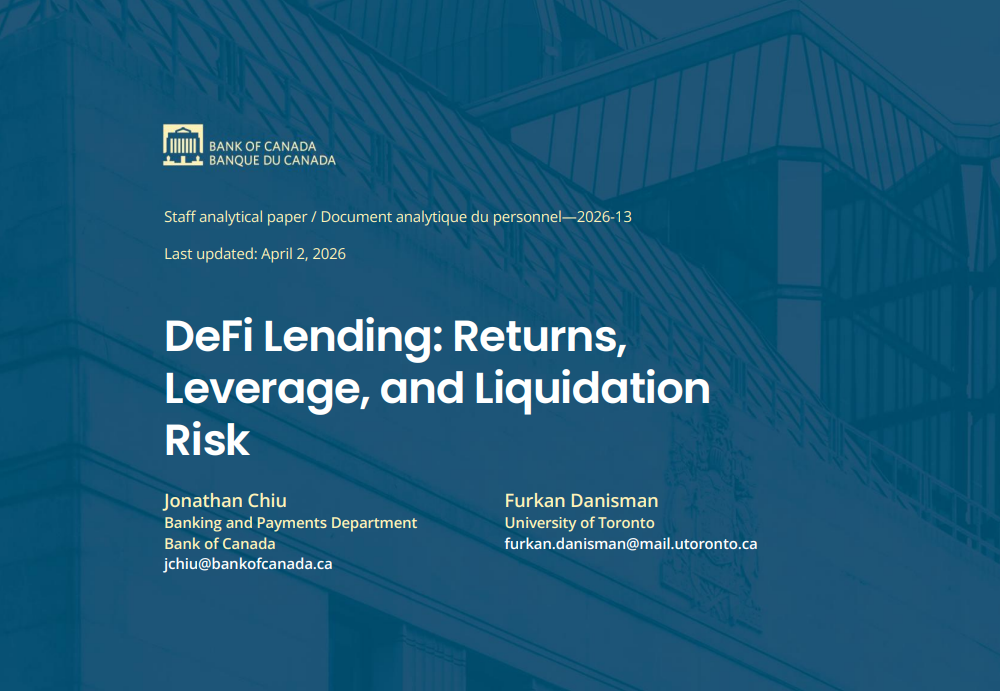
A new Bank of Canada staff analytical paper argues that DeFi lending is operationally viable, but still structurally dependent on overcollateralization, automated liquidations, and leveraged user behavior.
Focusing on Aave V3 on Ethereum between January 27, 2023, and May 6, 2025, the paper examines how the protocol generates revenue, how borrowers use leverage, and how liquidation risk builds during market stress.
Its core conclusion is that decentralized lending can function without traditional intermediaries, but it does so by replacing credit discretion with rigid collateral rules and exposing users to sudden forced losses when markets move sharply.
Key Takeaways
- DeFi lending works, but it depends on strict collateral rules.
- Aave V3 earnings were concentrated in WETH, USDT, and USDC.
- About 20% of borrowed volume was tied to recursive leverage.
- Margin traders were few in number but carried much higher risk.
- Most liquidations were triggered by falling collateral prices.
- Borrower losses often went beyond the liquidation amount itself.
- The paper found no strong evidence of lasting price damage from liquidations.
DeFi Lending Worked, but Under Rigid Conditions
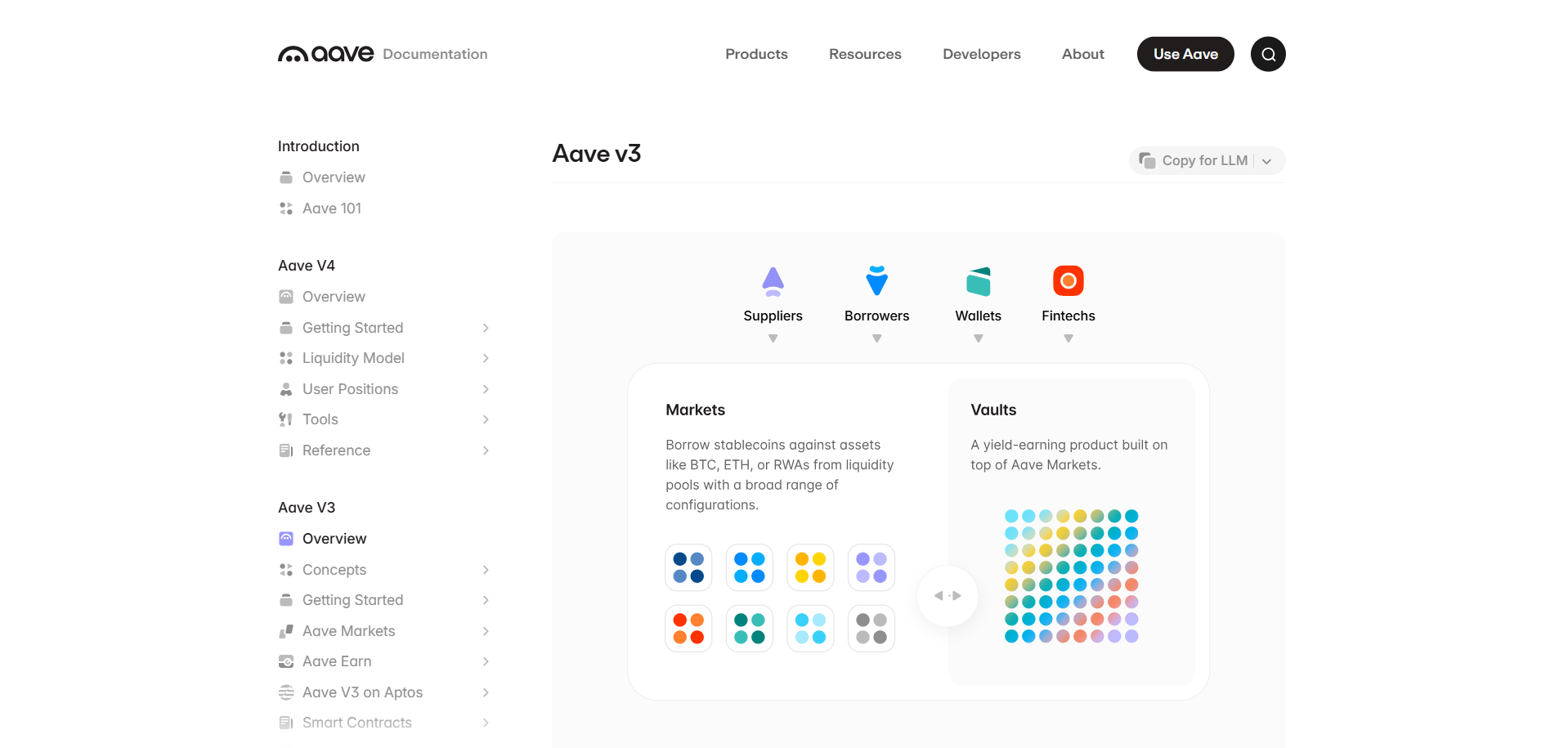
The report presents Aave V3 as evidence that lending without traditional financial intermediaries can work in practice. Users can supply crypto assets into liquidity pools, borrow against posted collateral, and interact with the system through smart contracts rather than banks, brokers, or credit officers.
The protocol continuously enforces lending terms, interest accrual, and liquidation thresholds on-chain.
But the paper also makes clear that this model is not equivalent to traditional lending. DeFi lending replaces borrower identification, legal enforcement, and human underwriting with pseudonymous participation, strict overcollateralization, and automatic liquidation rules.
That creates a technically efficient lending environment, but one with limited flexibility and high sensitivity to collateral price swings.
Most of Aave V3’s Earnings Came from a Small Number of Tokens
Although Aave V3 supports a broad range of assets, the report finds that only a small subset generated most of the protocol’s earnings. WETH, USDT, and USDC together accounted for nearly 83% of total earning share during the sample period.
By contrast, some assets with very large supply shares, including weETH and wstETH, contributed far less to earnings because their utilization was relatively low.
The report also shows that protocol earnings were meaningful in absolute terms. Total supplied volume peaked at around $30 billion, while borrowings reached roughly $12 billion.
Maximum daily earning from lending approached $200,000, while realized earnings, which also include liquidation fees, flash loan fees, and other service fees, occasionally moved above $600,000 to $800,000 on a seven-day moving average.
Recursive Leverage Was a Major Borrowing Use Case
One of the most important findings in the paper is that a significant portion of borrowing activity was linked to recursive leverage, effectively a form of DeFi margin trading. In this strategy, a borrower supplies one asset as collateral, borrows another, swaps the borrowed asset back into more collateral, and repeats the cycle to increase exposure.
Using transaction-level analysis, the authors estimate that this type of activity represented about $22 billion of borrow volume, or 20.46% of all borrowed volume, even though it accounted for only 8.2% of total borrow transactions.
That gap suggests margin-trading loans were larger than average and played a disproportionate role in the lending market.
Margin Traders Were Small in Number but Large in Risk
The paper shows that margin traders formed only a very small share of the user base, around 2% of active users, but they were disproportionately important in terms of volume and risk. They were more likely to be large investors, had higher outstanding debt, were active for more weeks, borrowed more often, and used flash loans at far higher rates than non-margin traders.
They also operated much closer to liquidation thresholds. Their median health factor was lower than that of non-margin traders, and they experienced liquidation events at about twice the rate.
In practical terms, the paper suggests that a relatively small set of sophisticated, leveraged users accounted for an outsized share of protocol activity while also carrying materially greater fragility.
Liquidations Arrived in Waves, Not as a Steady Process
Rather than appearing as a smooth and continuous risk control mechanism, liquidations on Aave V3 were heavily clustered in episodes of market stress. The ten largest liquidation waves accounted for roughly 80% of total liquidation volume during the sample period.
The biggest wave, on August 7, 2024, liquidated approximately $258 million.
The paper also finds that liquidation activity was concentrated in a small number of assets. WETH, wstETH, WBTC, and weETH together represented about 90% of total liquidated value.
In the buildup to major liquidation waves, smaller positions tended to be liquidated first, while larger positions became more prominent in the final hours before the peak. Within several waves, a small number of large borrowers accounted for a substantial share of the liquidated value.
Falling Collateral Prices Were the Main Liquidation Trigger
The report breaks down what actually caused borrowers’ health factors to collapse before liquidation.
Its conclusion is clear: collateral price declines were the dominant factor.
For the top 10 users with the largest liquidations, falling collateral prices explained 97.28% of the deterioration in health factor in the hour before liquidation. For all liquidated users, collateral price moves still explained 84.4% of the drop.
Debt price changes, interest rate effects, and user-driven borrowing or repayment activity contributed much less. That means liquidation risk on Aave V3 was driven primarily by market volatility in the assets posted as collateral, not by sudden shifts in borrowing costs or active portfolio management in the final hour.
Borrowers Often Lost More Than the Liquidation Headline Implied
The paper argues that liquidation volume alone does not capture the full borrower cost. Borrowers face direct liquidation penalties, typically around 5% to 10% of liquidated value, but they can also lose substantial upside if their collateral rebounds after being sold.
Across the largest liquidation waves, the authors estimate that combined losses from liquidation fees and missed price recoveries often reached 10% to 30% of liquidated value. In other words, the forced settlement itself may only tell part of the story; the real cost to the borrower can be significantly higher once opportunity cost is considered.
The Safety Module Helped, but Relative Coverage Declined
To protect against bad debt, Aave uses a decentralized insurance mechanism called the Safety Module, where staked AAVE tokens can be used as a backstop in insolvency events.
The paper notes that this insurance layer did provide meaningful protection, but its relative coverage weakened as V3 scaled. Effective insurance backing fell from roughly 10 cents per dollar supplied at the start of the sample to around 2 cents per dollar by 2025.
No backstop event occurred during the study period, but the decline suggests that insurance did not scale proportionally with supply growth. That does not mean the system failed, but it does highlight how resilience metrics can deteriorate even while the protocol continues to expand.
The Paper Found No Strong Evidence of Persistent Price Damage from Liquidations
While clustered liquidations can appear systemically dangerous, the paper does not find strong evidence that they caused lasting price declines in affected assets once broader market conditions were controlled for. Using benchmark comparisons with Litecoin and the CCI30 index, the authors found no statistically significant persistent market price effect tied specifically to liquidation size.
There was some evidence of short-term downward price pressure immediately after liquidation events in models without benchmark adjustment, but that effect disappeared when broader market movements were taken into account. The report therefore stops short of claiming that liquidation waves on Aave V3 created durable fire-sale effects in the wider market.
Conclusion
The Bank of Canada paper presents a nuanced picture of DeFi lending:
- On one hand, Aave V3 demonstrates that on-chain credit markets can operate continuously, transparently, and without centralized intermediaries.
- On the other, the system depends on strict collateralization, concentrated earning sources, and liquidation mechanisms that can impose abrupt losses on leveraged users during volatile periods.
The report’s broader message is that DeFi lending is functional, but not frictionless in the economic sense. It removes some traditional intermediation costs, yet replaces them with capital inefficiency, rigid rule-based enforcement, and high exposure to collateral volatility.
The authors suggest that future progress may depend on better collateral sources, including tokenized real-world assets, decentralized identity systems for selective disclosure, and possibly forms of prudential oversight adapted to on-chain finance.
Read Next:
- Aave March 2026 Report
- Solana Overtakes Ethereum in Stablecoin Volume for the First Time
- Circle Advances cirBTC
FAQs:
1. What is the main conclusion of the Bank of Canada’s DeFi lending paper?
The main conclusion is that DeFi lending works operationally, but it relies heavily on overcollateralization, automated liquidation, and leveraged behavior from a small group of active users. The paper finds that Aave V3 can function without traditional intermediaries, but that model creates rigidity and exposes borrowers to sudden losses during market stress.
2. How does Aave V3 make money according to the report?
Aave V3 makes money primarily through the spread between borrowing and supply rates, as well as through liquidation fees, flash loan fees, and other service-related revenue. The report also finds that most of that earning came from a small group of tokens, especially WETH, USDT, and USDC.
3. How much of Aave V3 borrowing was tied to margin trading?
The paper estimates that recursive leverage, which it uses as a proxy for margin trading, accounted for about 20.46% of total borrowed volume and 8.2% of total borrow transactions during the sample period. That indicates margin trading was a major use case and that these positions were larger than average.
4. Who faced the most liquidation risk on Aave V3?
The users with the highest liquidation risk were margin traders. Even though they represented only around 2% of active users, they borrowed more often, used larger positions, had lower health factors, and were liquidated at about twice the rate of non-margin traders.
5. What caused most liquidation events in the report?
Most liquidation events were caused by declines in collateral prices. The paper finds that falling collateral prices explained the overwhelming majority of health factor deterioration immediately before liquidation, especially among the largest liquidated users.
6. Did the paper find that DeFi liquidations crashed token prices?
No. The paper found no statistically significant evidence that liquidation size caused persistent token price declines once broader market conditions were controlled for. Any short-term pressure that appeared in simpler models was not robust after benchmark adjustments.
7. What does the paper say DeFi lending still needs to improve?
The paper suggests DeFi lending still needs stronger collateral quality, less capital inefficiency, and better tools for stability. It points to tokenized real-world assets, decentralized identity frameworks, and possible prudential-style rules as areas worth exploring for future development.
Disclaimer:
This content is provided for informational and educational purposes only and does not constitute financial, investment, legal, or tax advice; no material herein should be interpreted as a recommendation, endorsement, or solicitation to buy or sell any financial instrument, and readers should conduct their own independent research or consult a qualified professional.