

Table of Contents
The Senate Banking Committee is moving forward with the Digital Asset Market Clarity Act (CLARITY Act), scheduling a markup for January 15, 2026.
This legislative push addresses regulatory frameworks for digital assets, splitting oversight between the Securities and Exchange Commission (SEC) and the Commodity Futures Trading Commission (CFTC).
Central to the discussions are restrictions on third-party stablecoin yields, aimed at curbing competition with traditional banks. The bill builds on the House-passed version from July 2025 and incorporates elements from prior Senate drafts.
Senate Banking Committee Chair Tim Scott (R-SC) announced the markup date, emphasizing the need to resolve stalled negotiations.
The proposal includes tests to classify digital assets as securities or commodities, ethics rules, decentralized finance (DeFi) constraints, and stablecoin provisions. Bipartisan talks resumed in early 2026, involving senators from both parties and industry stakeholders.
Key Takeaways
- Senate markup on CLARITY Act set for January 15, 2026, focusing on stablecoin yield curbs to protect banks.
- Bill splits SEC/CFTC oversight, classifying assets to end regulatory uncertainty.
- Banking lobby pushes affiliate yield bans, closing GENIUS Act loopholes for deposit stability.
- Bipartisan talks address DeFi, ethics, quorums; unresolved issues risk delays.
- Potential passage in 2026 boosts institutional crypto flows, balances innovation with financial safeguards.
Background on the Clarity Act and Stablecoins
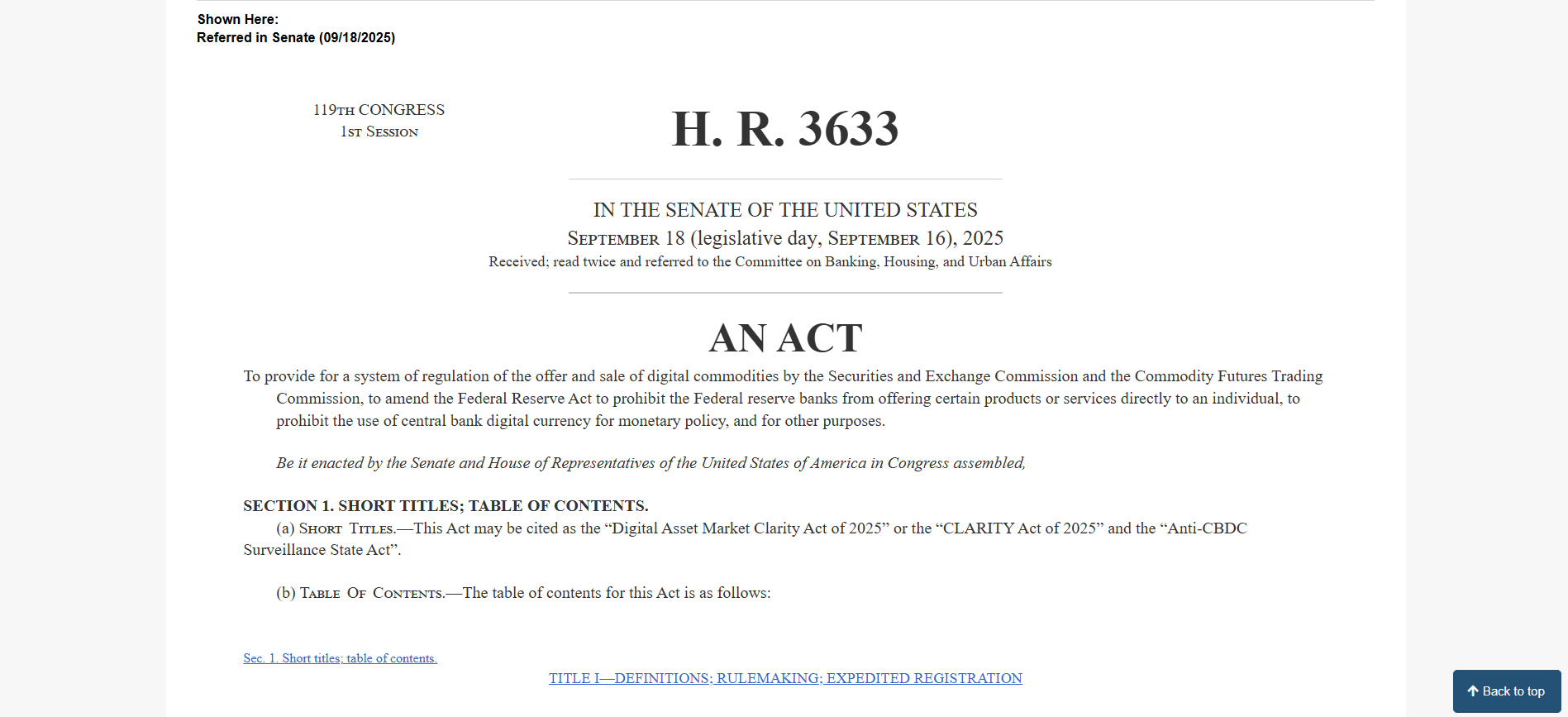
The CLARITY Act seeks to provide a comprehensive regulatory structure for cryptocurrencies, clarifying jurisdictional boundaries between the SEC and CFTC.
It follows the Guiding and Establishing National Innovation for U.S. Stablecoins (GENIUS Act), signed into law in July 2025, which regulates payment stablecoins by requiring dollar-for-dollar backing with Treasuries and prohibiting issuers from paying direct interest or yields.
This ensures stablecoins function primarily as payment mechanisms rather than investment products.
However, the GENIUS Act left a loophole allowing affiliates or partners of stablecoin issuers to offer yield-like incentives. Crypto exchanges have utilized this to provide rewards tied to stablecoin holdings, drawing deposits away from banks. Banks argue this undermines the law's intent, as it allows indirect competition for deposits that fund loans to communities.
The Federal Deposit Insurance Corporation (FDIC) approved procedures in December 2025 for banks to issue stablecoins through subsidiaries, reinforcing the GENIUS Act's framework. The CLARITY Act aims to extend these safeguards by addressing affiliate yields.

Current Developments in the Senate
Senators met on January 6, 2026, to restart discussions on the bill, marking the first bipartisan talks of the year. Participants included Republicans like Scott and John Kennedy (R-LA), alongside Democrats.
Kennedy confirmed the markup would proceed regardless of full agreement.
A summary of the proposal highlights open issues: ethics rules to prevent conflicts of interest, quorum requirements at regulators, DeFi provisions, and stablecoin yield restrictions.
The bill's Senate version, influenced by the Responsible Financial Innovation Act, merges inputs from the Banking and Agriculture Committees. If marked up successfully, it could advance to a floor vote in early 2026, followed by reconciliation with the House version.
Industry input has been solicited through requests for information on topics like token classification, custody, and illicit finance. Crypto firms met with senators in December 2025 to discuss priorities.
Debates on Stablecoin Yield Restrictions
The core debate centers on limiting third-party stablecoin yields. Banking groups, including the American Bankers Association (ABA), advocate for closing the GENIUS Act loophole. Over 200 community bank leaders urged Congress to prohibit affiliates from offering rewards, arguing it preserves bank deposits for lending.
Crypto advocates oppose these changes, stating stablecoins do not pose the same risks as bank loans and that yields enhance consumer choice. On X, discussions highlight the "banks vs. crypto turf war," with users noting the markup as a potential turning point for innovation.
Senator Cynthia Lummis (R-WY) and others have pushed for frameworks that support competition.
If enacted, restrictions could prevent stablecoin issuers from competing directly with banks, potentially stabilizing traditional finance but limiting crypto growth.

Bipartisan Negotiations and Unresolved Issues
Negotiations involve key Republicans like Scott, Lummis, Bill Hagerty (R-TN), and Bernie Moreno (R-OH), with Democratic input from figures like Catherine Cortez Masto (D-NV), who described recent talks as "very productive." Democrats seek stronger DeFi constraints and limits on yields to protect consumers.
Unresolved elements include ethics provisions restricting political figures' crypto involvement, regulator quorums to ensure bipartisanship, and protections for noncustodial wallets. The bill also addresses token exemptions, with concerns over SEC authority in classifications. Republicans issued a "closing offer" to advance the legislation.
Implications for the Crypto and Banking Sectors
Passage of the CLARITY Act could redefine U.S. crypto oversight, attracting institutional investment by providing clarity. For banks, yield restrictions would safeguard deposits, maintaining their role in credit provision.
Critics warn it may favor incumbents, potentially stifling DeFi innovation. The markup's outcome will signal the bill's viability amid a tight legislative calendar.

Conclusion
The CLARITY Act's advancement signals progress in crypto regulation, but stablecoin yield debates highlight tensions between innovation and banking stability.
Resolve open issues swiftly to secure bipartisan support and timely passage.
Read Next:
- 2025 Stablecoin Year-End Report
- 2025 Stablecoin Spending Report
- Who Is Winning the Stablecoin Infrastructure Race?
FAQs:
1. What is the CLARITY Act?
The Digital Asset Market Clarity Act establishes U.S. crypto regulations, dividing oversight between SEC and CFTC.
2. Why restrict stablecoin yields?
To prevent third-party incentives from drawing deposits away from banks, preserving lending capacity.
3. What is the GENIUS Act's role?
It regulates payment stablecoins, banning direct yields but allowing affiliate loopholes now targeted for closure.
4. Who supports yield restrictions?
Banking groups like ABA, arguing for fair competition; crypto firms oppose for consumer choice.
5. When could the bill pass?
Post-markup, Senate floor vote in early 2026, then House reconciliation.
6. What are other key issues?
Ethics rules, DeFi constraints, regulator quorums, and noncustodial wallet protections.
Disclaimer:
This content is provided for informational and educational purposes only and does not constitute financial, investment, legal, or tax advice; no material herein should be interpreted as a recommendation, endorsement, or solicitation to buy or sell any financial instrument, and readers should conduct their own independent research or consult a qualified professional.