
Table of Contents
Stablecoins are quietly becoming the backbone of a new financial era, bridging the gap between volatile cryptocurrencies and traditional fiat currencies. While often discussed in abstract terms, their practical applications are already transforming how we pay, save, and invest globally. The real value isn't in speculative trading; it's in their function as a stable, programmable unit of account on a decentralized ledger.
This comprehensive analysis moves beyond surface-level descriptions to provide a deep, strategic breakdown of the top 10 stablecoin use cases. We'll dissect how these applications are reshaping industries, from e-commerce and payroll to international aid and insurance. For each use case, we will unpack the specific mechanics, identify the key players, and offer a clear-eyed view of the benefits, risks, and regulatory hurdles involved.
The goal is to provide actionable intelligence for a diverse audience. Developers and fintech professionals will find replicable strategies and implementation notes. Investors and policymakers will gain insight into the tangible market impact and emerging policy considerations. This article is a detailed catalog of what's working right now, offering a practical guide to the most impactful applications driving adoption. We will explore the powerful, real-world utility of stablecoins and explain why understanding these use cases is crucial for navigating the future of digital finance.
1. International Remittances and Cross-Border Payments
One of the most powerful stablecoin use cases is the transformation of international remittances. Traditionally, sending money across borders is a slow and expensive process, often taking days and costing between 5-10% in fees through wire transfers or legacy money transfer operators.
Stablecoins disrupt this model by using blockchain rails for near-instant settlement at a fraction of the cost. A worker can send USDC or another stablecoin from a digital wallet in one country to a family member’s wallet in another. The recipient can then convert the stablecoin into their local currency via a local crypto exchange or a P2P marketplace, often with total transaction fees in the 1-3% range. This dramatically increases the amount of money that reaches the people who need it most.
Real-World Adopters and Strategic Insights
- Circle & Stellar: This partnership leverages Stellar’s low-cost, high-speed network to enable USDC remittances, particularly in corridors to Latin America and Africa. The strategy here is to build a compliant, regulated network that traditional financial institutions can plug into.
- Strike: Using the Bitcoin Lightning Network and stablecoins, Strike facilitates instant, low-fee remittances, most notably in El Salvador. This B2C approach bypasses the banking system entirely, offering a direct user experience.
- Tala & Paxos: This collaboration integrates Paxos' regulated stablecoins (like USDP) into Tala's mobile lending app, targeting unbanked populations in emerging markets like the Philippines. The goal is to embed crypto rails within an existing, trusted fintech ecosystem.
For individuals engaged in international employment, understanding efficient cross-border payment options for international workers is crucial for maximizing take-home pay.
Actionable Takeaways
Before utilizing this method, consider these practical steps:
- Verify Recipient Access: Ensure the recipient has a reliable way to convert the stablecoin into their local currency. Check for trusted exchanges or P2P services in their country.
- Assess Regulatory Climate: Research the crypto regulations in both the sender's and recipient's countries to ensure compliance.
- Start Small: Conduct a small test transaction to confirm the process works smoothly before sending larger amounts.
This approach is best for individuals and small businesses seeking to avoid high intermediary fees and long settlement times. Learn more about using stablecoins for overseas payments and how to implement this strategy effectively.
2. E-Commerce and Online Retail Payments
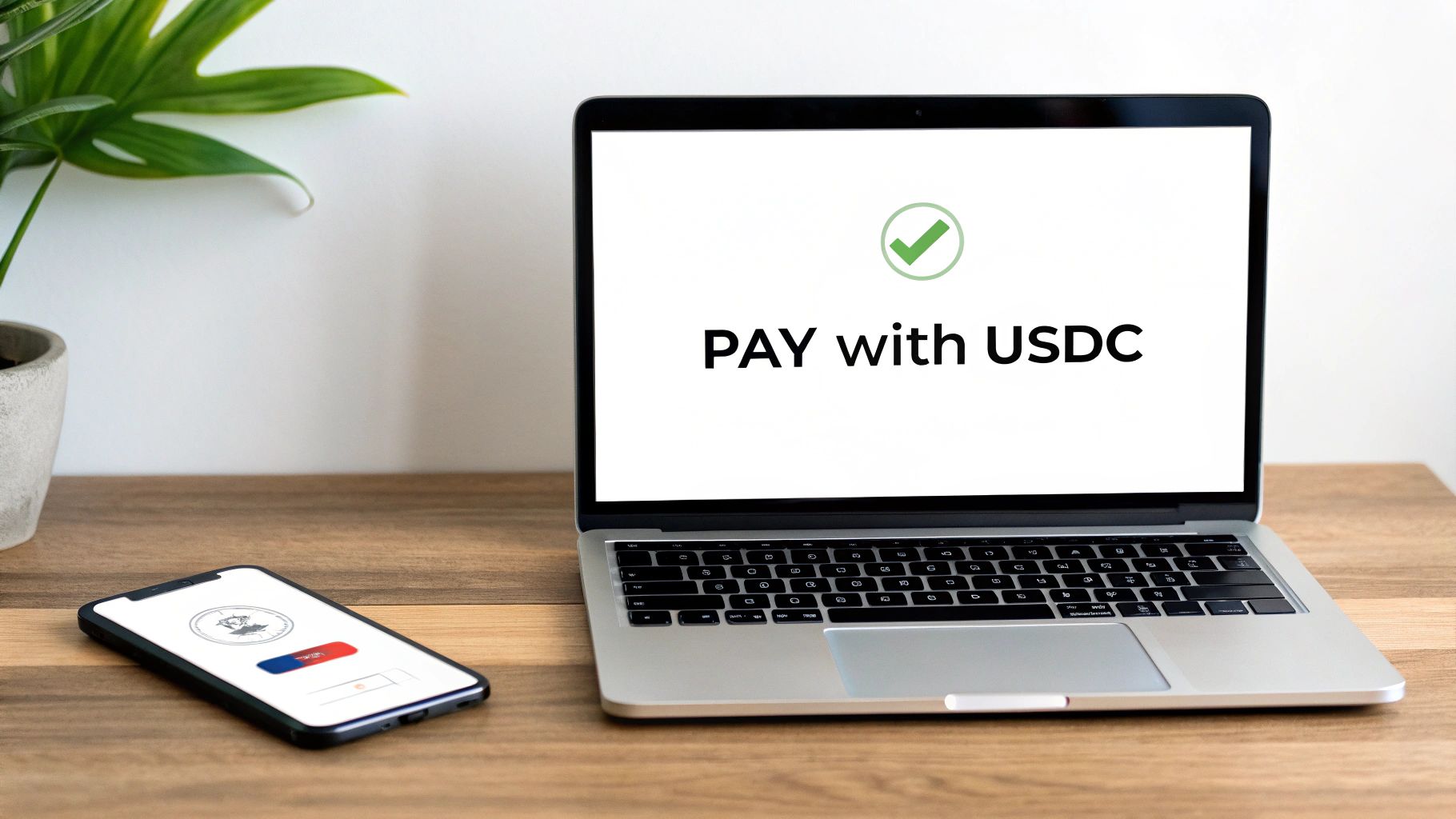
Another significant stablecoin use case is revolutionizing e-commerce and online retail payments. For merchants, traditional card payments come with high fees (typically 2-3%), several days of settlement delay, and the risk of costly chargebacks. Stablecoins offer a compelling alternative by enabling direct, peer-to-peer value transfer.
Accepting stablecoins like USDC allows merchants to receive payment almost instantly, drastically cutting down on settlement times. The transaction fees are significantly lower, often under 1%, which directly boosts profit margins. Furthermore, since blockchain transactions are irreversible, the problem of fraudulent chargebacks is virtually eliminated, providing merchants with greater payment security and finality.
Real-World Adopters and Strategic Insights
- Shopify & Coinbase Commerce: Shopify’s integration with payment gateways like Coinbase Commerce allows its millions of merchants to easily accept stablecoins. The strategy is to abstract away the crypto complexity, offering a simple plugin that opens up a new global customer base.
- Flexa Network: Flexa enables in-store retail payments using stablecoins (like GUSD) and other digital assets. It provides a POS-compatible solution that instantly converts the crypto to fiat for the merchant, removing volatility risk and simplifying accounting.
- BitPay: As a long-standing crypto payment processor, BitPay helps large enterprises like AT&T and WordPress.com accept stablecoins. Their B2B model focuses on providing robust APIs and compliance tools, making it feasible for major corporations to integrate crypto payments.
Actionable Takeaways
Before integrating stablecoin payments, merchants should consider these steps:
- Use an Established Processor: Partner with a reputable payment processor like BitPay or Coinbase Commerce to handle the technical integration, security, and conversion to fiat.
- Offer Choice, Don't Mandate: Introduce stablecoin payments as an optional alternative alongside traditional methods. This encourages adoption without alienating customers unfamiliar with crypto.
- Ensure Clear Accounting: Implement a clear system for tracking stablecoin transactions for tax and accounting purposes. Many processors provide detailed reporting tools to simplify this.
This approach is ideal for online merchants and global businesses aiming to reduce transaction costs, speed up settlement, and tap into the growing crypto-native consumer market. Learn more about how to integrate USDC into your e-commerce platform and the benefits it can offer.
3. Decentralized Finance (DeFi) Collateral and Lending
One of the most foundational stablecoin use cases is their role as the bedrock of Decentralized Finance (DeFi). Stablecoins provide the price stability necessary for complex financial operations like lending, borrowing, and trading. In DeFi, they act as reliable collateral, allowing users to borrow other crypto assets, or as the primary asset for lending to earn interest, creating an open and accessible alternative to traditional banking.
Users can deposit stablecoins like USDC or DAI into lending protocols and earn a variable yield, often significantly higher than traditional savings accounts. This system functions without intermediaries, relying instead on smart contracts to manage funds, issue loans, and distribute interest payments. This creates a more transparent and efficient financial ecosystem available to anyone with an internet connection.

Real-World Adopters and Strategic Insights
- Aave: This leading DeFi lending protocol allows users to deposit stablecoins to earn interest and borrow against their crypto holdings. Aave's strategy focuses on innovation with features like "flash loans" and a multi-chain presence, making it a capital-efficient hub for DeFi liquidity.
- MakerDAO: The issuer of the DAI stablecoin, MakerDAO enables users to generate DAI by locking up volatile assets like Ethereum as collateral. Its core strategy is to maintain the stability of DAI through a decentralized governance model and automated liquidation mechanisms.
- Curve Finance: Specializing in stablecoin swaps, Curve provides deep liquidity pools with minimal price slippage. The strategy is to become the essential backbone for stablecoin liquidity, attracting users by offering low fees for swaps and rewards for liquidity providers.
Actionable Takeaways
Before engaging with DeFi lending protocols, consider these practical steps:
- Understand Liquidation Risk: When borrowing, be acutely aware of your collateral's liquidation price. If your collateral value drops below a certain threshold, it will be automatically sold.
- Diversify Protocol Exposure: Do not place all your funds into a single protocol. Spreading assets across multiple, well-audited platforms can mitigate risks from smart contract bugs or exploits.
- Monitor Interest Rates: DeFi yields are variable. Regularly check the Annual Percentage Yields (APYs) as they fluctuate based on market supply and demand.
This approach is best for individuals comfortable with smart contract risk who are seeking higher yields than traditional finance offers. You can discover more about stablecoin lending strategies and how to participate safely.
4. Salary Payments and Payroll Distribution
One of the most rapidly growing stablecoin use cases is in modernizing salary payments and global payroll. Traditional payroll systems are often slow and costly, especially for companies with international teams. Cross-border salary payments can involve high wire fees, unfavorable exchange rates, and multi-day settlement delays.
Stablecoins address this by enabling instant, low-cost payroll distribution on the blockchain. A company can pay its remote workforce in a stablecoin like USDC, and employees receive their funds almost immediately in their digital wallets. This bypasses the traditional banking system's delays and intermediary fees, providing employees with faster access to their earnings and the flexibility to convert to local currency as needed.
Real-World Adopters and Strategic Insights
- Coinbase: As a crypto-native company, Coinbase offers its employees the option to receive all or part of their salary in USDC. The strategy is to showcase the practicality of its own ecosystem and provide employees with direct exposure to the crypto economy.
- Techstars & Circle: This partnership allows companies in the Techstars accelerator program to pay employees and contractors in USDC. The goal is to provide early-stage startups with a flexible, low-cost payroll solution that scales easily as they build globally distributed teams.
- Strike: While known for remittances, Strike’s API also supports B2B payroll services, allowing businesses to pay global freelancers and employees using the Lightning Network. This approach emphasizes speed and extremely low transaction costs, targeting gig economy workers and international contractors.
For businesses with distributed teams, this method offers a significant competitive advantage in attracting and retaining global talent.
Actionable Takeaways
Before implementing a stablecoin payroll system, consider these practical steps:
- Make it Optional: Position stablecoin payroll as an opt-in benefit rather than a requirement. This respects employee choice and varying levels of crypto comfort.
- Provide Education: Offer clear resources on how to set up a wallet, receive funds, and convert stablecoins into local fiat currency safely.
- Ensure Tax Compliance: Work with legal and accounting professionals to ensure proper tax withholding and reporting in all relevant jurisdictions, as payroll laws still apply.
This approach is best for remote-first companies, tech startups, and organizations with a significant number of international contractors seeking to streamline payroll operations. Explore the rise of stablecoin payroll to understand its future trajectory and implementation models.
5. Merchant Settlement and Business Operations
Another critical stablecoin use case is streamlining B2B payments and corporate treasury functions. Traditionally, businesses dealing with international suppliers or clients face slow settlement times, high foreign exchange (FX) fees, and the complexity of managing multiple currency accounts. This creates cash flow friction and adds operational overhead.
Stablecoins solve this by enabling businesses to make and receive payments on-chain, settling transactions in minutes instead of days. A company can pay an international supplier in USDC, bypassing the correspondent banking system entirely. This not only accelerates the payment cycle but also reduces costs associated with currency conversion and wire transfers, making it a powerful tool for global supply chain management and operational efficiency.
Real-World Adopters and Strategic Insights
- Largo Inc. & Circle: The publicly traded mineral resource company began accepting USDC for sales of its vanadium products. This B2B strategy allows Largo to receive settlement faster and reduce its exposure to FX volatility by holding a dollar-pegged asset.
- SandboxAQ & Coinbase Commerce: This enterprise AI and quantum computing company accepts stablecoins for its services. The goal is to cater to a global, tech-savvy client base and simplify cross-border invoicing and settlement, removing payment friction for international customers.
- Mexican Exporters & Bitso: Businesses in Mexico use stablecoins via platforms like Bitso to pay suppliers in the U.S. and Asia. This approach provides a hedge against local currency devaluation and offers a more efficient payment rail than the traditional SWIFT system.
This evolution in B2B payments showcases how stablecoins can function as a core component of modern treasury operations.
Actionable Takeaways
Before integrating stablecoins into business operations, consider these steps:
- Establish Clear Procedures: Create documented policies for stablecoin custody, conversion into fiat, and accounting practices to ensure regulatory and tax compliance.
- Start with Pilot Payments: Begin with non-critical, smaller-value supplier payments to test your internal workflows and the vendor's receiving process before scaling up.
- Negotiate Payment Terms: Proactively discuss and include stablecoin payment options in contracts with new and existing vendors to formalize the process.
This approach is best for businesses with significant international payables/receivables, especially in the import/export, tech, and digital services sectors. Major payment processors are now enabling these capabilities on a global scale. Learn more about how Stripe is facilitating global USDC payments for businesses.
6. Hedge Against Currency Devaluation and Inflation
For citizens in countries with volatile economies, one of the most vital stablecoin use cases is the preservation of wealth. In nations facing hyperinflation or severe currency devaluation, like Argentina, Turkey, or Venezuela, local currencies can lose significant value overnight. Holding savings in the local currency becomes a losing battle against economic instability.
Stablecoins offer a decentralized and accessible safe-haven asset. An individual can convert their rapidly depreciating local currency into a USD-pegged stablecoin like USDC or USDT, effectively pegging their savings to the US dollar. This allows them to protect their purchasing power without needing access to a traditional US dollar bank account, which is often difficult or impossible to obtain due to strict capital controls.

Real-World Adopters and Strategic Insights
- Argentinian Savers: Amidst persistent peso devaluation, Argentinians have flocked to stablecoins. They use P2P platforms like Binance P2P or local exchanges to buy USDT, treating it as a digital dollar to safeguard their life savings from inflation that regularly exceeds 100% annually.
- Venezuelan Commerce: In Venezuela, where the bolívar has collapsed, stablecoins are not just a store of value but also a medium of exchange. Citizens and small businesses use them for daily transactions, creating a parallel digital economy that sidesteps the failed local currency.
- Turkish Citizens: As the Turkish lira faces ongoing depreciation, tech-savvy citizens increasingly convert their lira savings into stablecoins. This strategy aims to hedge against domestic economic policy and preserve the long-term value of their capital.
This grassroots adoption demonstrates a powerful, demand-driven use case, proving stablecoins as an essential tool for financial self-preservation in unstable macroeconomic environments.
Actionable Takeaways
Before using stablecoins as a hedge, consider these crucial steps:
- Choose Reputable Stablecoins: Stick to well-established, fully reserved, and audited stablecoins like USDC or USDP to minimize issuer risk.
- Prioritize Self-Custody: Learn to use non-custodial wallets where you control the private keys. This prevents your assets from being frozen by a centralized exchange or government.
- Understand P2P Risks: If using peer-to-peer exchanges, transact with highly-rated, verified users and use the platform's escrow service to prevent fraud.
This method is best for individuals living under inflationary pressures who lack access to stable foreign currencies through traditional banking channels.
7. Healthcare and Pharmaceutical Supply Chain Payments
Another powerful stablecoin use case emerges in the complex world of healthcare and pharmaceutical supply chains. Traditionally, payments between hospitals, suppliers, and insurers are slow, opaque, and laden with administrative overhead. Cross-border procurement of medical equipment or specialized drugs further complicates matters with currency conversion fees and settlement delays.
Stablecoins address these friction points by creating a programmable, transparent, and efficient payment layer. A hospital can use a stablecoin like USDC to instantly pay an international pharmaceutical supplier, with the transaction recorded immutably on a blockchain. This provides a clear, auditable trail for regulatory compliance, speeds up procurement of critical supplies, and significantly reduces the manual reconciliation work that plagues healthcare administration.
Real-World Adopters and Strategic Insights
- Solve.Care & Hedera: Solve.Care utilizes Hedera's high-throughput distributed ledger to create healthcare payment networks. By using a stable digital currency, they aim to reduce fraud, waste, and abuse in programs like Medicaid by enabling real-time, event-based payments that are fully transparent. The strategy is to embed blockchain rails directly into existing healthcare administration workflows.
- VeChain (with partners): While known for supply chain tracking, VeChain’s platform enables payment settlement at key logistical milestones. A hospital could use a stablecoin on VeChain to automatically release payment to a supplier once a shipment of temperature-sensitive vaccines is confirmed to have arrived within its required conditions, verified by IoT sensors.
- DSLA Protocol: This project is exploring decentralized service level agreements (SLAs) for healthcare logistics. A pharmaceutical company could use stablecoins to pay insurance premiums that automatically pay out if a delivery partner fails to meet a specified delivery window, ensuring financial recourse without lengthy disputes.
Actionable Takeaways
Before implementing stablecoins in healthcare payments, consider these steps:
- Prioritize Regulatory Compliance: Healthcare is a highly regulated industry. Ensure any stablecoin solution is fully compliant with HIPAA, GDPR, and other relevant financial and healthcare regulations in all operating jurisdictions.
- Partner with Audited Issuers: Work exclusively with stablecoin issuers like Circle (USDC) or Paxos (USDP) that provide regular, transparent attestations and are regulated by financial authorities.
- Pilot with Non-Critical Suppliers: Begin with a small-scale pilot project involving non-critical administrative payments or a trusted, tech-savvy supplier to validate the process and address any integration challenges.
This approach is best for healthcare systems, pharmaceutical companies, and insurers seeking to increase payment transparency, accelerate settlement times with global partners, and reduce administrative costs.
8. Betting, Gaming, and Esports Prize Distribution
The gaming, esports, and online betting industries are rapidly adopting stablecoins to modernize their financial infrastructure. Traditionally, these platforms rely on payment processors that come with high fees, chargeback risks, and delayed payouts, especially for global tournaments. This friction creates a poor user experience for players and a financial headache for operators.
Stablecoins offer a powerful solution by enabling instant, low-cost, and transparent transactions. An esports tournament can pay out prize money in USDC immediately after a match, which winners worldwide can access without waiting for cross-border bank transfers. Similarly, a gaming platform can accept deposits and process withdrawals in a stablecoin, eliminating chargeback fraud and reducing operational overhead. This is one of the more consumer-facing stablecoin use cases, enhancing the speed and reliability of value transfer in digital entertainment.
Real-World Adopters and Strategic Insights
- FaZe Clan & MoonPay: Esports giant FaZe Clan partnered with MoonPay to explore crypto payments, including stablecoins, for merchandise and digital goods. The strategy is to cater to their digitally native audience by integrating payments that align with their community's interests.
- DraftKings & Polygon: DraftKings leverages the Polygon network, which supports stablecoins like USDC, for its NFT marketplace. While not direct betting integration yet, this move signals a strategic exploration of blockchain rails for faster, cheaper transactions within their ecosystem.
- Axie Infinity (Sky Mavis): This pioneering play-to-earn game used stablecoins as part of its in-game economy and reward system. The goal was to provide players with a stable store of value for their earnings, insulating them from the volatility of native game tokens.
For gaming companies and their financial teams, understanding the intersection of digital assets and corporate finance, such as the implications of a crypto treasury strategy, is becoming increasingly important.
Actionable Takeaways
Before integrating stablecoins into a gaming or betting platform, consider these steps:
- Ensure Regulatory Compliance: Vigorously check and comply with all local and international gaming and gambling regulations, which vary significantly by jurisdiction.
- Implement Robust KYC/AML: Integrate strong Know Your Customer (KYC) and Anti-Money Laundering (AML) procedures to prevent illicit activity and satisfy regulatory requirements.
- Prioritize User Education: Provide clear, simple instructions for players on how to deposit, withdraw, and manage stablecoins. A poor user experience can negate the benefits of speed and low cost.
This approach is ideal for global gaming platforms, tournament organizers, and betting sites aiming to reduce transaction costs, eliminate chargebacks, and offer instant global prize distribution.
9. Insurance Premium Payments and Claims Settlement
The insurance industry, traditionally burdened by administrative friction and slow claims processing, is another powerful frontier for stablecoin use cases. By leveraging stablecoins and smart contracts, insurers can automate premium collection and, more importantly, claims settlement, transforming a process that often takes weeks or months into one that can be completed in minutes.
This model is particularly effective for parametric insurance, where payouts are triggered by verifiable, external data points like weather events or flight delays. A smart contract can automatically execute a payout in USDC or DAI to a policyholder's wallet the moment a trusted data source (an oracle) confirms the trigger event occurred. This system dramatically reduces administrative overhead, minimizes disputes, and provides near-instant financial relief to policyholders.
Real-World Adopters and Strategic Insights
- AXA's Fizzy: A pioneering example of parametric insurance on the blockchain. Fizzy used smart contracts to automatically issue payouts to travelers for flight delays. The strategy was to create a transparent, "if-this-then-that" product that builds customer trust through automated, guaranteed settlements.
- Chainlink & Insurance Protocols: As a decentralized oracle network, Chainlink provides the critical infrastructure for this use case. It securely feeds real-world data (e.g., hurricane wind speeds, rainfall levels) to smart contracts, enabling DeFi insurance platforms like Arbol to offer parametric coverage to farmers and businesses. The strategy is to be the trusted data bridge between on-chain contracts and off-chain events.
- Lemonade: While a broader InsurTech innovator, Lemonade’s use of AI and a transparent "Giveback" policy on the blockchain sets a precedent. The integration of stablecoins is a natural next step, aiming to use technology to slash administrative costs and create a more efficient, user-centric claims process.
For insurance providers, a key challenge is integrating these new rails with legacy systems. Understanding how to bridge traditional finance with decentralized technology is essential for a successful transition.
Actionable Takeaways
Before implementing a stablecoin-based insurance model, consider these steps:
- Select Reliable Oracles: The integrity of your automated system depends entirely on the data source. Use reputable, audited oracle providers like Chainlink to prevent data manipulation.
- Start with Parametric Policies: Begin with simple, trigger-based insurance products (e.g., crop, travel, event cancellation) to prove the model before moving to more complex, judgment-based claims.
- Ensure Smart Contract Security: Conduct rigorous, third-party security audits of your smart contracts to protect policyholder funds and prevent exploits.
This approach is best for InsurTech companies and traditional insurers looking to reduce operational costs, increase transparency, and deliver a vastly improved customer experience for specific insurance products.
10. Non-Profit Donations and Charitable Giving
A significant and growing stablecoin use case is transforming non-profit donations and charitable giving. Traditionally, charities lose a portion of donations to credit card processing fees, which average 2-3%, and international donations can incur even higher costs. By accepting stablecoins, non-profits can receive funds directly with minimal transaction fees.
This model enhances transparency, as all donations are recorded on a public blockchain, allowing donors to track the flow of funds. It also enables the rapid deployment of aid, which is especially critical in disaster relief scenarios. A donor can send USDC directly to a relief organization's wallet, and those funds can be accessed and used on the ground almost instantly, bypassing slow and complex banking systems.
Real-World Adopters and Strategic Insights
- UNICEF: The United Nations Children's Fund launched its CryptoFund to accept, hold, and disburse cryptocurrency donations, including stablecoins. This strategy allows them to fund open-source technology benefiting children and young people globally, tapping into the crypto-native philanthropic community.
- The Giving Block: This platform acts as a crypto-native donation solution for thousands of non-profits, including Save the Children and the American Cancer Society. Their model simplifies the process, allowing charities to easily accept stablecoins without needing deep technical expertise, then automatically converting them to fiat if desired.
- Effective Altruism Community: Organizations like GiveWell have embraced crypto donations to optimize their impact. For this community, the efficiency and reduced overhead of stablecoin transactions align perfectly with their philosophy of maximizing the effectiveness of every dollar donated.
For non-profits, integrating digital asset donations can be a strategic move to engage a new generation of philanthropists. Understanding the tax implications of cryptocurrency donations is essential for both the organization and its donors.
Actionable Takeaways
Before implementing a stablecoin donation program, consider these steps:
- Use an Established Platform: Partner with a reputable service like The Giving Block to handle the technical and compliance aspects of accepting crypto donations securely.
- Educate Your Donors: Clearly communicate the benefits of donating with stablecoins, such as lower fees and increased transparency, and provide simple instructions on how to do so.
- Develop a Conversion Strategy: Decide on a policy for converting stablecoins to fiat. For operational stability, you may choose to convert donations immediately to cover expenses in your local currency.
This approach is ideal for forward-thinking non-profits and international aid organizations looking to reduce overhead, increase transparency, and accelerate their access to funds. Learn more about how charities can accept crypto and the platforms that facilitate it.
Stablecoin Use Cases: 10-Point Comparison
| Use Case | Implementation Complexity | Resources Required | Expected Outcomes | Ideal Use Cases | Key Advantages | Main Risks / Limitations |
|---|---|---|---|---|---|---|
| International Remittances and Cross‑Border Payments | Low–Medium — wallet + exchange access | Crypto rails, exchanges on both ends, user wallets | Near‑instant transfers, lower fees (1–3%) | Migrant remittances, family transfers | Fast settlement, low fees, unbanked access | Regulatory uncertainty, exchange access, UX barriers, fiat conversion risk |
| E‑Commerce and Online Retail Payments | Medium — payment gateway and checkout integration | Payment processors, accounting integration, fiat on/off ramps | Immediate settlement for merchants, lower processing costs | Online retailers, global merchants | Lower fees, chargeback protection, faster reconciliation | Customer adoption, compliance/tax complexity, conversion exposure |
| Decentralized Finance (DeFi) Collateral and Lending | High — smart contracts and protocol integration | Audited contracts, liquidity pools, developer expertise | Lending/borrowing markets, yield generation (4–8%+ APY) | Crypto users seeking yield, permissionless lending | Higher yields, composability, permissionless access | Smart contract risk, liquidation, systemic protocol risk, regulatory questions |
| Salary Payments and Payroll Distribution | Medium — payroll & exchange integration, HR processes | Payroll system updates, exchange partners, tax/reporting tools | Real‑time payroll, reduced cross‑border fees | Remote/global teams, crypto‑native companies | Faster pay, lower international fees, improved cash flow | Tax/withholding complexity, employee acceptance, regulatory compliance |
| Merchant Settlement and Business Operations | Medium — treasury and vendor onboarding | Treasury/custody solutions, vendor agreements, accounting workflows | Instant supplier settlement, reduced FX timing risk | Exporters, supply‑chain firms, international vendors | Faster vendor payments, reduced banking fees, improved cash flow | Vendor acceptance, accounting/audit complexity, banking relationship issues |
| Hedge Against Currency Devaluation and Inflation | Low — hold/use stablecoins via wallets/exchanges | Wallets, exchange access, internet connectivity | Preservation of purchasing power pegged to USD | Residents in high‑inflation or capital‑control countries | Protection from local currency collapse, accessible store of value | Local regulatory risk, issuer solvency risk, exchange liquidity |
| Healthcare & Pharmaceutical Supply Chain Payments | High — compliance + legacy IT integration | Regulatory compliance, audit trails, supplier onboarding | Faster supplier payments, auditable trails for regulators | Hospitals, pharma procurement, cross‑border suppliers | Improved transparency, faster settlement, reduced fraud | Regulatory uncertainty, supplier adoption, AML/compliance challenges |
| Betting, Gaming & Esports Prize Distribution | Medium — platform integration, KYC/escrow | Smart contracts/escrow, KYC/AML tooling, game integration | Instant prize payouts, reduced processing costs | Esports tournaments, gaming platforms, betting sites | Immediate payouts, chargeback elimination, global access | Gambling law uncertainty, AML compliance, user adoption |
| Insurance Premiums & Claims Settlement | High — oracles, smart contracts, regulatory alignment | Reliable oracles, audited contracts, insurer integration | Automated, near‑instant claims payouts (parametric) | Parametric insurance, automated claims workflows | Faster claims, lower admin costs, transparent histories | Oracle dependency, regulatory/regulatory integration, underwriting complexity |
| Non‑Profit Donations & Charitable Giving | Low–Medium — donation widget + accounting | Donation platforms, custodial wallets, tax reporting | Faster fund deployment, transparent fund tracking | Disaster relief, international NGOs, crypto donors | Lower fees, on‑chain transparency, rapid disbursement | Donor comfort with crypto, tax/accounting treatment, fiat conversion needs |
The Road Ahead: Integrating Stablecoins into the Global Economy
The journey through the ten distinct stablecoin use cases detailed in this article reveals a technology on the cusp of reshaping global finance. We've moved far beyond the initial concept of stablecoins as a simple trading pair on cryptocurrency exchanges. From streamlining international remittances and securing e-commerce transactions to revolutionizing payroll and protecting savings against inflation, these digital assets are proving their immense practical value.
The common thread weaving through each application, from DeFi lending to charitable donations, is the powerful combination of a stable unit of account with the efficiency and transparency of blockchain technology. This synergy addresses long-standing friction points in traditional finance: high fees, slow settlement times, lack of accessibility, and operational opacity. By providing a digital, programmable, and borderless representation of fiat currency, stablecoins are not just an alternative but an upgrade to the existing financial plumbing.
Synthesizing the Core Takeaways
As we look across the diverse applications, from merchant settlements to insurance claims, several strategic insights emerge for different stakeholders:
For Businesses and FinTechs: The primary value proposition is operational efficiency and cost reduction. The ability to settle transactions near-instantly, 24/7, across borders, and with reduced intermediary fees is a powerful competitive advantage. The key is to identify specific, high-friction internal processes or customer-facing payment flows where a stablecoin pilot program can deliver measurable ROI without requiring a complete system overhaul.
For Investors and Traders: The opportunity extends beyond simply holding stablecoins. The real growth potential lies in the enabling infrastructure. This includes regulated issuers, on/off-ramp providers, wallet developers, and compliance-as-a-service platforms. These are the companies building the critical bridges that will facilitate the widespread adoption of all the stablecoin use cases we've explored.
For Developers: The challenge and opportunity lie in improving the user experience (UX). For stablecoins to achieve mass adoption, interacting with them must be as seamless and intuitive as using a traditional banking app. This involves abstracting away complexities like wallet addresses and gas fees, creating a user-friendly layer that unlocks the power of the underlying technology for a non-technical audience.
For Policymakers and Regulators: The imperative is to create balanced and clear regulatory frameworks. The goal should be to mitigate systemic risks, such as those related to reserve management and illicit finance, while still fostering the innovation that allows these beneficial use cases to flourish. Proactive, technology-neutral regulation will be crucial for building trust and ensuring long-term stability.
Navigating the Path to Mainstream Adoption
Despite the clear potential, the road to widespread integration is not without significant obstacles. The primary challenges can be summarized into three key areas:
- Regulatory Uncertainty: Ambiguous or fragmented regulations across jurisdictions create hesitation for large enterprises and financial institutions, slowing down institutional adoption.
- Scalability and Interoperability: As adoption grows, the underlying blockchain networks must be able to handle increased transaction volume without compromising speed or cost. Furthermore, seamless interoperability between different stablecoins and blockchains is essential for a fluid financial ecosystem.
- Security and Trust: High-profile failures of algorithmic stablecoins have, in some cases, eroded public trust. Fiat-backed, fully-reserved, and regularly audited stablecoins must continue to differentiate themselves and prove their reliability to win over skeptical users and institutions.
The future of money is unlikely to be a complete replacement of the old system but rather a sophisticated hybrid model. In this future, the efficiency, programmability, and global reach of stablecoins will augment and enhance traditional financial infrastructure. The use cases we see today in remittances, payroll, and DeFi are the foundational layers of this new paradigm. As the technology matures and the regulatory landscape solidifies, we can expect an explosion of new and even more innovative applications.
Mastering the strategic and tactical nuances of today's leading stablecoin use cases is therefore not just an academic exercise; it is essential preparation for navigating the next evolution of digital commerce and finance.
The world of stablecoins is evolving at a breathtaking pace, with new use cases, regulatory updates, and technological breakthroughs emerging constantly. To stay ahead of the curve and make informed decisions, you need a dedicated source of expert analysis. Stablecoin Insider provides the in-depth research and timely insights necessary to navigate this dynamic landscape, turning complex information into actionable intelligence.
Visit us at Stablecoin Insider to continue your journey from enthusiast to expert.