
Table of Contents
Marketplaces are under pressure from both sides of the transaction. Buyers expect faster checkout, sellers want quicker access to funds, and operators need better control over cross-border payouts, FX exposure, compliance, and reconciliation.
Stablecoin settlement tools are becoming attractive because they can reduce payout friction, extend marketplace reach, and enable near-instant value transfer outside legacy banking hours.
Visa says circulating stablecoin supply reached $217B with adjusted transaction volume at $6.4T, while Coinbase expects continued growth in cross-border settlement and payment use cases.
For marketplaces, the real opportunity is not simply accepting stablecoins at checkout. It is using stablecoin rails to improve seller settlement, treasury movement, and global disbursements without rebuilding the entire payments stack.
The best tools in 2026 are the ones that combine stablecoin capabilities with marketplace-grade controls such as split payouts, wallet or bank routing, compliance workflows, API orchestration, and operational visibility.
Key Takeaways
- The best marketplace stablecoin tools are built around payouts, treasury movement, and orchestration, not just crypto checkout.
- Stripe is one of the clearest fits for platforms already using Connect, but its stablecoin payout feature is still in private preview and limited to US-based platforms.
- Bridge stands out for API-first orchestration across stablecoin movement, conversion, wallets, and cross-border flows.
- Fireblocks is strongest when a marketplace needs enterprise-grade wallet, payout, treasury, and infrastructure control rather than a simple plug-and-play payment widget.
- Circle, Coinbase, Triple-A, and similar providers can be strong depending on whether the main priority is networked payouts, business disbursements, checkout, or fiat/stablecoin flexibility.
Why Marketplaces Are Turning To Stablecoin Settlement
Traditional marketplace payment flows often create delays and fragmentation. Funds may come in through one processor, sit in float, move through internal ledgers, and then leave through regional banking rails with limited weekend coverage and inconsistent FX costs.
Stablecoin infrastructure changes that model by making settlement more programmable, more global, and often faster.
Visa highlights cross-border money movement and business payouts as major practical uses, while Circle positions stablecoin networks around 24/7 payouts and faster corridor expansion.
That matters especially for platforms serving creators, freelancers, merchants, hosts, drivers, or sellers across many countries. In those models, the settlement layer becomes a product feature, not just a back-office function. Faster seller access to funds can improve retention, while better treasury control can reduce operational drag for the marketplace itself.
Artemis reported stablecoin payments rising from $6.0B in February 2025 to $10.2B in August 2025, and said more than $136B in payments had been settled since 2023.
What Makes A Stablecoin Settlement Tool Good For Marketplaces
A marketplace should not evaluate these tools the same way a merchant evaluates a crypto checkout plugin. The core questions are different:
1. Can the platform route money between multiple parties cleanly?
Marketplaces need support for platform balances, seller payouts, and sometimes hybrid flows where buyers pay in fiat but sellers receive stablecoins or vice versa.
Stripe’s marketplace positioning is explicit here through Connect, and its stablecoin payouts product is designed for platform-to-recipient disbursement.
2. Does the provider handle conversion, wallets, compliance, and onchain complexity?
Bridge emphasizes that its orchestration APIs handle multi-chain connectivity, gas management, custody-related complexity, swaps, and regulatory work, which is important for teams that do not want to run their own crypto operations stack.
3. Can the tool support operational scale?
Enterprise marketplaces need reconciliation, treasury workflows, and low-friction payout automation.
Fireblocks and Circle are more infrastructure-heavy options here, while Coinbase Business and Triple-A are more oriented toward business payouts and collection flows.
Best Stablecoin Settlement Tools For Marketplaces In 2026
1. Stripe
Stripe is one of the strongest options for marketplaces that already run on Stripe Connect.
Its stablecoin payouts product is specifically built for platforms and marketplaces, allowing a Connect platform to make payouts in USDC while keeping the platform balance in fiat and letting Stripe handle conversion and payout.
Stripe also frames crypto infrastructure as a way to power marketplaces globally and broaden seller payout options.
Why it stands out for marketplaces:
- It is tightly connected to Stripe Connect, which is already designed for multi-party payment flows.
- Buyers can stay on familiar fiat rails while sellers can receive stablecoin payouts.
- Stripe’s broader crypto stack also supports stablecoin payment acceptance and global crypto-related money movement.
The main limitation is important: Stripe’s stablecoin payouts for Connect are currently in private preview and only available to US-based platforms. For many international marketplaces, that means Stripe is promising but not always deployable today.
Best for: US marketplaces already using Stripe Connect that want the lowest-friction path to stablecoin payouts.
2. Bridge
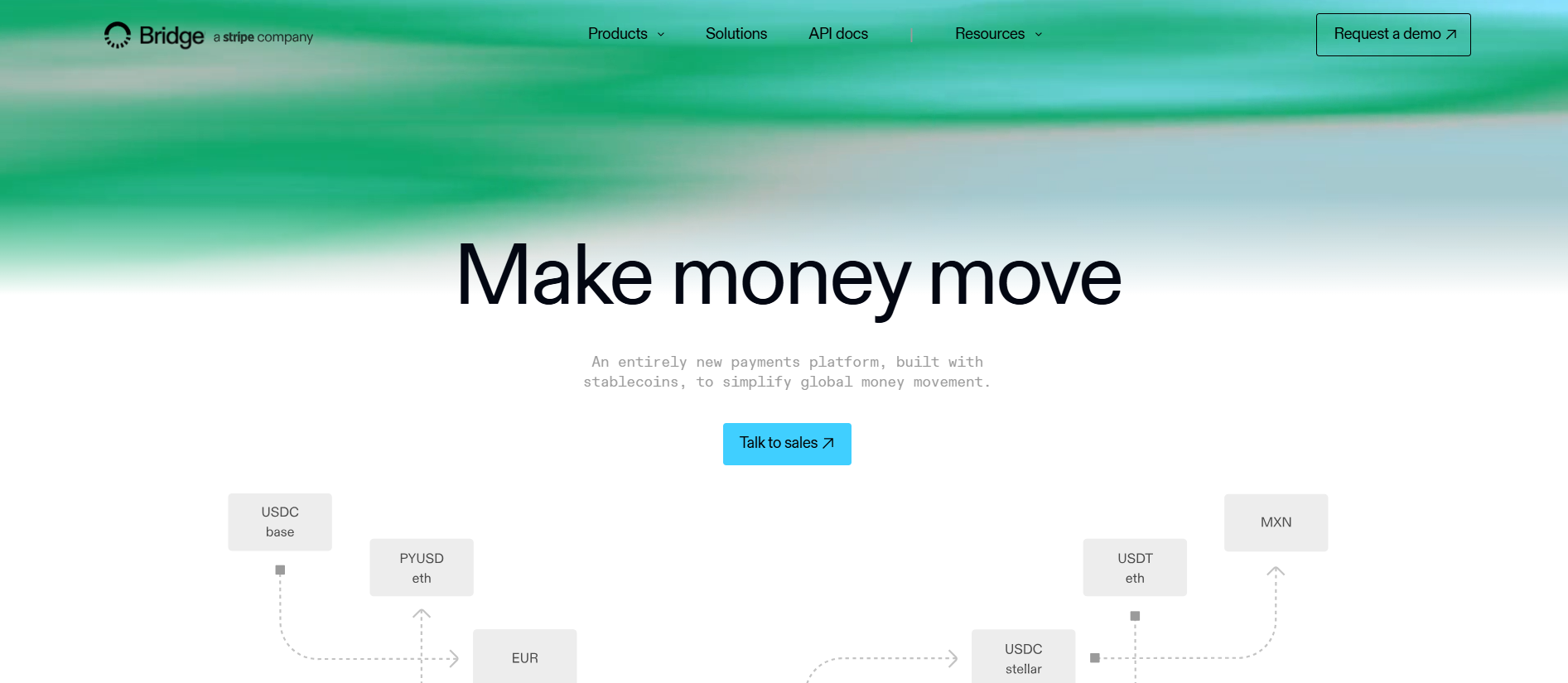
Bridge is one of the most compelling API-first stablecoin settlement platforms for marketplaces in 2026.
Its core pitch is stablecoin orchestration: receiving, storing, converting, issuing, and spending stablecoins through a single platform.
Bridge says its orchestration APIs let businesses integrate stablecoin payments into existing flows of funds, while the broader platform covers wallets, cross-border payments, and conversion.
Why it stands out for marketplaces:
- It is designed around money movement infrastructure, not just checkout.
- It handles technical complexity such as gas management and onchain operations.
- It supports fast cross-border settlement and can fit embedded payout or treasury models.
Bridge is especially useful when a marketplace wants to build custom settlement logic, expand into multiple corridors, or offer stablecoin-enabled money movement as part of its own platform experience. It is less of a turnkey SMB payment widget and more of an infrastructure layer for product and engineering teams.
Bridge’s developer agreement also publicly references transaction fees for orchestration services, which is useful for evaluating economics during procurement.
Best for: API-driven marketplaces that want flexible, embedded stablecoin settlement and cross-border payout infrastructure.
3. Fireblocks
Fireblocks is not the simplest option, but it is one of the strongest enterprise infrastructure choices for marketplaces with complex operational requirements.
Fireblocks positions itself as digital asset and stablecoin infrastructure for payments, treasury, wallets, and tokenization.
In its payments buyer materials, it explicitly cites merchant settlement, cross-border payments, and marketplace or micropayment payouts for creators, contractors, and gig workers.
Why it stands out for marketplaces:
- Strong fit for secure wallet infrastructure and treasury automation.
- Explicit support for remittances, payouts, merchant settlement, and micropayment use cases.
- Better suited than lightweight checkout providers when institutional controls matter.
Fireblocks becomes attractive when the marketplace is large enough that payout rails, wallet controls, security models, and treasury workflows are strategic infrastructure decisions. It is usually more relevant for enterprise marketplaces than for early-stage platforms looking for a fast launch.
Best for: large or regulated marketplaces that need wallet control, payout infrastructure, treasury operations, and enterprise security.
4. Circle Payments Network
Circle Payments Network is a strong option for marketplaces when the problem is not just stablecoin acceptance but networked global settlement.
Circle describes CPN as a framework for orchestrated stablecoin payments in which an originating institution performs verification and conversion into stablecoins, and a beneficiary institution receives, converts to local fiat, and pays the end recipient.
Circle highlights 24/7 payouts, transparent transfers, and faster corridor expansion.
Why it stands out for marketplaces:
- It is built around payout and settlement networks, not only merchant checkout.
- It is relevant for marketplaces that need to move money between countries and off-ramp to local fiat.
- Circle is also emphasizing broader stablecoin payment growth and commerce use cases in 2026.
The practical consideration is that Circle’s network model is more institution-oriented than plug-and-play. For many marketplace operators, Circle is best accessed through partners or as part of a broader payments architecture rather than as a basic frontend payments product.
Best for: marketplaces prioritizing cross-border settlement design, institutional-grade payout corridors, and fiat off-ramp coordination.
5. Coinbase Business
Coinbase has become more relevant for stablecoin business flows going into 2026. Coinbase Business launched global payouts and payment links, allowing businesses to send USDC to onchain addresses or email addresses, fund payouts from balances or connected bank accounts, and automate on-demand, batch, or scheduled payouts through an API.
Coinbase also says its payments suite is featured on Shopify and offers instant USDC payments to merchants.
Why it stands out for marketplaces:
- It combines payout workflows with collection tools.
- It supports batch and scheduled payout automation.
- It can be useful for platforms that need fast business disbursements without building a deep wallet stack from scratch.
Coinbase is especially interesting for marketplaces with strong USDC alignment, crypto-native counterparties, or seller bases comfortable receiving digital dollars. It is not as explicitly marketplace-native as Stripe Connect, but it is increasingly practical for business payout operations.
Best for: marketplaces that want straightforward USDC payout automation and simple collection flows.
6. Triple-A
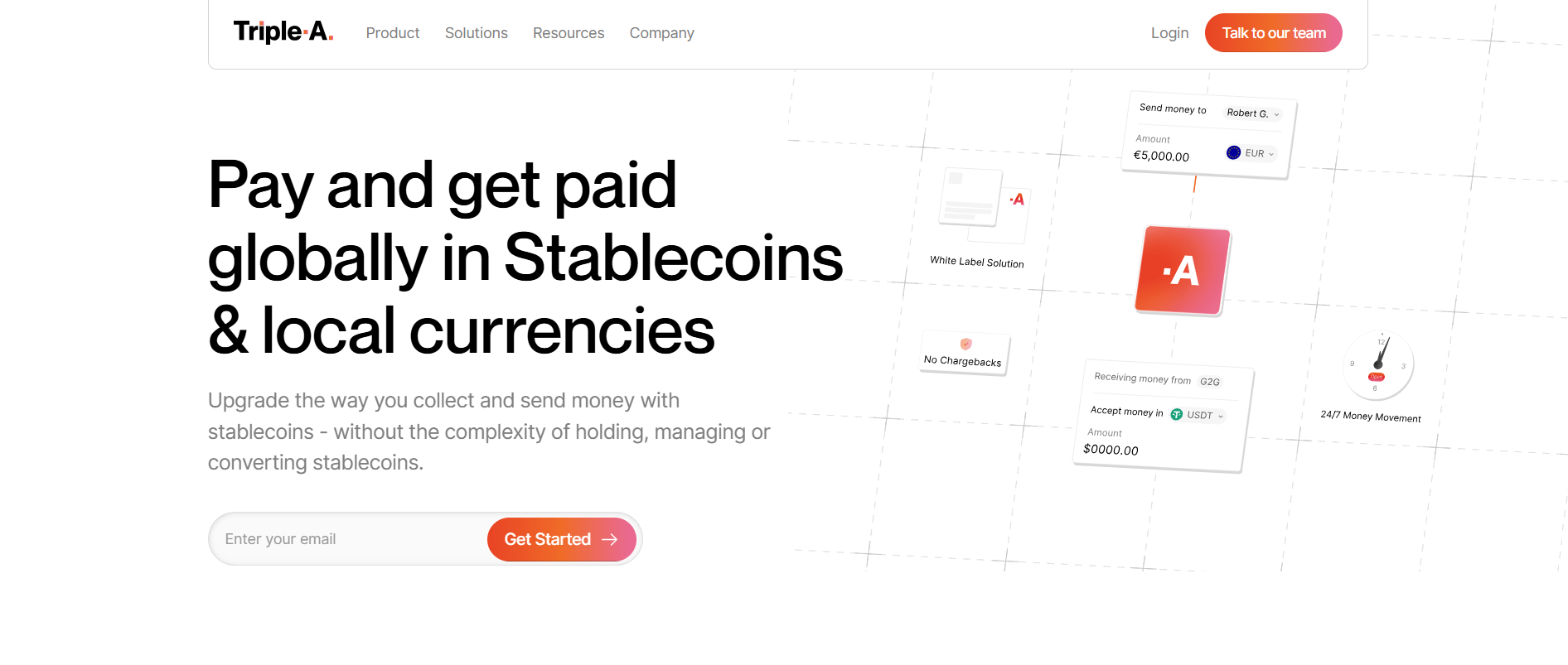
Triple-A is more commerce-facing than some of the deeper infrastructure players, but it deserves inclusion because it clearly targets e-commerce and marketplaces while offering both stablecoin payments and stablecoin or fiat payouts.
Its product positioning includes 24/7 payouts to suppliers, sellers, providers, and vendors, alongside acceptance through checkout, pay-by-link, and white-label gateways.
Why it stands out for marketplaces:
- Clear support for both pay-ins and pay-outs.
- Stronger out-of-the-box fit for marketplace and commerce use cases than pure infrastructure vendors.
- Useful when a platform wants a payments partner rather than a low-level orchestration layer.
Triple-A may not offer the same infrastructure depth as Bridge or Fireblocks, but it can be a strong fit for operators who need seller/vendor payout support and stablecoin-enabled collections without building a highly customized payments architecture.
Best for: commerce-driven marketplaces that want stablecoin acceptance and seller payouts in one provider relationship.
7. BVNK
BVNK is a serious contender for marketplaces that need stablecoin payment infrastructure with strong cross-border emphasis.
The company positions itself around receiving, storing, converting, issuing, and spending stablecoins, and says businesses can integrate stablecoins into existing flows through orchestration APIs.
BVNK also highlights cross-border payments settling instantly, 24/7, and cites real-world merchant settlement case studies.
Why it stands out for marketplaces:
- Good fit for cross-border settlement and treasury-heavy flows.
- API-led model can support custom marketplace payout experiences.
- Useful where partners or merchants want stablecoin settlement with fiat conversion options.
BVNK is less consumer-brand-visible than Stripe, but for marketplaces dealing with international merchant settlement or alternative payment corridors, it can be one of the more practical infrastructure options.
Best for: international marketplaces that need stablecoin-based settlement, FX flexibility, and infrastructure-level control.
Which Tool Is Best For Which Marketplace In 2026
The best choice depends on the marketplace model:
- A creator or freelancer marketplace already running on Stripe will usually find Stripe the most natural starting point, assuming US eligibility and preview access.
- A product-led marketplace building its own payout and treasury layer will usually get more flexibility from Bridge or BVNK.
- A large enterprise marketplace with compliance, wallet security, and internal treasury requirements may be better served by Fireblocks or a Fireblocks-led stack.
- A marketplace focused on institution-grade cross-border corridors and local currency disbursement logic may lean toward Circle’s network model.
- A platform that wants quick business payouts in USDC with light operational complexity may find Coinbase Business more practical.
- A commerce-heavy marketplace that wants both stablecoin checkout and seller payouts from one provider may prefer Triple-A.
How To Evaluate Vendors Before You Commit
Marketplace teams should pressure-test five areas before signing:
Start with payout architecture. Ask whether buyers can pay in fiat while sellers receive stablecoins, whether recipients can choose wallets or bank off-ramps, and how balances are managed.
Stripe explicitly supports fiat platform balances converting into USDC payouts for recipients, which is a useful benchmark.
Then review compliance and operating model. Regulation is moving from theory to implementation across major markets, and Chainalysis notes that 2025 saw rapid progress and friction as crypto frameworks rolled out, including full MiCA effectiveness in the EU. That means compliance readiness is now part of product readiness.
Next, examine treasury and reconciliation. A good stablecoin settlement tool should not only move money fast. It should also reduce operational mess around conversion, reporting, and payout tracking. This is where infrastructure players like Fireblocks, Bridge, and Circle often differentiate.
Also ask about corridor coverage, seller UX, fee transparency, and preview or geography restrictions. Stablecoin capabilities are still uneven by jurisdiction and product maturity. Stripe’s US-only private preview status is a good example of why teams need to validate availability early.
Final Thoughts
The best stablecoin settlement tools for marketplaces in 2026 are not necessarily the ones with the loudest crypto branding. They are the ones that solve practical marketplace problems: faster seller payouts, lower cross-border friction, better treasury movement, and cleaner operational control.
- For many platforms, Stripe is the most natural marketplace-native option when eligibility aligns.
- For infrastructure flexibility, Bridge and BVNK are strong. For enterprise control, Fireblocks is one of the most credible names.
- For networked cross-border settlement, Circle is important.
- For fast business payouts and collection flows, Coinbase Business is increasingly relevant.
- For combined commerce acceptance and payout support, Triple-A is worth serious consideration.
The broader market direction is clear: Stablecoins are moving deeper into real payment infrastructure, and marketplaces are one of the clearest places where settlement speed, programmability, and global reach translate into direct business value.
Read Next:
- The Biggest Stablecoin Trends In 2026
- 9 Fastest-Growing Stablecoin Use Cases In 2026
- Top 10 Stablecoin Compliance Tools in 2026
FAQs:
1. What Is A Stablecoin Settlement Tool For A Marketplace?
A stablecoin settlement tool for a marketplace is software or infrastructure that helps the platform move money between buyers, the platform, and sellers using stablecoin rails for some part of the payment flow. That can include collections, treasury transfers, seller payouts, conversion, wallet routing, and fiat off-ramping.
2. Are Stablecoin Settlement Tools The Same As Crypto Payment Gateways?
No. A crypto payment gateway usually focuses on accepting payment at checkout. A stablecoin settlement tool for marketplaces is broader and often includes payout orchestration, reconciliation, conversion, treasury movement, and multi-party fund routing.
3. Which Stablecoin Settlement Tool Is Best For A Marketplace Already Using Stripe?
Stripe is usually the most natural first option for a marketplace already built on Connect, because its stablecoin payout product is designed for platforms and marketplaces. The current limitation is that the feature is still in private preview and limited to US-based platforms.
4. Which Provider Is Best For Enterprise Marketplace Infrastructure?
Fireblocks is one of the strongest enterprise choices when the marketplace needs wallet infrastructure, payout orchestration, treasury management, and stronger operational controls rather than only checkout functionality.
5. Why Are Stablecoins Becoming More Important For Marketplace Settlement In 2026?
Stablecoins are becoming more important because they can support faster cross-border movement, 24/7 settlement, programmable disbursements, and broader seller reach. At the same time, major providers and researchers are pointing to growing payment, payout, and institutional settlement activity around stablecoins.
Disclaimer:
This content is provided for informational and educational purposes only and does not constitute financial, investment, legal, or tax advice; no material herein should be interpreted as a recommendation, endorsement, or solicitation to buy or sell any financial instrument, and readers should conduct their own independent research or consult a qualified professional.