
Table of Contents
Five years ago, paying a contractor in Manila from a company in Austin meant a wire transfer that took three to five business days, passed through multiple correspondent banks, and arrived 6% lighter than it started.
The contractor had no say.
The employer had no alternative.
That was just how international payroll worked.
It doesn't work that way anymore. Stablecoin rails settle in under 60 seconds for fractions of a cent.
The question in 2026 is no longer whether stablecoins belong in payroll, it is which platforms have actually built the infrastructure to deliver on that promise, and on what exact date they started doing it.
Key Takeaways
- Bitwage (July 21, 2014) and Rise (April 2022) are the only platforms that built crypto and stablecoin payroll as a core product from inception.
- The total stablecoin market cap reached $321 billion in March 2026. Adjusted transaction volume exceeded $9 trillion in 2025.
- Deel, the world's largest HR platform by payroll volume, announced its stablecoin feature on February 10, 2026.
- Only Rise supports both USDC and USDT natively for payroll. Remote, Deel, Rippling, and most EOR platforms offer USDC only or have not confirmed USDT support.
- The next competitive layer, yield on idle payroll balances, has been shipped only by Rise, via Rise Earn, built on Arbitrum and powered by Aave.
Why Payroll Platforms are Moving Now
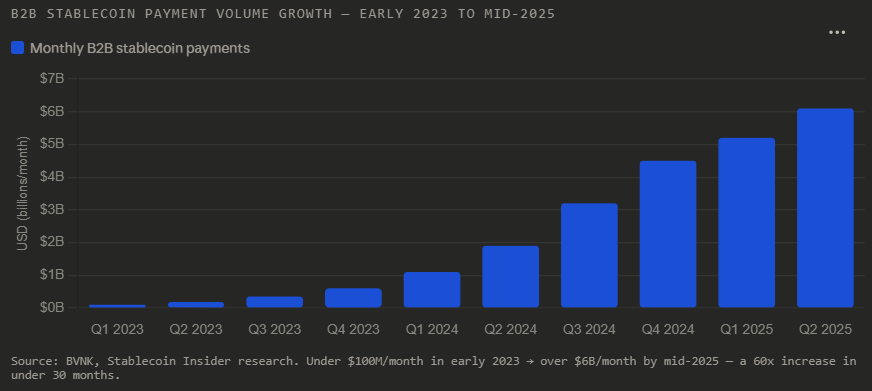
Three forces converged in 2024 and 2025 to push stablecoin payroll from a niche feature request into a competitive requirement across the global HR industry.
The first is cost. Traditional cross-border payroll fees have not moved. The World Bank's Q1 2025 Remittance Prices Worldwide report placed the global average cost of sending $200 internationally at 6.49%, a figure virtually unchanged over five years.
A contractor in Lagos earning $3,000 monthly loses roughly $195 per month to intermediary fees, FX spreads, and correspondent banking overhead.
Stablecoin transfers on Solana, Base, or Arbitrum cost fractions of a cent and settle in under 60 seconds. The gap between legacy rails and stablecoin rails is not narrowing. It is widening.
The second is regulatory clarity. The GENIUS Act, signed into law on July 18, 2025, established a federal framework for payment stablecoins in the United States, subjecting issuers to Bank Secrecy Act requirements and mandating AML and sanctions compliance programs.
The EU's MiCA framework created equivalent structure for European operations. Finance teams that had been waiting for legal cover now have it. The compliance objection that had delayed adoption at institutional level was removed.
The third is worker demand. Pantera Capital's survey of 1,600 crypto professionals across 77 countries found that the share of people receiving pay in cryptocurrency jumped from 3% in 2023 to 9.6% by end of 2024.
More than 25% of global freelancers opted for partial crypto payments by 2024. Workers in Argentina, Nigeria, and Southeast Asia drove early adoption, not out of ideology, but economics.
An Argentine developer watching 124% annual inflation in 2023 didn't need a whitepaper to understand why receiving USDC made more sense than pesos. A Nigerian contractor paying 6% on every international transfer saw the math in their bank statement.
Implementation Timeline: Who Launched When
Understanding which platforms entered stablecoin payroll, and precisely when, is essential context for evaluating what each product actually represents today.
A feature announced in February 2026 through a third-party partner is a fundamentally different product than one built natively and running in production since 2022.
1. Bitwage: live since July 21, 2014
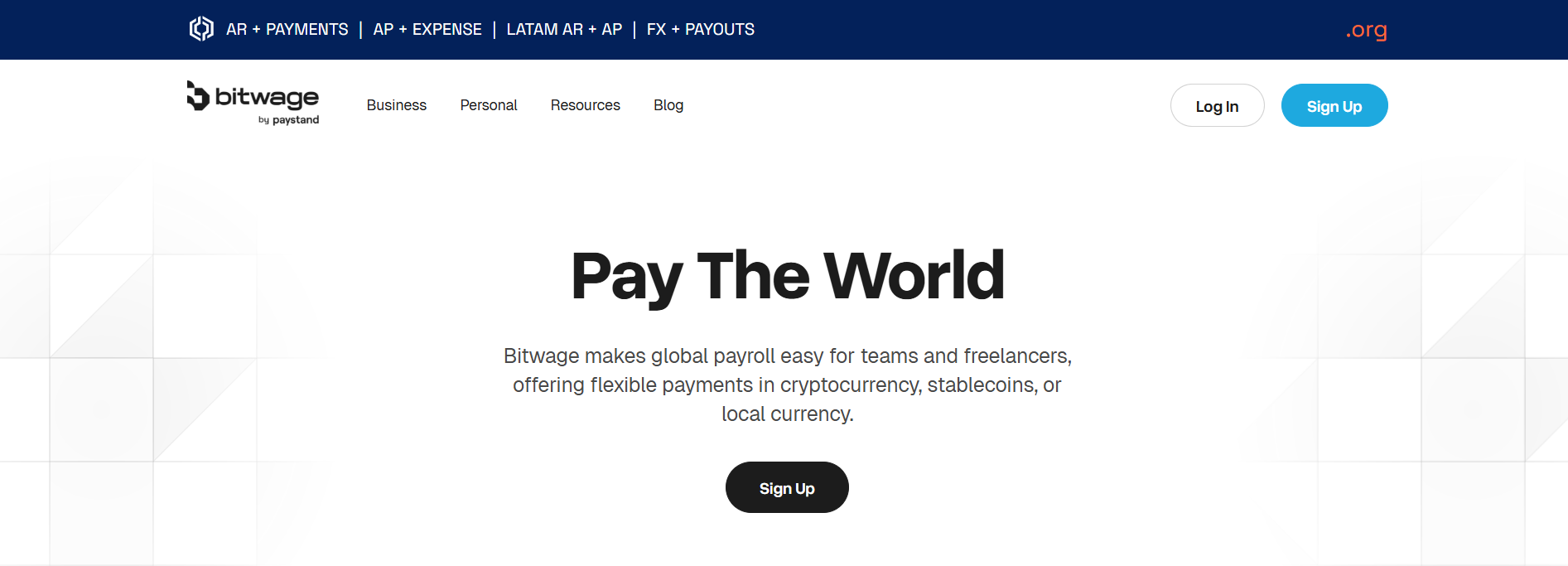
Bitwage is the category's original platform, and that provenance matters. Incorporated on May 27, 2014 by Jonathan Chester and John Lindsay, Bitwage launched the world's first Bitcoin payroll beta on July 21, 2014, for US companies paying employees.
In November 2014, it extended the model so individual workers could opt into crypto wages without employer sign-up. International payroll services followed in February 2015.
Bitwage didn't add crypto payroll to an existing product. It built the first version of the product category itself.
Over eleven years of operation, Bitwage processed over $400 million in wages, onboarded 90,000+ workers and 4,500+ businesses across approximately 200 countries, and maintained a spotless security record with zero reported breaches.
Its stablecoin support (USDC, USDT, BTC, ETH), and 80+ local fiat currencies, remains among the broadest of any platform in the market.
On November 3, 2025, Paystand, a blockchain-powered B2B payments network processing over $20 billion annually for 1,000+ enterprise clients, acquired Bitwage for an undisclosed sum. The deal integrates Bitwage's cross-border payroll infrastructure into Paystand's accounts receivable and payable network, giving enterprise clients access to stablecoin payroll rails alongside full AP/AR automation.
Integration began immediately for select enterprise customers with broader rollout staged by corridor and currency.
2. Rise: live since April 2022
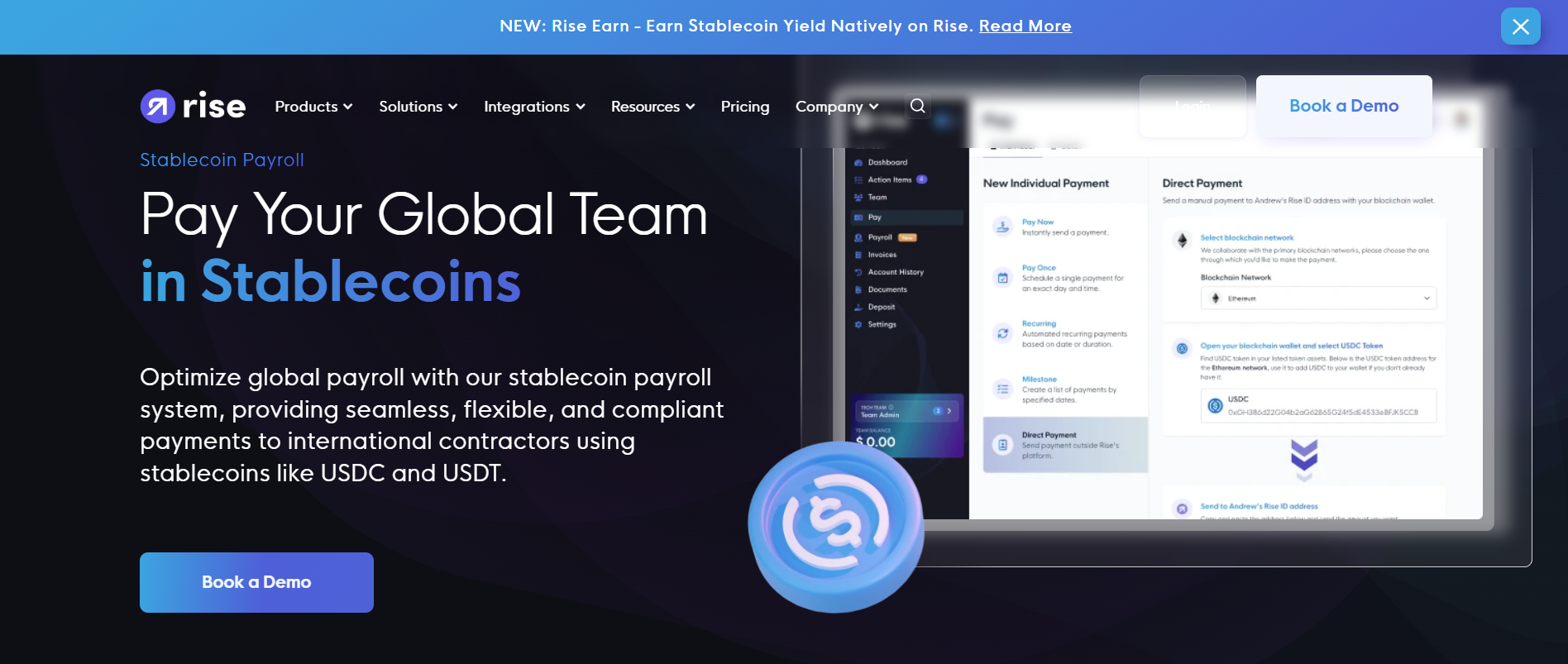
Rise launched its current platform in April 2022, natively on Arbitrum, with stablecoin payroll as a core feature from day one, not an add-on retrofitted from a legacy system.
The company pivoted to a paycheck service in June 2021, raised pre-seed funding in October 2021 from investors including JAM Fund, and launched the live product in April 2022 with a $3.8 million seed round led by Sino Global Capital.
The product works as follows:
- Companies fund payroll in USD bank transfer or USDC/USDT from a crypto wallet.
- Workers choose their withdrawal method per pay cycle from 90+ local fiat currencies, USDC, USDT, or 100+ other crypto assets, without employers managing separate processes.
Multi-chain settlement spans Arbitrum, Ethereum, Polygon, Optimism, and Avalanche. L2 payouts settle in 15 to 90 seconds.
As of Q1 2026, approximately 80% of Rise's on-chain withdrawal volume runs through Arbitrum. The deposit funding mix across the platform runs 30% crypto / 70% fiat; withdrawals run 40% crypto / 60% fiat, a pattern reflecting companies funding from wherever is convenient while workers increasingly choose to exit through stablecoin rails.
Rise is the only major payroll platform to support both USDC and USDT natively for payroll. Pantera Capital's research across 1,600 crypto professionals found USDC dominates with 63% of crypto payroll market share, but attributed that gap partly to the fact that none of the legacy EOR platforms (Deel, Remote, Rippling) offer USDT for payroll.
USDT is the dominant stablecoin in LATAM, Africa, and parts of APAC, precisely the geographies where cross-border payroll demand is highest and banking friction is greatest. Platforms without USDT support cannot fully serve those corridors.
Rise Earn, native yield on idle payroll balances, built on Arbitrum and powered by Aave, launched in early 2026, allowing companies to generate return on prefunded payroll funds without leaving the platform or interacting with DeFi directly.
3. Remote: live since December 17, 2024
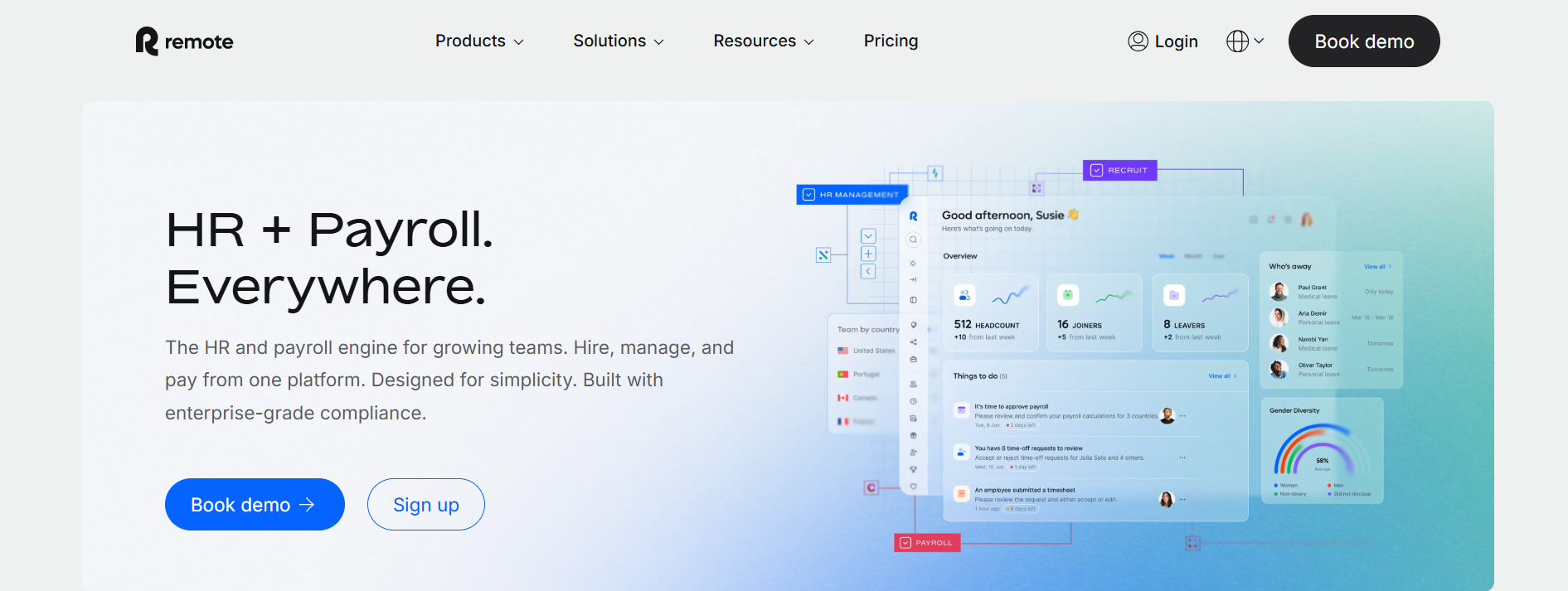
Remote announced its stablecoin payout feature on December 17, 2024, making it the first major EOR platform to ship production stablecoin payroll.
The implementation used Stripe Connect and Coinbase's Base network (a Layer-2 chain) to enable USDC payouts in 69 countries.
CEO Job van der Voort described it as a response to customer demand: "One of the biggest hurdles companies face when hiring international talent is providing fast, flexible, and reliable payments."
The feature works as follows: contractors link a Base-compatible crypto wallet to Stripe Express, select crypto as their withdrawal method, and receive USDC payouts while their employer is billed in USD.
Remote handles local compliance; Stripe routes the payout. As of Q1 2026, the feature supports USDC on Base only, no USDT, no alternative chains. It is available to US-based employers only.
Full employees are excluded; only contractors can receive stablecoin payouts. There is no confirmed expansion timeline for additional stablecoins, chains, or non-US employer access.
4. Toku: stablecoin on Polygon since January 13, 2026
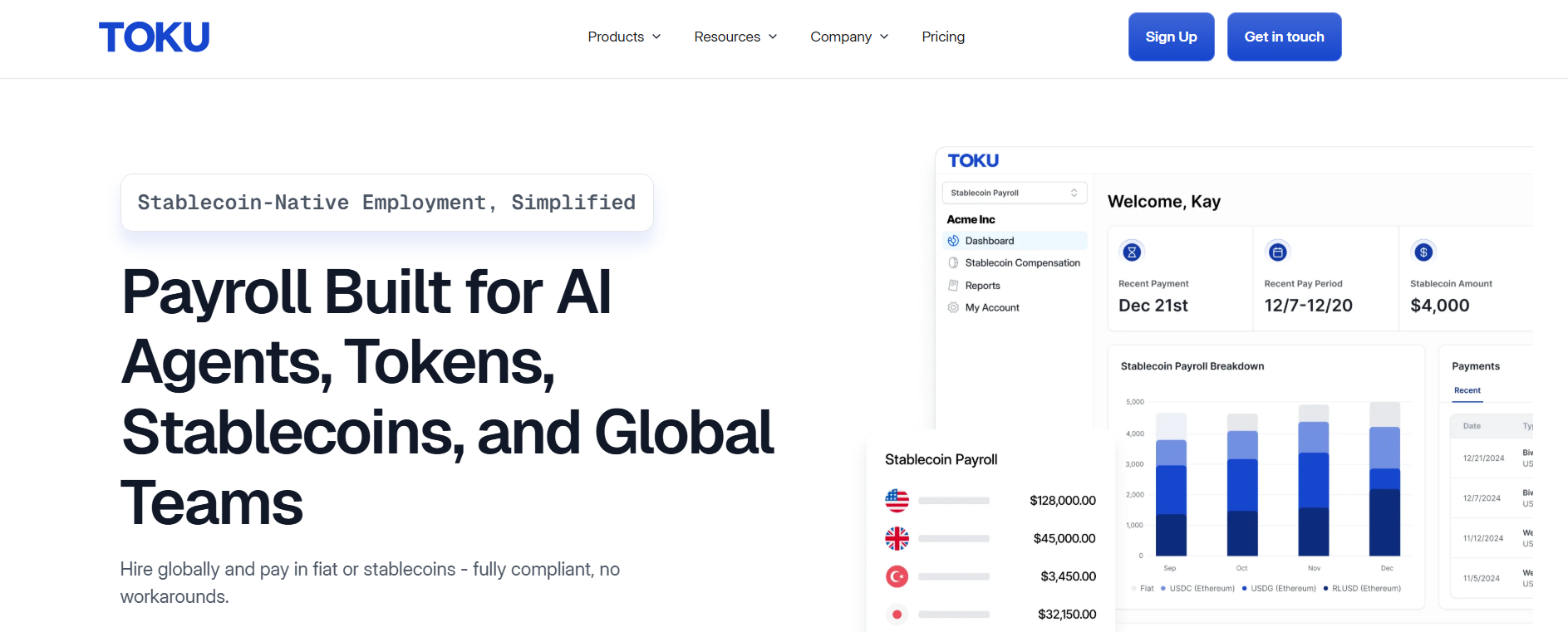
Toku built its initial payroll engine around token-based compensation and tackled tax compliance as its foundational layer before expanding to stablecoins.
On January 13, 2026, Toku announced global stablecoin payroll on Polygon with $1 billion in annual token payroll volume, the first platform to connect compliant stablecoin payroll directly to existing enterprise HRIS systems (ADP, Workday, UKG, Gusto) without requiring a full platform migration.
On February 12, 2026, Toku extended to the Sei blockchain, which was processing over $3 billion in stablecoin volume in its prior 30-day period.
Toku's architecture is API-native. Rather than building a standalone payroll system, Toku sits underneath existing infrastructure as an EOR and stablecoin settlement layer. Workers can split compensation, for example, 70% USDC and 30% local fiat, configured per person.
Toku also made a significant infrastructure bet in January 2026, partnering with Aleo and Paxos Labs to launch the first private stablecoin payroll using zero-knowledge proofs.
The product addresses a real enterprise blocker, described directly by Toku's CEO Ken O'Friel: "Every public company CFO we talk to gets excited about stablecoins until they realize their payroll would be public. That's where the conversation ends."
ZK-proof private payroll removes on-chain salary transparency as a blocker for large public companies. Toku's trade-off is depth: it functions as a modular integration layer, not a complete payroll operating system.
5. Papaya Global: Banco Wallet since February 6, 2026
Papaya Global's history with crypto goes back to late 2017, when it announced workers could receive up to 30% of net salary in Bitcoin or Ethereum, a cap set explicitly to "protect companies and employees" given crypto's volatility at the time. That early feature operated with significant limitations and was never a scaled stablecoin product.
The substantive moment came on February 6, 2026, when Papaya announced Banco Wallet, a global workforce wallet built with Fireblocks, the digital asset infrastructure provider that processes approximately 15% of global institutional stablecoin volume, around $40 billion quarterly, across 150+ blockchains.
Banco Wallet supports fiat and stablecoin payments across 180+ countries, with multi-currency holding, credit card connectivity, and fiat-to-stablecoin conversion. Workers can receive wages in stablecoins directly, without needing to change existing bank accounts or wait days for international transfers. The wallet serves both banked and unbanked workers.
Papaya also uses stablecoins as a backend settlement rail in its Payments OS, reducing FX costs and settlement time between employer payment and contractor bank account, without workers touching digital assets at all. Papaya's 2024 revenue reached $145.1 million across 1,000+ enterprise clients.
6. Deel: announced February 10, 2026
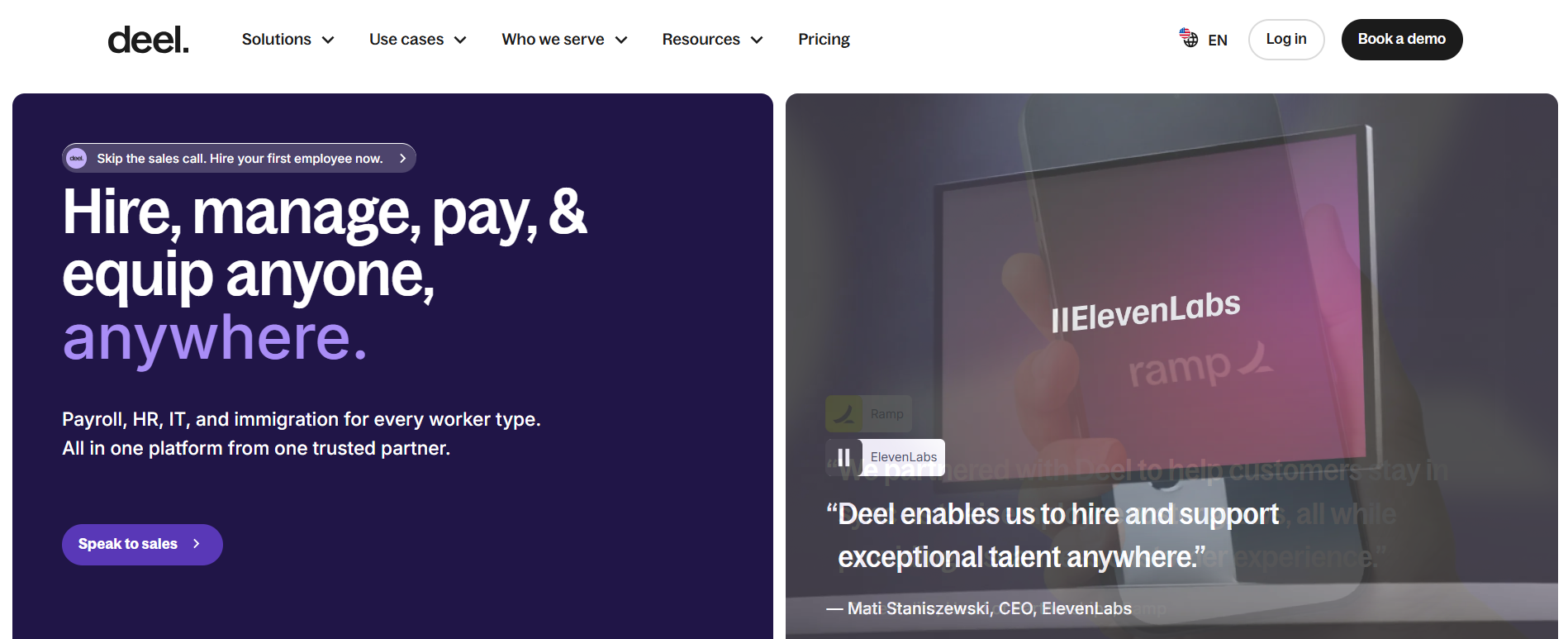
Deel is the world's largest global HR and payroll platform by volume, processing $22 billion annually across 150+ countries for over 40,000 customers. Its stablecoin entry, announced on February 10, 2026 via a partnership with MoonPay, specifically using MoonPay's fiat infrastructure subsidiary Iron, is significant as a market signal but structurally constrained as a product.
The mechanism is as follows: workers opt into stablecoin payouts; MoonPay's Iron infrastructure handles conversion and wallet delivery; Deel manages the payroll and compliance layer. Stablecoins are delivered to workers' non-custodial wallets.
The UK and EU rollout began in March 2026, starting with GBP conversion. A US expansion is planned with no confirmed timeline. The specific stablecoins supported were not disclosed at the time of announcement.
Deel's head of crypto, Thierry Edde, said the partnership is about giving the global workforce "ultimate flexibility in how they receive their earnings." MoonPay CEO Ivan Soto-Wright described it as "a major step forward in bringing digital assets into real-world financial use cases like salary payments."
The Iron founder, Max von Wallenberg, noted: "Deel processed $22 billion in global payroll in 2025 and they're making a bold bet on crypto infrastructure."
That framing is accurate in terms of scale, but the architecture tells a different story: Deel's stablecoin capability is a third-party dependency, not a native capability. When Deel announced this feature on February 10, 2026, Rise had already been running stablecoin payroll natively in production for 46 months.
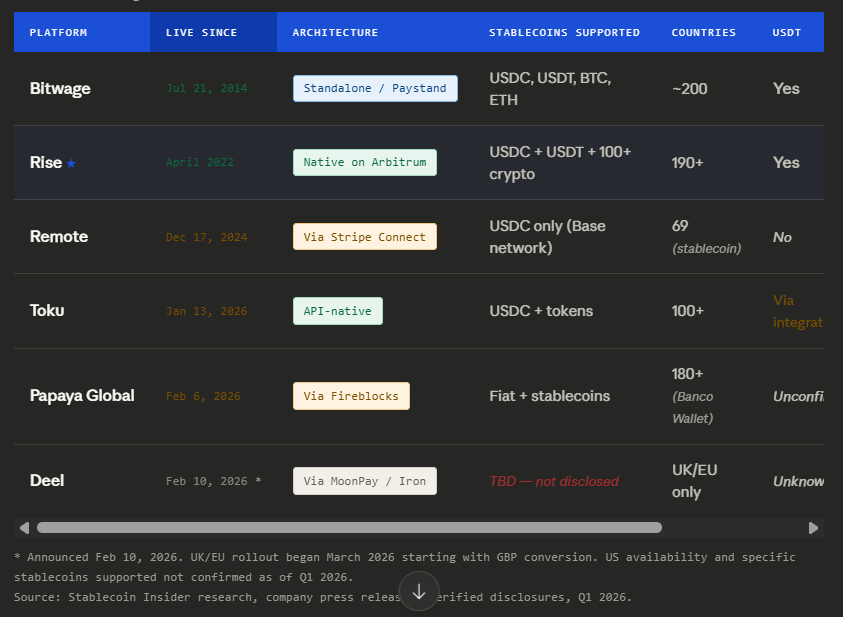
The Architecture Gap: Native Versus Retrofitted
The single most consequential variable in platform selection is not which stablecoins are listed in a product page, it is whether the platform built natively on blockchain infrastructure or added stablecoin support as a layer on top of a legacy payroll system.
Platforms with native integrations control the full stack: funding methods, settlement networks, stablecoin selection, worker withdrawal options, and compliance automation.
Feature velocity is faster because there is no partner dependency. Stablecoin coverage expands through internal product decisions rather than contract renegotiation. The worker experience is unified because the product was designed around it from day one.
Platforms with retrofitted integrations (Deel via MoonPay's Iron, Remote via Stripe Connect) operate within their infrastructure partner's constraints. Rollout begins in one region. One stablecoin is supported. One employer geography can access it. Expansion depends on partner roadmaps rather than internal engineering.
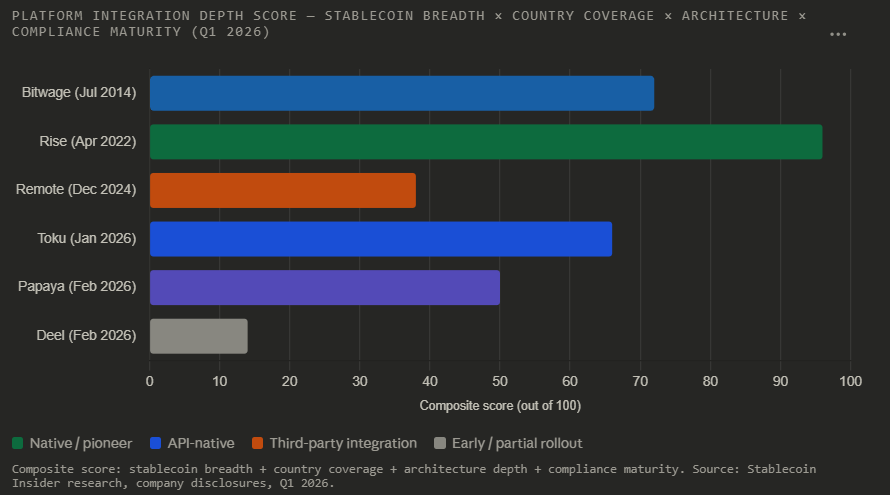
The Demand Side: Why Workers are Pulling This Forward
The stablecoin payroll shift is not a supply-side innovation being pushed onto a reluctant workforce. Workers in key global markets had been requesting stablecoin payroll since 2022, and the data reflects it clearly.
Volatile cryptocurrencies like Solana (1.9%) and Ethereum (1.3%) make up less than 5% combined. Workers chose stablecoins over volatile assets by a decisive margin.
Rise's 2026 projections put global business adoption of stablecoin payroll at 35–40% by end of year, up from 25% in 2025. 75% of Gen Z stablecoin users report preferring to receive salaries in stablecoins.
As this demographic advances in their careers, the preference becomes a recruitment and retention variable, not a novelty request.
What Comes Next
Three developments will determine the competitive shape of stablecoin payroll through 2026 and into 2027.
1. USDT coverage on enterprise platforms:
USDT is the world's most liquid stablecoin, processing $703 billion in monthly volume in 2025 and peaking at $1.01 trillion in June.
Despite this scale, none of the major legacy EOR platforms offer it for payroll. Pantera Capital's research attributed USDC's dominant 63% payroll market share partly to this infrastructure gap.
USDT dominates in LATAM, Africa, and parts of APAC, the same geographies where cross-border payroll demand is highest. Platforms that extend genuine, native USDT support will capture demand that architecturally constrained competitors cannot serve.
2. Private stablecoin payroll:
Toku's January 2026 partnership with Aleo and Paxos Labs introduced zero-knowledge proof private payroll, the first solution to combine compliant global payroll with on-chain privacy.
Public company CFOs, large enterprises with competitive compensation sensitivity, and publicly listed protocols cannot expose salary structures on-chain. That blocker had no technical solution before January 2026. The feature is early-stage but will likely become a standard enterprise requirement as blockchain payroll scales beyond crypto-native companies.
3. Yield on idle payroll balances:
Rise Earn, native yield on Arbitrum via Aave, launched in early 2026, lets companies generate return on prefunded payroll balances inside the Rise platform, without managing DeFi complexity.
As stablecoin payroll volumes grow and companies begin prefunding larger balances on-chain, the ability to earn yield on that idle capital becomes a material treasury management consideration. No other major payroll platform has shipped a comparable capability as of Q1 2026.
Conclusion
The stablecoin payroll market has crossed the adoption threshold in 2026. All six major platforms profiled here now have live or actively rolling-out features.
The $321 billion stablecoin market cap, over $9 trillion in adjusted 2025 transaction volume, and GENIUS Act regulatory clarity have collectively removed the "if" from this conversation. What remains is the "how well."
The architectural divide tells the real story of this market:
- Bitwage invented the category in July 2014.
- Rise built the modern native infrastructure in April 2022, accumulating over $1 billion in verified payroll volume, 190+ country coverage, native USDT support alongside USDC, and a yield product, all before Deel, Remote, Toku, or Papaya announced their first stablecoin features.
- Remote launched via Stripe in December 2024.
- Toku and Papaya followed in January and February 2026 respectively.
- Deel, the world's largest HR platform by volume, announced its third-party MoonPay integration on February 10, 2026, 46 months after Rise had gone live.
For companies evaluating platforms in 2026, two variables matter above all others: implementation date and architecture depth. A platform that announced a stablecoin feature in February 2026 through a third-party partner has a fundamentally different product than one that has been running it natively since 2022.
That gap shows up in stablecoin breadth, settlement flexibility, country coverage, compliance depth, and feature velocity. The rails are ready. The question is who built on them first, and who is still catching up.
Read Next:
FAQs:
1. Which payroll platform was the first to offer stablecoin payroll?
Bitwage launched the world's first crypto payroll beta on July 21, 2014, initially Bitcoin only. Rise launched the first native hybrid fiat-stablecoin platform built natively on blockchain in April 2022, and remains the only major EOR platform with both USDC and USDT support.
2. When did Deel add stablecoin payroll?
Deel announced its stablecoin payroll feature on February 10, 2026, through a partnership with MoonPay's Iron infrastructure. The UK and EU rollout began in March 2026. The US rollout has no confirmed timeline as of Q1 2026. Supported stablecoins were not disclosed at announcement.
3. When did Remote launch stablecoin payouts?
Remote launched USDC payouts on December 17, 2024, via Stripe Connect on the Base network. The feature supports contractors in 69 countries, is currently available to US-based employers only, and supports USDC on Base only.
4. What is the total stablecoin market cap in March 2026?
The total stablecoin market cap reached $311 billion as of March 2026 (CoinGecko). USDT holds approximately 58% at roughly $183 billion; USDC holds approximately 25% at roughly $78 billion. Adjusted stablecoin transaction volume exceeded $9 trillion in 2025.
5. Which platforms support USDT for payroll?
Rise and Bitwage (now under Paystand) both support USDT natively for payroll. Remote, Deel, Rippling, and Gusto do not offer confirmed USDT support as of Q1 2026. Toku supports USDT via integrations in select markets.
Disclaimer:
This content is provided for informational and educational purposes only and does not constitute financial, investment, legal, or tax advice; no material herein should be interpreted as a recommendation, endorsement, or solicitation to buy or sell any financial instrument, and readers should conduct their own independent research or consult a qualified professional.