
Table of Contents
Stablecoin payroll looks simple on paper: send a token, get an on-chain confirmation, call it done. In practice, most payroll friction shows up after the transfer, when employees try to cash out, spend, or reconcile what they received, and your team inherits the resulting support load.
That's the actual problem this guide solves.
Stablecoin usage has grown well beyond crypto trading collateral. In 2025, stablecoins processed an estimated $33 trillion in annual transaction volume , and the total market capitalization stands at roughly $316–320 billion as of March–April 2026, with the top five stablecoins accounting for nearly 90 percent of the total.
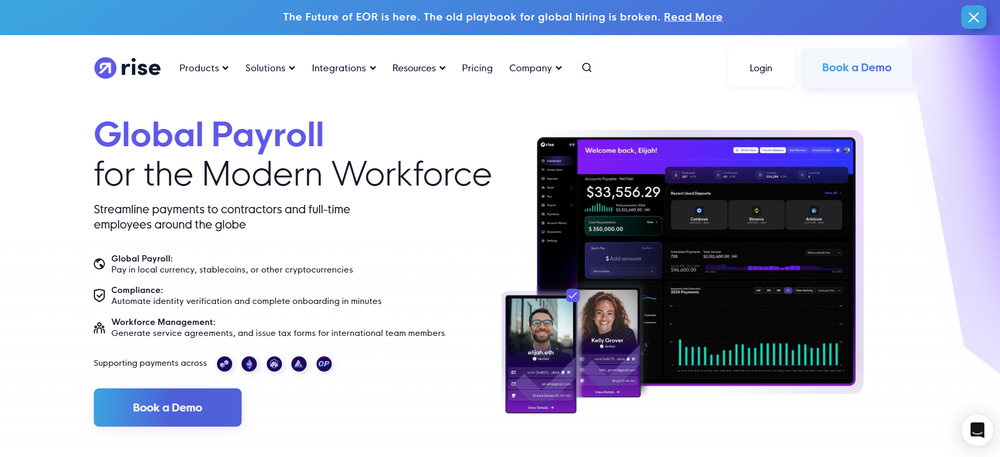
According to Rise's State of Crypto Payroll Report, over 225 businesses integrated stablecoins for payroll and operational payments in 2025 alone, and more than 50% of worker withdrawals on Rise's platform, which has processed over $1 billion in payroll volume, now occur in stablecoins.
Three of the five largest global EOR platforms had live stablecoin payout features by Q1 2026. The right question for 2026 is not which stablecoin is biggest. It is which stablecoin, and which network, creates the fewest employee cash-out failures across your actual countries.
Key Takeaways
- Choose the stablecoin your employees can reliably cash out, by country, before optimizing for on-chain fees
- Support load is driven by cash-out friction, compliance holds, and network mismatches, not on-chain confirmation
- The GENIUS Act, signed July 18, 2025, now governs U.S. stablecoin issuance; implementing regulations are required by July 18, 2026, with the Act taking full effect on the earlier of January 18, 2027, or 120 days after primary federal regulators issue final rules
- Treat stablecoin + chain as one bundled decision, the same stablecoin on different networks produces very different cash-out outcomes
- A controlled two-asset policy often outperforms a single global stablecoin for teams spanning multiple regions
What Payroll-Ready Means in 2026
A payroll-ready stablecoin is not simply pegged to $1 or €1. It must work end-to-end, repeatedly, at scale:
- Employee cash-out reliability: Employees can convert it into local money, or spend it directly, without repeated failures.
- Operational predictability: Clear handling exists when something goes wrong: wrong network, deposit hold, delayed crediting.
- Liquidity where employees actually off-ramp: Not just global exchange depth, but supported rails in the specific countries your workforce is in.
- Compliance and audit readiness: Finance and payroll teams can document flows and explain exceptions, increasingly non-negotiable as the GENIUS Act framework takes effect and final implementing regulations arrive by mid-2026.
Start With Employee Cash-Out Paths (Not With Coins)
Stablecoin selection is downstream from how your employees convert value into something usable. There are five common paths in global payroll:
- Path A: Exchange cash-out to bank: Employee receives stablecoin → deposits to an exchange → sells → withdraws to bank.
Primary risks: wrong-chain deposits, exchange crediting delays, bank reversal from name mismatches. - Path B: Direct stablecoin-to-bank via regulated off-ramp: Employee receives stablecoin → uses an off-ramp for conversion.
Primary risks: corridor gaps (not all off-ramps operate in all countries), KYC/identity holds, transaction screening delays. - Path C: Spend-first via card rails: Employee receives stablecoin → spends via a linked card or wallet spending flow.
Primary risks: merchant category blocks, card provider disputes, complex support handoffs across wallet provider and card issuer. - Path D: P2P liquidity in local markets: Employee sells stablecoin peer-to-peer for cash or bank transfer.
Primary risks: counterparty disputes, pricing slippage, typically outside your operational control. - Path E: Self-custody savings: Employee holds stablecoin in a wallet and cashes out later.
Primary risks: wallet mistakes, lost keys, network confusion — and when cash-out fails months later, employees still attribute the friction to payroll.
Map which paths dominate your workforce by country and persona before you shortlist stablecoins. That mapping is the highest-leverage input to your selection decision.
What Actually Causes Support Load
Support load in stablecoin payroll is measurable: tickets per payroll run, average resolution time, escalations to payroll ops, reimbursements and reruns, and erosion of employee confidence in payroll reliability.
The biggest real-world failure modes:
- Wrong network selection: Funds sent on a chain the employee's exchange doesn't support for that token. This is the single most common source of escalations.
- Exchange crediting delays: Deposit confirmed on-chain but not credited for hours, or moved to manual review.
- Compliance holds: Screening and enhanced due diligence delays can block cash-out even after on-chain finality.
- Confirmed vs. credited confusion: Employees interpret a transaction hash as proof of receipt when the exchange hasn't credited them yet.
- Fee and amount confusion: Employee expects exactly X, receives slightly less due to fees or spread, and opens a ticket.
- Wallet UX errors: Copy/paste mistakes, address format errors, wrong address type, especially high among first-time recipients.
A note on volume data
Raw stablecoin transfer volume can be misleading for payroll planning. Macquarie estimates adjusted stablecoin transfer volume reached roughly $11 trillion in 2025, significantly below the gross reported figure of $33 trillion, once organic economic activity is separated from arbitrage loops and exchange-internal flows.
For payroll, you want behavior that resembles real disbursements, recipients, cash-outs, regularity, not arbitrage loops or exchange-internal flows that inflate totals.
Download Our 2025 Stablecoin Year-End Report
What the GENIUS Act Means for Payroll Teams in 2026
The regulatory landscape changed materially in mid-2025. The GENIUS Act was enacted on July 18, 2025, establishing the first federal regulatory framework for payment stablecoin activities in the United States. The OCC published a notice of proposed rulemaking on February 25, 2026 to implement its provisions.
Implementing regulations are required by July 18, 2026, with the Act taking effect on the earlier of January 18, 2027, or 120 days after primary federal regulators issue final rules.
Three practical implications for payroll operators:
- Compliance-first stablecoins gain a structural advantage:
The OCC's proposed rules cover reserve requirements, redemption obligations, risk management, licensing, and capital adequacy for permitted payment stablecoin issuers. Regulated USD stablecoins with monthly reserve disclosures and 1:1 liquid backing are now better positioned on regulated payroll rails, particularly for U.S.-governed operations and multinationals with U.S. reporting requirements. - The yield ban matters for product design:
The OCC proposes a bright-line prohibition on stablecoin issuers paying interest or yield to holders solely for holding, using, or retaining a payment stablecoin. This orients payroll-grade stablecoins toward cash-like functionality rather than investment products, relevant for how your treasury and legal teams classify these instruments. - Major banks can now enter:
JPMorgan, Bank of America, and any FDIC-insured institution can now apply to issue their own dollar-pegged tokens. The first bank-issued stablecoins could appear by late 2026 or early 2027, competing directly with USDT and USDC for institutional payroll share.
The GENIUS Act does not ban the stablecoins payroll teams use today. It defines which issuers can operate compliantly and creates a 2026–2027 window where the competitive landscape will shift materially. Payroll operators should verify their stablecoin providers' compliance posture before final rules take effect.
The Non-Negotiable: Stablecoin + Chain Is One Decision
Payroll outcomes depend heavily on whether employees' cash-out destinations support both the stablecoin and the specific chain you sent it on. Exchange and off-ramp support is often chain-specific even within the same asset.
A useful framing:
- Asset choice drives liquidity depth, trust, and off-ramp availability.
- Chain choice drives wallet compatibility, fee predictability, reliability, and the probability of unsupported-deposit errors.
If your team treats USDT or USDC as universal assets and ignores chain selection, support load rises sharply.
Best Stablecoins for Payroll in 2026
Below are stablecoins commonly encountered in payroll-related discussions, with supply figures updated to March 2026.
1. USDT (Tether)
As of April 1, 2026, USDT carries a market cap of approximately $184.2 billion with a circulating supply of 184.22 billion tokens, more than twice the size of second-place USDC.
- Payroll-relevant assessment:
USDT remains the global liquidity heavyweight and the most widely integrated stablecoin across exchanges and off-ramps. For corridors in Southeast Asia, Latin America, and Africa, USDT's exchange depth is unmatched, and USDT is the dominant stablecoin in exactly the geographies where cross-border payroll demand is highest and banking friction is greatest.
Pantera Capital research across 1,600 crypto professionals found that platforms without USDT support cannot fully serve those corridors.
Operationally, the USDT experience differs materially by network:
- Tron (TRC-20) carries the majority of supply and is the most common network for global exchange cash-out.
- Ethereum (ERC-20) carries higher fees and is less practical for payroll-scale disbursements.
Standardize on one chain per corridor.
GENIUS Act compliance for Tether remains unresolved. Tether operates primarily offshore; structural changes may be required before January 2027. For U.S.-governed payroll programs, this is a material risk to monitor.
Best fit: Exchange cash-out corridors globally; strongest depth in Southeast Asia, LatAm, and Africa.
2. USDC (Circle)

As of April 2026, USDC carries approximately $77.5 billion in circulating supply. The growth trajectory has accelerated significantly: USDC captured 64% of total stablecoin transaction volume in mid-March 2026, surpassing USDT for the first time in nearly a decade, a milestone that drove an 87% monthly gain in Circle's stock (CRCL).
Year-to-date USDC on-chain transaction volumes reached $2.2 trillion through early April 2026, compared to $1.3 trillion for USDT over the same period.
- Payroll-relevant assessment:
USDC is the leading choice for payroll teams prioritizing regulatory compliance. Circle's monthly reserve attestations, transparent reserve composition, and U.S. regulatory positioning make it the preferred stablecoin for enterprise payroll on regulated rails.
Remote launched stablecoin payouts using USDC on Base; Rise processes the majority of its on-chain volume through Arbitrum. USDC is native on 15+ chains including Ethereum, Solana, Base, Arbitrum, and Polygon.
If your workforce uses regulated off-ramps and compliance-heavy rails, or if you have U.S. reporting requirements, USDC's operational predictability and documentation readiness are the decisive selection criteria in 2026.
Best fit: Compliance-first payroll programs; U.S.-tied enterprises; regulated off-ramp corridors.
3. DAI (MakerDAO / Sky)

MakerDAO's Endgame plan introduced Sky Dollar (USDS) as a successor token, with DAI and USDS currently coexisting.
As of April 1, 2026, DAI circulating supply stands at approximately $5.4 billion, with deep integration across DeFi protocols making it the stablecoin of choice for investors in that space.
- Payroll-relevant assessment:
DAI is used primarily in crypto-native contexts. Payroll success depends entirely on whether employees' cash-out venues support it in the required regions and on the required networks. If your workforce is not crypto-native, expect elevated onboarding support volume around wallet handling and the DAI/USDS distinction.
The rebranding introduces transitional complexity, assess whether employee wallets and exchanges have updated USDS support before making any payroll policy changes.
Best fit: Crypto-native teams comfortable with self-custody and DeFi rails.
4. PYUSD (PayPal USD)
PYUSD holds approximately $3.6–3.9 billion in circulating supply as of April 2026, with PayPal having expanded PYUSD access to users across 70 markets via PayPal wallets, enabling cheaper cross-border transfers and quicker merchant settlements.
PayPal has expanded PYUSD availability to 70 markets worldwide across Asia-Pacific, Europe, Latin America, and North America, a significant widening of payroll corridor coverage compared to 12 months ago. PYUSD now spans 9+ chains including Ethereum, Solana, Arbitrum, and Stellar.
- Payroll-relevant assessment:
PYUSD's 70-market expansion is a meaningful payroll development. Employees in newly supported markets can buy, hold, send, receive, and convert PYUSD to local currency directly through PayPal, reducing dependence on third-party exchange cash-out in those corridors.
As a Paxos-issued token, PYUSD is U.S.-regulated and well-positioned for GENIUS Act compliance. The multi-chain expansion increases corridor flexibility but also increases the risk of wrong-network errors if employees aren't given clear chain guidance.
Best fit: Recipients in PayPal-supported markets; direct PayPal cash-out without third-party exchange.
5. EURC (Circle Euro Stablecoin)
As of March–April 2026, EURC carries a market cap of approximately $413–460 million, commanding over 50% share of the euro stablecoin market. This represents a dramatic expansion from the sub-$400M range of late 2025.
EURC reached an all-time high of $1.2003 on January 28, 2026, reflecting EUR/USD rate movement. Circle's MiCA-compliant positioning in the EU gives EURC a regulatory clarity advantage for European payroll programs.
- Payroll-relevant assessment:
EUR stablecoins reduce FX conversion steps for EUR-denominated payroll liabilities, but corridor coverage remains more limited than USD stablecoin rails. Country-by-country cash-out validation is required before deployment. EURC benefits from MiCA compliance across the EU, increasingly important for European payroll operators who need regulatory certainty.
EUR payroll is operationally simpler when workforce and liabilities are EUR-native, provided off-ramp rails exist for your specific countries.
Best fit: EUR liabilities; EU-native workforces; MiCA-compliant European payroll programs.
Option 6: A Two-Asset Policy (Often the Practical Winner)
For many global teams, no single stablecoin cleanly covers all countries and employee preferences.
A controlled policy can reduce tickets:
- Stablecoin A for the majority corridor(s),
- Stablecoin B for a specific region or employee group,
- clear rules about eligible networks.
This is not more choices is better. It is limited choice with explicit rules reduces failure modes.
A Practical Decision Framework for 2026
Step 1: Build a cash-out coverage scorecard
For your top employee countries, document the top 1–3 exchanges and off-ramps employees actually use, which stablecoins and chains those venues support, and known friction points (cutoffs, minimums, review frequency, required metadata).
This is the single highest-leverage artifact you can build before selecting an asset.
Step 2: Forecast support load before launch
Model recipients per pay run, percentage of new (first-time) recipients, expected cash-out path distribution, and expected error rate by path based on pilot data. Track tickets per 100 payouts, time-to-credited (not time-to-confirmed), rework rate, and reimbursement rate.
Step 3: Choose stablecoin + chain bundles
Pick bundles that minimize unsupported deposit and crediting delay tickets: a default bundle for your largest corridor, an exception bundle for regions with different exchange realities. Do not scale a bundle until it survives a real pilot.
Step 4: Define the payroll policy layer
Reduce tickets by eliminating ambiguity. Define your wrong-network policy, cutoff policy (what qualifies as paid vs. credited), retry policy, fee policy (who bears fees and how employees see amounts), escalation policy (what evidence support requires from employees), and compliance policy (which stablecoins in your stack will remain usable once the GENIUS Act takes full effect).
Step 5: Pilot, then scale
Pilot with a representative set of countries, a mix of employee personas, and real support processes, not founder-handled exceptions. Only scale after the pilot generates measurable support load data.
Implementation Playbook to Reduce Tickets
1. Address and Network Hygiene
- Require employees to select network first, then paste the address.
- Use address validation and checksum where possible.
- For first-time recipients, consider a test transfer policy for high-risk corridors.
2. Employee onboarding that prevents repeat failures
- Provide a simple "How to receive and cash out" guide, by country.
- Make confirmed vs credited explicit: explain what each status means.
- Provide a short list of supported networks (not a long menu).
3. Monitoring and reconciliation that support teams can use
Your support team should be able to answer, quickly:
- Was the transfer broadcast?
- Is it confirmed?
- Was it sent to the correct chain?
- Is the destination a known exchange/off-ramp address?
- What is the expected crediting timeline for that destination?
Industry efforts like Visa's on-chain analytics work emphasize distinguishing real economic activity from noisy transfer volume through adjusted methodologies.
That mindset — defining what you count and what you do not — maps directly to payroll monitoring and support operations.
Comparison Table
| Option | Evidence-based size snapshot (March 2026) | Best fit (by cash-out path) | Primary support risks (what to plan for) | GENIUS Act posture |
|---|---|---|---|---|
| USDT | ~$184B market cap | Exchange cash-out corridors globally; strongest depth in Southeast Asia, LatAm, Africa | Wrong-network deposits; chain-specific exchange support; compliance holds; offshore regulatory uncertainty | Offshore issuer; compliance timeline unresolved |
| USDC | ~$79B market cap (growing) | Compliance-first payroll; U.S.-tied enterprises; regulated off-ramp corridors | Chain variance; deposit/crediting expectations; compliance-related delays | U.S.-regulated; best positioned for GENIUS Act |
| DAI / USDS | ~$4.3–5.4B supply | Crypto-native teams comfortable with self-custody and DeFi rails | Higher onboarding load; DAI/USDS rebranding transition adds operational complexity | Decentralized issuer; regulatory status evolving |
| PYUSD | ~$4.1B market cap; 70 markets | Recipients in PayPal-supported markets; direct PayPal cash-out without third-party exchange | Multi-chain wrong-network risk; exchange depth below USDT/USDC in some corridors | Paxos-issued; U.S. regulated; GENIUS Act aligned |
| EURC | ~372M circulating | EUR liabilities; EU-native workforces; MiCA-compliant European payroll programs | Smaller ecosystem vs USD rails; corridor limitations; FX movement for non-EUR employees | Circle-issued; MiCA compliant in EU |

Conclusion
The stablecoin that produces the fewest payroll incidents is the one that:
- Matches how your employees cash out in their countries,
- Is supported on the networks their cash-out venues actually accept,
- Is wrapped in clear policies that define paid vs credited and handle exceptions, and
- Comes from an issuer with a regulatory posture that holds up as the GENIUS Act framework takes full effect.
Stablecoins have demonstrated real settlement scale, $33 trillion in 2025, $320 billion in total market cap by March 2026, but payroll teams only benefit from that scale when the last mile (crediting, cash-out, and support handling) is designed deliberately.
Read Next:
- Tether's First Full Independent Audit of USDT Reserves
- Deloitte Canada and Stablecorp Announce Strategic Partnership
- Who Is Adding Stablecoins to Payroll and Why It's No Longer Optional in 2026
FAQs:
1. Which stablecoin is best for payroll in 2026?
The best stablecoin for payroll in 2026 is the one your employees can cash out reliably in their countries on the exact networks their cash-out venues support, while also coming from an issuer with a clear regulatory compliance posture as the GENIUS Act framework takes effect.
2. What is the biggest cause of payroll support tickets with stablecoins?
The biggest cause is cash-out friction after the transfer, especially wrong-network deposits, exchange crediting delays, and compliance screening holds.
3. Why do employees say they did not get paid if the transaction is confirmed?
Because confirmed on-chain does not mean credited by an exchange or completed by an off-ramp, so employees may not see funds available to sell or withdraw yet.
4. Should payroll use one stablecoin globally or a controlled mix?
A controlled mix often reduces failures when your workforce spans countries with different exchange and off-ramp coverage, as long as you enforce strict network rules per corridor.
5. How do I choose the right network for payroll payouts?
Choose the network that employees' cash-out venues support most reliably for that stablecoin, then standardize it to reduce wrong-network and unsupported deposit issues.
Disclaimer:
This content is provided for informational and educational purposes only and does not constitute financial, investment, legal, or tax advice; no material herein should be interpreted as a recommendation, endorsement, or solicitation to buy or sell any financial instrument, and readers should conduct their own independent research or consult a qualified professional.