
Table of Contents
Moving stablecoins onto Layer 2 (L2) networks is no longer a niche optimization. It is a structural requirement for applications that need frequent transfers, onchain payment flows, or high-volume DeFi activity without absorbing Ethereum mainnet gas costs.
At the same time, the reason many teams prefer Ethereum as their base layer is not speed, but settlement: the ability to anchor balances, proofs, and dispute resolution to a widely used, highly scrutinized base chain.
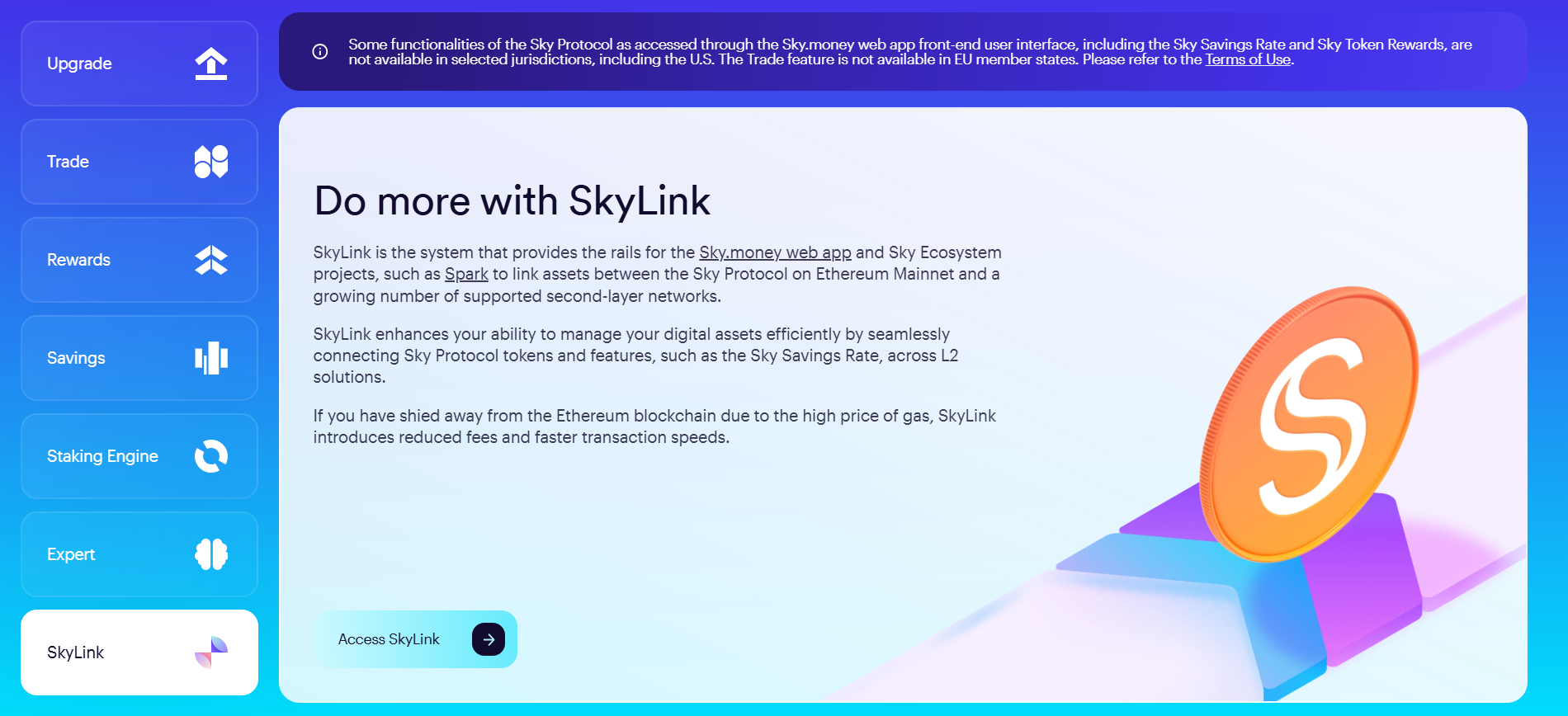
SkyLink sits directly in that intersection. Sky describes SkyLink as the rails that connect Sky Protocol assets between Ethereum mainnet and a growing set of supported L2s (including Base, Arbitrum, Optimism, and Unichain).
For teams deploying USDS on L2s, the technical question becomes: how do you scale execution to L2s while keeping the settlement story legible and Ethereum-aligned?
Key Takeaways
- SkyLink is described by Sky as the system that provides bridging rails between Sky Protocol on Ethereum mainnet and supported L2 networks.
- USDS is an ERC-20 token in Sky Protocol with permit support; Sky’s documentation also describes a DAI↔USDS converter enabling 1:1 conversions between DAI and USDS.
- sUSDS is described in Sky’s documentation as an ERC-4626 tokenized implementation of the Sky Savings Rate (SSR), designed for real-time share-to-asset conversions.
- For OP Stack “Standard Bridge” style withdrawals, the documented constraint is a minimum 7-day wait from L2 to Ethereum, while L1→L2 transfers are typically minutes (e.g., 1–3 minutes in Optimism’s docs).
- L2 adoption is measurable at the ecosystem level: L2 activity dashboards report rollup “UOPS” and an associated scaling factor versus Ethereum, illustrating that L2 execution capacity can materially exceed L1 throughput.
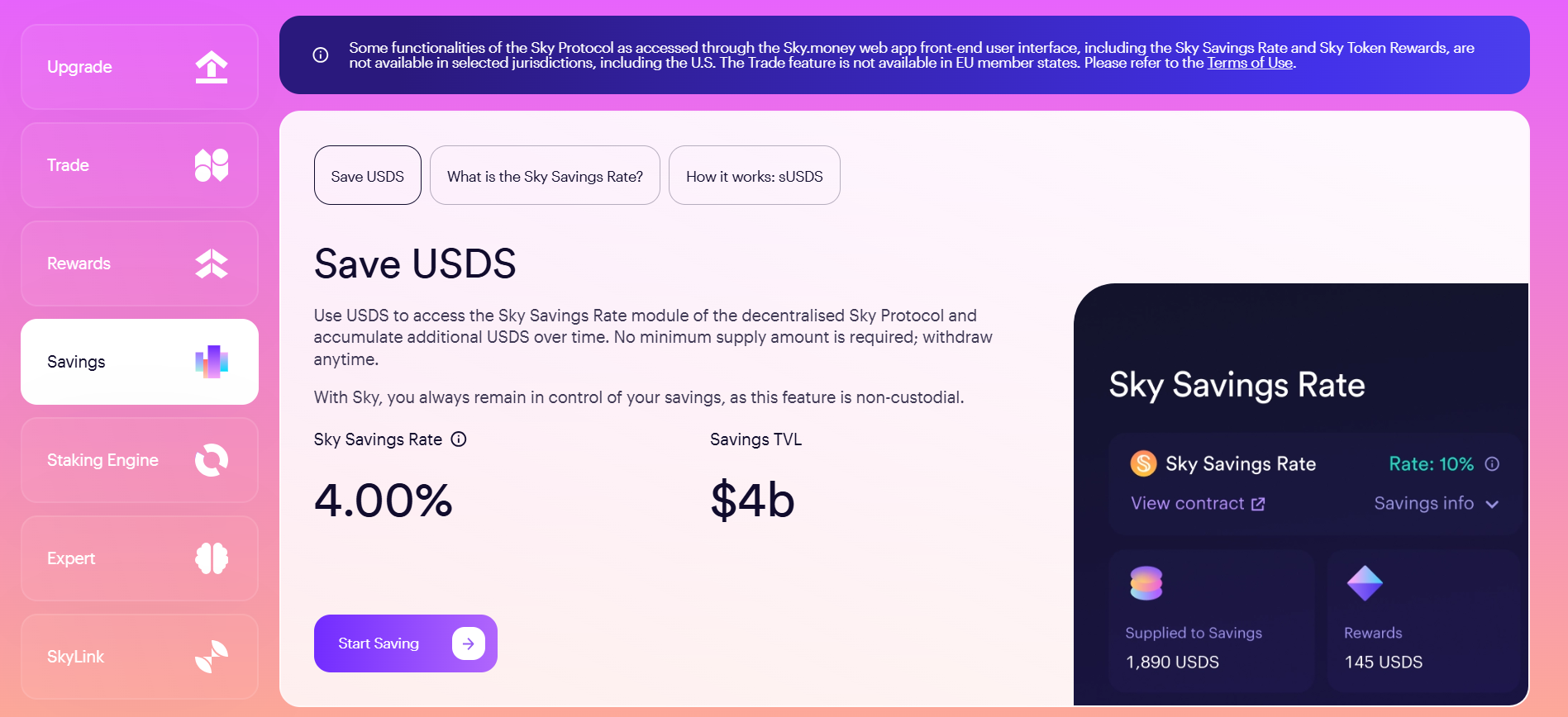
- Sky’s public interface shows SSR information (including a displayed SSR rate and savings TVL) and states the SSR is variable and determined by decentralized onchain voting.
Why This Topic Matters: Scaling Stablecoin Execution Without Losing Settlement Clarity
Stablecoins are “high-frequency” assets by nature: payroll batching, B2B settlements, recurring subscriptions, exchange transfers, consumer payments, and DeFi routing all create flows where per-transaction cost and confirmation time matter.
This is why L2s have become the default execution venue for many apps. L2 activity dashboards quantify this using rollup activity metrics (such as “UOPS”) and a scaling factor relative to Ethereum, which is a direct way to understand why L2 execution is attractive for stablecoin-heavy applications.
However, scaling execution is not the same as securing settlement. In practical terms:
- Execution is “what happens quickly” (transactions included, state updated).
- Settlement is “what becomes final under the system’s security model,” including the ability to resolve disputes or validate state commitments.
SkyLink is positioned specifically to move Sky ecosystem assets across Ethereum and L2 environments while keeping the “home base” settlement anchor on Ethereum.
Sky describes this in product terms: SkyLink connects Ethereum-based Sky Protocol tokens and features to supported L2 networks.
To use SkyLink safely at scale, you need to translate those product statements into concrete engineering and operations requirements.
The Assets: USDS and sUSDS in Sky Protocol
USDS: What the Token Is (As Documented)
Sky’s developer documentation describes USDS as an ERC-20 token with:
- permit functionality, and
- EIP-1271 smart contract signature validation support,
and notes an upgradeable design approach (UUPS / proxy storage standards).
The same documentation also describes a DAI↔USDS converter that “facilitates 1:1 conversions between DAI and USDS.”
Operational implication: when you are dealing with bridging, treasury, or reconciliation, you should treat USDS as a standard ERC-20 asset from an interface standpoint (approvals, allowances, transfers), while also acknowledging that the ecosystem supports a documented 1:1 conversion pathway between DAI and USDS via the converter.
sUSDS: The Savings Wrapper (And Why It Matters for Bridging)
Sky’s documentation describes sUSDS as a tokenized implementation of the Sky Savings Rate:
- fully compliant with ERC-4626, and
- enabling real-time share-to-asset conversions (even if “drip” has not been called recently).
This matters because bridging a yield-bearing wrapper is not the same as bridging a plain stablecoin:
- With USDS, your reconciliation is usually “token units moved.”
- With sUSDS, your reconciliation may need to account for the vault/share model (assets vs shares), and for the fact that value accrual is represented through the ERC-4626 conversion relationship.
If your L2 deployment expects users to hold “savings exposure” on L2, then sUSDS bridging becomes part of your functional requirements, not an edge case.
What SkyLink Is (And What It Is Not)
Sky describes SkyLink as:
- the rails for the Sky.money web app and Sky ecosystem projects (e.g., Spark) to bridge assets between Sky Protocol on Ethereum mainnet and supported L2 networks, and
- enabling end users on L2s such as Base, Arbitrum, Optimism, and Unichain to access Sky Protocol features.
From an engineering viewpoint, you should interpret “SkyLink” as a system layer that includes:
- bridge deployments (contracts and integration paths) across chains,
- governance-controlled configuration for token support and operational controls, and
- user-facing flows that abstract away cross-chain complexity.
What SkyLink is not (based on the constraints of rollup systems generally) is a magic removal of L2-to-L1 settlement constraints.
If your L2 inherits Ethereum settlement via an optimistic design, canonical withdrawals still face the fraud/challenge window described in rollup documentation.
Ethereum Settlement Assurance: A Precise, Non-Marketing Explanation
Ethereum settlement assurance can sound like a slogan unless you tie it to the mechanics of rollups.
How Rollups Anchor to Ethereum
Rollups are systems that periodically post state commitments to Ethereum.
Those commitments are validated either:
- by validity proofs (ZK-style), or
- accepted optimistically but challengeable via a fraud proof mechanism within a fraud proof window.
Operationally, this is the “settlement assurance” story:
- L2 executes quickly.
- Ethereum acts as the ultimate reference for data availability and dispute resolution (depending on the rollup design).
- Final settlement, especially for canonical L2→L1 exits, may require waiting through the challenge window.
Why “Finality” and “Withdrawal Time” Are Not the Same Thing
Standard bridge documentation is explicit about this distinction:
- L2→Ethereum transfers can require a minimum 7-day wait due to the withdrawal challenge period,
- but that delay affects withdrawals through the bridge rather than whether the L2 chain itself considers transactions final for normal use.
This matters because teams often over-rotate on “finality” in user messaging.
For product and risk, you should separate:
- L2 user-experience finality: when the sequencer includes the transaction and your app can proceed.
- Ethereum settlement finality (canonical exit readiness): when the system permits trust-minimized withdrawal to Ethereum under the rollup’s dispute model.
The SkyLink Ethereum–Base Native Bridge: What Sky’s Docs Actually Say
Sky’s developer guide on the SkyLink Ethereum–Base Native Bridge states it is designed to simplify transferring tokens between Ethereum and Base and that the guide covers:
- depositing and withdrawing supported tokens (specifically USDS and sUSDS),
- contract approvals,
- cross-chain messaging, and
- governance control of bridge operations.
The guide also notes customizations (from the OP Stack bridge codebase) that allow Sky ecosystem governance to:
- manage token support, and
- add new features when needed, including setting limits for withdrawals.
Separately, governance communications describe initializing a SkyLink bridge to facilitate bridging USDS and sUSDS between Ethereum mainnet and Base.
What you should take from this, operationally:
- The Base bridge is not described as a generic third-party bridge; it is a “native” pathway with governance-managed parameters.
- USDS and sUSDS are explicitly called out as supported tokens in the Base native bridge guide.
- Governance-controlled token support and withdrawal limits are part of the system model you should expect in production.
Step-by-Step: Bridging USDS to an L2 Using a Native Bridge Pattern
This section is intentionally written as an “operator’s mental model.” Exact UI labels differ across apps, but the underlying mechanics are consistent.
Step 1: Validate You Are Using the Intended Bridging Rail
Before a user (or your operations team) moves funds cross-chain, validate three things:
- Source chain and destination chain (e.g., Ethereum → Base).
- Token contract identity on both chains (USDS vs sUSDS, and the correct deployment addresses).
- Bridge route (native SkyLink bridge path vs other routes).
Sky’s Base native bridge guide is explicit that USDS and sUSDS are the supported tokens it covers.
Step 2: Prepare Approvals (Allowance Hygiene)
Most ERC-20 bridging flows require approvals (unless permit is used in the flow). The SkyLink bridge guide includes approvals as part of the deposit/withdraw process.
Operational best practices for approvals:
- Approve only what you intend to bridge (avoid infinite approvals for hot wallets).
- Use separate wallets for treasury operations vs routine user activity.
- Maintain a written process for revoking or rotating approvals after incidents.
Step 3: Initiate Deposit (L1 → L2)
For OP Stack standard bridging systems, deposits are typically fast because they do not require a challenge window.
Standard bridge documentation describes L1→L2 transfers as usually completing within minutes (commonly cited as 1–3 minutes in OP Stack documentation).
While Base is not Optimism, the “native bridge” concept and OP Stack lineage are relevant because Sky’s Base guide references customizations from the OP Stack bridge codebase.
What “fast deposit” does not mean:
- It does not mean the asset has reached Ethereum-level settlement on the destination chain.
- It means the messaging and inclusion path is designed for rapid execution.
Step 4: Confirm Receipt and Reconcile on the Destination L2
For production deployments, “confirmed” should be defined by your policy:
- at least one block inclusion on L2 (minimal),
- a set number of confirmations (stronger),
- additional monitoring checks (best), including bridge message status.
Sky’s Base guide references cross-chain messaging as part of understanding deposit and withdrawal flows.
Step 5: Withdraw (L2 → L1) With Realistic Timeline Expectations
This is where “Ethereum settlement assurance” becomes operationally visible.
For OP Stack standard bridge withdrawals, standard bridge documentation describes L2→Ethereum transfers as completed in 7 days due to the withdrawal challenge period.
Practical implication for USDS on L2:
- If your app or treasury workflow relies on “rapid returns to Ethereum,” you must design around the canonical window or use alternative mechanisms (which may introduce different trust assumptions).
- If your workflow does not require frequent L2→L1 exits, then the challenge window is less disruptive, and the L2 execution benefits are more likely to dominate your UX.
Statistics That Actually Matter for Deployment Decisions
This section focuses on metrics that influence engineering design and operational policy.
Stablecoins Are a Large, Measurable Market Segment
Stablecoin dashboards track stablecoin market capitalization as a core metric and present stablecoins as a distinct ecosystem-wide category rather than a single-token phenomenon.
Why this matters for SkyLink:
Cross-chain stablecoin rails are not “extra functionality.” They are a core scaling primitive for stablecoin usage.
L2 Throughput Has Materially Exceeded L1 Activity in Practice
L2 activity dashboards report rollup activity using “UOPS” and provide a “scaling factor” relative to Ethereum. This is a direct, quantitative expression of why L2 execution is attractive for stablecoin-heavy applications.
Even if you do not base your architecture solely on throughput, these metrics are useful for:
- forecasting user growth without proportional fee increases,
- deciding where to host frequent stablecoin flows (L2) vs where to anchor final settlement (Ethereum).
Withdrawal Timelines Are Not Opinion; They Are Documented Constraints
For OP Stack standard bridging, the key numbers are consistently stated:
- minutes (commonly cited as 1–3 minutes) for L1 → L2 transfers, and
- 7 days for L2 → Ethereum withdrawals through the standard bridge.
These values are critical because they shape:
- user expectations,
- customer support burden,
- liquidity management (if you offer instant withdrawals via an intermediary model), and
- treasury policies (when funds must return to L1).
Sky Savings Rate (SSR) and Savings TVL Are Observable in Sky’s Interfaces
Sky’s website presents SSR as variable and determined by decentralized onchain voting, and displays SSR-related values including a rate and savings TVL.
For deployment planning, this matters because:
- sUSDS is the tokenized form of SSR exposure (ERC-4626),
- so if SSR adoption is high, demand for sUSDS on L2s becomes a plausible product requirement, not a theoretical nice-to-have.
Deployment Design: How to Build L2 USDS Availability Without Operational Fragility
Decide What “Settlement Assurance” Means for Your Use Case
You should explicitly document which of these you require:
- Fast execution on L2 (most consumer/payment UX).
- Ethereum-rooted dispute model for canonical exits (risk and compliance posture).
- Predictable liquidity availability (may require market makers or liquidity providers; different trust model).
If you cannot tolerate multi-day canonical exits for certain user journeys, you must treat that as a product constraint rather than a bridge deficiency. The 7-day window is a documented property of the rollup bridging model.
Choose the Asset Set: USDS Only vs USDS + sUSDS
- USDS-only deployments are simpler: fewer conversion semantics, fewer accounting edge cases, fewer user confusion points.
- USDS + sUSDS deployments are more complete: users can hold a “savings exposure” token on L2, and apps can integrate ERC-4626 vault patterns.
The sUSDS design goal is clear in Sky’s documentation: a tokenized SSR implementation compliant with ERC-4626 and intended to support accurate share-to-asset conversions.
Treat Governance Controls as Part of Your Risk Model
Sky’s Base native bridge guide states that governance can manage token support and set limits for withdrawals.
That has two operational consequences:
- Change management: you need a process to track governance changes that could affect bridging availability or limits.
- Blast-radius planning: limits can reduce exposure during incidents, but they can also create bottlenecks if your app relies on high-frequency or high-volume exits.
Monitoring and Controls: A Practical Checklist
If you are deploying USDS on an L2 and relying on a cross-chain rail, you should operationalize observability.
A minimal checklist:
Onchain and Bridge Observability
- Track bridge contract addresses you rely on (allowlist and verify).
- Monitor deposit and withdrawal event flows (mint/burn or lock/unlock patterns depending on the bridge design).
- Alert on mismatches between initiated transfers and completed receipts (message delays).
Time-to-Resolution (TTR) Policies for Support
Build policies around documented timelines:
- For standard-bridge L2→L1 paths, set expectations around the 7-day canonical window.
This is essential for reducing ticket churn and avoiding unnecessary panic escalations.
Treasury Controls
- Separate hot operational wallets from treasury/cold custody wallets.
- Use limited approvals and rotate them.
- Document who can initiate cross-chain movements and what approvals are required.
Common Failure Modes (And How to Explain Them Correctly)
“It’s Confirmed Onchain, Why Isn’t It Received?”
In rollup bridging, “confirmed on L2” does not automatically mean “settled and withdrawable on Ethereum.” Standard bridge withdrawals can require a documented waiting period.
“Why Can I Deposit Quickly But Withdraw Slowly?”
This is the normal asymmetry in optimistic bridging models:
- deposits are fast because they do not require challenge windows,
- withdrawals are slow because they must respect the challenge/fraud-proof period described in rollup documentation.
“Why Does sUSDS Look Different Than USDS?”
Because sUSDS is an ERC-4626 tokenized vault implementation of SSR, it can represent value via shares-to-assets conversion rather than a constant “1 token = 1 dollar” mental model.

Conclusion
SkyLink is presented by Sky as the bridging rail that connects Sky Protocol assets and features on Ethereum mainnet to supported L2 networks such as Base, Arbitrum, Optimism, and Unichain.
For USDS deployments on L2s, “Ethereum settlement assurance” should be understood through the rollup model: state commitments and dispute mechanisms ultimately anchor back to Ethereum, but canonical L2→L1 exits can be constrained by multi-day challenge windows (commonly documented as about one week in optimistic systems).
If you design around those realities, using clear user messaging, monitoring bridge lifecycle events, and planning treasury flows with the documented withdrawal timelines, you can get L2 execution benefits without losing control of your settlement and risk posture.
Read Next:
- Best Stablecoins for Cross-Border Payments in 2025
- The Role of Stablecoins in Monetary Policy Transmission
- The Neobank Transition Report
FAQs:
1. What is SkyLink in the context of USDS bridging?
SkyLink is described by Sky as the bridging rail that connects Sky Protocol assets on Ethereum mainnet to supported L2 networks, enabling access to USDS (and other supported assets) across networks.
2. What does “Ethereum settlement assurance” practically mean for an L2 USDS deployment?
It means the L2’s settlement model ultimately anchors to Ethereum through posted commitments and dispute or proof mechanisms. Your L2 can execute quickly, but trust-minimized exits back to Ethereum may be gated by rollup-specific constraints.
3. Can USDS be bridged and used on L2s like Base, Arbitrum, and Optimism?
Sky describes SkyLink as supporting bridging from Ethereum to multiple L2s, and the SkyLink Ethereum-Base native bridge guide explicitly discusses USDS and sUSDS support for transfers between Ethereum and Base.
4. What is the difference between bridging USDS and bridging sUSDS?
USDS is a standard ERC-20 stablecoin token from an interface standpoint. sUSDS is an ERC-4626 vault token representing exposure to the Sky Savings Rate, so its accounting and user expectations can involve shares-to-assets conversion behavior.
5. Why do some L2-to-Ethereum withdrawals take around 7 days?
In optimistic rollup-style systems that use a standard bridge model, withdrawals to Ethereum can be delayed by the challenge window. This is a documented security property of the rollup withdrawal process, not a UI choice.
6. How fast should a team expect Ethereum-to-L2 deposits to complete?
In standard bridge patterns used across OP Stack ecosystems, L1→L2 deposits are typically completed within minutes. Exact timings can vary by chain conditions and bridging implementation, but deposits are generally far faster than canonical withdrawals.
7. What does “native bridge” imply in the SkyLink Ethereum–Base setup?
It implies the bridge is designed as a first-party path for that ecosystem’s assets, with governance-managed parameters such as token support and operational controls, rather than being a generic third-party liquidity bridge.
8. Which operational checks prevent the most bridging incidents?
The highest-leverage checks are: verifying correct chain selection, verifying token contract identity, confirming approvals are correct and limited, and monitoring the cross-chain message lifecycle from initiation to receipt.
9. What should customer support say when a user claims their withdrawal is “stuck”?
Support should first confirm whether the transaction is a canonical L2→Ethereum withdrawal that is still inside the expected challenge window. If it is, the correct resolution is setting expectation on the documented timeline and tracking message status.
10. How should teams monitor bridge health in production?
Track bridge contract allowlists, watch deposit/withdraw events, alert on message delays, and reconcile initiated transfers against completed receipts. Monitoring should focus on lifecycle status, not only transaction inclusion.
11. Does deploying USDS on an L2 remove Ethereum risks entirely?
No. It changes the risk surface. You gain lower-cost execution, but you inherit L2-specific risks (sequencer issues, message delays, contract risk) and you must respect rollup withdrawal constraints for trust-minimized exits.
12. When should a project include sUSDS on L2, not just USDS?
When the project wants users to hold a tokenized savings exposure on L2 or integrate ERC-4626 vault behavior into its product. If the product requires savings-like UX, sUSDS becomes a functional asset requirement.
Disclaimer:
This content is provided for informational and educational purposes only and does not constitute financial, investment, legal, or tax advice; no material herein should be interpreted as a recommendation, endorsement, or solicitation to buy or sell any financial instrument, and readers should conduct their own independent research or consult a qualified professional.