Table of Contents
Russian Deputy Finance Minister Ivan Chebeskov said on September 23, 2026 that investors, not intermediaries, will absorb the losses if a foreign stablecoin issuer freezes their assets. He made the comments at the Moscow Financial Forum, reported by TASS. The condition attached is specific: the freeze must occur for reasons outside a Russian depository's control.
This is an allocation of liability under Russia's new digital asset law rather than a report of any new freeze. No USDT or USDC holdings belonging to Russian retail investors have been reported blocked in connection with the statement.
Chebeskov put the scale of the exposure at roughly 20 million crypto users holding about 3.7 trillion rubles, or around $44 billion. Daily crypto transaction volume in the country runs near 50 billion rubles, close to $595 million.
The warning is not that stablecoins might be frozen. It is that Russian law has now decided who pays when they are, and the answer is the holder.
Key Takeaways
- Russia says investors bear losses if foreign issuers freeze their stablecoins.
- Deputy Finance Minister Ivan Chebeskov made the comments on September 23.
- Russian depositories are not liable for freezes outside their control.
- About 20 million users hold roughly $44 billion in crypto assets.
- USDT is the only stablecoin approved on regulated Russian platforms.
What Chebeskov Actually Said
Under the new framework, Russian digital depositories remain responsible for accurate recordkeeping, safe custody, correct transfers, and preventing unauthorised use of client assets. That responsibility stops at the border of their own control.
If Tether or Circle blocks a specific address for reasons tied to foreign law, the depository has not failed at anything it was obliged to do. The loss therefore sits with the investor, and the state will not compensate it.
Responsibility that stops at the edge of what you actually control is a familiar shape well outside finance. The part a team can see and record is the part it can answer for, which is why free employee scheduling and time tracking tends to be the first system a small operation puts in, with payroll and HR added later. No card or code required to start it.
Freeze Capability Is a Design Feature
The mechanism Chebeskov described is not a loophole. Centralised stablecoins are issued and administered by identifiable companies that can block individual addresses, which is precisely what distinguishes them from bitcoin.
Issuers build that capability in deliberately, and regulators increasingly require it. U.S. Bank's own stablecoin pilot this month ran with mint, redeem, freeze, and clawback functions on a public chain, which we covered in our report on its freeze and clawback testing.
There is also a documented precedent in this specific context. Tether froze assets connected to Garantex, a Russian exchange sanctioned by US and European authorities, in 2025.
The Law Behind the Warning
Federal Law No. 282-FZ was signed on August 4, 2026 and took effect on September 1. It creates a licensing framework for crypto intermediaries and routes retail trading through those licensed platforms.
Non-qualified investors must pass a test before buying, and the Central Bank of Russia set an annual purchase limit of 300,000 rubles through any single intermediary. Russian tax residents must report crypto activity conducted outside the domestic regulated infrastructure to the Federal Tax Service, with that obligation reported to begin in 2027.
The framework is not fully built. The Bank of Russia has said 27 subordinate regulatory acts are in preparation, and the first regulated market participants could enter the system before the end of 2026.
Retail caps and testing requirements sit in a different lane from companies moving money across borders. Those firms still run mostly on conventional multi-currency business accounts, some of which return 2% cashback on eligible transactions, and where no issuer can block an individual balance. That is the comparison any stablecoin rail faces outside the retail framework.
Only One Stablecoin Is Approved
The law narrows the list of stablecoins available on regulated Russian platforms to a single asset: USDT. That is the same token whose issuer Chebeskov is warning investors about.
The reasoning behind that choice is liquidity. USDT remains the most widely traded stablecoin globally, and excluding it would leave the domestic market with very little to route through licensed intermediaries.
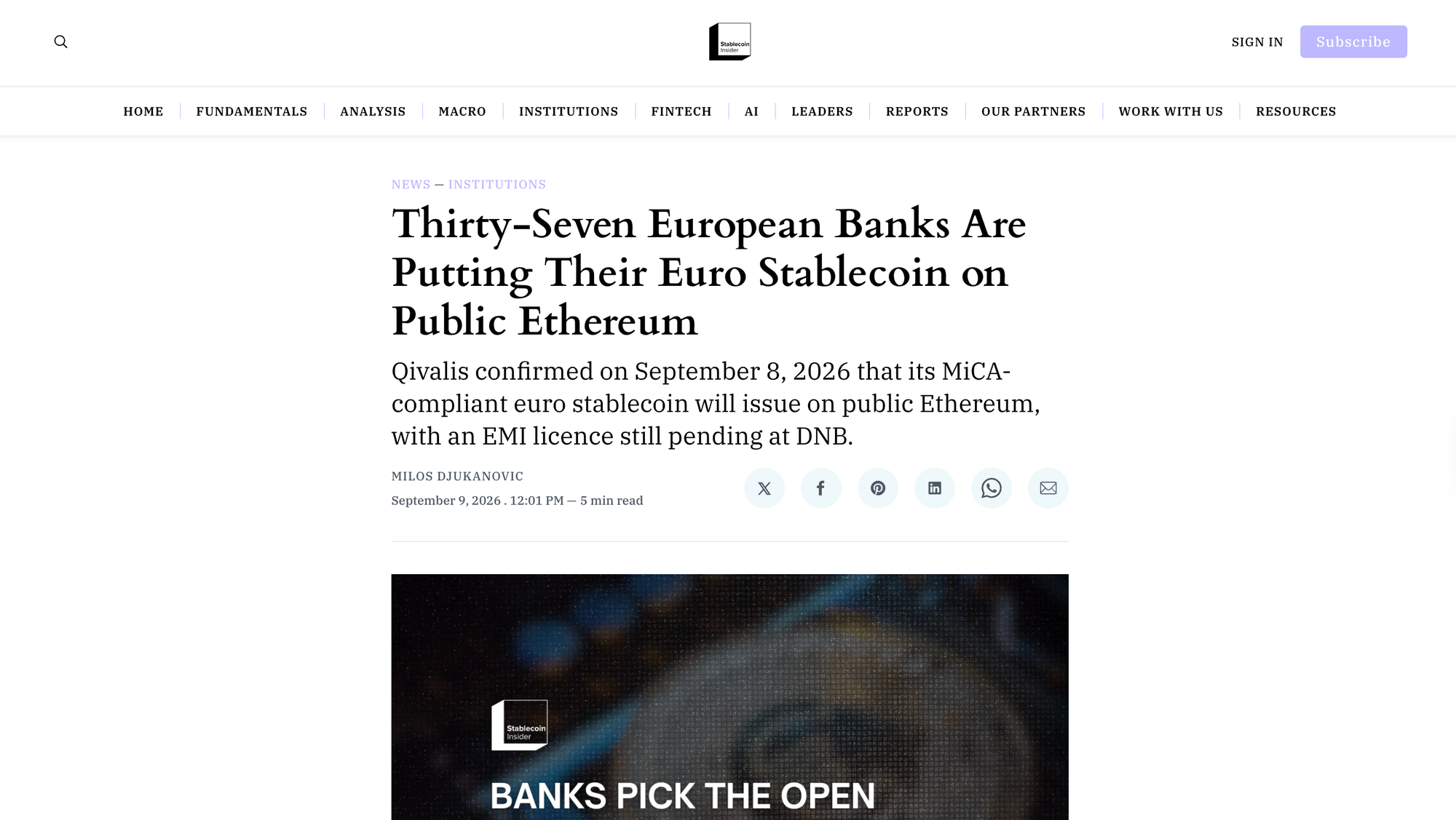
Other jurisdictions have taken the opposite route and built regulated tokens in their own currency. Thirty-seven European banks are launching a euro stablecoin under MiCA, which we covered in our report on that MiCA euro stablecoin.
What the Numbers Show
The $44 billion figure covers crypto and related products across roughly 20 million users, which is a material share of Russian household savings behaviour rather than a niche activity. Against 50 billion rubles of daily turnover, the market is active rather than dormant.
Chebeskov did not break out how much of that total sits in stablecoins specifically, or how much passes through foreign versus domestic infrastructure. Without that split, the size of the actual freeze exposure is unknown.
The Dollar Dependence Underneath
The structural issue is that the most liquid stablecoins are dollar tokens administered under US law. Any jurisdiction relying on them inherits a control point it does not hold, regardless of its own regulatory framework.
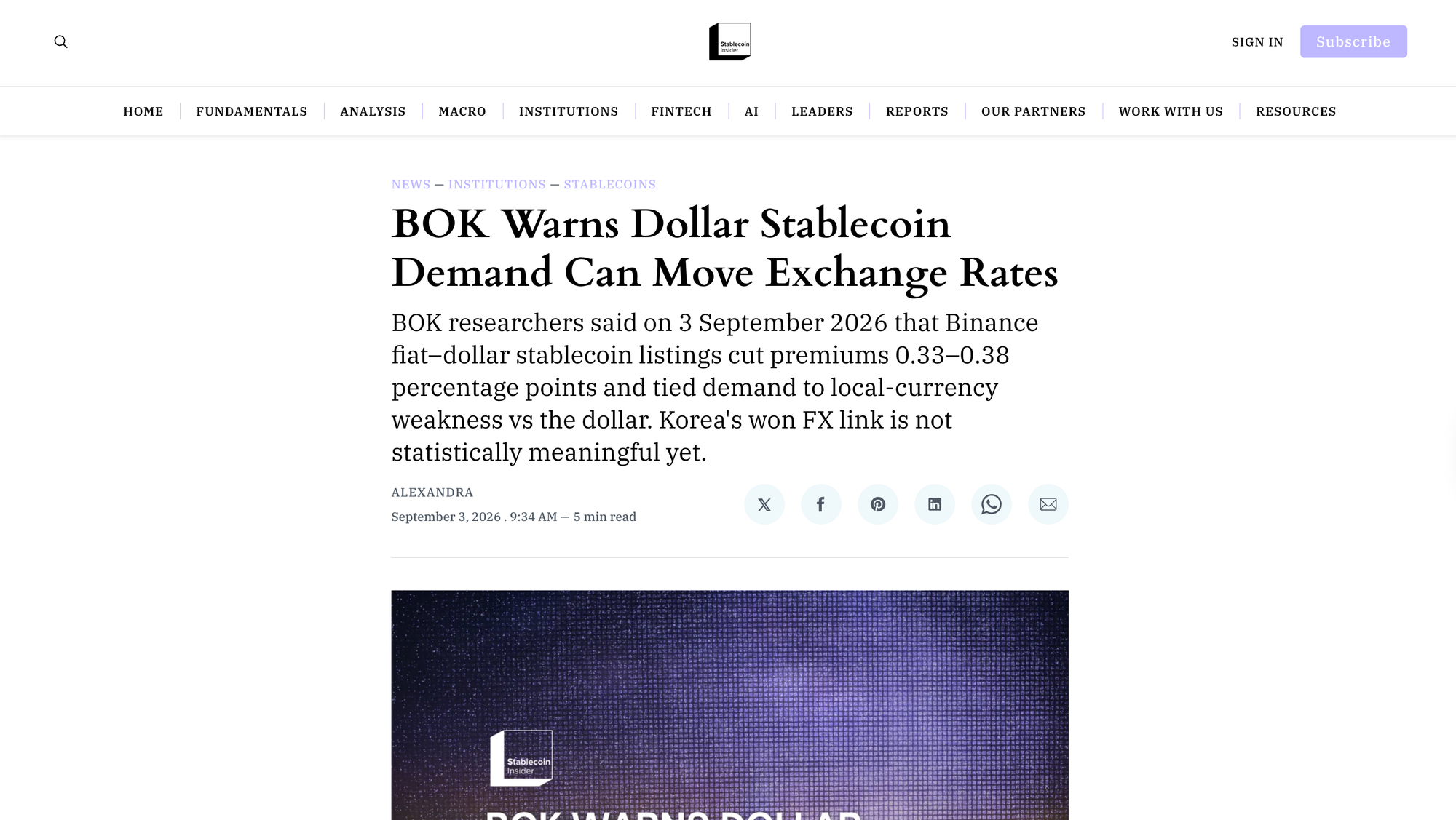
That concern is not confined to sanctioned economies. Bank of Korea researchers have tied domestic demand for dollar stablecoins to local currency weakness, which we covered in our report on the BOK's dollar stablecoin warning. Russia's response has been to build licensing and disclosure around the risk rather than to remove it.
FAQs:
1. What did Russia say about frozen stablecoins?
Deputy Finance Minister Ivan Chebeskov said on September 23, 2026 at the Moscow Financial Forum that if foreign issuers such as Tether or Circle freeze assets for reasons outside a Russian depository's control, the resulting losses fall on the investor rather than the intermediary, and the government will not compensate them.
2. Have USDT or USDC been frozen for Russian investors?
No such freeze was reported alongside the statement. The comments are a clarification of how risk is allocated under Russia's new digital asset law. Tether did freeze assets connected to the sanctioned Russian exchange Garantex in 2025, which is the precedent behind the concern.
3. What is Federal Law No. 282-FZ?
Signed on August 4, 2026 and effective September 1, it creates a licensing framework for crypto intermediaries in Russia, routes retail trading through licensed platforms, requires non-qualified investors to pass a test, and caps their annual purchases at 300,000 rubles per intermediary.
4. Which stablecoins can Russians trade on regulated platforms?
USDT only. The law narrows the approved list on domestic regulated platforms to that single asset, reportedly because of its liquidity, even though its issuer is subject to the same foreign freeze risk the government is warning about.
5. How large is Russia's crypto market?
Chebeskov put holdings at about 3.7 trillion rubles, roughly $44 billion, across approximately 20 million users, with daily transaction volume near 50 billion rubles or about $595 million. He did not disclose how much of that is held in stablecoins.
Disclaimer:
This content is provided for informational and educational purposes only and does not constitute financial, investment, legal, or tax advice; no material herein should be interpreted as a recommendation, endorsement, or solicitation to buy or sell any financial instrument, and readers should conduct their own independent research or consult a qualified professional.