
Table of Contents
Rebase tokens are a fascinating and often misunderstood corner of the crypto world. At their core, they're cryptocurrencies built with an elastic supply—meaning the total number of tokens in circulation can actually change. This isn't random; it's a programmed mechanism designed to steer the token's price toward a specific target, automatically adjusting the number of tokens in your wallet to do so.
What Is An Elastic Supply?
Let's use an analogy. Imagine you own 1% of a pizza. With a rebase token, the pizza itself can magically grow or shrink, but your ownership slice always remains 1%. The number of physical slices you hold might change, but your proportional claim on the whole pie is constant. That's the main idea behind rebase tokens.
This is a stark contrast to something like Bitcoin, which has a hard-capped, fixed supply. An elastic supply token is built on a smart contract that periodically adjusts the total supply. This event, known as a "rebase," happens automatically to push the market price toward a set target, which is often pegged to $1.00.
The Mechanics of Price Targeting
So, how does this supply adjustment actually work to influence the price? It’s all about simple supply and demand, but enforced by code.
- If the price is above the target: The smart contract automatically mints new tokens and distributes them to all existing holders, proportional to their stake. This sudden increase in supply is designed to create downward pressure on the price, bringing it back toward the peg.
- If the price is below the target: The contract does the opposite. It "burns" a portion of tokens from every single wallet. This reduces the total supply, which should, in theory, help push the price back up.
This is why your wallet balance can literally change overnight without you making a single trade. The system's goal isn't to protect the number of tokens you hold, but to preserve your percentage share of the network's total value.
A common misconception is that rebase tokens are just another type of stablecoin. While they often aim for a stable price, their underlying mechanism is fundamentally different and can be far more volatile. Getting a good grip on these crypto https://stablecoininsider.org/tag/fundamentals/ is key before diving in.
Why Your Share of the Network Is What Matters
The entire model forces a mental shift. With rebase tokens, you have to stop thinking about how many tokens you have and start focusing on what percentage of the network you own.
If you held 5% of the supply before a rebase, you will still hold 5% after, regardless of whether the number of tokens in your wallet went up or down. That proportional ownership is the one thing that stays the same.
This means savvy investors track their holdings by looking at their share of the total market cap, not just the token price or the quantity in their wallet. For a deeper dive into the terminology and concepts frequently used in this space, you can consult a comprehensive Web3 dictionary.
Rebase Tokens vs Fixed-Supply Tokens Key Differences
To really drive the point home, let's look at a direct comparison. This table breaks down the fundamental differences between an elastic-supply token like Ampleforth (AMPL) and a fixed-supply asset like Bitcoin.
| Feature | Rebase Tokens (e.g., AMPL) | Fixed-Supply Tokens (e.g., Bitcoin) |
|---|---|---|
| Total Supply | Elastic - changes based on price | Fixed - capped at a maximum (21M for BTC) |
| Wallet Balance | Changes automatically during rebase events | Changes only through transactions (buy/sell/transfer) |
| Price Stability | Aims for a target price via supply adjustments | Price is determined purely by market supply and demand |
| Unit of Account | Value is in the % share of the network | Value is in the number of tokens owned |
As you can see, they operate on completely different principles. While both exist on the blockchain, their economic models and how you measure your investment in them are worlds apart.
How Positive and Negative Rebasing Works
So, what actually happens inside a rebase token's protocol? The core idea is an automated, elastic supply. This isn't random—it’s a programmed reaction to the market, broken down into two main events: a positive rebase and a negative rebase. These are the reasons you might look at your wallet one day and see your token balance has changed, even though you haven't bought or sold anything.
It all runs on a smart contract that’s constantly keeping an eye on the token's market price versus its target price, which is almost always $1.00. To do this, it needs a live price feed. That's where a price oracle comes in; it's a service that pipes real-world data—like a token's price on Coinbase or Uniswap—directly onto the blockchain for the contract to use.
These rebases don't happen constantly. They're scheduled, typically for a specific time every 8 or 24 hours. When the clock strikes, the contract pings the oracle, compares the current market price to the target, and decides whether to expand or shrink the supply.
This image really helps visualize the concept. Think of the total supply as a pizza.
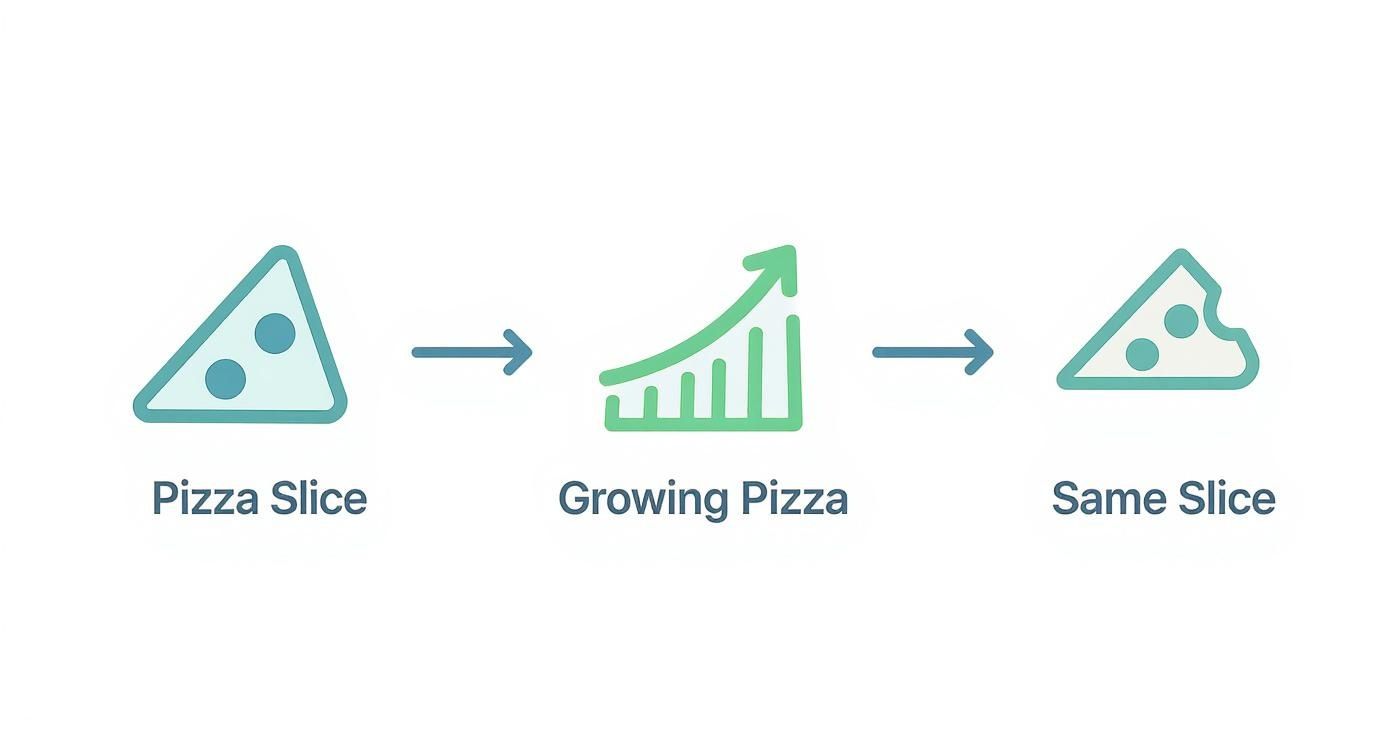
Even if the whole pizza gets bigger or smaller, your slice—your percentage of the total—stays exactly the same. That’s the fundamental principle at play here.
Understanding Positive Rebase Events
A positive rebase (or an expansion) kicks in when the token is trading above its target price. The logic is simple: if the price is too high, increase the supply to bring it back down toward the peg.
Let's walk through it. Say you own 100 tokens, and the target is $1.00. A wave of buying pressure pushes the market price to $1.10. The protocol flags this difference and triggers a positive rebase.
- Trigger: Market price ($1.10) is greater than the target price ($1.00).
- Action: The smart contract automatically mints new tokens and distributes them proportionally to all holders.
- Result: A 10% supply expansion occurs. You glance at your wallet and now see 110 tokens instead of 100.
You have more tokens, but the total value of your bag is unchanged at that exact moment. Before the rebase, you had 100 tokens worth $1.10 each ($110). After, you have 110 tokens theoretically worth $1.00 each ($110). The system simply printed more tokens to absorb the extra demand.
Deconstructing Negative Rebase Events
On the flip side, a negative rebase (or a contraction) is what happens when the token's price dips below its target. Here, the protocol tries to engineer scarcity by reducing the total supply, hoping to push the price back up.
Let's use the same numbers but in reverse. You have 100 tokens, but weak demand has caused the price to fall to $0.90, well below the $1.00 target.
- Trigger: Market price ($0.90) is less than the target price ($1.00).
- Action: The smart contract programmatically burns tokens from every single wallet holding the asset.
- Result: A 10% supply contraction is executed. Your balance drops from 100 to 90 tokens.
Watching tokens vanish from your wallet is a strange and often jarring experience. But again, the goal is to preserve the value of your total position. Pre-rebase, your holdings were worth $90 (100 tokens * $0.90). Post-rebase, you have fewer tokens, but the value is still $90 (90 tokens * $1.00). The protocol is trying to restore the peg by making each remaining token scarcer.
Key Takeaway: Whether it's a positive or negative rebase, the mechanism is not designed to change the total dollar value of your holdings at the instant it happens. It only adjusts the quantity of tokens in your wallet to keep your ownership percentage of the network consistent.
A Look at Rebase Tokens in the Wild
Theory is one thing, but seeing how elastic supply tokens perform in the real world is where the real lessons are. The history of rebase tokens is filled with ambitious experiments that pushed this economic model to its limits, and each one left a unique mark on the DeFi landscape.
By digging into these examples, we can get a much clearer picture of both the explosive potential and the built-in fragility of these assets. Two projects really define the major chapters of rebase token history: Ampleforth (AMPL), the pioneer that first brought the idea to DeFi, and OlympusDAO (OHM), which took the concept and sparked the "DeFi 2.0" movement.
Ampleforth (AMPL): The Original Elastic Currency
Back in 2019, Ampleforth arrived with a radical goal: to create a synthetic commodity money that wasn't backed by collateral. AMPL was engineered to target the price of a 2019 U.S. dollar, using a daily rebase to automatically adjust its supply and nudge the price back toward its peg. It was the purest form of elastic supply theory we’d seen.
The mechanics were straightforward:
- Price > $1.06: A positive rebase kicks in, adding more AMPL to every holder's wallet.
- Price < $0.96: A negative rebase is triggered, removing AMPL from every holder's wallet.
- Price between $0.96 and $1.06: Nothing happens. This is the "target zone" where the supply remains stable.
AMPL’s journey was a true rollercoaster. During bull runs, it saw massive expansion phases where positive rebases created incredible gains for those who understood they owned a share of the network, not a fixed number of tokens. But the flip side was just as extreme. It also went through brutal contraction cycles where negative rebases crushed value, often trapping holders in a "death spiral" of a shrinking supply and a falling price.
The big lesson from AMPL? A pure rebase mechanism is extremely pro-cyclical. It pours gasoline on the fire, whether the market is going up or down.
OlympusDAO (OHM) and the DeFi 2.0 Revolution
Fast forward to 2021, and OlympusDAO grabbed the rebase concept and put it on steroids. While its OHM token used a rebase, the goal wasn't to peg to the dollar. Instead, Olympus aimed to become a free-floating, decentralized reserve currency for the entire DeFi world. The key innovation here was something called Protocol Controlled Value (PCV).
Instead of relying purely on market psychology, Olympus built a treasury backed by real assets like DAI and ETH. It grew this treasury through a clever mechanism called bonding, where users could sell assets to the protocol at a discount in exchange for newly created OHM.
This bonding system, paired with sky-high staking rewards funded by the rebases, created a powerful feedback loop. The game theory behind it, which became famously known as (3,3), incentivized everyone to stake and hold their OHM, since that was the most profitable move for the group.
The rise of OlympusDAO was nothing short of meteoric, rocketing to a market cap of over $4 billion at its peak. It spawned an entire ecosystem of forks and became the poster child for the "DeFi 2.0" narrative, which was all about protocols owning their own liquidity.
But when the crypto market turned sour in late 2021, the (3,3) game theory fell apart. As people started selling, the price tumbled, and the whole system unraveled just as quickly as it had grown. The lesson from Olympus was that even sophisticated game theory and a massive treasury can’t always win against overwhelming market forces. PCV was a brilliant idea, but the project showed just how tough it is to keep a rebase model afloat during a long bear market.
These projects are fantastic case studies of the experimental nature of different DeFi assets and the valuable lessons they provide.
Comparison of Major Rebase Token Models
To better understand their differences, let's compare the two giants of the rebase world side-by-side.
| Project | Rebase Mechanism | Primary Goal | Key Innovation |
|---|---|---|---|
| Ampleforth (AMPL) | Daily supply adjustment based on a 24-hour time-weighted average price. | Maintain a price target of ~$1 (2019 USD), functioning as a synthetic commodity. | The first-ever implementation of a purely algorithmic elastic supply token on-chain. |
| OlympusDAO (OHM) | Supply expands through staking rewards, controlled by protocol policy. | Become a decentralized reserve currency for DeFi, backed by a treasury of assets. | Protocol Controlled Value (PCV) and the (3,3) game theory bonding/staking model. |
While both used an elastic supply, their goals and methods were fundamentally different. Ampleforth was a pure monetary experiment, whereas OlympusDAO created a complex economic engine to build a treasury, showing just how versatile the rebase concept can be.
Investing in Rebase Tokens and Managing Risk
Jumping into rebase tokens requires a complete reset of your typical crypto investing mindset. The usual charts and metrics you rely on can be dangerously misleading here, and getting a handle on the unique risks is everything. The elastic supply mechanism creates some truly wild dynamics that can catch even the most experienced traders off guard.

The first thing you have to do is learn to ignore the standard price chart. Seriously. A chart showing a perfectly flat price holding steady around the $1.00 peg looks great on the surface, but it tells you absolutely nothing about how your investment is actually doing.
During a positive rebase, that flat price could be masking the fact that your token balance is growing every day, increasing the value of your position. On the flip side, during a negative rebase, the price might hold firm while your token count is actively being slashed, draining your capital without the chart ever showing a dip.
Focus on Market Capitalization, Not Price
If you want the real story of a rebase token's health, you have to track its market capitalization. Calculated by multiplying the token price by the total circulating supply, the market cap is the one metric that cuts through all the noise of the supply changes. It shows you the true, network-wide value of the asset in real-time.
Here’s why it’s the only number that really matters:
- During a positive rebase: The token supply goes up. If the price holds or even climbs, the market cap will increase, signaling genuine growth.
- During a negative rebase: The supply shrinks. Even if the price looks stable, the market cap will drop, revealing a loss in the network's overall value.
Think of it this way: a rising market cap means your slice of the pie is getting more valuable, no matter how many tokens are in your wallet. A falling market cap means your investment is shrinking. Period.
The Psychological Challenge of Negative Rebases
One of the toughest pills to swallow for investors is the psychological gut punch of a negative rebase. It’s a bizarre and deeply unsettling experience to watch the number of tokens in your wallet literally decrease right before your eyes.
This feeling can easily trigger a wave of panic selling. It’s a terrible user experience, and it takes real discipline to remember the goal is to create scarcity and push the price back up. The emotional reaction to a shrinking balance is a powerful force that often just makes a bad situation worse.
The core investment thesis for a rebase token relies on the belief that the protocol can attract enough future demand to reverse negative rebase cycles and enter a sustained period of expansion. It's a bet on network growth, not just price stability.
Given how volatile and complex this corner of crypto is, developing solid DeFi risk management strategies is non-negotiable before you even think about putting capital in. You have to understand the specific rules of each project and never, ever invest more than you’re willing to lose completely.
The Ultimate Risk: The Death Spiral
The absolute worst-case scenario for a rebase token is the infamous "death spiral." This is what happens when a negative rebase completely fails to restore confidence. Instead of stabilizing the price, the shrinking supply just fuels more fear, causing a feedback loop of selling.
Here’s how it typically unfolds:
- Price Drops: Heavy selling pressure pushes the token’s price below its target peg.
- Negative Rebase: The protocol burns tokens from every wallet to increase scarcity, hoping to prop up the price.
- Confidence Erodes: Instead of buying the "scarcer" asset, investors see their balance shrink and panic-sell to get out. This pushes the price down even further.
- Cycle Repeats: The next rebase is also negative, burning more tokens, sparking more panic, and so on.
This vicious cycle feeds on itself, with both the token supply and the price collapsing toward zero. It can effectively wipe out a token's entire market cap, leaving investors holding a bag of worthless digital dust. Many projects have met this exact fate.
If this sounds too risky, remember there are less volatile options. Our guide on how to invest in stablecoins explores alternatives. Ultimately, successfully navigating the world of rebase tokens demands a deep understanding of their mechanics and an ironclad discipline to focus on market cap over price.
How Rebase Tokens Compare to Stablecoins
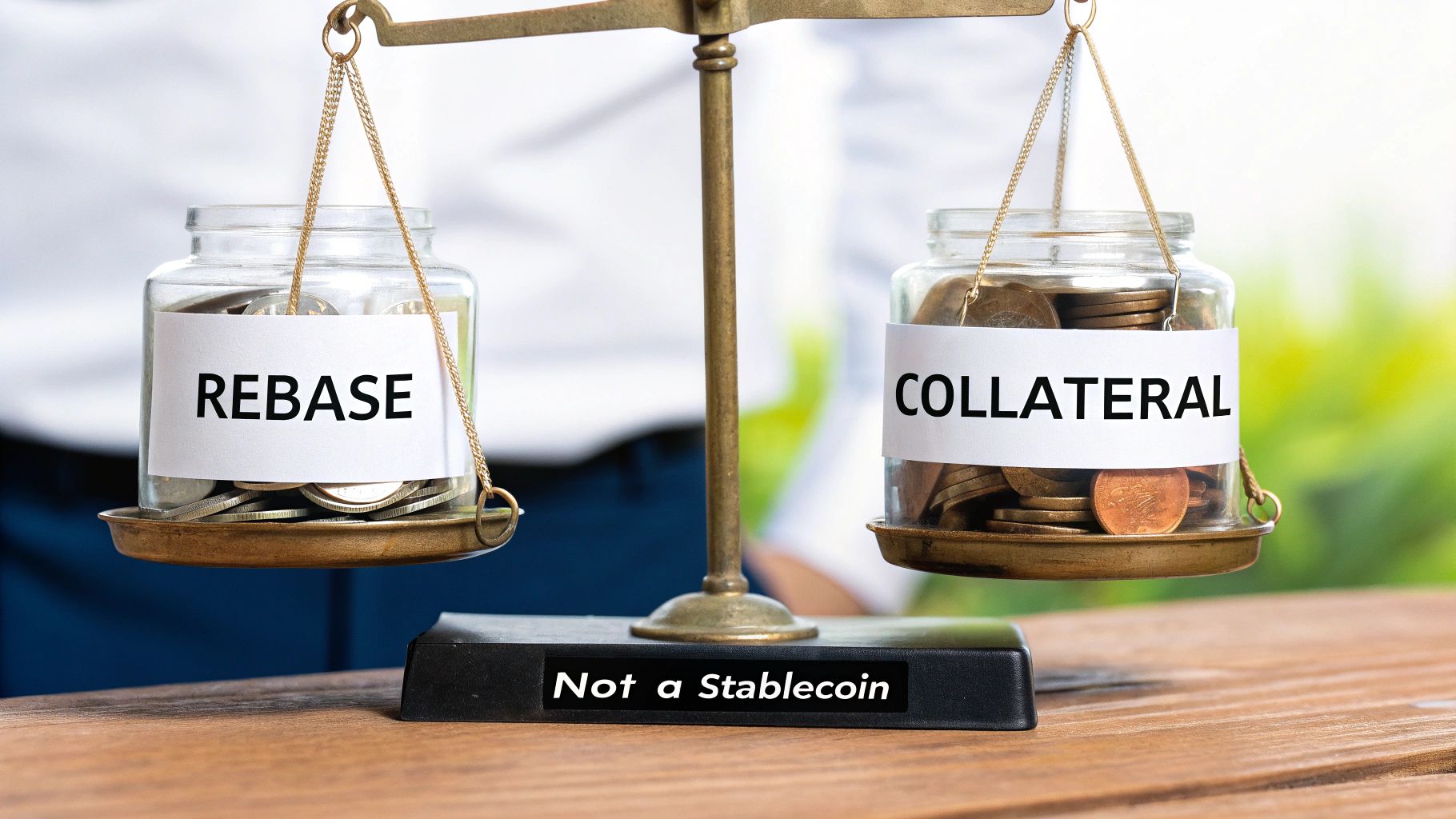
It’s easy to look at a rebase token aiming for a $1.00 price tag and think, "Oh, it's a stablecoin." That’s a common and costly mistake. While they share a target, the way they get there couldn't be more different, and lumping them together ignores what makes each unique.
Your standard stablecoins, like USDC or even DAI, are all about tangible backing. They achieve their price peg because there’s something of real value sitting behind them. USDC has actual U.S. dollars in a bank account, while DAI is over-collateralized with a vault of other crypto assets. The whole point is that there's a verifiable reserve system ensuring each token can, in theory, be redeemed for its pegged value.
Rebase tokens throw that entire concept out the window. They have no collateral. None. Their stability is a purely algorithmic illusion, relying entirely on supply adjustments to nudge the market price. Think of them less as a reliable store of value and more as a fascinating experiment in programmable money.
Different Paths to a Price Target
The fundamental split is in how they try to maintain their price. It's a classic case of brute force versus psychological suggestion.
Stablecoins use direct, hard-coded economic incentives. Rebase tokens, on the other hand, run on a speculative feedback loop. The protocol changes the supply, hoping to create a psychological nudge for traders to behave in a way that brings the price back to its peg. It’s a game of sentiment, not collateral.
Let’s break down the two approaches:
- Collateralized Stablecoins: These are built on arbitrage. If DAI’s price slips to $0.99, savvy traders will scoop it up on the cheap and redeem it for $1.00 of its underlying collateral. This buying pressure naturally pushes the price back up—it’s a self-correcting economic machine.
- Rebase Tokens: This is all about supply manipulation. If the token price falls to $0.99, the protocol simply removes tokens from every single wallet. The hope is that this newfound scarcity will make the remaining tokens seem more valuable and encourage buying.
A key takeaway is that rebase tokens are not true stablecoins. Their value is driven by market sentiment and speculative dynamics, not by tangible reserves.
Technologically, rebase tokens are a wild frontier in decentralized finance. The entire rebase mechanism is governed by smart contracts that automatically adjust supply based on data from price oracles, with no human intervention needed. This purely algorithmic approach is a world away from stablecoins that peg their value to real-world assets through reserves.
You can’t even group them neatly with other algorithmic stablecoins, many of which use a more complex dual-token model to absorb price shocks. Rebase tokens are their own strange beast—a unique, single-asset experiment testing the limits of on-chain economic theory.
What's Next for Elastic Supply Tokens?
After a wild ride of hype, bold experiments, and some pretty spectacular implosions, the world of rebase tokens is at a turning point. The first wave, led by pioneers like Ampleforth and OlympusDAO, gave us a ton of real-world data on what works—and more importantly, what really doesn’t. Now, armed with those hard-won lessons, developers are looking beyond those early models.
The future of elastic supply tokens isn't really about creating another dollar-pegged currency anymore. It's about taking that core rebase mechanism and using it for new, more specialized jobs. We're seeing a shift away from grand monetary experiments toward building more focused and sustainable financial tools on-chain.
Learning from the Past
If the first generation of rebase tokens taught us anything, it's that pro-cyclical mechanics are dangerous. Models that expand supply in a bull run and slash it in a bear market often just crank up the volatility they were supposed to tame. That painful realization has forced a complete rethink.
A few key takeaways are shaping what comes next:
- Algorithms Are Brittle: Trying to manage market psychology with supply changes alone is a losing game. When sentiment turns sour, it can easily steamroll protocol rules, triggering the dreaded "death spiral."
- The UX is Rough: Let's be honest, negative rebases feel terrible. Watching your token balance shrink—even if your slice of the pie stays the same—creates a powerful psychological urge to just sell and get out.
- Game Theory Has Limits: The (3,3) "prisoner's dilemma" model from OlympusDAO was brilliant on paper. But in the real world, it couldn't stand up to coordinated selling or a major market crash. Incentives only work until they don't.
These lessons have sparked a pivot. Instead of trying to build a standalone currency from scratch, the new focus is on plugging elastic supply mechanics into larger, more resilient systems.
Next-Generation Rebase Models
The evolution of rebase tokens is branching out. We’re moving from pure monetary theory into practical financial engineering, with developers exploring hybrid models that blend elastic supply with other DeFi tools to build stronger products.
So where might we see this pop up next?
- Yield-Bearing and Staked Assets: Think about what Lido's stETH does. Your balance of stETH grows every single day to reflect the staking rewards your underlying ETH is earning. It’s a rebase-style mechanism, but it’s used to distribute yield in a way that feels natural and sustainable.
- Algorithmic Indices: An elastic supply could power a decentralized index fund that rebalances itself automatically. Imagine a token whose supply adjusts to track a basket of DeFi blue-chips, sparing you the hassle and cost of manually rebalancing the assets yourself.
- Exotic Derivatives and Options: The power to programmatically change a token’s supply opens up a whole new design space for complex financial products. You could create a token whose supply is tied to an asset's volatility, giving traders a novel way to hedge risk or make a specific bet on market conditions.
The next chapter for elastic supply tokens isn't about replacing the dollar. It's about finding product-market fit as a powerful building block for more complex on-chain financial systems.
Building for the Long Haul
To sidestep the traps of the past, new projects are baking in features designed for long-term health. The goal is shifting from chasing a price peg to making sure the whole ecosystem can survive a market shock. That means taking a much more pragmatic approach.
Here are some features we're likely to see in the next wave:
- Partial Collateralization: Instead of running on pure belief, future rebase tokens might be partially backed by a treasury of stable assets like USDC or DAI. This provides a hard price floor and softens the blow of negative rebase cycles.
- Slower Rebase Speed: The aggressive, daily rebases of early projects were a recipe for chaos. Newer models will likely opt for much slower, less frequent supply adjustments to create a smoother ride for holders.
- Governance-Controlled Triggers: Rather than blindly following a price oracle, rebase events could be triggered by more nuanced conditions approved by a DAO. This adds a layer of human oversight to prevent purely algorithmic death spirals.
In the end, rebase tokens aren't going away. Their core mechanic—the elastic supply—will simply be absorbed into the broader DeFi toolkit. It’s poised to become a niche but potent tool for specialized applications, marking a mature evolution from a radical experiment to a practical instrument.
Common Questions About Rebase Tokens
Diving into rebase tokens often brings up a few head-scratchers, especially for those used to how traditional cryptocurrencies work. Let's tackle some of the most common questions to clear things up.
Are Rebase Tokens Just Another Type of Stablecoin?
That's a common misconception, but the answer is a firm no. It's a critical difference.
While many rebase tokens aim for a $1.00 price target, they operate completely differently from true stablecoins like USDC. A genuine stablecoin holds collateral—real cash or other assets—in reserve to guarantee its value.
Rebase tokens have no such backing. Their entire model is built on an algorithm that changes the token supply to influence the price. This lack of collateral makes them far more speculative and, frankly, much riskier.
Why Did the Number of Tokens in My Wallet Suddenly Change?
If you saw your token balance shift without making a single transaction, you've just experienced the core rebase mechanism in action. The project's smart contract is programmed to automatically adjust everyone's balance.
- Positive Rebase: When the token's price climbs above its target, the protocol mints new tokens and distributes them proportionally. Your balance goes up.
- Negative Rebase: If the price falls below the target, the protocol "burns" tokens directly from everyone's wallets. Your balance goes down.
This all happens on-chain, automatically. It’s the defining feature of how these assets work.
How Can I Lose Money if the Price Stays at $1?
Yes, and this is the single biggest trap for newcomers. Watching only the price chart is a recipe for disaster.
Imagine a token is in a long "negative rebase" period. The price might successfully stick right around $1.00, which looks great on the surface. But behind the scenes, the protocol is constantly removing tokens from your wallet to prop that price up.
Even though the price per token is stable, your token count is shrinking every day. The total value of your holdings is what's really taking a hit. This is why you must track the project's market capitalization, not just its unit price. Your slice of the total network value is the only metric that truly reflects your investment's performance.
At Stablecoin Insider, we provide the in-depth analysis you need to understand complex digital assets like rebase tokens and the broader DeFi ecosystem. Explore our expert coverage to stay informed. Learn more at https://stablecoininsider.com.