
Table of Contents
PayPal's dollar-backed stablecoin crossed a pivotal threshold this quarter. On March 17, 2026, PayPal announced the expansion of PYUSD to users in 70 markets worldwide, extending the token's reach well beyond the U.S.
The rollout lands as PYUSD's market cap has more than quintupled over the past year to $4.1 billion. For a stablecoin that launched just over two years ago, that trajectory demands a close read.
This report covers PYUSD's supply growth, competitive positioning, multi-chain footprint, key Q1 2026 partnerships, regulatory exposure, and what comes next.
Key takeaways
- PYUSD grew 680% YoY to a $4.08B market cap, the fastest growth rate among major stablecoins
- The March 2026 expansion to 70 markets is the most significant distribution event in PYUSD's history
- Paxos' conversion to OCC federal oversight in December 2025 makes PYUSD the largest dollar-backed stablecoin issued by a federally regulated entity
- PYUSD's revenue model, float yield on Treasury-backed reserves, generates an estimated $176M/year at current supply
- The primary near-term risk is regulatory: the OCC's GENIUS Act rulemaking (comment period closes May 1, 2026) could force a restructuring of PYUSD's 4% reward program
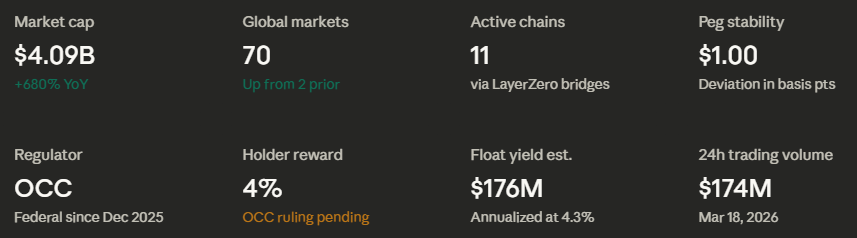
PYUSD Summary Scorecard
Market Cap and Supply
As of March 18, 2026, PYUSD has a live market cap of approximately $4.09 billion and a circulating supply of roughly 4.09 billion tokens.
The peg holds at $1.00 with minimal deviation, deviations are measured in basis points, and the price has not diverged meaningfully from $1 even during periods of higher crypto volatility.
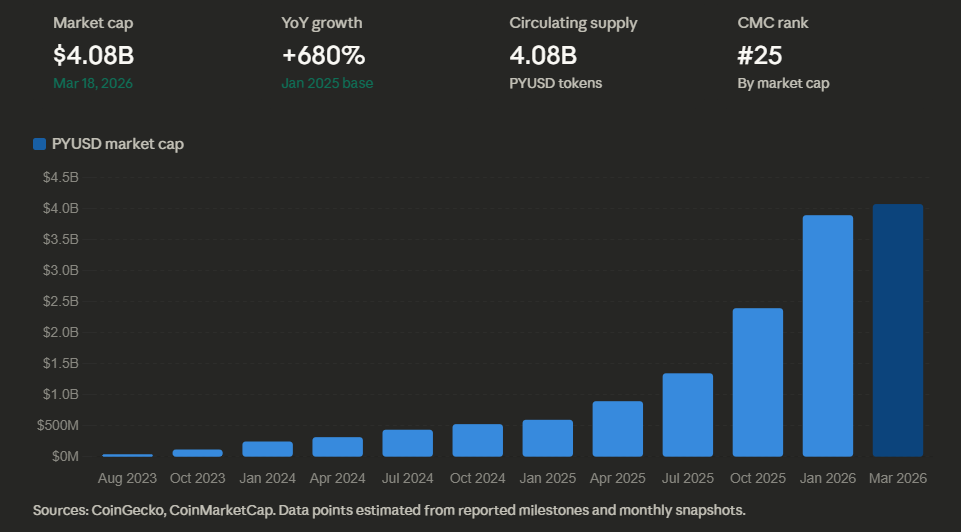
Supply growth since January 2025 alone reached 680%, driven in part by integrations outside PayPal's core platform.
A December 2025 partnership with YouTube allowed US creators to receive payouts in PYUSD. That single integration connected PYUSD to the $100 billion creator economy and injected meaningful real-world demand into the supply curve.
Competitive Positioning in the Stablecoin Market
PYUSD is not competing with USDT or USDC in the near term, the gap is too wide. But its growth rate is faster than either of the two leaders posted at a comparable stage.
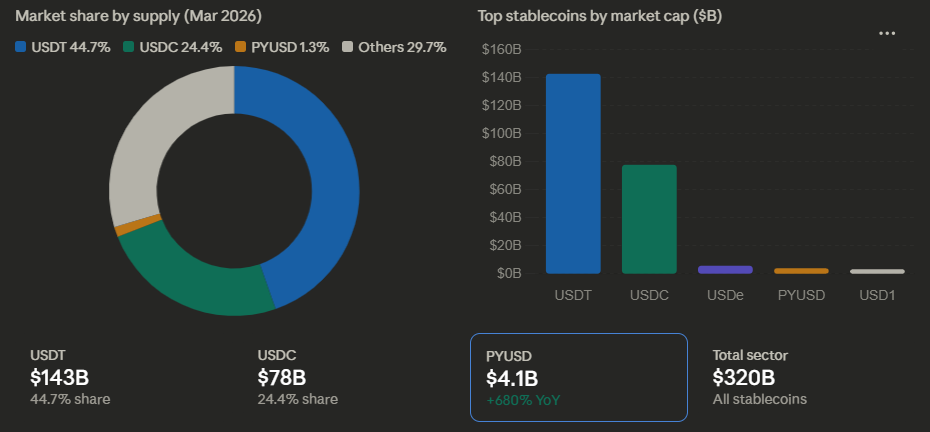
The stablecoin sector is led by Tether's USDT at approximately $143 billion and Circle's USDC at roughly $78 billion, with the sector as a whole crossing $320 billion in total market cap.
PYUSD's $4.1 billion puts it at roughly 1.3% of the total market, a small slice, but one growing faster than the sector average.
PYUSD is currently the 7-th largest stablecoin by market cap.
Its most direct competitor is the Trump-backed USD1, which has been trading market-cap position with PYUSD in recent months.
Multi-Chain Footprint
PYUSD launched on Ethereum in August 2023, added Solana in May 2024, and has since expanded across Arbitrum, Stellar, and through LayerZero bridging technology to a total of eleven networks.
The Solana expansion was the most consequential. Since July 2025, transaction volume of PYUSD on Solana has consistently surpassed that of Ethereum. PayPal expanded PYUSD supply on Solana past $1 billion.
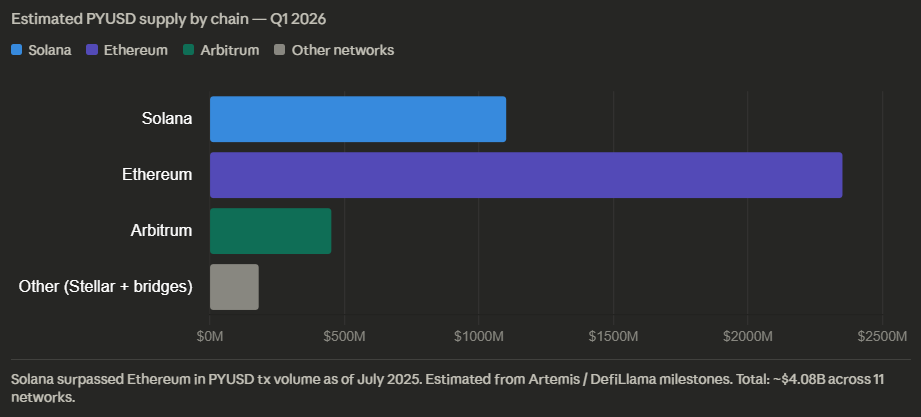
The chain preference shift reflects PYUSD's use case evolution:
- Ethereum remains the dominant host for DeFi collateral and institutional holdings.
- Solana handles consumer payment flows, where speed and sub-cent fees matter.
Solana now handles 60–70% of all stablecoin transactions across USDC, PYUSD, and USDT, outpacing L2s combined. On Solana's DeFi layer specifically, PYUSD grew 112.3% to $445.3 million in Q3 2025 alone.
Key Q1 2026 Developments
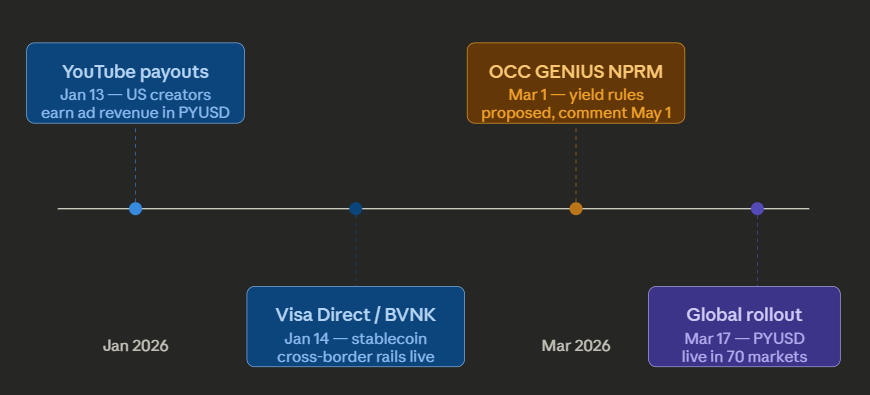
Three events defined PYUSD's quarter.
1. YouTube creator payouts:
On January 13, 2026, U.S. creators gained the ability to earn ad revenue in PYUSD via PayPal. This anchors PYUSD in a recurring payment workflow used by millions of creators.
Yield is the gateway; habit formation is the goal.
2. Visa Direct integration via BVNK:
On January 14, 2026, Visa enabled PYUSD payouts via BVNK, targeting cross-border efficiency. The integration targets corridors such as India and Nigeria, where traditional remittance fees can exceed 6%.
Visa/BVNK reduces fees on those corridors from roughly 6% to below 2%.
3. Global expansion to 70 markets:
The new markets span Asia-Pacific, Europe, and Latin America, with countries such as Singapore, the U.K., Peru, and Guatemala among those gaining access.
Previously, only customers in the U.S. and U.K. were able to hold the stablecoin.
Also notable this quarter: a $1 billion incentive program launched in January 2026 offering 4.5% yield on PYUSD deposits for AI infrastructure loans, targeting GPU purchases and operational expenses.
The program positions PYUSD as collateral in institutional credit markets, a use case with longer-term significance than consumer payments.
Reserve Structure and Regulatory Standing
PYUSD is 100% backed by U.S. dollar deposits, short-term U.S. Treasuries, and similar cash equivalents. It is redeemable 1:1 for U.S. dollars and issued by Paxos Trust Company.
Attestation reports as of February 2025 are issued by KPMG LLP under AICPA standards.
In December 2025, Paxos received approval to convert its NYDFS charter to a national trust charter overseen by the OCC.
PYUSD is now the largest U.S. dollar-backed stablecoin issued by a federally regulated entity.
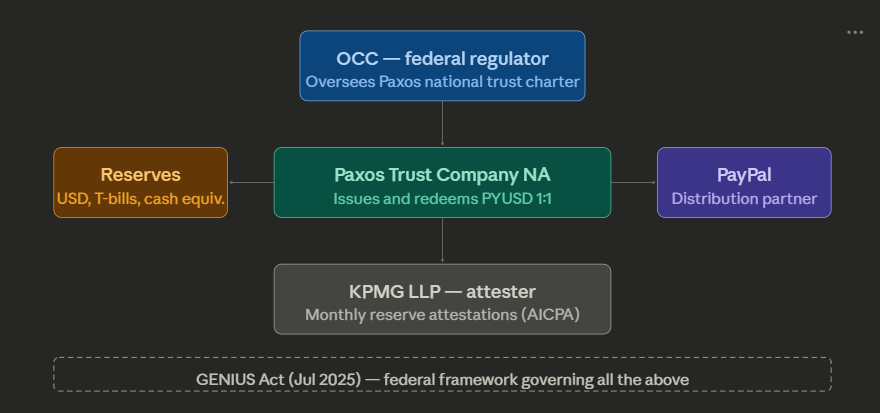
The regulatory environment is both a tailwind and a constraint. The GENIUS Act, signed July 18, 2025, created the first federal framework for payment stablecoins, requiring issuers to maintain 1:1 reserves in cash, deposits at insured institutions, or short-term U.S. Treasuries, with monthly attestations examined by a PCAOB-registered firm.
Paxos meets all of these requirements.
The constraint is on yield. While Paxos does not directly pay interest to holders, PayPal offers 4% annually and characterizes this as "platform rewards" rather than issuer-paid interest.
The OCC published a notice of proposed rulemaking in March 2026 implementing the GENIUS Act, raising questions about whether affiliate yield arrangements are permitted.
The comment period closes May 1, 2026. Until it resolves, PYUSD's 4% reward program operates in a gray zone.
PYUSD vs. Stablecoin Sector: Key Metrics
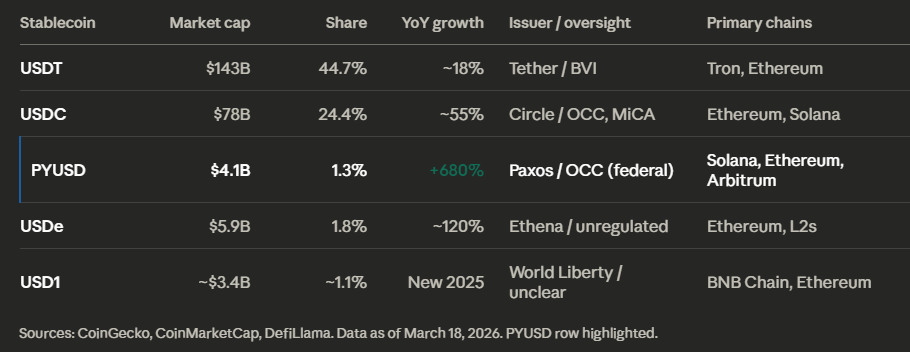
PYUSD's 680% YoY supply growth leads the major stablecoins by a wide margin, though it is growing from the smallest base.
The more meaningful comparison is whether that growth rate is sustainable as the base grows. The 70-market rollout provides the distribution infrastructure to sustain momentum, the question is whether demand in those markets materializes.
The Business Model: Float Yield
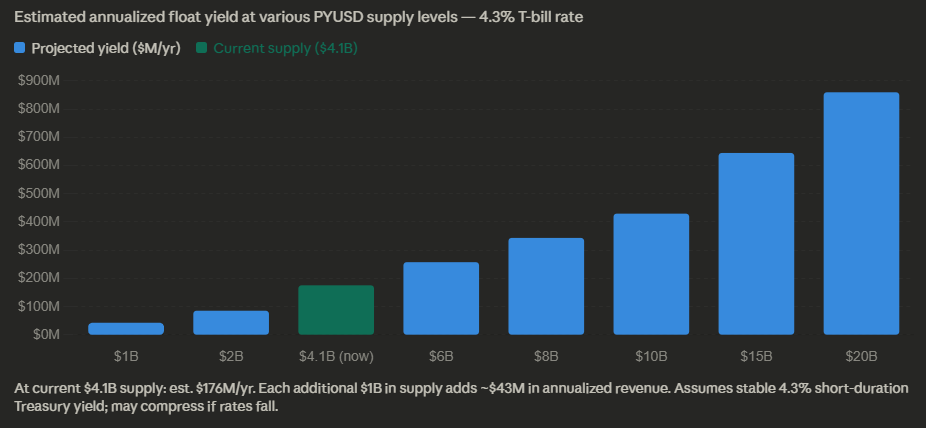
PYUSD is a revenue mechanism for PayPal, not just a product. By parking the dollar reserves backing each token in short-term Treasuries, PayPal earns yield on the float, a business model that becomes increasingly lucrative as the stablecoin's circulating supply grows.
At $4.1 billion in supply and a short-term Treasury yield of approximately 4%, that float generates roughly $176 million in annualized yield for PayPal, before operating costs.
At $10 billion in supply, that number grows past $430 million.
Key Risks
1. Yield regulation:
The OCC's proposed rulemaking raises questions about whether affiliates of stablecoin issuers can offer yield solely for holding deposits. If the final rule bars such arrangements, PayPal and Paxos may need to restructure their reward program.
- The 4% reward is a meaningful user acquisition lever, losing it would affect retention.
2. Centralization exposure:
In October 2025, a technical incident saw 300 trillion PYUSD accidentally minted and burned within 22 minutes before Paxos resolved it. The incident did not result in user losses, but exposed concentration of supply control in a single administrative key.
- Paxos subsequently implemented a SupplyControl contract that caps daily supply changes to 10% of reserves, approximately $360 million as of January 2026.
3. Competition:
The growth has attracted traditional financial institutions and payments companies, with firms such as Visa and Mastercard exploring stablecoin integrations.
- Fiserv is launching FIUSD with stated interoperability with PYUSD, which could either extend PYUSD's utility or fragment it.
4. Stripe/PayPal M&A speculation:
In February 2026, Bloomberg reported early exploratory talks between Stripe and PayPal. If a deal were to materialize, PYUSD's future would depend on how Stripe prioritized it against its own B2B infrastructure via Bridge.
- No formal offer has been made as of this report.
DeFi Integrations
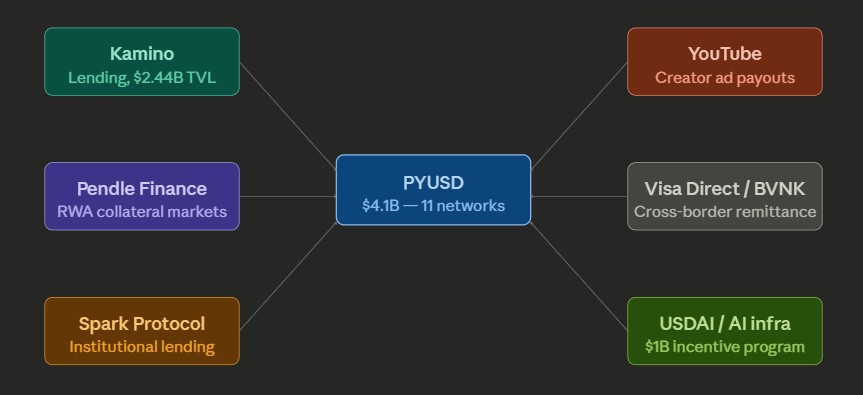
Beyond holding rewards on the PayPal platform, PYUSD has developed meaningful DeFi integrations.
Kamino, Solana's leading DeFi protocol with $2.44 billion in TVL, supports PYUSD lending markets. PYUSD has also been integrated into Pendle Finance markets as primary collateral for RWA products.
Conclusion
PYUSD enters Q2 2026 with more distribution, more regulatory clarity, and more institutional integration than it has had at any prior point. The 70-market rollout is the clearest signal yet that PayPal is treating PYUSD as a core product rather than an experiment.
Three factors will determine whether the growth curve holds:
- Whether demand in newly opened markets materializes, particularly in corridors like India and Nigeria where remittance pain is acute.
- How the OCC yield rulemaking resolves, a ban on platform-level rewards would remove one of PYUSD's strongest user acquisition levers.
- Whether the Stripe/PayPal M&A speculation resolves cleanly; if PayPal is acquired, PYUSD's roadmap becomes dependent on Stripe's priorities, not PayPal's.
PayPal's ambition is to build a more inclusive and globally connected commerce ecosystem. PYUSD is now the clearest expression of that ambition.
At $4.1 billion in supply and growing, it is no longer a stablecoin experiment. It is a stablecoin business.
Read Next:
- WLFI's USD1 Q1 2026 Stablecoin Report
- Ethena's USDe Q1 2026 Report
- USDT Monthly Report - February 2026
FAQs:
1. What is PYUSD and who issues it?
PYUSD is a fiat-backed stablecoin pegged 1:1 to the U.S. dollar, issued by Paxos Trust Company under a national trust charter overseen by the OCC. PayPal distributes it to end users across its platform.
2. How does PYUSD differ from USDC and USDT?
PYUSD differs from USDC and USDT in issuer, regulatory standing, and distribution. All three share the same basic mechanism, dollar-backed, redeemable 1:1, but USDT is issued by Tether in the British Virgin Islands with historically opaque reserves, USDC is issued by Circle under OCC oversight, and PYUSD is unique in being backed by the distribution infrastructure of a 400+ million-user payments network.
3. Why did PYUSD's market cap grow 680% in one year?
PYUSD's market cap grew 680% in one year due to three key drivers: the December 2025 YouTube creator payout integration, which tied PYUSD to recurring real-world payment flows; the Visa Direct/BVNK cross-border remittance integration in January 2026; and a $1 billion USDAI incentive program offering 4.5% yield on deposits.
4. What blockchains does PYUSD operate on?
PYUSD operates natively on Ethereum, Solana, Arbitrum, and Stellar. Through LayerZero bridging infrastructure, it is accessible across a total of eleven networks. Since July 2025, Solana has surpassed Ethereum as the primary chain by transaction volume, reflecting PYUSD's use in consumer payments rather than only DeFi collateral.
5. What is the regulatory risk to PYUSD's 4% reward?
The regulatory risk to PYUSD's 4% reward comes from the OCC's March 2026 GENIUS Act rulemaking, which raised questions about whether affiliate yield arrangements are permissible under the new federal framework. PayPal offers the 4% annually to U.S. holders, characterized as "platform rewards" rather than issuer-paid interest. The comment period closes May 1, 2026, and if the final rule restricts yield payments through affiliated platforms, PayPal may need to restructure the program entirely.
Disclaimer:
This content is provided for informational and educational purposes only and does not constitute financial, investment, legal, or tax advice; no material herein should be interpreted as a recommendation, endorsement, or solicitation to buy or sell any financial instrument, and readers should conduct their own independent research or consult a qualified professional.