
Table of Contents
December 5, 2025
Polygon Labs announced a major expansion of its stablecoin payment infrastructure and tokenization initiatives, positioning the layer-2 network as a leading rail for institutional and cross-border stablecoin flows.
The protocol now processes billions in monthly stablecoin volume and has deepened partnerships, including a new collaboration with Mastercard on wallet solutions.
This push comes as enterprises and payment giants increasingly choose Polygon for low-cost, high-speed stablecoin settlements.
Key Takeaways
- Stablecoin volume: Polygon handles over $8 billion in monthly stablecoin transfers (up ~120% YoY).
- Partnership highlight: Mastercard selected Polygon to power stablecoin card payments and enhanced self-custodial wallet features.
- Enterprise adoption: New integrations with Nubank, Flipkart, and several European neo-banks for payroll and remittance on Polygon PoS and zkEVM.
- Tokenization focus: Polygon now supports tokenized real-world assets (RWAs) including treasury bills, private credit, and carbon credits through partnerships with Hamilton Lane, Centrifuge, and Figure.
- Network growth: Polygon PoS daily active addresses topped 2.1 million, second only to Tron among non-EVM chains.
What Changed Today for Polygon?
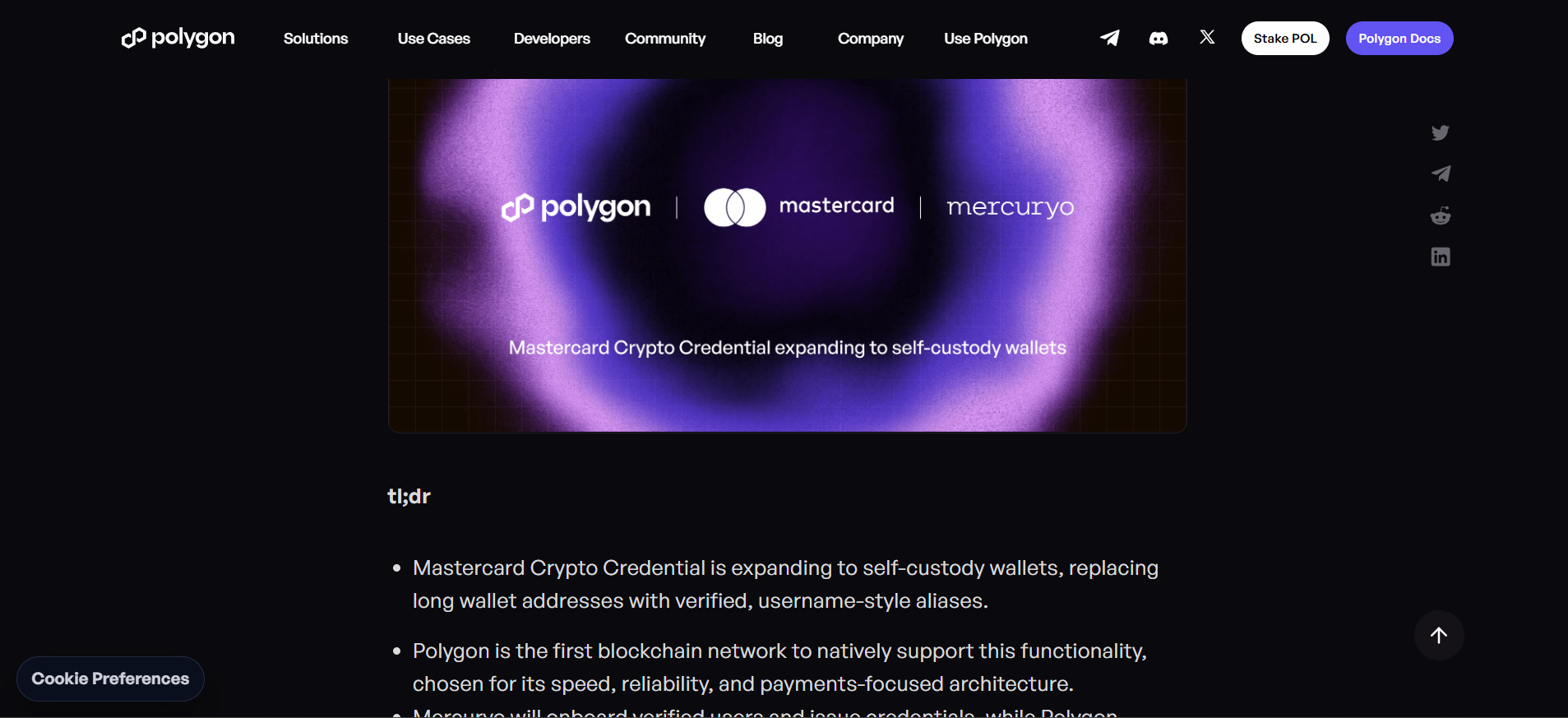
Polygon Labs unveiled a sweeping set of enterprise-grade stablecoin and tokenization initiatives during a keynote at the Mastercard Crypto & Blockchain Summit on December 4, 2025.
The announcement bundle includes direct integration of Mastercard Crypto Credential on Polygon, new stablecoin payout corridors in Latin America and Southeast Asia, and expanded RWA tooling on both Polygon PoS and the recently launched AggLayer-powered zkEVM chains.
The Mastercard partnership specifically enables card issuance backed 1:1 by USDC or EURC held on Polygon, with instant on-chain settlement.
On-Chain Data and Market Reaction
The data so far points to renewed institutional interest in Polygon as a settlement layer.
- Price: POL $0.62 (+14% 24h) | MATIC legacy token $0.61 (+12% 24h)
- Volume: 24h trading volume across POL/MATIC $1.8 billion, up 180% vs previous week
- Stablecoin inflows: $420 million net USDC + USDT minted or bridged to Polygon in past 48h
- TVL growth: Polygon ecosystem TVL rose to $1.42 billion (+8% week-on-week)
- Daily transactions: Polygon PoS + zkEVM combined 10.3 million transactions in last 24h
Why This Move Matters for Traders, Builders, and Regulators
Traders: Increased institutional stablecoin volume typically compresses bid-ask spreads on major Polygon DEXs (QuickSwap, Uniswap v3) and reduces slippage for large USDC/USDT trades.
Builders: Mastercard and Nubank integrations open regulated on/off-ramps directly into Polygon DeFi, potentially boosting liquidity in USDC lending pools (Aave, Compound) by hundreds of millions.
Payment companies & custodians: Mastercard’s endorsement significantly de-risks Polygon for traditional finance, likely accelerating banking partnerships and licensed stablecoin issuance on the network.
Regulators: By routing through Mastercard’s compliance framework and MiCA-compliant EURC, Polygon positions itself as a regulatory-friendly settlement layer compared to pure public chains.
Risks and Unanswered Questions
- Centralization risk: Heavy reliance on Polygon PoS sequencer (still centralized) despite AggLayer progress.
- Partnership execution risk: Mastercard pilot limited to select Latin American markets; broader rollout timeline unclear.
- Stablecoin concentration risk: Over 70% of volume remains USDC, Circle black-swan event would impair Polygon payment corridors.
- Regulatory pivot risk: EU or U.S. clampdown on non-KYC self-custodial wallets could slow Mastercard wallet adoption.
What Happens Next
Watch for the public launch of Mastercard stablecoin cards on Polygon (expected Q1 2026) and the first $100 million+ tokenized treasury fund going live via Hamilton Lane before year-end.
- Upcoming dates: Mastercard pilot results presentation at Davos (January 2026); AggLayer mainnet with unified liquidity (February 2026)
- Key metrics to monitor: USDC + USDT supply on Polygon (> $12 billion = strong bullish signal), Polygon PoS sequencer decentralization progress
- Bullish signal: Sustained > $10 billion monthly stablecoin transfer volume; Bearish signal: Reversal of institutional inflows below $5 billion
Read Next:
FAQs:
1. What exactly did Polygon announce with Mastercard?
Mastercard will use Polygon for instant settlement of stablecoin card transactions and to power enhanced self-custodial wallet features with Crypto Credential identity tools.
2. How does this affect Polygon DeFi users right now?
Higher stablecoin inflows are already tightening spreads on QuickSwap and Uniswap v3; lending yields on Aave may compress slightly as more institutional liquidity enters.
3. Is Polygon PoS still safe after these enterprise deals?
Yes, the core protocol remains unchanged; enterprise flows use the same audited contracts as retail users.
4. What are the main risks if I hold POL or use Polygon for stablecoins?
Primary risks are sequencer centralization (temporary outage risk) and over-reliance on Circle’s USDC (single-issuer risk).
5. Where can I track live Polygon stablecoin flows and TVL?
Use Dune Analytics dashboards for Polygon, DefiLlama Polygon ecosystem page, or Artemis terminal for stablecoin transfer volume.