
Table of Contents
Adding stablecoins to your NFT marketplace is more than just a technical upgrade. It involves picking the right coin (like USDC), designing smart contracts that can manage ERC-20 transfers, and crafting a user-friendly interface that includes fiat on-ramps. This single move directly confronts crypto's notorious volatility, giving creators and collectors a stable, familiar way to transact. Getting it right demands a solid plan covering liquidity, security, and the overall user experience, which we'll break down step-by-step.
Why Stablecoins Are Essential for NFT Marketplaces

Before we get into the nuts and bolts, let's talk about the why. The real value of stablecoins goes way beyond just keeping prices steady. They solve some of the biggest hurdles that have kept NFT marketplaces from hitting the mainstream. Think about it: volatile assets like ETH can scare off new buyers who aren't comfortable knowing their funds could drop in value overnight.
By offering a payment method pegged to the dollar, you're building a more predictable and trustworthy marketplace. That sense of familiarity is a game-changer for bringing in people who are new to Web3 but are completely at home with regular e-commerce.
Slashing Costs and Simplifying Commerce
One of the most powerful arguments for stablecoins is how much they cut down on transaction costs. As the NFT space has grown, so has the adoption of stablecoins for payments. By mid-2025, the total stablecoin market cap soared to $252 billion, with centralized coins like USDT and USDC making up a staggering 90% of that market. NFT platforms have jumped on this trend, recognizing that stablecoins offer dramatically lower fees—averaging just 0.1% compared to the 3.5% charged by traditional credit cards.
This cost saving is a direct win for everyone. Creators get to keep more of their earnings, and collectors pay less for their purchases. It's a healthier economic model.
On top of that, stablecoins make global commerce incredibly simple. An artist in Brazil can sell an NFT to a buyer in Japan without anyone worrying about messy currency conversions, settlement delays, or high international transfer fees. The transaction is borderless and settles in minutes, not days. This opens up a truly global and accessible market, delivering on one of the core promises of Web3. The rise of regulated stablecoins, many backed by traditional financial institutions, adds another layer of trust. You can learn more about which major players are involved by checking out the top banks with stablecoins.
By abstracting away the volatility, you shift the user's focus from speculating on cryptocurrency prices to appreciating the art and utility of the NFTs themselves. This is essential for long-term platform growth.
This subtle shift helps build a more sustainable ecosystem that attracts serious collectors and creators, not just short-term speculators. In the end, integrating stablecoins isn't just another feature—it's a foundational move that builds user trust, expands your market reach, and creates a better financial model for your entire community.
To put it in perspective, let's quickly compare how stablecoins stack up against traditional payment methods in the context of an NFT marketplace.
Table: Stablecoins vs Traditional Payments in NFT Marketplaces
| Feature | Stablecoins (USDC, USDT) | Credit Cards / Bank Transfers |
|---|---|---|
| Transaction Fees | Typically 0.1% or less (plus network gas fees) | 2.5% - 3.5% plus additional processing fees |
| Settlement Speed | Minutes (depending on blockchain confirmation) | 2-5 business days |
| Global Accessibility | Borderless; anyone with a wallet can transact | Limited by banking systems, country restrictions |
| Chargeback Risk | None; transactions are final | High risk of fraudulent chargebacks |
| User Onboarding | Requires crypto wallet and some Web3 knowledge | Familiar and easy for mainstream users |
| Price Volatility | Minimal; pegged 1:1 to a fiat currency | None for the currency, but exchange rates apply |
As the table shows, while traditional payments offer familiarity, stablecoins provide unmatched efficiency, speed, and finality for on-chain transactions. A well-designed marketplace can bridge this gap with smooth fiat on-ramps, giving users the best of both worlds.
Selecting the Right Stablecoins and Liquidity Strategy
Picking the right stablecoin for your NFT marketplace is one of those foundational decisions that has ripple effects across your entire platform. This choice isn't just about what's popular; it directly shapes user trust, how much your users pay in fees, and, most importantly, the liquidity of your ecosystem.
While it's tempting to support every stablecoin under the sun, that’s usually a mistake. A focused, deliberate approach is almost always the better path, especially when you're just starting out. You need a clear framework for making this decision—one that weighs regulatory standing, actual user adoption, and deep on-chain liquidity.
Comparing the Top Stablecoin Contenders
The stablecoin arena is really a game of a few major players. For an NFT marketplace, your choice will likely come down to one of the big, well-established, fiat-backed options. Each comes with its own flavor and set of trade-offs.
- USDC (USD Coin): This is the go-to choice if you're prioritizing compliance and transparency above all else. USDC is backed by fully reserved assets and undergoes regular audits, giving it a rock-solid reputation. This makes it a favorite for institutions and more cautious retail users who value that peace of mind.
- USDT (Tether): As the original and biggest stablecoin by market cap, Tether's main advantage is its sheer scale. USDT has incredible liquidity and is woven into the fabric of nearly every blockchain and exchange. Your users will know it and have it.
- DAI: For those leaning into decentralization, DAI is a fascinating option. It’s a crypto-backed stablecoin managed by the Maker protocol, which gives it a high degree of censorship resistance. The flip side is that its reliance on crypto collateral adds a layer of complexity and potential risk that you just don't get with fiat-backed coins.
It's hard to overstate just how dominant the top two are. In 2025, USDT and USDC accounted for a staggering 87% of the entire stablecoin supply. Tether alone was processing around $703 billion a month, even hitting a peak of $1.01 trillion in June 2025. Meanwhile, USDC’s monthly volume fluctuated between $3.21 billion and $1.54 trillion.
These aren't just vanity metrics; they show how integral these assets are to the market's plumbing. For any NFT platform that needs to scale, they're practically essential. You can see a full breakdown of these numbers in the latest global crypto adoption report.
Building a Robust Liquidity Strategy
Once you've picked your stablecoin, the work isn't over. Now you have to make sure you have enough of it to go around. Poor liquidity is a platform killer. It causes slippage—the frustrating gap between the price a user clicks and the price they actually get. It’s a surefire way to destroy user trust.
You have to think strategically about where this liquidity will come from. Are you expecting users to bring all their own funds, or will you actively manage a treasury to keep trades flowing smoothly?
A proactive liquidity strategy isn't a "nice-to-have"; it's a core requirement. It’s what ensures your payment system doesn’t buckle when a blue-chip NFT sells or when trading volume suddenly spikes. Without it, your users will be the ones paying the price—literally.
To keep your marketplace flush with funds, you generally have two paths:
- Decentralized Exchanges (DEXs): You can tap into existing liquidity pools on platforms like Uniswap or Curve. This is a great, capital-efficient way to handle stablecoin swaps on-chain and stay true to a decentralized ethos. The main drawback? Gas fees can get brutal during periods of high network congestion.
- Centralized Exchanges (CEXs): Partnering with a major exchange like Coinbase or Binance gives you access to incredibly deep, reliable pools of liquidity. This path often requires more complex integrations and custody solutions, but it provides a level of price stability and volume capacity that DEXs sometimes can't match.
In my experience, a hybrid model is often the sweet spot. You can use CEXs for large, planned treasury movements and lean on DEX aggregators for smaller, on-demand swaps initiated by users. If you want to go deeper on this, our guide on the best stablecoin liquidity providers in 2025 is a great resource that compares different services.
At the end of the day, your stablecoin choice and liquidity plan are two sides of the same coin. A highly trusted and liquid stablecoin like USDC makes your life a lot easier, as it's readily available everywhere—giving you the flexibility you need to build a truly resilient marketplace.
Architecting Your Stablecoin Payment Infrastructure
Alright, let's get into the weeds. Building the technical backbone for stablecoin payments is where your strategy actually becomes code. This is far more than just adding a token to a dropdown menu. We're talking about designing a robust, scalable, and secure system that can handle everything from a user’s deposit to the final settlement of a sale, all without a single hiccup.
When done right, a well-architected system is practically invisible to the user—it just works. This means piecing together several critical components: the smart contracts that govern fund flows, a reliable way to listen for on-chain events, and clean integrations with the wallets your users already know and trust. Every piece has to work in concert to create a payment experience people can rely on.
Smart Contracts: The Core of Your Payment Logic
At the heart of any on-chain transaction sits a smart contract. For an NFT marketplace, this contract is your digital escrow agent. It holds onto funds and assets until every condition of a sale has been met. When you start accepting stablecoins, your contract logic must be airtight in how it handles ERC-20 tokens (or their equivalents on other chains).
The two most important functions you'll be working with are approve() and transferFrom(). The standard flow goes like this: a buyer first calls approve() on the stablecoin's contract, which gives your marketplace contract permission to spend a certain amount of their tokens. Once they hit "buy," your contract calls transferFrom() to pull those approved funds from the buyer's wallet and send them directly to the seller. Transaction complete.
Here’s a simplified look at how that plays out in Solidity:
// SPDX-License-Identifier: MIT
pragma solidity ^0.8.20;
import "@openzeppelin/contracts/token/ERC20/IERC20.sol";
import "@openzeppelin/contracts/token/ERC721/IERC721.sol";
contract NFTMarketplace {
// ... other contract logic
function purchaseNFT(
    address _nftContract,
    uint256 _tokenId,
    address _stablecoinContract
) external {
    // Assume price is 100 stablecoins (for simplicity)
    uint256 price = 100 * 10**18;

    IERC721 nft = IERC721(_nftContract);
    IERC20 stablecoin = IERC20(_stablecoinContract);

    address seller = nft.ownerOf(_tokenId);

    // Pull stablecoins from buyer to seller
    // This requires the buyer to have called `approve` on the stablecoin contract first!
    require(stablecoin.transferFrom(msg.sender, seller, price), "Stablecoin transfer failed");

    // Transfer the NFT from seller to buyer
    nft.transferFrom(seller, msg.sender, _tokenId);

    // ... emit an event
}
}
This snippet gets the basic idea across. Keep in mind, a production-ready contract needs much more—think robust checks, fee calculations, and detailed error handling. But that core transferFrom mechanic is the engine driving the whole process.
On-Chain vs. Off-Chain Order Books: A Big Decision
One of the first major architectural forks in the road is deciding where to store your order book—the list of all NFTs for sale. Each path comes with some serious trade-offs in cost, speed, and decentralization.
- On-Chain Order Books: Every single listing, bid, and cancellation is a transaction written to the blockchain. It's the gold standard for transparency and trustlessness since anyone can verify the data. The downside? It's slow and expensive. Every action costs gas and has to wait for block confirmation.
- Off-Chain Order Books: Listings and bids are stored in a good old-fashioned centralized database. Only the final sale transaction gets pushed to the blockchain. This is the model used by giants like OpenSea, and it creates a lightning-fast, gas-free experience for browsing and listing. The trade-off is a bit of centralization; users have to trust your server.
For most modern marketplaces trying to build a smooth user experience, an off-chain order book is the way to go. It dramatically cuts down on friction for sellers and enables killer features like gas-free listings, which is a huge magnet for creators.
Building a Resilient Event-Listening System
Your marketplace backend needs to know what’s happening on the blockchain, and it needs to know right now. It's not enough to just fire off a transaction. You have to listen for its confirmation and update your platform’s state to match. This is the job of event listeners, often called indexers.
These services watch your smart contracts for specific events, like SaleFinalized, and then trigger corresponding actions in your backend. This is how your user interface stays in sync with the on-chain reality, instantly updating an NFT's status from "For Sale" to "Sold."
A rock-solid indexing solution is non-negotiable. Without one, your frontend and the blockchain’s state will drift apart, creating a confusing and untrustworthy experience. Your system has to be smart enough to handle things like network reorganizations and other blockchain quirks without breaking a sweat.
You could build this system yourself with libraries like Ethers.js or Web3.js, but that's a heavy lift. A smarter move is often to use dedicated indexing services like The Graph or Alchemy's APIs. These managed services handle the complexity for you, saving a ton of development time and giving you a much more reliable data pipeline.
The process flow below shows the key decision points you'll face when picking a stablecoin, which in turn shapes your architectural needs around compliance, liquidity, and wallet support.
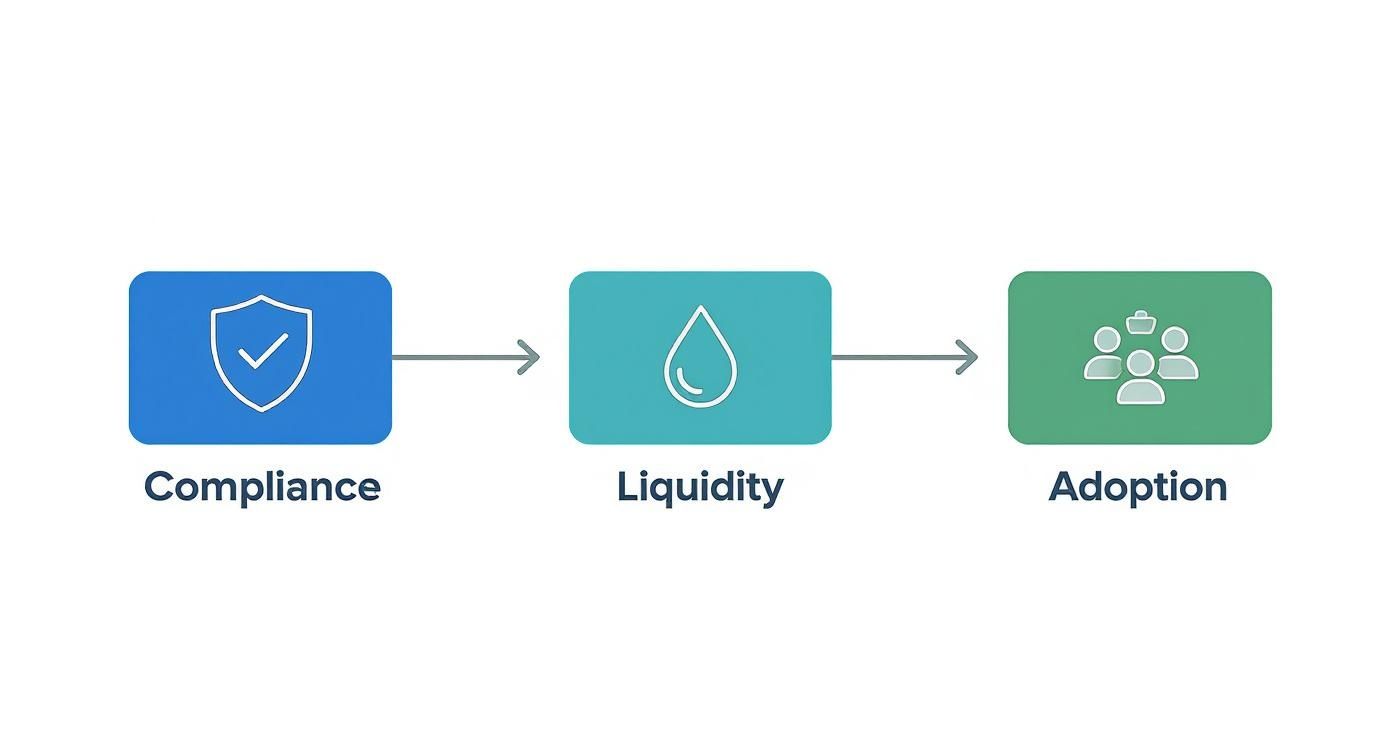
This flow underscores a key point: your technical architecture must be built to support a stablecoin that ticks all the boxes—it’s compliant, has deep liquidity, and is already in your users' wallets.
Integrating Wallets and Payment Gateways
Finally, your architecture has to connect to the tools people are already using. That means seamless integration with popular browser extensions and mobile wallets. Libraries like WalletConnect and Web3Modal are your best friends here. They provide a single, unified interface that lets users connect a huge range of wallets, from MetaMask and Trust Wallet to hardware wallets like Ledger.
Beyond direct wallet connections, you might also want to look into a dedicated payment API. These services can abstract away a lot of the backend mess, handling different stablecoins, managing transactions, and even integrating fiat on-ramps. If you're considering that path, our rundown of the best stablecoin payment API options is a great place to start your research. Nailing these integrations ensures your platform isn't just functional, but also secure and intuitive right out of the gate.
Designing a Payment Experience That Just Works
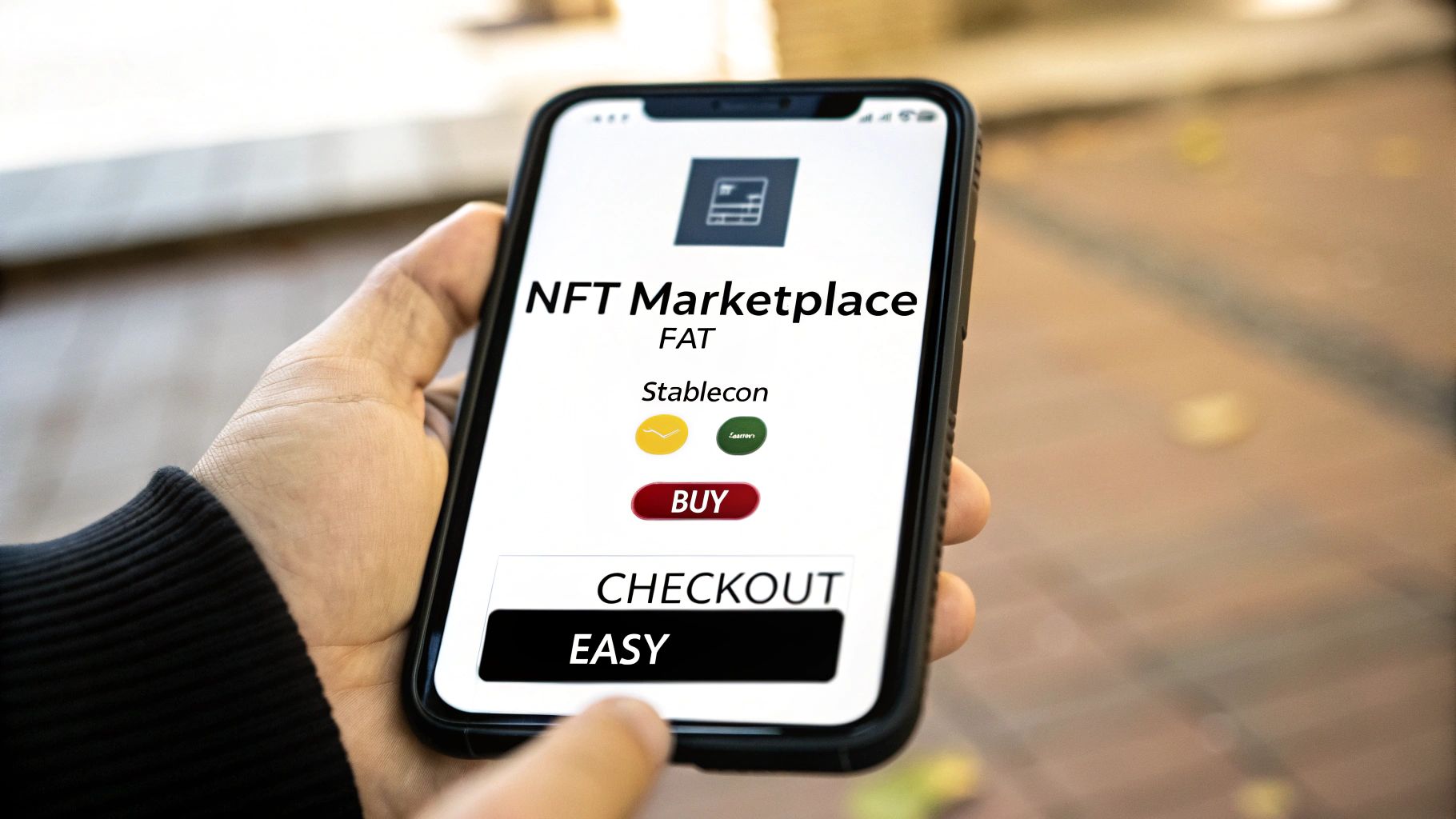
You can build the most robust backend in the world, but if the user experience is a headache, it’s all for nothing. When it comes to stablecoins, your integration is only as good as the user journey you design. The real goal here is to make buying an NFT feel as simple as checking out on Amazon. All that blockchain complexity? It needs to be completely invisible to the user.
This starts with something deceptively simple: clear pricing. Your buyers shouldn't need a calculator. Showing prices in both the stablecoin (e.g., 100 USDC) and the user's local currency (e.g., $100.00 USD) is absolutely essential. This dual-display instantly removes friction and builds trust, especially for people who think in dollars, not crypto.
Bridging the Gap With Fiat On-Ramps
Let's be realistic. The single biggest roadblock for mainstream users is actually getting their hands on crypto in the first place. Most people won't show up on your marketplace with a wallet already loaded with USDC. If you make them leave your site to sign up for a third-party exchange, complete KYC, and then figure out how to transfer funds back, you've already lost the sale.
This is exactly where fiat on-ramps become your most valuable tool.
By integrating a service like Stripe, MoonPay, or Ramp, you let users buy stablecoins right on your platform with a credit card or bank transfer. What was once a complicated, multi-step ordeal becomes a single, smooth checkout flow, all without ever leaving your ecosystem.
The NFT platforms that are truly winning are the ones that make the “crypto” part of the transaction disappear for the user. An on-ramp isn't a nice-to-have feature; it's a fundamental piece of your user acquisition strategy.
Choosing the right partner is key. You'll need to weigh their global coverage, fee structure, and how easily their widget slots into your existing UI. A great on-ramp experience is how you turn curious visitors into committed collectors. For a much deeper dive into the mechanics, check out our guide on converting fiat to stablecoins in 2025.
On-Ramp Provider Feature Comparison
Deciding on an on-ramp provider requires a careful look at your specific needs and your target audience's geographic location. Here’s a quick comparison of some popular options to help you evaluate which might be the best fit.
| Provider | Supported Regions | Typical Fees | Integration Complexity |
|---|---|---|---|
| MoonPay | 160+ countries | 3.5% - 4.5% (card) | Low (Widget/API) |
| Ramp | 150+ countries | 2% - 3.5% (card) | Low (Widget/API) |
| Stripe | ~50 countries | Varies (blended) | Low to Medium (API) |
Ultimately, the choice depends on balancing reach, cost to the user, and the development lift required. Always test the user flow from a new user's perspective before committing.
Handling Transaction States and Fees Gracefully
On-chain transactions aren't instant, and this is another critical spot for thoughtful UX. When a user clicks "Buy," they need clear, constant feedback about what's happening behind the scenes.
Your interface has to manage three key states perfectly:
- Pending: Give them a clear visual cue that the transaction is working. Think of a spinner with an estimated time, not just a frozen screen.
- Success: Make it a moment! A bold confirmation message celebrating that the NFT is officially theirs is a must.
- Failed: Avoid cryptic errors. Provide a simple, empathetic message explaining what went wrong (e.g., "insufficient funds") and give them a clear path to try again.
And then there's the gas fee problem. Don't just show a line item called "Gas Fee"—that means nothing to most people. Label it plainly as a "Network Fee" and, if you can, show its estimated cost in fiat. For a truly next-level experience, you can explore gas abstraction, where you bundle this fee into the total stablecoin price. This lets the user approve a single, clean transaction, which is the gold standard for simplicity.
Mastering Security, Compliance, and Audits
Look, any payment system comes with risk. But when you’re dealing with irreversible on-chain transactions, the stakes jump through the roof. For an NFT marketplace taking stablecoins, security and compliance aren't just checkbox items—they're the foundation of your entire business. A single smart contract bug or a regulatory blind spot can sink you overnight.
So, let's walk through a practical risk-mitigation plan. Building a resilient marketplace means fighting on two fronts: locking down your tech against attackers and navigating the tricky legal landscape of digital money. You can't afford to get either one wrong.
Fortifying Your Smart Contract Security
Your smart contracts are your vault. They hold user funds and manage their most valuable assets. Every vulnerability is a neon "rob me" sign for hackers. While a full security review is its own deep dive, there are a few classic blunders you absolutely must avoid when building contracts that handle stablecoin payments.
These aren't some obscure edge cases; they are well-known attack vectors that have cost the Web3 ecosystem millions.
- Reentrancy Attacks: The OG of smart contract exploits. This happens when a malicious contract calls back into your code before your first function has finished its work, letting an attacker drain funds by calling a withdraw function over and over. Always, always use the "checks-effects-interactions" pattern to shut this down.
- Integer Overflows and Underflows: Remember old car odometers rolling over? Early versions of Solidity could do that with numbers, creating massive accounting errors. Modern Solidity (version 0.8.0 and up) has built-in protection, so using an up-to-date compiler is your first line of defense.
- Unchecked External Calls: When your contract talks to another—like an ERC-20 token—you have to assume the call might fail. If you don't check the return value, your contract could proceed as if everything is fine when, in reality, the token transfer never happened. Always verify the results.
A professional, third-party audit isn't a luxury; it's a non-negotiable cost of doing business. Think of it as the foundational insurance policy for your platform. An independent auditor will pound on your code, actively trying to break it, and find these vulnerabilities before the bad guys do.
Launching without an audit is just reckless. Savvy users and serious collectors will see it as a giant red flag and stay far away.
Navigating the Regulatory and Compliance Maze
The second you plug in a fiat on-ramp and start touching real-world money, you’ve entered the world of financial regulation. Ignoring the rules isn't an option—it’s a fast track to crippling fines and legal battles. The rulebook for digital assets is still being written, but some core principles are already set in stone.
Your main duties will center on Know Your Customer (KYC) and Anti-Money Laundering (AML). These are standard procedures designed to stop your platform from being used for fraud, money laundering, and other illicit activities.
When you partner with a fiat on-ramp provider, they usually carry the heavy load here. As the regulated entity, it's their job to verify identities and flag suspicious transactions. But that doesn't let you off the hook. You are still responsible for picking a compliant partner and understanding your own obligations based on where you operate.
Staying Ahead of Evolving Stablecoin Legislation
The legal ground is constantly shifting under our feet. Governments worldwide are scrambling to write clear rules for stablecoins. This isn't some distant problem; it means you have to keep a close watch on new laws that could directly impact your business.
For example, we're seeing new frameworks that dictate who can issue stablecoins, what kind of reserves they need to hold, and how transparent they have to be. A perfect example is the legislative push happening in the United States. To get a feel for how lawmakers are thinking, it's worth reading up on proposals like The 2025 STABLE Act and similar initiatives.
Here’s a quick-and-dirty checklist to keep your compliance strategy on track:
- Get a Good Lawyer: Find a law firm specializing in fintech and crypto. This will be the single best investment you make in your platform's survival.
- Pick Regulated Partners: Work with fiat on-ramp and custody providers who already have a solid compliance record in major markets like the U.S. and Europe.
- Write Clear Terms of Service: Your user agreements need to spell out everyone's responsibilities, your platform's rules, and how you handle legal requests and disputes.
- Monitor Your Own Platform: Even with a KYC partner, setting up your own transaction monitoring can help you spot weird activity and protect your community from scammers.
At the end of the day, security and compliance aren't a one-and-done task. It’s an ongoing process that requires constant vigilance and investment to build a marketplace that people can actually trust.
Common Questions About Stablecoin Integration
When you're in the trenches building an NFT marketplace, a few thorny questions about stablecoins always pop up. Getting these right from the get-go is the difference between a smooth launch and a series of painful, expensive revisions. Let's walk through the big ones I see teams grapple with all the time.
How Should We Handle Gas Fees for Users?
This is, without a doubt, one of the biggest UX hurdles in all of Web3. A user has USDC ready to go for an NFT, but then they hit a wall: they need ETH, MATIC, or some other native token just to pay the gas fee. For anyone new to crypto, it's a confusing, frustrating, and often deal-breaking moment.
You have a couple of ways to play this:
- The Standard Method: Make the user pay the gas fee directly. It’s the easiest path for your developers but the clunkiest for your customers. You're basically forcing them to understand blockchain mechanics just to buy something.
- Gas Abstraction: This is the magic wand. Your platform figures out the likely gas cost, converts that amount into the stablecoin's value, and just rolls it into the final price. The user sees one price, approves one transaction in USDC, and you handle the messy native currency payment behind the scenes.
Gas abstraction is how you make the blockchain disappear for your users. When you sponsor transactions or bundle fees, the experience starts to feel like Web2. That’s crucial if you want to attract anyone beyond the crypto-native crowd.
What Is the Difference Between On-Chain and Off-Chain Settlement?
This is a core architectural choice that will define your platform's speed, cost, and user experience. The question really comes down to where you keep your order book—the live list of all NFTs for sale.
On-chain settlement is the purist's approach. Every single action—listing an NFT, making an offer, canceling a bid—is a transaction written directly to the blockchain. It's decentralized and transparent, but also brutally slow and expensive. Every click costs gas.
Off-chain settlement is what you see on virtually every major marketplace for a reason. The order book lives on a fast, centralized server. Listing and bidding are instant and free. Only the final sale transaction actually gets settled on-chain. It’s a far better experience, but it does introduce an element of trust—users have to trust your server is accurate.
Do I Need a Special License to Accept Stablecoins?
This is where things get tricky, and the answer is a firm "it depends" on your location and business model. If you're running a pure crypto-to-crypto platform where users are expected to bring their own stablecoins, you might be in the clear.
But the second you introduce a fiat on-ramp—letting people buy stablecoins with a credit card or bank account—you're stepping into the world of money transmission. In that case, you almost certainly need to work with a regulated partner who can handle the KYC/AML checks and has the right licenses.
Let me be blunt: talk to a lawyer who specializes in fintech and crypto. Trying to navigate this regulatory maze on your own is a recipe for disaster. Getting compliance right from day one is non-negotiable if you want to build a lasting business.
At Stablecoin Insider, we provide the in-depth analysis and news you need to stay ahead in the world of digital finance. Visit us at https://stablecoininsider.com to explore the latest trends.