Table of Contents
To check if a stablecoin is MiCA-compliant, download the "Issuers of EMT" file from ESMA's interim MiCA register and search for the issuer's legal name, not the ticker. A row with no withdrawal date and a white paper for that token means the issuer is authorised to offer it in the EU. USDC passes this check. USDT does not.
Readers searching this have a practical reason: since the end of Q1 2025, EU crypto platforms have been expected to stop offering stablecoins whose issuer is not authorised in the EU, according to a 17 January 2025 ESMA statement. This guide walks through the register file as ESMA last updated it on 11 November 2026, using USDC and USDT as worked examples. It covers the EU and EEA only.
Last updated: 12 November 2026. Register data re-read from the ESMA files updated 11 November 2026.
Key Takeaways
- Under MiCA, a fiat-pegged stablecoin is an e-money token (EMT). Only an authorised bank or e-money institution that has notified a white paper may offer one in the EU.
- ESMA's Issuers of EMT file (11 Nov 2026) had 51 rows from 26 issuers. The asset-referenced token (ART) file listed no issuers at all.
- The file has no ticker column, so search by issuer legal name or LEI. Token names only appear in white paper links or comments.
- Circle Internet Financial Europe SAS is listed for USDC and EURC. No Tether entity appears in either stablecoin file.
- A listing is not an endorsement: ESMA says the listed white papers have not been reviewed or approved by any EU authority.
What does "MiCA-compliant" mean for a stablecoin?
A MiCA-compliant stablecoin is one whose issuer meets the authorisation and disclosure rules for its token type. For a token pegged to one currency, such as USDC or EURC, Article 48 of MiCA says that only the issuer can offer it to the public or seek admission to trading, and only if it is authorised as a credit institution or e-money institution and has notified and published a white paper. Other firms need the issuer's written consent.
Tokens backed by a basket of assets are asset-referenced tokens (ARTs) and follow a separate authorisation route. If you are not sure which category a coin falls into, our EMT vs ART explainer covers the difference.
"Compliant" applies to the issuer and the offer. It does not mean holding a non-listed token is illegal. ESMA's 2025 statement says that holding and transferring such tokens "should remain possible" while EU platforms stop selling them (ESMA).
Where is the official list of MiCA-authorised stablecoins?
The official EU-wide list of MiCA-authorised stablecoin issuers is ESMA's interim MiCA register, published as five CSV files on the ESMA MiCA page. Two matter for stablecoins: "Issuers of EMT" and "Issuers of ART". National authorities report the data to ESMA, which republishes it weekly, so a fresh authorisation can take days to appear.
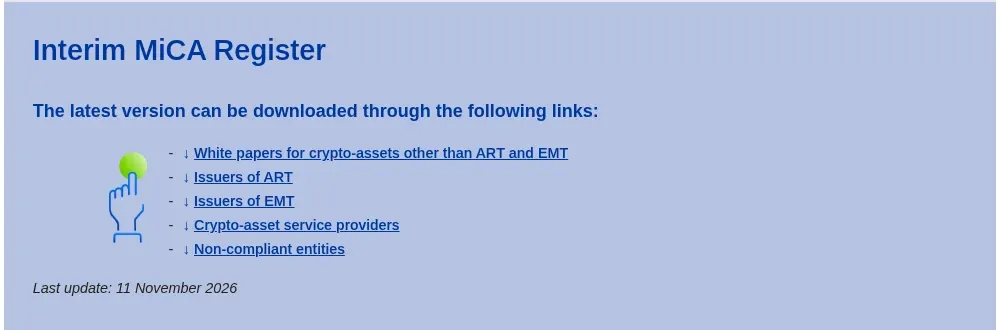
ESMA had planned to move the register into its own IT systems by mid-2026. On 12 November 2026 the page still served the CSV files.
How do you check a stablecoin in the ESMA register?
You check a stablecoin in the ESMA register by finding its issuer's row in the EMT file, confirming it has not been withdrawn, and matching the white paper to the token you hold. The whole check takes a few minutes in any spreadsheet app.
Step 1: Download the Issuers of EMT file
Open the ESMA MiCA page and download "Issuers of EMT". Note the "Last update" date next to the links. If the token is backed by a basket rather than one currency, also download "Issuers of ART".
Step 2: Search by the issuer's legal name
Search for the issuer's legal entity name or LEI, not the ticker. The file has no token-name column. USDC appears only inside the white paper link (circle.com/…/mica-usdc-whitepaper) under "Circle Internet Financial Europe SAS". The issuer's EU entity is usually named in its terms of use or white paper.
Step 3: Read the authorisation fields
Check the competent authority, the authorisation type and the withdrawal date. ESMA keeps withdrawn records in the file and adds the date the withdrawal took effect, so a row on its own is not proof the issuer is still active.
| Field | What it tells you | Watch for |
|---|---|---|
| ae_lei_ | Issuer legal name and LEI | Use these to search, not the ticker |
| ae_ | The national supervisor to cross-check | Spelling varies between rows |
| ae_ | Credit institution or e-money institution | One row reads "N/A" |
| ac_ | Withdrawal date, if any | Must be blank for an active issuer |
| wp_url / wp_ | White paper link and the token it covers | "EMT_NO_WP" means no white paper issued yet |
| ae_DTI | ISO 24165 token codes, one per chain | Match against the white paper |
Two fields deserve caution. Several Dutch rows have a blank authorisation date, and one German issuer's authorisation date falls a year after its first white paper date. These look like reporting quirks, which is why Step 5 exists.
Step 4: Match the white paper and token identifiers
Open the white paper link and confirm it names the token and chain you hold. Under Article 51(11), authorities "shall not require prior approval" of EMT white papers, so the document is the issuer's own disclosure. The DTI codes in the register are ISO 24165 identifiers that link a token to the ledger it runs on, according to the DTI Foundation. Then check the contract address against the issuer's own list, as in our guide to checking the official USDC or USDT contract.
Step 5: Confirm on the national authority's register
Cross-check the issuer on the home authority's own register, for example the ACPR's REGAFI database for French e-money institutions. ESMA's file is a weekly copy of what national authorities report, so the national register is the more current source.
Step 6: Check the platform selling it
If you are buying through an exchange or broker, look up that firm in the "Crypto-asset service providers" file and make sure it is not in the "Non-compliant entities" file. On 11 November 2026 the CASP file held 407 rows and the non-compliant file 216, of which 180 were reported by Italy. Coinbase Luxembourg S.A., for example, is listed under Luxembourg's CSSF with authorisation dated 20 June 2025 and services passported to 30 countries.
What does the check show for USDC and USDT?
The check shows USDC has an active EU issuer and a notified white paper, while USDT has no EU issuer in either stablecoin file. The table lists what the 11 November 2026 file contains for each.
| Check | USDC | USDT |
|---|---|---|
| Row in Issuers of EMT | Yes: Circle Internet Financial Europe SAS, LEI 969500OYUDADGZKCR583 | No row for any Tether entity |
| Home authority | ACPR, France | None |
| Authorised as | E-money institution, 1 Jul 2024 | None |
| Withdrawal date | Blank (active) | Not applicable |
| White paper | Circle MiCA USDC white paper, record updated 15 Sep 2026 | None notified |
| Token codes | 36 chain DTIs plus group code TJWK5QTRK | None |
One detail is worth copying for any token. All 36 chain-level DTI codes in the register match the 36 in the "Blockchain DTI Code" table of Circle's white paper, from Algorand to Pharos, and the white paper marks two of those chains (Flow and Tron) as deprecated. A match like this tells you the register row and the document describe the same token set.
USDC also carries a new label. The EBA classified it as the EU's first significant e-money token on 14 October 2026, and from 12 November 2026 the EBA supervises its reserves, liquidity and own funds jointly with the ACPR (EBA). That status does not show in the ESMA file. Our EBA USDC supervision explainer covers what changed.
For USDT, the absence matters mainly to platforms. ESMA expected EU platforms to stop making tokens with no EU-authorised issuer available for trading, with "sell only" service allowed until the end of Q1 2025 (ESMA).
What does the register show as of 11 November 2026?
The register shows a small, concentrated field: 26 EMT issuers across 14 home states, and no ART issuers. The 51 rows include updated versions of the same white paper, so the row count is not a token count. On 14 October 2026 the EBA put the number of notified EMTs at 45.
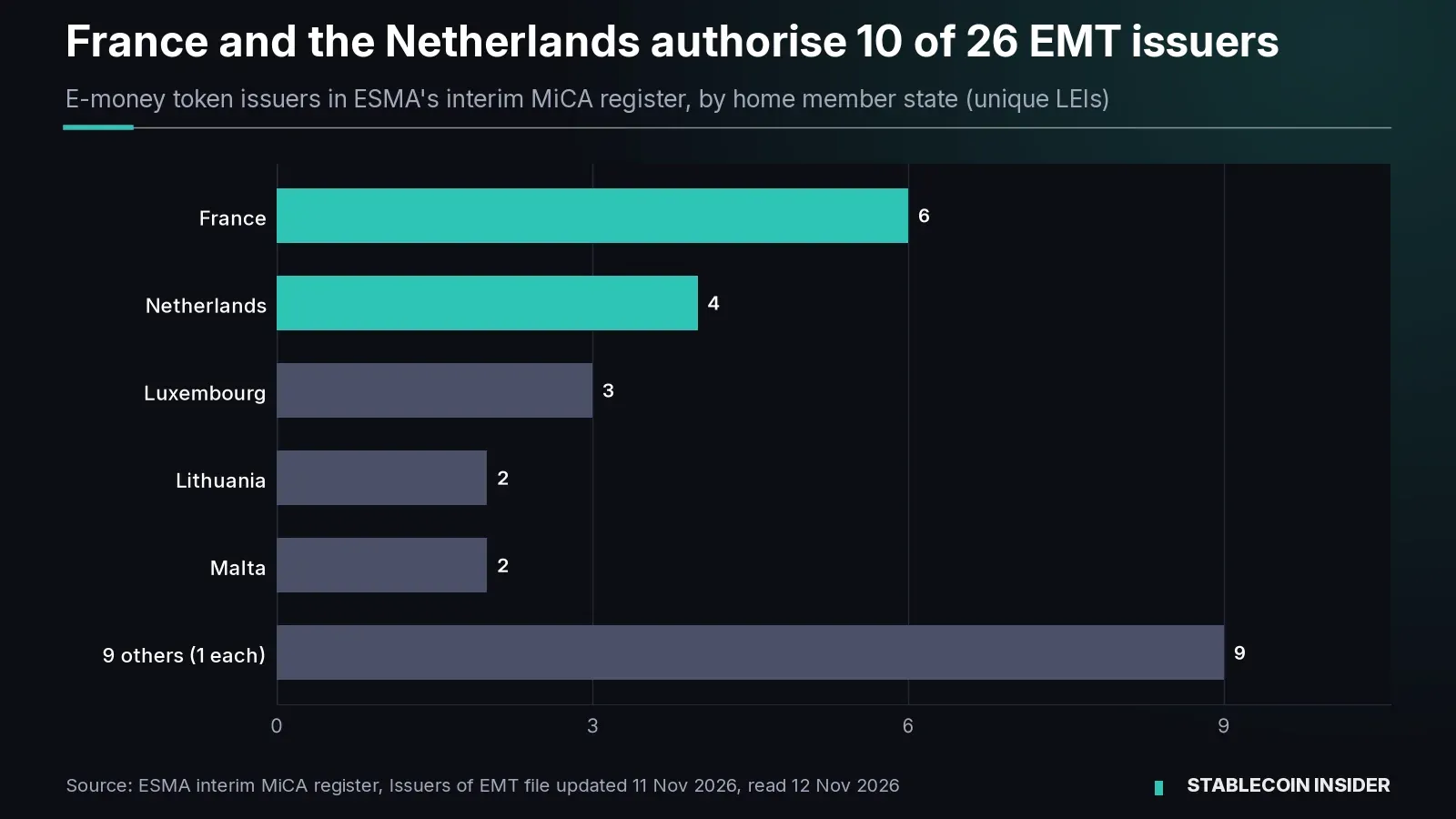
Two patterns stand out. First, 21 of the 26 issuers are e-money institutions and only four are credit institutions; the remaining Bridge Building row gives no type. Second, the big global dollar tokens are mostly absent. Searching the file for Tether, USDT, PYUSD, Ripple, RLUSD, Ethena, USDe, DAI, FDUSD and USD1 returned no matches. Because the file has no ticker field, treat a missing name as a prompt to check the issuer's EU entity, not as final proof.
Recognisable names in the file include Circle's EURC, SG-Forge's EURCV and USDCV, Paxos Issuance Europe's USDG, Monerium's EURe, AllUnity's EURAU, Bridge Building's EURR and Qivalis's EURqi, whose white paper entry is dated 21 October 2026. Our European stablecoins guide compares several of them.
Running a business that pays or settles in stablecoins? See our MiCA compliance guide for EU businesses. For the full picture, see our Stablecoin regulation hub.
FAQ
Is it illegal to hold USDT in the EU?
Does a listing in the ESMA register mean the stablecoin is safe?
How often is the MiCA register updated?
Can a stablecoin be MiCA-compliant if its issuer is outside the EU?
Why is my stablecoin not in the EMT file even though my exchange lists it?
Sources: ESMA, Markets in Crypto-Assets Regulation page and interim MiCA register CSV files (updated 11 Nov 2026); MiCA Article 48, ESMA interactive single rulebook; MiCA Article 51, ESMA interactive single rulebook; ESMA statement on non-MiCA compliant ARTs and EMTs, 17 Jan 2025; EBA press release, 14 Oct 2026; Circle, MiCA USDC white paper; DTI Foundation FAQs; ACPR REGAFI register. All read on 12 November 2026.
This content is provided for informational and educational purposes only and doesn't constitute financial, investment, legal or tax advice. Register figures were read on 12 November 2026 from ESMA's interim MiCA register files updated 11 November 2026 and may change weekly. Mentions of USDC, EURC, USDT, Circle, Tether, Coinbase, SG-Forge, Paxos, Monerium, AllUnity, Bridge, Qivalis or any other company or asset are not endorsements. Speak to a qualified professional before making legal or financial decisions.