
Table of Contents
Earning a yield on your stablecoins with Real-World Assets (RWAs) is pretty straightforward at its core. You're essentially taking your digital dollars and putting them to work in protocols that invest in tangible, income-producing assets—think Treasury bills, corporate debt, or real estate. This approach is a welcome change from the often unpredictable yields in DeFi, offering returns backed by something you can actually point to in the off-chain world. It’s the best of both worlds: the reliability of traditional finance meets the efficiency of the blockchain.
Why RWAs Are Reshaping Stablecoin Yield
Anyone who was in DeFi during the boom-and-bust cycles knows that traditional yield farming could feel like a wild ride. Returns were often driven by pure crypto speculation, soaring one week and crashing the next. The pivot to Real-World Assets grounds stablecoin yields in something much more predictable: the cash-flowing, established world of traditional finance. Instead of trying to time complex tokenomics, you’re earning from government bonds, business loans, or property income.
This isn't just a fleeting trend. It’s a genuine evolution in how people think about earning on-chain. To really grasp the shift, it helps to look at the broader cryptocurrency landscape, where there's a growing appetite for stability and sustainable income streams.
Connecting Two Financial Worlds
The real magic of RWAs is how they tokenize off-chain assets, bringing their value—and more importantly, their yield—onto the blockchain. Imagine a portfolio of U.S. Treasury bills, one of the safest investments on the planet, backing a yield-bearing token sitting in your digital wallet. This simple but powerful mechanism unlocks some serious benefits.
- Sustainable Yields: Your returns come from real economic activity, not just what the crypto markets are doing that day.
- Lower Volatility: The underlying assets are far less volatile than typical crypto, which translates to much more stable yields.
- Real Transparency: Many RWA platforms provide on-chain proof of reserves, so you can actually verify the assets backing your funds.
This model is catching on fast. By mid-2025, the market for yield-bearing stablecoins backed by real-world assets had already swelled into a multi-billion-dollar industry. In fact, the Bank for International Settlements reported that the total market cap of stablecoins shot past $280 billion by September 2025, with RWA-backed options claiming an ever-growing piece of the pie. You can dive into the full report from the Bank for International Settlements for more detail.
By merging the stability of TradFi with the open access of DeFi, we're seeing an entirely new class of financial products emerge. For the first time, regular stablecoin holders can tap into institutional-grade yield opportunities that were once walled off to all but accredited investors.
At the end of the day, earning yield on stablecoins through RWAs offers a more mature, risk-conscious way to grow your digital holdings. It opens the door to strategies that just weren't possible in the early days of crypto, which is a massive part of the future of stablecoins and their place in the financial world.
Exploring Your RWA Yield Opportunities
Not all RWA yields are built the same. Once you decide to put your stablecoins to work in this space, you'll find a whole spectrum of options, each with its own unique risk profile, liquidity, and potential returns. The key is figuring out which one aligns with your own financial goals.
Let's break down the most common ways to earn yield with RWAs.
This infographic really drives home the difference between the often-volatile yields in pure DeFi and the more predictable, asset-backed returns you get from RWAs.
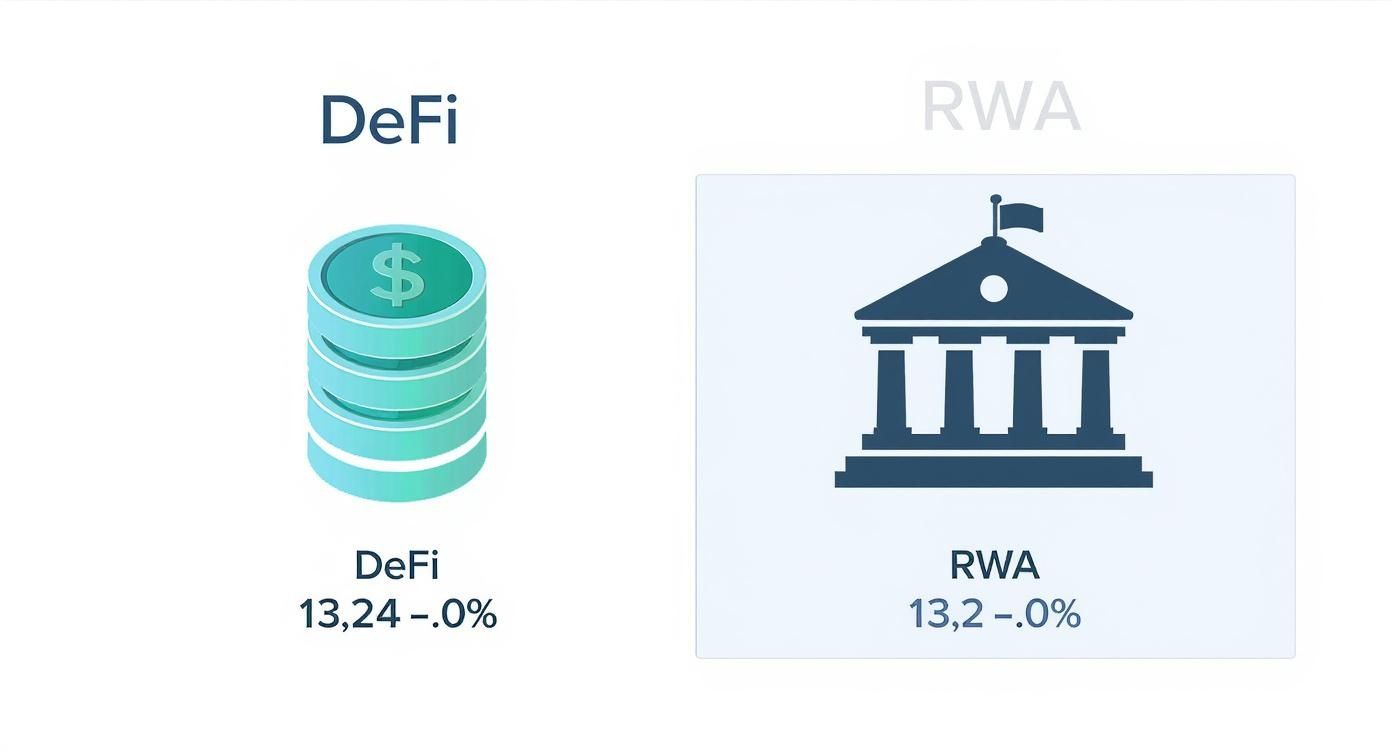
As you can see, RWA yields are grounded in actual economic activity, offering a solid alternative to the speculative nature of many crypto-native strategies.
Tokenized U.S. Treasuries: The Bedrock of RWA Yield
If safety and stability are your top priorities, Tokenized U.S. Treasuries are the place to start. Period. These are digital tokens that represent ownership of U.S. government debt—widely considered one of the safest investments on the planet. Platforms like Ondo Finance have built their entire model around this, taking the yield from T-bills and packaging it into on-chain tokens.
The mechanics are simple: your stablecoins are used to buy these ultra-low-risk assets, and the interest they generate gets passed back to you. It’s a transparent process, with yields that move in lockstep with U.S. interest rates. This is a brilliant way to tap into TradFi-grade security without ever leaving the crypto ecosystem.
By tokenizing government debt, these protocols are effectively bringing the global financial system's "risk-free" rate on-chain. This creates a reliable baseline yield that sets a whole new standard for what you can do with stablecoins.
This isn't just theory. The model gained serious traction by offering rates that blew traditional banking out of the water. By September 2025, some providers were offering up to 4.25% APY on USDC, more than four times the average U.S. bank deposit rate at the time. They did this by funneling stablecoin deposits into regulated money market funds backed by these exact same government securities.
Private Credit: Funding Real-World Businesses
Moving a bit further out on the risk-reward spectrum, you'll find private credit. This involves lending your stablecoins to actual businesses that need capital for things like financing invoices, buying inventory, or expanding their operations. Protocols like Centrifuge and Goldfinch are the matchmakers here, connecting DeFi liquidity with these off-chain borrowers.
Here’s a quick look at how it works:
- Asset Originators: These are real-world lending companies that find and vet the businesses looking for loans.
- Tokenization: The loans are then bundled together and turned into tokens on the blockchain.
- Liquidity Pools: You deposit your stablecoins into pools that fund these loans, and you earn interest as the businesses make their repayments.
The yields can be quite attractive—often hitting double digits—but the risk is higher, too. You’re exposed to the creditworthiness of the borrowers, which makes doing your homework on the platform and its partners absolutely critical. It can also be helpful to review our guide on the https://stablecoininsider.org/best-stablecoin-liquidity-providers/ to get a feel for the broader ecosystem.
Tokenized Real Estate: Earning from Bricks and Mortar
Tokenized real estate lets you buy fractional ownership in income-generating properties. Instead of needing the capital to buy an entire apartment building, you can purchase tokens that represent a small piece of it. Your stablecoins go toward acquiring these tokens, and you get a cut of the rental income or any appreciation in the property's value.
This model opens up an asset class that was once totally out of reach for most people. The platforms handle all the heavy lifting—property management, legal work, and tokenization—making it a fairly hands-off way to earn. To get a better handle on how returns are calculated, it's worth understanding Cash on Cash Return, a core metric in real estate investing.
The main trade-off here is liquidity. Unlike a T-bill token, selling your real estate tokens might take some time, as you’ll need to find a buyer on a secondary market. This balance between higher potential returns and lower liquidity is a constant theme as you explore RWA yield options.
Comparing RWA Yield Generation Methods
To help you visualize the trade-offs, here’s a side-by-side look at the main RWA strategies for generating yield on your stablecoins.
| RWA Method | Typical APY Range | Risk Profile | Liquidity | Example Platforms |
|---|---|---|---|---|
| Tokenized U.S. Treasuries | 3% - 5% | Very Low | High | Ondo Finance, Maple Finance |
| Private Credit | 8% - 15% | Medium to High | Medium | Centrifuge, Goldfinch |
| Tokenized Real Estate | 6% - 12% | Medium | Low | RealT, Lofty |
This table is just a starting point. Your own risk tolerance and investment timeline are what will ultimately determine the right fit for your portfolio. Each path offers a unique way to connect your digital assets to tangible, real-world value.
How to Vet and Select an RWA Platform

It’s tempting to jump into the first RWA platform you see, but that’s a recipe for disaster. While the potential to generate yield on stablecoins with RWA is incredibly compelling, not all protocols are built the same. Honestly, your diligence here is the single most important factor in protecting your capital.
This isn't just about chasing the highest APY. It's about looking under the hood to understand the foundation that yield is built on. Think of this as your personal checklist for vetting any RWA platform before you deposit a single dollar. Let’s get past the marketing hype and focus on what really matters.
Scrutinize the Security and Smart Contracts
Before you even think about the assets, you have to look at the platform's security. The smart contracts are the digital vaults holding your funds, and any weakness is a critical point of failure. Don't just take the platform's word for it—verify everything.
Start by looking for third-party security audits. Any platform worth its salt will have its code audited by well-known firms like CertiK, Trail of Bits, or OpenZeppelin. These audits should be public. Read the summary and pay close attention to any critical or high-severity findings and, more importantly, whether the team actually fixed them.
Next, I always check the contract's history. Has the protocol ever been exploited? A past incident isn't an automatic "no"—how the team responded is what's crucial—but a clean track record is obviously better. A platform that has operated for years without a major security breach has proven its resilience.
Assess the Underlying Asset Quality
This is the absolute heart of RWA due diligence. The yield you’re earning is only as good as the real-world assets backing it. If the loans default or the properties underperform, your returns—and maybe even your principal—are on the line.
You need to ask some hard questions about where the money is really going:
- Who are the asset originators? For private credit, dig into the companies sourcing and underwriting the loans. Do they have a long, successful track record in traditional finance?
- What is the collateral? If you're investing in loans, what are they secured against? Is it real estate? Business inventory? Future invoices? The quality and liquidity of that collateral are everything.
- How is credit risk managed? Look for details on their underwriting standards. What's the plan for defaults? Some protocols use a tranche system, where junior investors take the first hit, which adds a layer of protection for senior investors.
The ultimate source of your yield isn't some complex DeFi algorithm; it's the performance of a real-world business or asset. If you can't get clear, satisfying answers about the quality and management of the underlying assets, walk away.
Demand Radical Transparency and On-Chain Proof
This is where blockchain technology is supposed to shine. A trustworthy RWA platform will use the chain to prove its claims, not just make them on a pretty website. This is what separates a legitimate operation from a black box.
One of the best tools for this is on-chain proof of reserves. For platforms dealing with things like U.S. Treasuries, you should be able to see a real-time, on-chain attestation that proves the assets exist and match the amount of tokens issued. This eliminates the need to just "trust" the issuer. You can check out our breakdown of the top 10 prominent RWA protocols in 2025 for examples of platforms doing this right.
Also, look for detailed performance reporting. The platform should have a clear dashboard showing you key metrics like:
- Total value of assets under management
- Historical and current yield performance
- Loan status, including any delinquencies or defaults
If a platform is vague about its assets or how they're performing, that's a massive red flag.
Verify Regulatory Compliance
Finally, check the platform's approach to regulation. DeFi often prides itself on existing outside traditional finance, but RWAs are the bridge to that world. That means compliance isn't just a nice-to-have; it's essential for long-term survival.
Look for adherence to Know Your Customer (KYC) and Anti-Money Laundering (AML) procedures. It might feel like an annoying extra step, but it’s a strong signal that the platform operates professionally and is working to prevent illicit activity. It also means they're prepared to engage with regulators, which lowers the risk of an abrupt shutdown. Different jurisdictions have different rules, so understanding the legal structure and where the platform is domiciled gives you another layer of confidence.
Putting It All Together: Your First RWA Investment
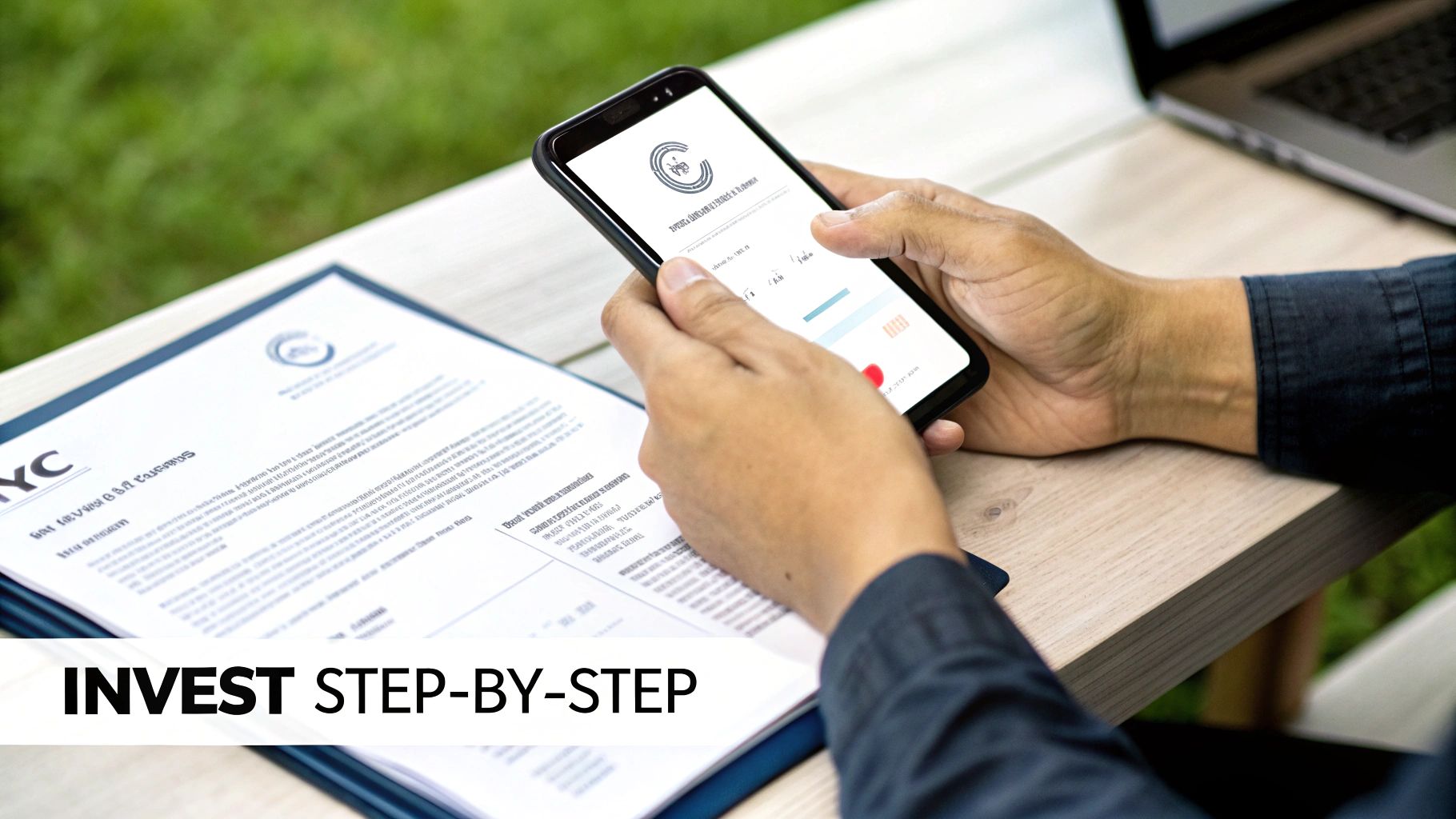
Alright, theory is one thing, but now it's time to get our hands dirty. This is where we walk through the actual steps to make your first RWA investment, from wallet setup all the way to watching your returns come in. This is how you really generate yield on stablecoins with RWA.
To keep things grounded, let’s use a classic real-world example: investing USDC into a tokenized U.S. Treasury bill fund. This is a perfect entry point for newcomers. Why? Because it hits that sweet spot of security, transparency, and a solid yield backed by one of the safest assets on the planet. The whole process is designed to be surprisingly straightforward.
Getting Your Wallet and Funds Ready
First things first, you need a Web3 wallet. This is your digital passport and bank account for the on-chain world. Mainstays like MetaMask, Rabby, or Coinbase Wallet are widely supported and have solid security track records.
Once you have your wallet installed, you need to load it up with two key ingredients:
- Your Stablecoins: For our T-bill example, you'll need USDC on a network the platform supports (like Ethereum, Polygon, or Arbitrum).
- Gas Money: You'll also need a bit of the network's native token—think ETH for Ethereum or MATIC for Polygon—to pay for transaction fees, commonly called "gas."
What if your USDC is on a different blockchain? No problem, you'll just need to "bridge" it over. If you're new to this, we've got a full guide that explains exactly how to bridge tokens. This is a standard part of the process to get your funds where they need to be.
The Onboarding Step: Identity Verification
Here’s a step that might feel a bit different for DeFi veterans: Know Your Customer (KYC) and Anti-Money Laundering (AML) checks. Because the most trustworthy RWA platforms are regulated, they have to play by the rules.
The process is a lot like opening an account with a modern fintech company or online broker. You'll typically need to provide:
- Basic personal details (name, address, DOB)
- A photo of a government-issued ID (passport, driver's license)
- Sometimes, a proof of address like a utility bill
- A quick selfie to match your face to the ID
Don't let this spook you. This is actually a green flag. It means the platform is serious about compliance and security, which protects everyone involved from bad actors. The whole thing is usually handled by a secure third-party service and is often over in just a few minutes.
Making Your First Deposit
Okay, your wallet is funded and your identity is verified. Time for the main event.
Head over to the platform’s investment dashboard. You should see the different products available, like the T-bill fund we're targeting. The key stats—current APY, total value locked (TVL), and other metrics—should be displayed front and center.
The actual investment is handled by a smart contract. Here’s a play-by-play:
- Connect Your Wallet: The first thing you'll do is click a button to connect your wallet. A prompt will pop up from MetaMask or your wallet of choice asking for permission.
- Enter Your Amount: Type in how much USDC you want to invest.
- Approve the Contract: This is a crucial security step in DeFi. You have to give the platform's smart contract permission to access your USDC. Your wallet will ask you to sign a small "approval" transaction.
- Confirm the Deposit: Once the approval is confirmed, you'll sign one final transaction. This is the one that actually moves your USDC into the protocol and, in return, mints yield-bearing tokens directly into your wallet.
As soon as that final transaction is confirmed on the blockchain, you’ll see a new token in your wallet. It might be called something like "rUSD" or "USDY." This token is your digital receipt—it represents your claim on the underlying Treasury bills and is what accrues yield.
Congratulations! You've just seamlessly bridged the gap between traditional finance and DeFi. That token in your wallet is now backed by U.S. government debt, earning you a stable yield, 24/7, right on the blockchain.
Watching Your Investment Grow
The last piece of the puzzle is tracking your performance. Every RWA platform has a dashboard where you can see your investment grow, often in real time. You’ll be able to monitor your total balance, how much yield you’ve earned, and the fund's current APY.
Yield typically gets paid out in one of two ways:
- Rebasing: The number of tokens in your wallet literally increases every day. If you started with 1,000 tokens, tomorrow you might have 1,000.15, then 1,000.30, and so on.
- Accruing Value: Your token balance stays the same, but the token itself becomes more valuable over time. When you go to cash out, each token is worth more USDC than when you started.
Most protocols let you withdraw your principal and earnings whenever you want, though some might have a short lock-up or redemption window. Withdrawing is just the deposit process in reverse—you'll sign a transaction to trade your yield-bearing tokens back for your original USDC, plus all the interest you've earned.
Managing Risks and Planning Your Exit
While the yields coming out of RWA protocols look great on paper, this isn't a "set it and forget it" kind of investment. Every dollar you deploy comes with a unique risk profile. Honestly, the difference between a savvy investor and one who gets wiped out is having a clear-eyed view of what can go wrong—and a solid plan for when to head for the exit.
When you generate yield on stablecoins with RWA, you’re straddling two worlds. You've got the familiar on-chain risks of DeFi, but you're also importing all the classic risks from traditional finance. If you only pay attention to one side of that coin, you're setting yourself up for a nasty surprise.
Let's break down what you actually need to watch out for and how to build a defensive strategy.
Deconstructing the Key RWA Risks
The dangers in RWA investing aren't always obvious because they're a blend of old-school financial problems and crypto-native vulnerabilities.
We all know about smart contract bugs. A single flaw in the code can be exploited, potentially draining a protocol overnight. That's why you should never, ever invest in a platform that hasn't undergone multiple, public security audits from reputable firms. It's table stakes.
But a perfect smart contract is useless if the off-chain operations fall apart. This is where counterparty risk becomes a huge factor. If you're in a private credit pool, your yield is directly tied to real-world businesses paying back their loans. What’s the plan if a major borrower defaults? You need to know how the protocol is structured to absorb that kind of loss without your principal taking a hit.
Then there’s a more subtle but critical risk: oracles. These are the data feeds connecting the smart contract to the real world, reporting things like asset valuations. If an oracle is compromised or just feeds bad data, it can cause the protocol to behave erratically, leading to a cascade of costly errors.
The real takeaway here is that your due diligence isn't over once you've deposited your funds. The risk landscape is constantly shifting. You're not just investing in code; you're backing an entire operational and financial business.
Navigating Liquidity and Exit Paths
Unlike swapping ETH for USDC on Uniswap, RWA tokens can have serious liquidity challenges. The token representing your slice of a private credit portfolio or a fraction of a building isn't something you can just dump on a major exchange. This illiquidity is often the trade-off for those higher, more stable yields.
That's why you have to map out your exit strategy before you even think about investing.
Start by asking these questions:
- What's the redemption process? Can you get your stablecoins back on demand, or is there a waiting period? Many protocols only process redemptions on a weekly or even monthly basis.
- Are there lock-up periods? Some investments, particularly in private credit or venture debt, might require you to commit your capital for a fixed term, like six months or a year. Make sure you're okay with that.
- What are the exit fees? Watch out for withdrawal fees or early redemption penalties. These can take a serious bite out of your net returns and should be clearly spelled out.
A tokenized T-bill fund, for example, might offer daily redemptions with no fees, making it feel very liquid. On the flip side, an investment in tokenized real estate might require you to list your token on a secondary market and wait for a buyer. That could take time and force you to sell at a discount if you need cash quickly. For a refresher on the basics, understanding how to swap stablecoins provides good context for how assets move in this ecosystem.
Building a Resilient RWA Strategy
The goal isn't to avoid risk entirely—that’s impossible. It's about managing it intelligently. Your best friend here, as always, is diversification. Don't go all-in on a single private credit protocol, no matter how good it looks. Spread your capital across different platforms, asset classes, and geographies.
A simple defensive allocation could look something like this:
- 50% in Tokenized U.S. Treasuries: This is your foundation—a low-risk, highly liquid base earning a reliable yield.
- 30% in Diversified Private Credit: Pick a platform with a transparent, battle-tested underwriting process and a solid track record.
- 20% in Tokenized Real Estate: This introduces an asset with returns that aren't directly tied to the credit markets, adding another layer of diversification.
With an approach like this, a problem in one area—say, a default in one of the loan pools—won't sink your entire portfolio. By combining sharp platform selection with a pre-planned exit strategy and smart diversification, you can navigate the RWA space with confidence.
Common Questions About RWA Stablecoin Yields
Even with a solid plan, you’re bound to have questions when bridging the gap between traditional finance and crypto. Let's dig into some of the most frequent ones I hear from investors who are just starting to generate yield on stablecoins with RWA. My goal here is to give you straight answers so you can move forward confidently.
How Does This Differ From Traditional DeFi Staking?
The biggest difference is where the yield actually comes from. In traditional DeFi, your returns are often tied to things happening entirely within the crypto world. Think protocol emissions (newly minted tokens), fees from on-chain lending and borrowing, or rewards for providing liquidity—all of which can swing wildly.
RWA yields, on the other hand, are grounded in the cash flows of off-chain assets. You're getting a slice of the interest from a U.S. Treasury bill, the payment from a real-world business loan, or the rental income from a physical property. This connection to the real economy makes the returns far more predictable and less susceptible to the whims of crypto market sentiment.
Is This Yield Considered Passive Income For Tax Purposes?
This is a huge question, and the answer isn't simple. In many places, the yield from RWA protocols looks a lot like interest or investment income—similar to what you’d earn from a savings account or stock dividends.
But the rulebook for crypto is still being written. The tax treatment can change dramatically based on a few key factors:
- Your location: Tax laws are different everywhere. What works in the U.S. might not apply in Europe or Asia.
- The token’s structure: Is the yield from a debt instrument or something that looks more like equity? The classification matters.
- How you get paid: A rebasing token that adds more tokens to your wallet might be taxed differently than a token whose price simply appreciates.
I can't stress this enough: talk to a qualified tax professional who actually understands digital assets. They can give you advice tailored to your specific situation and make sure you're playing by the rules. Don't ever assume RWA yields are taxed the same as your other crypto gains.
Should I Expect Crypto-Level Volatility With RWA Yields?
For the most part, no. The whole point of RWA-backed yield is to find stability in the often chaotic world of DeFi. Because your returns are linked to real-world economic activity, they don't see the kind of daily price swings that are common for assets driven by pure speculation.
That doesn't mean the yields are set in stone, though. For example, the APY on a tokenized U.S. Treasury fund will move up or down as the Federal Reserve changes interest rates. Likewise, a private credit pool's performance will depend on the health of the businesses borrowing from it. You’re swapping crypto’s extreme volatility for traditional market and credit risks—it's the trade-off for more sustainable returns.
What Happens If The RWA Platform Fails?
This is a perfectly valid concern and it really underscores why doing your homework on a platform is so crucial. If an RWA platform goes under, what happens to your money boils down to the legal and technical setup of the investment.
The best platforms use what are called bankruptcy-remote Special Purpose Vehicles (SPVs) to hold the actual assets. This creates a legal wall, separating your assets from the platform’s own balance sheet and protecting them from the company's creditors. If the platform failed, a legal process would kick off to sell the real-world assets and distribute the money back to the token holders. Just be aware that this process can take time and isn't always straightforward.
Ready to explore the world of stable, asset-backed yields? Stablecoin Insider provides the latest news, in-depth analysis, and expert insights to help you navigate the evolving landscape of digital finance. Visit us at https://stablecoininsider.com to stay ahead of the curve.