

Table of Contents
Think of a crypto payment API as the universal translator for digital commerce. It's the essential piece of plumbing that lets any app or website talk directly to a blockchain network to handle payments.
Your On-Ramp to the New Digital Economy
At its heart, a crypto payment API (Application Programming Interface) is a toolkit for developers. It provides the rules and connections needed to weave cryptocurrency payment processing directly into your software.
Instead of getting bogged down building and maintaining your own complex blockchain infrastructure, you can simply plug into an API. It does all the heavy lifting, acting as the bridge between your application and the decentralized world of crypto.
This isn't just a niche tool for crypto enthusiasts anymore. These APIs are quickly becoming a standard part of the modern commerce toolkit. They give businesses a direct line to a global customer base, cutting out the slow, expensive middlemen of traditional banking. For developers, getting a handle on these APIs is now a core skill for building what comes next in finance.
The numbers tell the same story. The crypto APIs market is on a tear, projected to hit USD 1,074 million in 2025 and then explode to USD 7,975.7 million by 2035. That’s a staggering 22.2% annual growth rate, fueled by the rapid expansion of Web3. You can dig into the specifics in the full crypto APIs market report.
Why This Technology Matters Now
For any business looking ahead, integrating a crypto payment API is no longer a question of if, but when. It’s a strategic decision with some powerful, real-world advantages.
- Go Global, Instantly: You can accept payments from anyone on the planet. No more headaches with currency conversion or waiting for cross-border transfers to clear.
- Slash Your Fees: Credit card processors typically skim 2-3% off every transaction. Crypto fees are often a fraction of that, which means more money stays in your pocket.
- Get Paid Faster: Forget waiting days for a bank transfer to settle. Crypto payments often finalize in minutes, which is a game-changer for cash flow.
This guide is your roadmap. We’re going to move past the buzzwords and get into the nuts and bolts, taking you from the core concepts all the way to a practical integration.
Of course, the crypto world is vast, with various cryptocurrencies making up the ecosystem. We'll also zero in on stablecoins, which offer the price stability that businesses need to truly embrace digital currency. If you want to learn more, check out the benefits of stablecoins for businesses. Let's get started.
How a Crypto Payment API Actually Works
So, what’s really going on under the hood?
Think of a crypto payment API as a translator and a high-security courier, all rolled into one. Your application has a simple request—"I need to accept $50 in USDC from this customer"—but the blockchain speaks a totally different, highly complex language. The API acts as that essential middle layer, translating your simple request into a secure blockchain transaction and then delivering the confirmation back to you.
It handles all the messy, low-level details so you don't have to. You get to focus on your app's user experience, not on running blockchain nodes or calculating network gas fees. The API takes your "order," communicates it to the blockchain "kitchen," and ensures the final "meal" (the payment confirmation) gets delivered back to your app reliably.
This flow chart gives a great high-level view of how a developer’s code uses an API to plug into the blockchain.
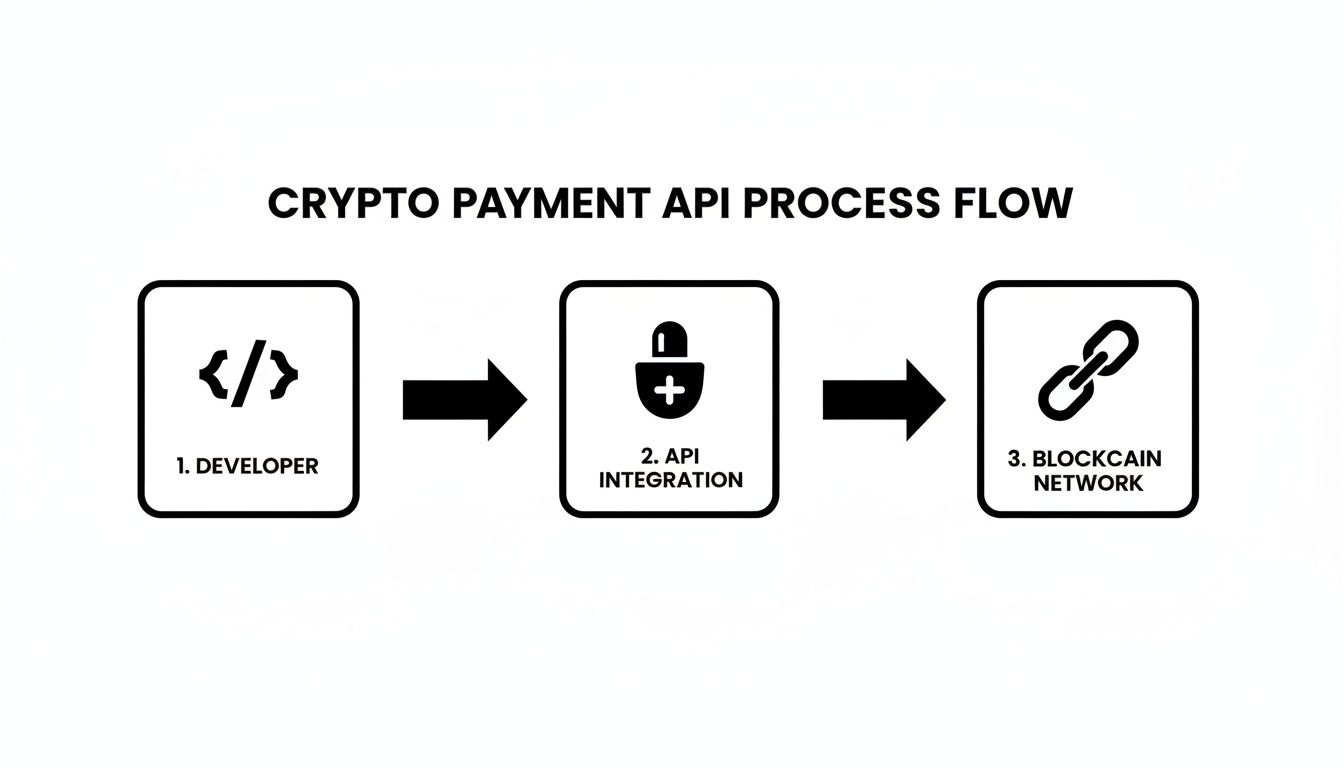
As you can see, the API is the bridge that abstracts away the complexity, making blockchain interactions feel just like any other modern payment integration.
The Core Components of the Process
Behind this seemingly simple flow are a few key ingredients that you, as a developer, will work with directly. These are the tools the API provider gives you to build out your payment system.
- API Endpoints: These are just specific URLs that perform a single job. For example, you’ll send a request to a
/create-paymentURL to kick off a new transaction or ping/get-balanceto check an account. Each endpoint is a direct command. - API Keys: This is your secret key to the kingdom. It's a unique code that authenticates your application and proves your requests are legitimate. You have to keep these keys secure—they’re the digital equivalent of a bank vault password.
- Webhooks: This is where the magic happens for real-time updates. Instead of you constantly having to ask the API, "Did the payment go through yet? How about now?", webhooks flip the script. The API sends an automated message to you the instant an event occurs, like a payment being confirmed. It’s a push, not a pull, system, and it's absolutely vital for a responsive user experience.
These three components work in concert to manage the entire payment journey. When a user clicks "Pay with Crypto," your app hits an endpoint, authenticates with an API key, and then waits for a webhook to confirm everything went smoothly.
Key Takeaway: A crypto payment API’s main purpose is abstraction. It’s designed to shield you from the raw complexity of signing transactions, managing private keys, and monitoring network status. This lets you build great products without needing a Ph.D. in cryptography.
A Step-By-Step Payment Flow
Let's walk through a real-world example to see how these pieces fit together. Imagine a customer is buying a product from your online store.
- Payment Initiation: The customer chooses to pay with a stablecoin like USDC. Your front-end app notifies your server, which then makes an API call to create a new payment.
- Address Generation: The API instantly generates a unique, one-time wallet address for this specific transaction. It sends this address back to your app.
- Customer Broadcasts Transaction: Your app displays this address to the customer, usually as a QR code. The customer scans it with their personal crypto wallet and sends the exact amount of USDC. This action broadcasts the transaction to the public blockchain network (like Polygon or Base).
- API Monitoring: This is the API's job now. It diligently watches the blockchain, waiting for a transaction to arrive at that specific, single-use address it created. You don't have to do anything here.
- Confirmation and Notification: Once the transaction is picked up by the network and gets enough confirmations to be considered final and irreversible, the API marks the payment as complete. It then immediately triggers a webhook, sending a notification to your server.
- Fulfillment: Your server gets the webhook, verifies it’s legitimate, and updates the order status to "Paid." Now you can confidently ship the physical product or unlock the digital content for your customer.
This whole process is underpinned by smart contracts—self-executing code on the blockchain that governs how funds are handled. If you want to go deeper on that foundational layer, this is a great guide on how stablecoin smart contracts are built.
Why Stablecoins are a Game Changer for Payments
Let's be honest, the idea of accepting crypto is cool, but the wild price swings have always been a dealbreaker for most businesses. Who wants to accept a $100 payment in Bitcoin, only to discover it's worth $90 by the time you can cash out? That kind of uncertainty is a non-starter for anyone trying to run a business with predictable revenue.
This is exactly where stablecoins come in and completely change the conversation.
Stablecoins are a specific type of digital currency built to hold a steady value. They achieve this by being "pegged" to a real-world asset, usually the U.S. dollar. Just think of them as digital dollars that live and move on a blockchain.
A good crypto payment API makes it incredibly simple to accept stablecoins like USDC (USD Coin) or USDT (Tether). For a business owner, this means getting paid in a digital currency that's reliably worth one dollar today, tomorrow, and next week. Suddenly, the guesswork and financial risk are gone, turning crypto into a practical tool for everyday commerce.
The Power of Predictability
The difference between getting paid in a volatile asset versus a stable one is truly night and day. A well-built crypto payment API uses stablecoins to offer features that real businesses actually need.
- Automated Conversion: The best APIs can instantly convert a customer's payment—whether it’s Bitcoin or something else—directly into a stablecoin like USDC. This completely shields the merchant from market swings.
- Low-Cost Global Settlement: This is where stablecoins really shine. Sending money across borders with traditional banks can take days and come with hefty fees. Stablecoin payments, on the other hand, settle in minutes for a tiny fraction of the cost, no matter where you are in the world.
- Simplified Accounting: When every payment you receive is pegged to a familiar currency like the dollar, your bookkeeping gets a whole lot easier. You don't have to worry about calculating capital gains or losses on assets you only held for a few hours.
These aren't just small perks; they're essential for any business to operate with confidence. A modern stablecoin payment gateway bundles these API-driven tools into a package that’s easy for any merchant to use.
Volatile Crypto vs Stablecoin Payments A Transactional Comparison
To really see the difference, it helps to put the two side-by-side. The practical gap between a volatile crypto payment and a stablecoin payment is enormous.
| Feature | Volatile Crypto (e.g., Bitcoin) | Stablecoin (e.g., USDC) |
|---|---|---|
| Price Stability | High risk. Value can change significantly between transaction and settlement, impacting revenue. | Extremely low risk. Value remains pegged 1:1 to a fiat currency like the USD. |
| Merchant Certainty | Low. The final settled value is unpredictable, creating accounting and cash flow challenges. | High. A $100 payment is received as $100, ensuring predictable revenue. |
| Transaction Fees | Can be unpredictable and high, especially during times of network congestion ("gas spikes"). | Generally low and more predictable, often costing just pennies on efficient networks. |
| Use Case Focus | Often viewed as a speculative asset or a long-term store of value. | Designed specifically as a medium of exchange for payments, commerce, and settlement. |
As you can see, stablecoins are built from the ground up for the practical demands of commerce, not speculation.
This practical advantage is driving a huge shift in the market. Global crypto payment adoption is accelerating, and it's stablecoins that are handling most of the volume. Research shows that USDT alone averaged a staggering $703 billion in monthly volume. At the same time, payment apps are projected to grow from $1.26 billion in 2025 to $2.66 billion by 2029. You can discover more insights about these payment trends in the full report.
For developers building payment solutions, focusing on stablecoin support isn't just a good idea—it's a strategic must. It’s what provides the stability and reliability that businesses need to finally feel comfortable embracing blockchain payments.
Your First Crypto API Integration: A Practical Walkthrough
Theory can only take you so far. It's time to roll up our sleeves and see what this looks like in actual code. This walkthrough will guide you through the key steps of your first integration, showing you how to go from zero to accepting your first test payment.

Think of it like setting up a new online store. First, you get your business license (the API keys). Then, you build the storefront (your development environment). Finally, you need a way to know when an order comes in (that’s where webhooks come in). Let's get building.
Step 1: Getting Your API Keys
Before you can make a single call to a crypto payment API, you need to identify yourself. API keys are how you do it. They’re unique credentials that tell the API provider that a request is legitimately coming from your application and not some random imposter.
- Sign Up for an Account: Pick a crypto payment API provider and create an account. Almost all of them offer a free sandbox or test environment to get your feet wet.
- Navigate to the Developer Section: Once you're logged in, look for an "API," "Developer," or "Settings" area in your dashboard.
- Generate Your Keys: You'll see an option to generate a new set of API keys. This usually gives you two distinct keys: a public key and a secret key.
The public key is shareable and identifies your account, but the secret key is for your server's eyes only. Keep it private and secure—never, ever expose your secret key in your front-end code.
Step 2: Setting Up Your Environment
With keys in hand, the next job is to get your coding environment ready. This just means installing the tools and libraries you'll need to talk to the API. For this example, we’ll stick with a simple Node.js setup.
First, you'll need an HTTP client library like axios to make requests to the API endpoints. You can pull this in with a simple command in your project's terminal:
npm install axios
Next, and this is crucial, you need to store your API keys securely. Instead of pasting them directly into your code, use environment variables. Create a .env file in your project's root directory and add your keys like this:
API_SECRET_KEY=your_secret_key_here
This is a security best practice and makes it way easier to switch between different keys for development and production. If you're new to this, it’s worth reviewing some foundational API integration insights to make sure you start off on the right foot.
Step 3: Making Your First API Call
Now for the fun part: making your first API call to generate a payment address. We'll send a request to the API’s payment creation endpoint, using our secret key to authenticate and telling it the amount and currency we want.
Here’s what that looks like in JavaScript using axios:
const axios = require('axios');
require('dotenv').config();
const API_ENDPOINT = 'https://api.provider.com/v1/payments';
const API_KEY = process.env.API_SECRET_KEY;
async function createPayment() {
try {
const response = await axios.post(
API_ENDPOINT,
{
// Request body: specifies the payment details
amount: '10.00',
currency: 'USDC', // Requesting a payment in USDC
description: 'Test Product Purchase'
},
{
// Headers: includes your secret key for authentication
headers: {
'Authorization': Bearer ${API_KEY},
'Content-Type': 'application/json'
}
}
);
console.log('Payment created successfully:', response.data);
// The response will contain the unique payment address
// e.g., response.data.address
} catch (error) {
console.error('Error creating payment:', error.response.data);
}
}
createPayment();
This little script sends a request to create a $10 USDC payment. The API provider’s server will then shoot back a JSON object containing a unique wallet address, which you can now show to your customer.
Step 4: Configuring Webhooks for Notifications
The final piece of the puzzle is setting up webhooks. This is how the API tells your server, "Hey, that payment just went through!" without you having to constantly ask.
Key Takeaway: Webhooks are the backbone of a real-time payment system. They transform your application from a passive checker into an active listener, enabling instant order fulfillment the moment a payment is confirmed on the blockchain.
In your API provider's dashboard, you'll find a section for webhooks. Here, you'll paste in a publicly accessible URL on your server where the API can send these updates. When a payment is confirmed, the API will send a POST request to your URL with all the transaction details.
Your server just needs to listen for these incoming pings, verify they're legit, and update your database accordingly. For a deeper dive, you can learn more about how to integrate USDC into your e-commerce platform, which walks through webhook handling in more detail. With these steps done, you now have a functional, end-to-end payment flow.
Navigating Security and Compliance
Let's be clear: when you start accepting payments of any kind, security and compliance become your top priorities. This is especially true when you're dealing with a crypto payment API. Getting this right isn't just a "best practice"—it’s the bedrock of building trust with your customers and ensuring your business is built to last.
When you handle digital assets, you're taking on the responsibility of protecting people's money and navigating a maze of global regulations. The good news is that a professional-grade API is designed to shoulder much of this burden, giving you the tools to manage risk without needing a law degree or a cybersecurity team on standby.

So, let’s unpack the essential security measures and compliance frameworks that are already baked into a solid crypto payment API. This will give you a clear roadmap for protecting both your business and your users.
Essential Security Practices
Your first line of defense is always strong security hygiene. When you integrate an API, you're handing it the keys to a critical part of your operation, so locking down your side of the connection is non-negotiable.
Think of your API keys as the keys to a bank vault. You wouldn't leave those lying around, right? Treat them with the same level of care. Never, ever expose secret keys in your front-end code, and always use server-side environment variables to keep them separate from your codebase.
Of course, the provider's own security architecture is just as critical. You need to look for platforms that use advanced wallet technologies to safeguard the funds they manage.
- Multi-Signature (Multi-Sig) Wallets: These wallets require several different keys to approve a single transaction. It’s a powerful defense mechanism because it eliminates single points of failure. A hacked server or a rogue employee can't drain the funds alone.
- Multi-Party Computation (MPC): This is the next level of cryptographic security. MPC technology splits a private key into multiple encrypted "shards" held by different parties. To sign a transaction, these parties work together to create a signature without ever reconstructing the full key. This makes theft incredibly difficult.
If you’re working specifically with stablecoins, it’s worth digging deeper into the layers of protection involved. Our guide to stablecoin security measures breaks down the specific mechanisms that keep these assets safe.
Meeting Compliance Obligations
Stepping into the world of finance means you have to play by the rules. Regulatory requirements are there to prevent illegal activities, and the two acronyms you absolutely need to know are KYC (Know Your Customer) and AML (Anti-Money Laundering).
Key Insight: A modern crypto payment API isn't built to help you sidestep compliance—it's designed to make it manageable. The best APIs integrate with third-party verification services to automate KYC checks and offer powerful transaction monitoring tools, helping you meet your legal duties without the usual headache.
A good API gives you the tools and data you need to stay compliant. This often includes features like transaction monitoring, which can automatically flag suspicious activity for you to review, and detailed reporting to make audits less painful.
The market leaders are doubling down on this. Crypto payment gateways—the engines powered by these APIs—are seeing huge adoption precisely because of their robust security and compliance features. Giants like Coinbase Commerce and Crypto.com Pay now command over 34% market share. Their recent partnership to cut costs and boost efficiency is a clear signal that the industry is maturing fast. You can read more about the growth of crypto payment gateways to understand their market impact.
Ultimately, choosing a provider that obsesses over security and compliance is one of the most important decisions you'll make. It’s about finding a partner who not only processes payments but also helps you build a resilient and trustworthy business from the ground up.
Avoiding Common Integration Pitfalls
Integrating a crypto payment API can be a game-changer, but a few common mistakes can lead to lost funds, angry customers, and a world of development pain. The good news? You don't have to learn these lessons the hard way. Understanding a few key tripwires can help you build a system that's secure, reliable, and ready for whatever your users throw at it.
Most of the time, the biggest problems don't come from complex code, but from small oversights in how blockchain networks and API callbacks actually work. By getting ahead of these issues, you can build a far more resilient payment system right from the start.
We'll look at the three classic blunders developers run into: fumbling webhook notifications, misjudging network fees, and picking an API provider that doesn't fit their long-term goals.
Mishandling Webhook Notifications
Here’s a rookie mistake I see all the time: treating a webhook notification as the absolute truth. A webhook is just a message telling your system something happened. But what if that message is a fake? A clever attacker could send a phony notification to your server, tricking you into shipping a product or enabling a service that was never paid for.
The fix is simple but non-negotiable: always verify the webhook signature. Your API provider signs every webhook it sends with a secret key. Your server’s first job is to check that signature. If it's valid, you know the message is authentic and came from the right place.
- Pitfall: Blindly trusting incoming webhook data without any cryptographic proof.
- Solution: Your webhook handler must validate the signature before it does anything else, like updating an order status or granting access.
Think of it as your system's bouncer. It's the one simple check that protects you from a flood of fraudulent notifications.
Underestimating Network Gas Fees
Another common headache is forgetting about blockchain network fees, better known as gas. Every single transaction needs gas to get processed, and the cost can swing wildly depending on how busy the network is. If your system—or your customer's wallet—doesn't include enough gas, the transaction can get stuck in limbo for hours or even fail completely.
This is a huge problem for businesses that need to move funds around, especially for payouts. A sudden gas price spike on a network like Ethereum can make small transactions completely pointless or bring your entire payment operation to a grinding halt.
Key Takeaway: Gas fees are just a fact of life on public blockchains. A good crypto payment API can help by offering low-cost networks and better fee estimates, but your application still needs to be built to handle the inevitable price swings.
You can get ahead of this by choosing an API that supports multiple, cheaper blockchains like Polygon or Base. It’s also smart to design your app to manage potential delays and communicate clearly with users if a payment is taking longer than usual to confirm.
Choosing the Wrong API Provider
Finally, there's the strategic blunder of picking a crypto payment API that can't grow with you. The provider that works perfectly for a handful of test transactions might completely fall apart when you're hit with hundreds of payments at once. Or you might find out a year from now that they don't support crucial features you need, like recurring billing or multi-currency settlements.
Before you commit, dig deep into a provider's documentation. Check their security practices and see which stablecoins they actually support. Switching payment APIs later on is a massive, expensive undertaking. Getting it right the first time will save you from a world of hurt down the road.
Frequently Asked Questions
It's natural to have questions when you're digging into new tech. Let's clear up some of the most common things developers and business owners ask about crypto payment APIs.
What Is the Difference Between an API and a Gateway?
I like to think of it like this: a crypto payment API is a set of professional-grade tools. It gives a developer the raw building blocks—code, protocols, and functions—to construct a completely custom payment experience right inside their app. You get total control over the look, feel, and flow.
A crypto payment gateway, on the other hand, is the pre-built, plug-and-play solution. It’s like a ready-made checkout page that a merchant can drop onto their site with very little coding. The gateway is built for simplicity and speed, while the API is built for power and customization.
How Can My Business Accept Crypto Without Price Risk?
This is probably the most critical question for any business, and the answer is simple: use a crypto payment API that offers auto-conversion or instant settlement. It's a non-negotiable feature for anyone who needs predictable revenue.
Here’s how it works: when a customer pays you in crypto, the API instantly converts it into a stablecoin or your local fiat currency (like USD). This locks in the value at the precise moment of the transaction, effectively shielding you from market swings. That way, a $100 sale is always a $100 sale.
Are Payments Made Through an API Anonymous?
That's a common myth. Crypto transactions are pseudonymous, not anonymous. This means every transaction is tied to a public wallet address, not a person's name, but the entire history is permanently recorded on the blockchain for anyone to see.
It's important to remember that professional crypto payment APIs are built with compliance in mind. They almost always include tools for KYC (Know Your Customer) and AML (Anti-Money Laundering) checks, helping you operate transparently and meet your legal requirements.
Do I Need to Hold Crypto to Use an API?
Nope, not at all. Most modern API providers are designed specifically so that you, the merchant, never have to touch cryptocurrency if you don't want to.
The API handles everything on the crypto side—accepting the payment, converting it, and depositing the funds directly into your regular bank account in your preferred currency. You get all the benefits of global crypto payments without the headache of managing a corporate wallet or dealing with asset custody.
At Stablecoin Insider, we provide the latest analysis on the tools and technologies shaping the future of finance. For more expert insights into stablecoins and digital payments, explore our resources at https://stablecoininsider.com.