

Table of Contents
So, you're thinking about building a stablecoin. It's a massive undertaking, but with the right blueprint, it's entirely achievable. You're not just creating a token; you're building a system that needs to be secure, trustworthy, and able to withstand market chaos.
This guide will break down the entire process—from designing the core mechanics and coding the smart contracts to navigating the tricky legal landscape and actually getting your coin into people's hands. Let's start by getting a clear picture of the world you're about to enter.
Your Blueprint for Building a Stablecoin
Jumping into the stablecoin arena isn't for the faint of heart. Before you write a single line of code, you need a solid grasp of the market. It’s dominated by a few giants, but there's still plenty of room for innovation if you know where to look.
Understanding the Market Landscape
The stablecoin market is enormous. By late 2025, it had ballooned to a market cap of around $308 billion after 25 straight months of growth. But that growth isn't evenly distributed.
The reality is that U.S. dollar-pegged stablecoins account for nearly 99% of the entire market. Dig a little deeper, and you'll find that Tether (USDT) and USD Coin (USDC) alone control almost 89% of that. This isn't just competition; it's a duopoly. For a closer look at these numbers, CoinDesk's 2025 market analysis offers a great breakdown.
What does this mean for you? It means you’re not just launching a new product. You're trying to break into a market with incredibly strong network effects. To succeed, you have to be ready to answer some tough questions:
- Breaking the Habit: Why would someone switch from the deep liquidity and widespread acceptance of USDT or USDC to your new coin?
- The Liquidity Problem: How will you fund the deep liquidity pools needed to get listed and trusted on major exchanges? It takes serious capital.
- Regulatory Headwinds: Are you prepared for the intense and ever-changing compliance requirements? Regulators are watching this space very closely.
Despite these hurdles, there are still paths to success. New projects can carve out a niche by offering superior transparency, serving a specific market (like a non-USD currency), or building in unique utility that the big players lack.
Core Components of Your Launchpad
Before we get into the nitty-gritty, let's zoom in on the architectural decisions you'll need to make. Every choice here will ripple through your entire project, affecting everything from security to user adoption.
The two most critical pillars are your pegging mechanism—the engine that keeps your coin's value stable—and your reserve management strategy, which is the foundation of user trust. We cover these mechanics in-depth in our guide on how stablecoins work.
A stablecoin is only as strong as its promise. Whether that promise is backed by fiat, crypto, or an algorithm, your ability to transparently uphold it during market stress will define your success or failure.
Let's look at the key design choices you'll be facing.
Key Decisions in Stablecoin Design
The table below summarizes the critical choices you'll face when designing your stablecoin. Each path has distinct trade-offs in terms of stability, decentralization, and capital efficiency.
| Design Aspect | Common Approaches | Primary Consideration |
|---|---|---|
| Peg Mechanism | Fiat-Collateralized, Crypto-Collateralized, Algorithmic | Stability vs. Decentralization & Capital Efficiency |
| Reserve Assets | Cash, T-bills, Commercial Paper, On-chain Crypto Assets | Safety & Liquidity vs. Yield & Complexity |
| Redemption Process | Direct 1:1 On/Off-Ramp, Open Market Arbitrage | User Trust & Accessibility vs. Operational Overhead |
| Oracle Integration | Centralized Feeds (e.g., Chainlink), Decentralized Networks | Reliability & Security vs. Cost & Latency |
| Governing Body | Centralized Entity, DAO-based Governance | Speed & Compliance vs. Community Control & Transparency |
Thinking through these elements is the first real step. Your decisions here will shape the technical requirements, legal structure, and go-to-market strategy for everything that follows.
Choosing Your Stablecoin Pegging Mechanism
The peg is the soul of your stablecoin. It’s the set of rules and assets that dictates how your token holds its value, and honestly, picking the right one is the single most important decision you'll make. This choice ripples through everything—user trust, regulatory heat, and the sheer operational headache of keeping the project running.
Let's get past the textbook definitions and dig into the real-world trade-offs of the three main models. The path you choose here really does define your entire journey.
You’re at a crossroads: is building a stablecoin a massive new opportunity, or is it a monumental challenge you need to be prepared for?
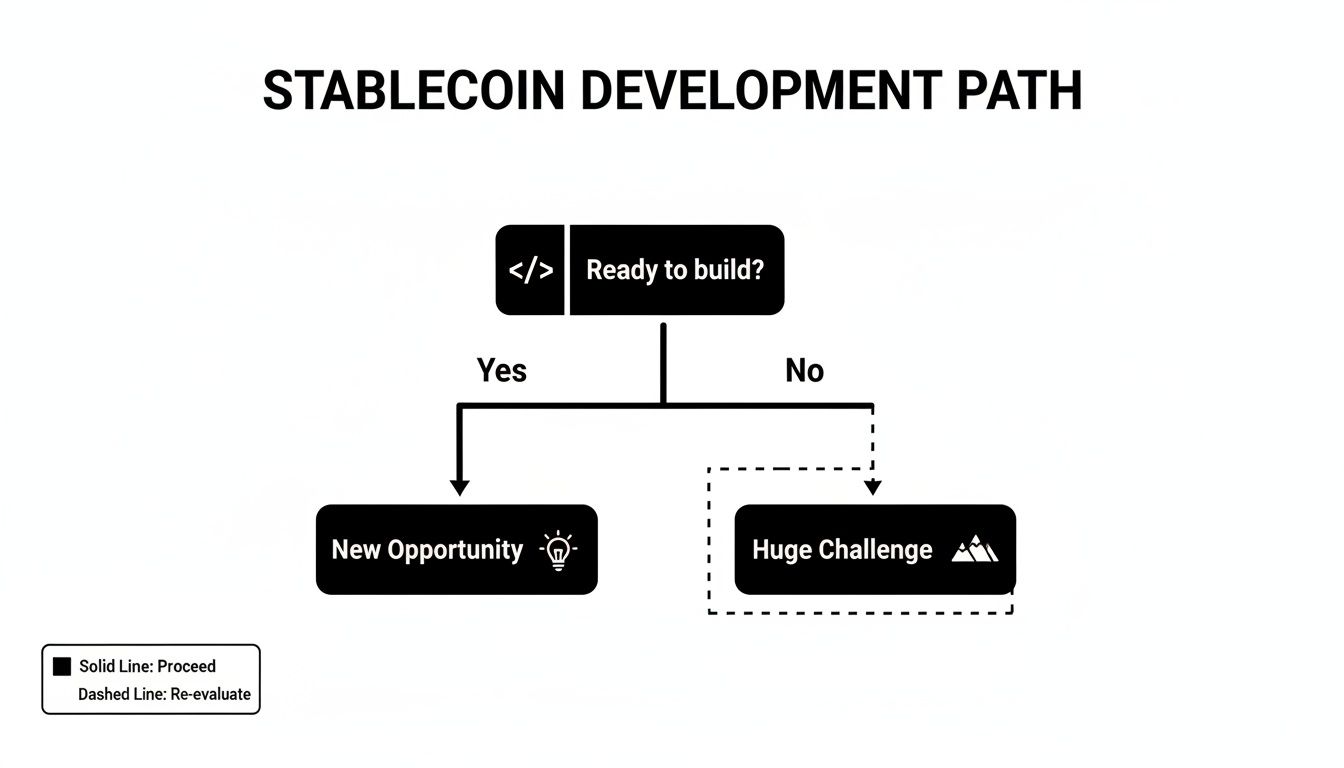
Ultimately, you need a clear-eyed assessment of the potential rewards and the very real obstacles ahead.
The Fiat-Collateralized Model
This is the most direct and well-trodden path. For every stablecoin you issue, you hold one unit of a fiat currency (like a U.S. dollar) in a bank or in ultra-safe assets like government T-bills. Think of it as a digital claim check for real-world cash.
The big win here is trust through simplicity. People get it. It has also proven to be the most reliable model for actually holding a peg. But its greatest strength—the connection to traditional finance—is also its biggest operational burden.
You aren't just a crypto project anymore; you're running a fintech company that has to play by the old-world banking rules. That means:
- Managing Reserves: You need to securely hold potentially billions of dollars. This requires forging relationships with top-tier banks and custodians.
- Transparent Audits: To earn and keep trust, you must publish regular, public attestations from reputable accounting firms. This proves your reserves match your circulating supply, and it's absolutely non-negotiable.
- Regulatory Burden: You will be under a microscope. Financial regulators worldwide will take a keen interest because you're bridging the gap between crypto and TradFi.
This model trades decentralization for stability and a clearer (though more demanding) regulatory path. It’s a capital-intensive and operationally heavy lift.
The Crypto-Collateralized Model
If decentralization is your north star, the crypto-collateralized model is a compelling alternative. Instead of fiat, these stablecoins are backed by a surplus of other crypto assets (think ETH or WBTC) locked up in smart contracts.
To absorb the wild price swings of crypto collateral, these systems are built on over-collateralization. What does that mean? A user might have to lock up $150 worth of ETH just to mint $100 of your stablecoin. That extra $50 acts as a buffer, protecting the system if the collateral’s price starts to tank.
The acid test for any crypto-backed stablecoin is surviving a "black swan" market crash. Your system's ability to automatically liquidate collateral before it becomes underwater is what separates a robust design from a failed experiment.
This approach is more capital-efficient for the issuer (you don't have to source and hold the reserves yourself), but it shifts the risk onto the users minting the stablecoin. It demands sophisticated risk modeling, rock-solid price oracles, and a battle-tested liquidation engine to have any chance of surviving market stress.
The Algorithmic Model
Welcome to the bleeding edge of DeFi—and its most dangerous frontier. Algorithmic stablecoins try to maintain a peg using software alone, with no direct collateral backing them. Typically, they rely on algorithms to automatically expand or contract the token supply based on market price.
While incredibly innovative on paper, this model is littered with high-profile implosions. The delicate balance of incentives can shatter during intense market stress, triggering a "death spiral" where a loss of confidence causes the peg to completely and permanently break. We cover the mechanics and historical failures in our deep dive into how algorithmic stablecoins work.
Let’s be blunt: attempting to build a purely algorithmic stablecoin is an exceptionally difficult endeavor. It demands a PhD-level grasp of monetary and game theory, and it carries the highest possible risk for both you and your users.
Getting Your Smart Contract Live
Alright, you've settled on your pegging mechanism. Now it's time to roll up your sleeves and turn that blueprint into code. This is the crucial step where your stablecoin goes from a concept on a whiteboard to a living, breathing asset on the blockchain. The smart contract is the very heart of your project—it’s the autonomous engine that enforces every rule your token will ever follow.

This isn’t just about writing code; it’s about building a fortress. Your contract must be airtight, performing its core jobs flawlessly while being ruthlessly optimized to keep transaction costs (gas fees) from scaring away your users.
Building the Core Functions
No matter what pegging model you've chosen, every stablecoin smart contract is built on a few fundamental functions. Think of these as the non-negotiable pillars that hold the entire structure up.
- Minting: This is how new tokens are born. For a fiat-backed coin, this function gets called when a user deposits real-world dollars into your reserves. If you're crypto-backed, it’s triggered when someone locks up their crypto collateral in the contract.
- Burning: This is the opposite of minting; it's how tokens are permanently destroyed. It happens when a user wants their collateral back, ensuring the circulating supply never gets out of sync with the value in your reserves.
- Transferring: This is the bread-and-butter function that lets users send your stablecoin between wallets. It's what makes your coin a usable medium of exchange.
These are the absolute basics. If you want to dive into the technical nitty-gritty, checking out real-world examples of USST stablecoin smart contracts is a great way to see how these concepts are actually implemented.
A pro tip from the trenches: build in an emergency pause or "circuit breaker." This is an admin function, ideally controlled by a multi-sig wallet, that can halt all minting, burning, and transfers. If a major vulnerability is ever discovered, this one function can be the difference between a manageable crisis and a catastrophic failure.
Choosing Your Blockchain Platform
Where you deploy your smart contract isn't a small decision—it has massive downstream effects. The chain you choose will dictate your stablecoin's transaction speed, costs, security posture, and the ecosystem you can plug into.
Ultimately, you're making a trade-off between decentralization, scale, and cost. Each platform offers a unique blend of these attributes.
| Platform | Key Advantages | Key Disadvantages |
|---|---|---|
| Ethereum Mainnet | Unmatched security, decentralization, and the largest, most battle-tested ecosystem. | High gas fees during peak times and slower transaction finality. |
| Layer 2 Solutions | Significantly lower transaction costs and faster speeds while inheriting Ethereum's security. | Can be less decentralized than mainnet and adds a layer of complexity. |
| Alternative L1s | Often feature extremely high throughput and near-zero transaction fees. | May have smaller user bases, less mature tooling, and varying security models. |
For a new team launching a stablecoin today, Ethereum's Layer 2 solutions often hit the sweet spot. You get access to the network's deep liquidity and massive user base but sidestep the high gas fees that can make a stablecoin unusable for everyday transactions.
Integrating Oracles for Reliable Data
If your stablecoin is crypto-collateralized or algorithmic, let me be clear: a reliable price oracle isn't a "nice-to-have." It is the absolute linchpin of your entire system. Oracles are the bridge that feeds real-world data, like the current price of ETH, onto the blockchain for your smart contract to use.
Without this data, your contract is flying blind. It needs these price feeds to perform its most critical tasks:
- Valuing Collateral: Is a user’s locked-up crypto still valuable enough to back the stablecoins they minted?
- Triggering Liquidations: If the collateral's value drops too low, the contract must automatically sell it to protect the system's solvency.
Relying on a single, centralized data feed is asking for trouble—it creates a massive single point of failure. Smart projects use decentralized oracle networks like Chainlink, which pull data from many independent sources. This approach makes the data feed tamper-proof and ensures your contract is always acting on accurate information, which is fundamental to maintaining the peg and your users' trust.
Fortifying Your Project: Security and Regulation
If you're launching a stablecoin, thinking about security and regulations as an afterthought is a fatal mistake. It's like building a bank vault with a screen door. Your smart contract's integrity and your legal standing aren't just important—they're the entire foundation of user trust. Mess up either one, and your project is doomed from the start.
Your code is your single biggest vulnerability. A single, overlooked flaw can drain every dollar from your protocol and evaporate your reputation overnight. This is exactly why independent, third-party security audits aren't just a nice-to-have; they are an absolute, non-negotiable requirement for any serious project.
Why Smart Contract Audits Are Your First Line of Defense
A professional audit is far more than a simple code scan. It's an exhaustive, adversarial review where experts are paid to think like a hacker and actively try to break your system. They'll simulate sophisticated economic attacks and push your code to its absolute limits, looking for any weak points.
During a proper audit, you can expect them to hammer on things like:
- Reentrancy Attacks: The classic DeFi exploit where a malicious contract repeatedly calls a function to drain funds before the first transaction even settles.
- Integer Overflows/Underflows: A nasty bug where a number wraps around its maximum or minimum value, leading to completely unpredictable and often catastrophic results.
- Oracle Manipulation: Scenarios where an attacker could manipulate a price feed, tricking your protocol into issuing unbacked tokens or liquidating collateral at the wrong price.
- Access Control Flaws: Making absolutely sure that powerful functions—like an emergency pause or upgrade—can only be triggered by the right people.
Choosing the right firm is just as important as the audit itself. You want a team with a proven track record of auditing high-value, battle-tested DeFi protocols. Prepare for a demanding back-and-forth process; it often takes multiple rounds of fixes and re-audits before your code is truly ready for primetime.
Don't ever make the mistake of thinking a clean audit report is a permanent shield. Security is a continuous process, not a one-time checkbox. Post-launch, you'll need ongoing monitoring and bug bounty programs to stay ahead of new threats.
Navigating the Regulatory Maze
At the same time you're hardening your code, you have to tackle the incredibly complex and ever-changing world of financial regulations. Regulators across the globe have stablecoins squarely in their sights, and falling out of compliance can lead to crippling fines, project shutdowns, and even personal liability. A crucial first step is properly setting up your business entity to handle these legal obligations.
For any fiat-backed stablecoin, the heart of compliance is reserve transparency. This is quickly shifting from a best practice to a legal mandate. You must be prepared to:
- Publish Regular Attestations: Hire a reputable accounting firm to regularly verify that your reserves match your circulating supply, and then make those reports public.
- Disclose Your Reserve Mix: Be crystal clear about what assets are backing your stablecoin. Is it cash? U.S. Treasury bills? You need to show the exact composition.
- Define Clear Redemption Paths: Users need a reliable, documented process to redeem their stablecoins for the underlying fiat currency.
New regulatory frameworks, like the EU’s Markets in Crypto-Assets Regulation (MiCAR), are setting a new global benchmark. By late 2025, the composition of stablecoin reserves had become a major focus. S&P Global estimated that stablecoin issuers held a staggering $155 billion in U.S. Treasury bills, making them a major player in traditional finance. This demonstrates just how integrated stablecoins are becoming and why regulators are stepping in.
Regulations like MiCAR are actually creating clearer paths to operate legally, while a lack of clarity in other regions can suffocate innovation. The takeaway is clear: be ready for reporting and custody requirements on par with traditional financial institutions. For more on this, you can dig into the excellent S&P Global's analysis on stablecoin reserves.
Ultimately, getting security and compliance right is how you build genuine, lasting trust. To get a better handle on the specific rules you’ll face, our comprehensive guide on stablecoin regulation is an essential resource. It's a tough landscape to navigate, but it’s the only path to building a project that endures.
Building and Scaling Your Stablecoin Ecosystem
Getting your smart contract deployed is a massive achievement, but let's be real—it's just the starting line. A stablecoin without users, deep liquidity, and a network of applications is nothing more than an elegant piece of code. The true test when you create your own stablecoin isn't the technical side; it's building a vibrant, self-sustaining ecosystem. This is where your go-to-market strategy comes into play.
The journey from a freshly minted token to a trusted medium of exchange starts with one critical ingredient: liquidity. Without it, your stablecoin is essentially unusable.
Bootstrapping Initial Liquidity
Liquidity is the absolute lifeblood of any token. It’s what allows users to buy and sell your stablecoin without causing wild price swings. Your first, most urgent task is to establish deep, accessible liquidity pools, and your primary battleground will be on decentralized exchanges (DEXs).
This means you’ll need to pair your stablecoin with a major asset—think ETH, WBTC, or even an established stablecoin like USDC—in a liquidity pool on a platform like Uniswap or Curve. Seeding these pools isn't cheap; it requires a significant chunk of initial capital from your project's treasury.
Think of it this way: a shallow liquidity pool is like a small puddle. Even a tiny splash (a single trade) can create huge ripples (price volatility). A deep pool, on the other hand, can absorb much larger impacts with minimal disturbance. Your goal is to build an ocean.
To get there, many projects bring in the pros and partner with market-making firms. These specialists use sophisticated algorithms to provide constant buy and sell orders across multiple exchanges, ensuring tight spreads and a stable trading environment. It's often a necessary cost to build the initial confidence required for wider adoption.
Securing Exchange Listings and Building Credibility
While DEX liquidity is essential for the DeFi-native crowd, getting listed on major centralized exchanges (CEXs) is a powerful catalyst for growth. A CEX listing acts as a massive signal of legitimacy to the broader market, often bringing a huge influx of new users and trading volume.
The listing process can be a grind and varies from one exchange to another, but you can generally expect:
- A Rigorous Vetting Process: Exchanges will put your project under a microscope, scrutinizing your security audits, legal structure, and the team’s background.
- Demonstrable Demand: You’ll need to prove that your stablecoin has an active community and a real-world use case beyond pure speculation.
- Technical Integration: Your team must collaborate closely with the exchange’s engineers to ensure a smooth, secure integration of your token.
The importance of this step cannot be overstated. Recent data shows stablecoins have evolved into an active payments layer driving massive financial flows. In a single month—October 2025—centralized exchanges handled approximately $2.08 trillion in stablecoin pair trading volumes, with Tether dominating over 75% of that activity. These staggering figures highlight the immense liquidity needed and why listings on platforms capable of supporting trillions in annual flows are so critical.
Creating Utility and Fostering an Ecosystem
Listings and liquidity get you in the game, but long-term success hinges on creating genuine, sticky utility that weaves your stablecoin into the fabric of the digital economy. You want your coin to be a useful tool, not just another trading pair.
This means a relentless focus on integrations and partnerships. You need to be actively pushing to get your stablecoin accepted and used by:
- DeFi Protocols: Get integrated with lending platforms, yield farms, and derivatives markets to make your stablecoin a core collateral asset.
- Payment Gateways: Team up with services that allow merchants to accept your stablecoin for real-world goods and services.
- Wallet Providers: Make sure your stablecoin is supported by popular custodial and non-custodial wallets to make it easy for anyone to hold and use.
To kickstart this process, consider launching a grant program to incentivize developers to build new applications using your stablecoin. By offering resources, you can jumpstart the creation of a unique ecosystem. A well-documented stablecoin API is also a game-changer, making it dead simple for developers to plug your token into their dApps and services.
This strategic plan—from bootstrapping liquidity to fostering a developer community—is a great starting point. Here's a quick checklist to keep you on track.
Go-to-Market Checklist for a New Stablecoin
| Phase | Action Item | Key Metric for Success |
|---|---|---|
| Phase 1: Foundation | Seed initial DEX liquidity pools (e.g., on Uniswap, Curve). | $5M+ in Total Value Locked (TVL) within the first month. |
| Phase 1: Foundation | Partner with a professional market-making firm. | Bid-ask spread consistently below 0.1% on key pairs. |
| Phase 2: Growth | Secure listings on 2-3 mid-tier centralized exchanges. | Daily trading volume exceeding $10M. |
| Phase 2: Growth | Integrate with 5+ major DeFi lending/borrowing protocols. | Stablecoin becomes a recognized collateral asset. |
| Phase 3: Expansion | Launch a developer grant program to spur ecosystem growth. | 10+ new projects building on your stablecoin within 6 months. |
| Phase 3: Expansion | Partner with a payment processor for merchant acceptance. | 1,000+ active users transacting for goods/services. |
Building a thriving community through social media, developer forums, and events is just as crucial. An engaged user base provides priceless feedback, drives organic growth, and becomes your project's most passionate advocate. This powerful combination of deep liquidity, strategic listings, and relentless ecosystem building is how you transform your code into a lasting financial utility.
Common Questions About Creating a Stablecoin
So, you're thinking about building a stablecoin. It's a massive undertaking, and it's natural to have a ton of questions swirling around. Even the most well-prepared teams run into the same hurdles and head-scratchers. Let's cut through the noise and tackle some of the most pressing questions that come up time and time again.
Getting clear, straight answers on these points from the outset can save you a world of pain, time, and money down the road. We'll cover everything from the sticker shock of the initial budget to the day-in, day-out grind of keeping the thing afloat.
How Much Does It Really Cost?
There's no single answer here. The cost to create and launch a stablecoin can range from tens of thousands of dollars to well into the millions. It all comes down to the complexity of your model and the scope of your ambition.
A few non-negotiable line items will be on every project's budget:
- Smart Contract Development: The core engineering work to design, code, and test your token.
- Third-Party Security Audits: Don't even think about skipping this. A stamp of approval from a top-tier audit firm is your ticket to earning user trust. It’s expensive, but a hack is infinitely more so.
- Legal and Compliance Fees: This is a big one. You'll need expert legal counsel to navigate the labyrinth of global financial regulations, and it's a significant, ongoing expense.
- Initial Liquidity Capital: Your coin needs to be tradable from day one. That means you need a substantial war chest to seed liquidity pools on decentralized and centralized exchanges.
If you’re building a straightforward, fiat-backed stablecoin on an established EVM chain, you'll be on the lower end of that spectrum. But if you're pioneering a new algorithmic mechanism? Expect to budget a whole lot more for R&D, specialized development, and a much more intense security and legal review.
What's the Hardest Part of Running a Stablecoin?
The initial technical build is a huge challenge, no doubt. But the truly difficult part—the relentless, day-to-day grind—is maintaining the peg under market stress and managing ongoing regulatory compliance. These aren't one-time problems to solve; they are a permanent state of being.
For any crypto-backed or algorithmic model, the real acid test is a black swan event in the market. When prices are in freefall, your risk management frameworks and liquidation engines have to work perfectly, without a single hiccup. One failure can trigger a death spiral.
For fiat-backed models, the challenge is pure operational discipline. It's about flawlessly managing reserves, processing redemptions on time, every time, and keeping your attestations squeaky clean. All while the global regulatory goalposts are constantly moving. Staying compliant requires a dedicated team of experts and is a cost center that never goes away.
The technical build is a sprint; maintaining the peg and navigating compliance is a marathon with no finish line. Your long-term success hinges far more on operational discipline than on the cleverness of your initial code.
Can a Stablecoin Exist Without Real-World Assets?
Yes, it's definitely possible—that’s the whole idea behind crypto-collateralized and algorithmic stablecoins. These models are specifically designed to function without a vault of dollars or gold sitting in a bank somewhere.
Crypto-collateralized stablecoins like DAI from MakerDAO are backed by a surplus of other crypto assets (like ETH or WBTC) locked into smart contracts. The system requires users to over-collateralize—that is, lock up, say, $150 worth of crypto to mint $100 worth of stablecoins. This creates a buffer to absorb price shocks.
Algorithmic models are even more ambitious, trying to maintain a peg using nothing but software rules that expand or contract the token's supply. Both of these approaches, however, come with their own serious risks. Crypto-collateralized coins are still vulnerable if their underlying collateral crashes too fast. And as we've seen, purely algorithmic stablecoins have proven to be incredibly fragile, often failing spectacularly during market crises.
How Do Stablecoins Actually Make Money?
This is the bottom-line question for anyone trying to build a sustainable business. For most issuers, the primary revenue stream is simple: interest earned on the reserve assets.
Think about a fiat-collateralized stablecoin. The issuer takes the billions of dollars in customer funds and parks them in very safe, yield-bearing instruments, like U.S. Treasury bills. The issuer pockets the yield generated from those assets.
For example, if an issuer holds $1 billion in reserves and invests it in T-bills that earn a 4% annual yield, that's $40 million in revenue. Simple as that. Some projects might also charge small transaction fees for minting and redeeming tokens, but these are usually kept low to encourage adoption.
At Stablecoin Insider, we provide the in-depth analysis and news you need to stay ahead in the world of digital finance. Whether you're a developer, investor, or policymaker, our platform is your essential resource for understanding the future of money. Explore our latest insights at https://stablecoininsider.com.