
Table of Contents
Stablecoins are fundamentally reshaping global commerce, offering a powerful combination of blockchain’s efficiency and the price stability of traditional fiat currencies. For businesses ranging from e-commerce startups to large-scale enterprises, this translates into tangible benefits: significantly lower transaction fees, near-instant settlement times, and access to a global, borderless customer base without the volatility typically associated with cryptocurrencies. The key to unlocking this potential lies in selecting the right integration partner.
This guide is designed to help you navigate this critical decision. We provide a comprehensive, developer-focused analysis of the best stablecoin payment APIs on the market. Forget generic marketing claims; we delve into the practical details that matter for implementation, scalability, and compliance. Our goal is to equip you with the insights needed to choose a solution that aligns perfectly with your business model, technical stack, and growth ambitions.
Inside, you will find a detailed breakdown of 12 top-tier providers. Each review covers:
- Core features and supported stablecoins (USDC, USDT, etc.)
- On/off-ramp capabilities and fiat settlement options
- Regional availability and KYC/AML processes
- Developer resources, including SDKs and documentation quality
- Pricing structures and potential hidden fees
We offer an honest assessment of each platform's pros and cons, complete with screenshots, direct links, and integration tips to streamline your evaluation process. This resource will help you find the most effective stablecoin payment API to reduce operational costs, enhance user experience, and future-proof your payment infrastructure. Let’s dive in.
1. Stripe – Stablecoin payments
Stripe, a titan in traditional payment processing, has entered the digital asset space with its stablecoin payments API. This solution is designed for businesses seeking the benefits of crypto payments without the operational complexities of holding digital assets. By leveraging Stripe's familiar infrastructure, merchants can accept stablecoin payments and receive settlements directly as fiat USD into their Stripe balance.
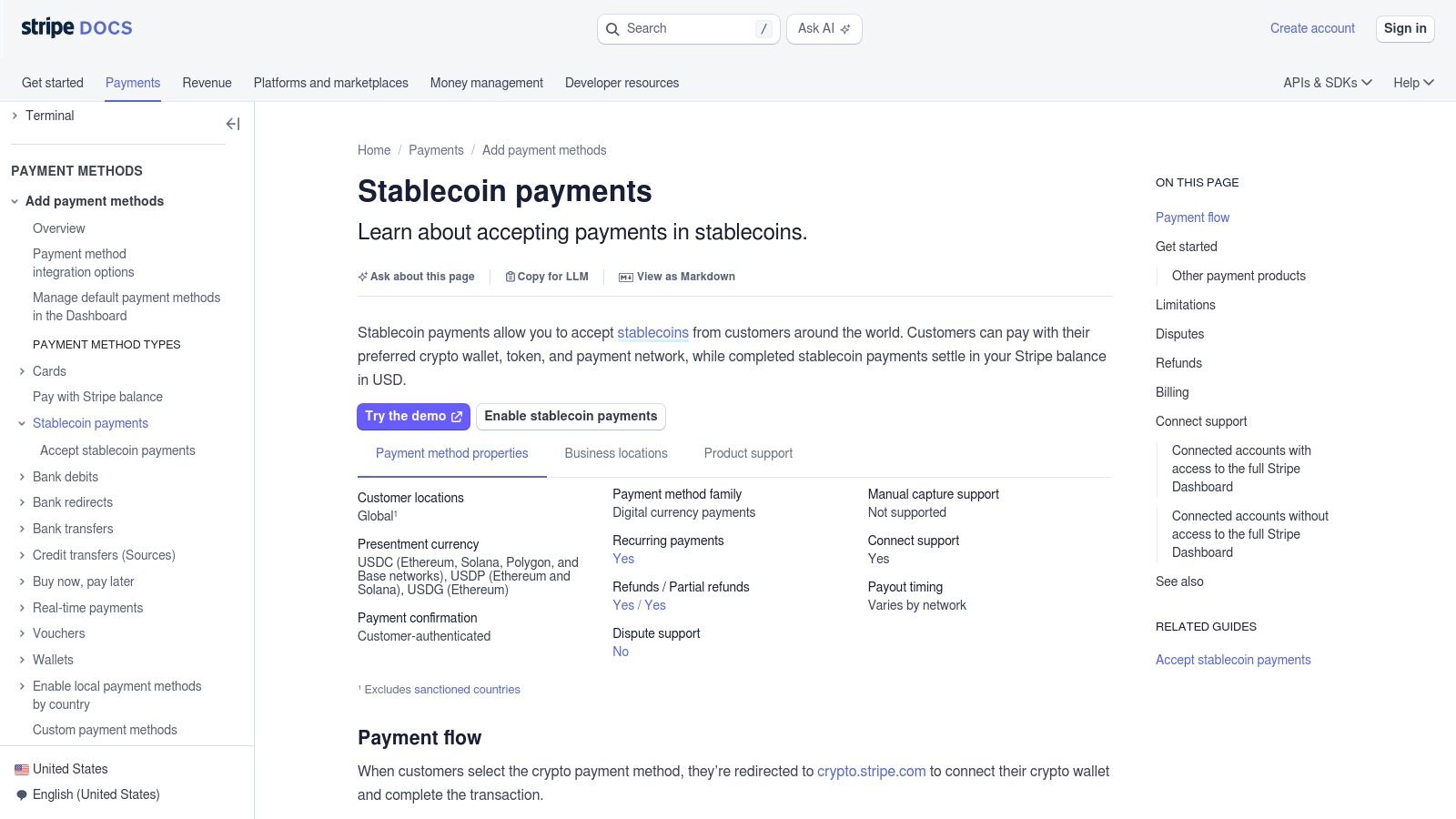
This approach makes Stripe one of the best stablecoin payment APIs for businesses prioritizing simplicity and risk management. Integration is seamless for existing Stripe users, utilizing tools like Checkout, Elements, and the Payment Intents API. The system handles all crypto-to-fiat conversions, shielding merchants from price volatility and gas fee management.
Key Features & Considerations
- Supported Assets: Accepts USDC on Ethereum, Solana, Polygon, and Base, plus USDP and USDG on select networks.
- Settlement: Payments settle automatically as USD, eliminating merchant crypto custody. Refunds are processed back to the customer in the original stablecoin.
- Integration: Uses the same robust tools as Stripe's fiat products, ensuring a low learning curve for developers.
- Payouts: Stripe Connect enables platforms and marketplaces to send stablecoin payouts directly to recipients' wallets.
Our Take: Stripe is the ideal choice for established businesses wanting to test crypto payments with minimal disruption. The enterprise-grade security, reporting, and dispute handling are significant advantages, although the service is currently in a public preview limited to approved U.S. businesses. Learn more about the top solutions available when you check out our complete guide to the best stablecoin payment APIs.
Website: https://docs.stripe.com/payments/stablecoin-payments
2. Coinbase Commerce / Coinbase Payments
Coinbase, a leading name in the crypto ecosystem, offers a powerful suite of tools for merchants through its Commerce API and Payments stack. This solution is designed for businesses ready to embrace onchain crypto payments, providing guaranteed settlement in USDC to mitigate volatility risk. It empowers merchants to accept a wide range of cryptocurrencies while maintaining financial stability through stablecoins.
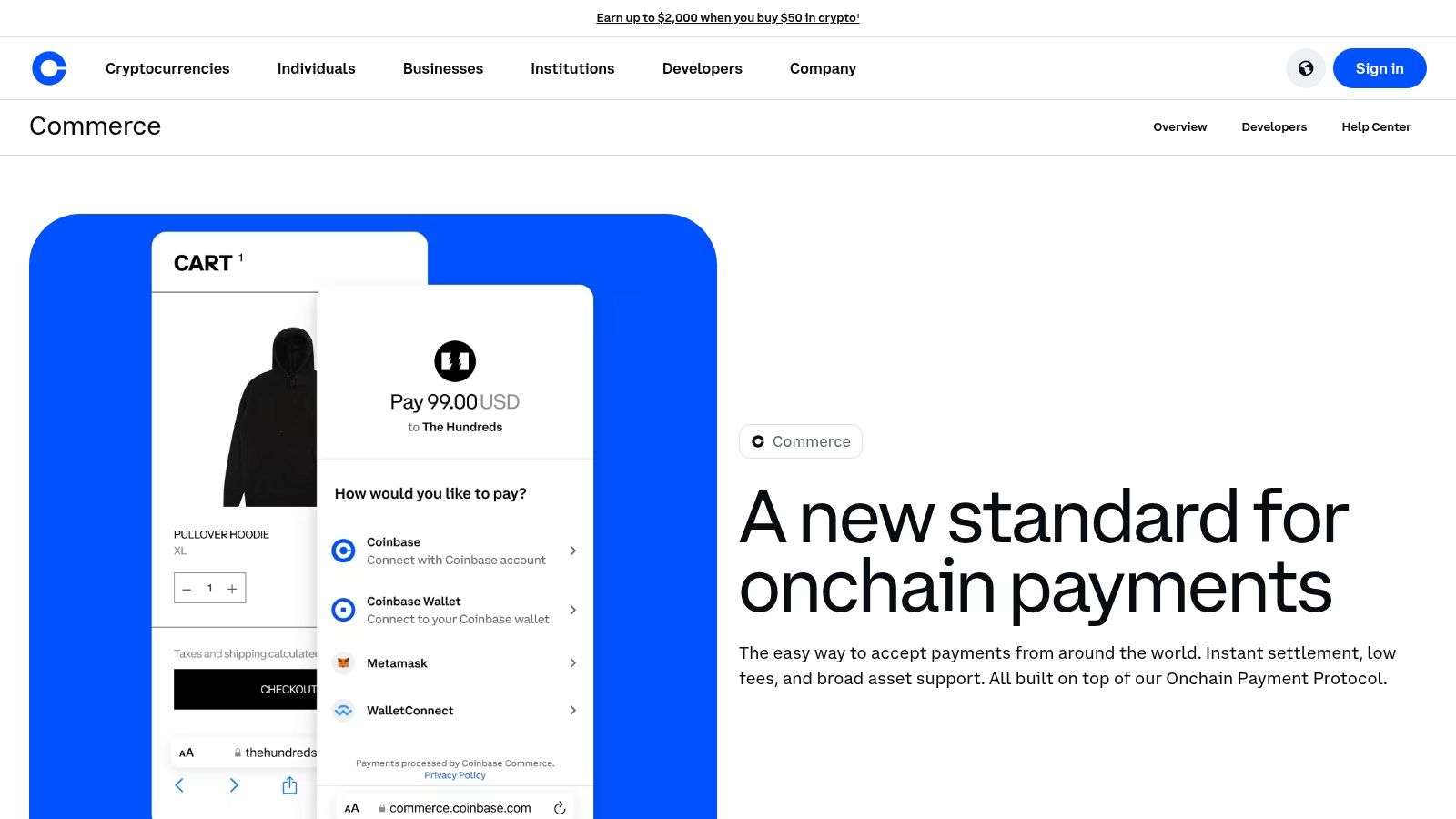
What makes Coinbase one of the best stablecoin payment APIs is its focus on a native onchain experience. The platform delivers a gasless payment flow for customers and advanced smart-contract features like authorization, refunds, and delayed capture. Integration is facilitated through SDKs, webhooks, and direct partnerships with major e-commerce platforms like Shopify, simplifying the setup for a broad range of businesses.
Key Features & Considerations
- Supported Assets: Accepts a wide variety of cryptocurrencies, including ETH, BTC, and multiple stablecoins across different networks.
- Settlement: Offers guaranteed settlement to USDC, insulating merchants from market fluctuations. Payouts are made directly to a merchant's Coinbase account or a self-custody wallet.
- Integration: Provides robust SDKs, webhooks for real-time notifications, merchant ledgering, and checkout links. It supports Base, Ethereum, and Polygon.
- User Experience: Creates a seamless, browser-native payment experience for customers, removing the complexities of gas fees from the transaction process.
Our Take: Coinbase is an excellent choice for digitally native businesses or those looking to fully integrate onchain operations. The trust associated with the Coinbase brand and its extensive ecosystem, including wallet integrations, provides a significant advantage. While it requires a greater comfort level with onchain flows compared to traditional processors, its feature set is ideal for crypto-forward companies. Get an in-depth analysis when you review our Coinbase complete breakdown.
Website: https://www.coinbase.com/cloud/products/commerce-api
3. Circle – USDC/EURC APIs
As the official issuer of USDC and EURC, Circle provides APIs that offer direct, institutional-grade access to the stablecoin ecosystem. Unlike merchant-focused processors, Circle's APIs are designed for platforms needing to manage their own stablecoin treasury, build programmatic minting and redemption flows, or provide first-party liquidity. This makes it a foundational tool for businesses that want deep integration with stablecoin operations.
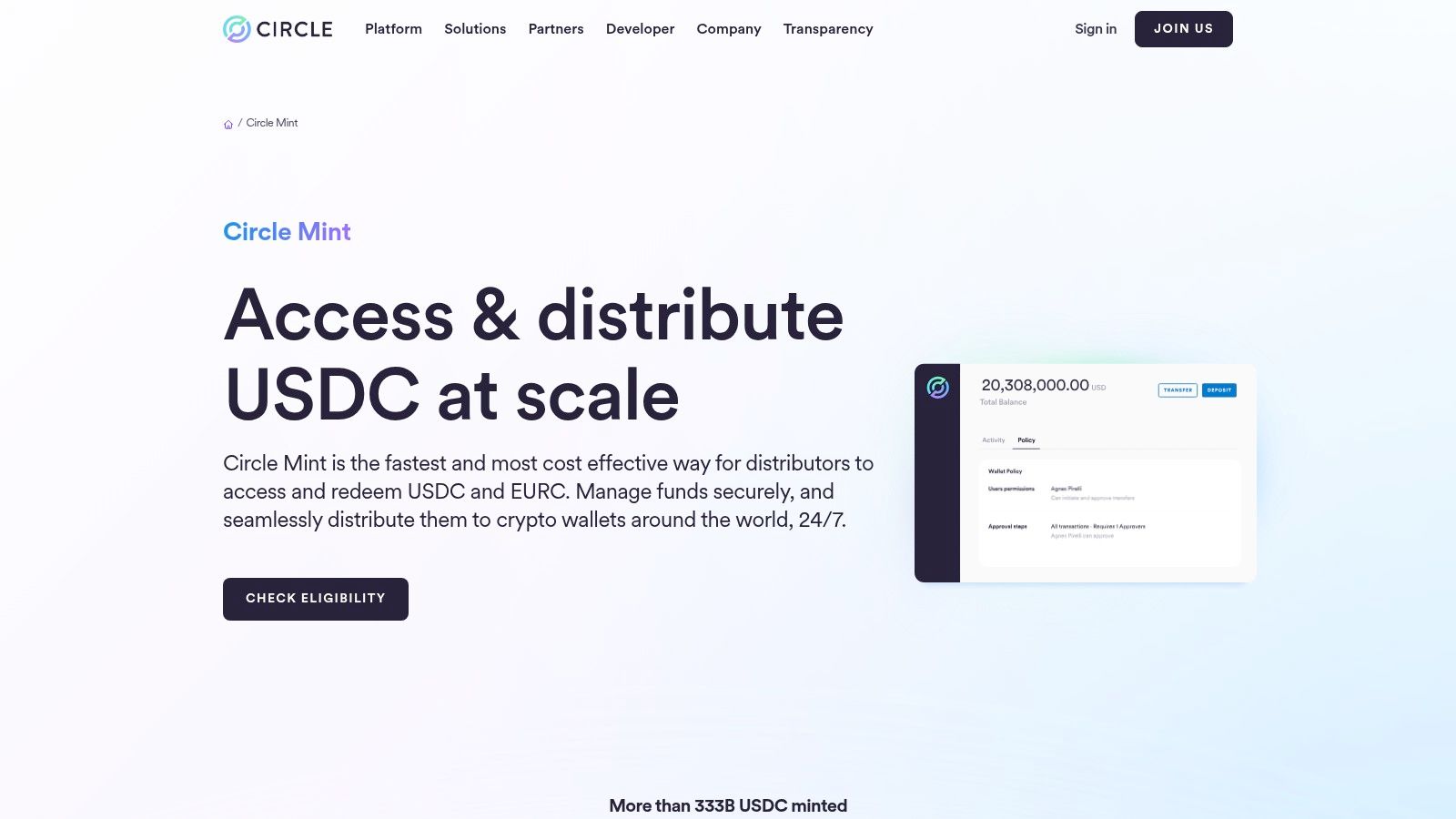
This direct-from-issuer approach is what makes Circle one of the best stablecoin payment APIs for large-scale financial applications, exchanges, and wallets. The platform allows businesses to programmatically convert funds between bank transfers (wires/SEPA) and stablecoins, enabling seamless treasury management and cross-border payments without relying on third-party liquidity providers.
Key Features & Considerations
- Direct Issuer Access: Mint and redeem USDC and EURC at a 1:1 ratio directly with the source, reducing counterparty risk.
- Institutional Onboarding: Requires comprehensive KYB (Know Your Business) and compliance screening, tailored for corporations and financial institutions.
- Multi-Network Support: APIs support USDC across various blockchains, although specific network availability may change over time.
- Treasury Management: Ideal for managing corporate treasury operations, enabling programmatic fund flows between fiat and digital dollars.
Our Take: Circle is the definitive choice for institutionally-focused platforms that need to handle stablecoin liquidity and treasury at scale. Its robust compliance framework and direct access are unparalleled, though it is not a plug-and-play solution for SMB e-commerce. The lengthy onboarding process is a barrier for smaller businesses. To find out more, explore our guide on how to integrate USDC into your e-commerce platform.
Website: https://www.circle.com/en/payments-api
4. BitPay – Payment gateway and payouts
BitPay is a long-standing crypto payment processor that provides a comprehensive suite of tools for businesses to accept digital assets. Its offerings include APIs, hosted checkout pages, and e-commerce plugins, making it a versatile choice for both online and in-person merchants. BitPay supports settlement to bank accounts or directly in crypto, including USDC, providing flexibility for managing revenue.

This platform’s maturity and established compliance posture make it one of the best stablecoin payment APIs for businesses seeking reliability. The BitPay Send feature is a standout, enabling global mass payouts to vendors, contractors, or affiliates in USDC and other digital currencies. This dual capability for both acceptance and payouts positions BitPay as an all-in-one solution for crypto-enabled commerce.
Key Features & Considerations
- Settlement Options: Merchants can choose to receive automated daily settlements as fiat (USD via ACH for U.S. businesses) or in crypto, including USDC.
- Integration Tools: Offers everything from direct API access to simple e-commerce plugins for platforms like Shopify and WooCommerce, catering to various technical skill levels.
- Global Payouts: The BitPay Send service facilitates efficient, low-cost mass payouts in stablecoins, bypassing traditional international banking friction.
- Reporting: Provides strong accounting and export capabilities to simplify reconciliation and financial reporting for businesses.
Our Take: BitPay is an excellent choice for businesses that need a proven, reliable crypto payment processor with flexible settlement and robust payout features. While perhaps less web3-native than newer stacks, its mature tooling and support infrastructure are significant advantages for merchants prioritizing stability and comprehensive functionality. Check out our guide to other payment gateways like Alchemy Pay for more options.
Website: https://bitpay.com/business
5. CoinPayments
CoinPayments is a long-standing crypto payment gateway that offers extensive multi-asset support through a versatile v2 REST API. It is designed for businesses that need to accept a wide variety of digital currencies, including stablecoins like USDC and USDT, across numerous blockchain networks. The platform provides tools like invoices, webhooks, and e-commerce plugins to facilitate integration.
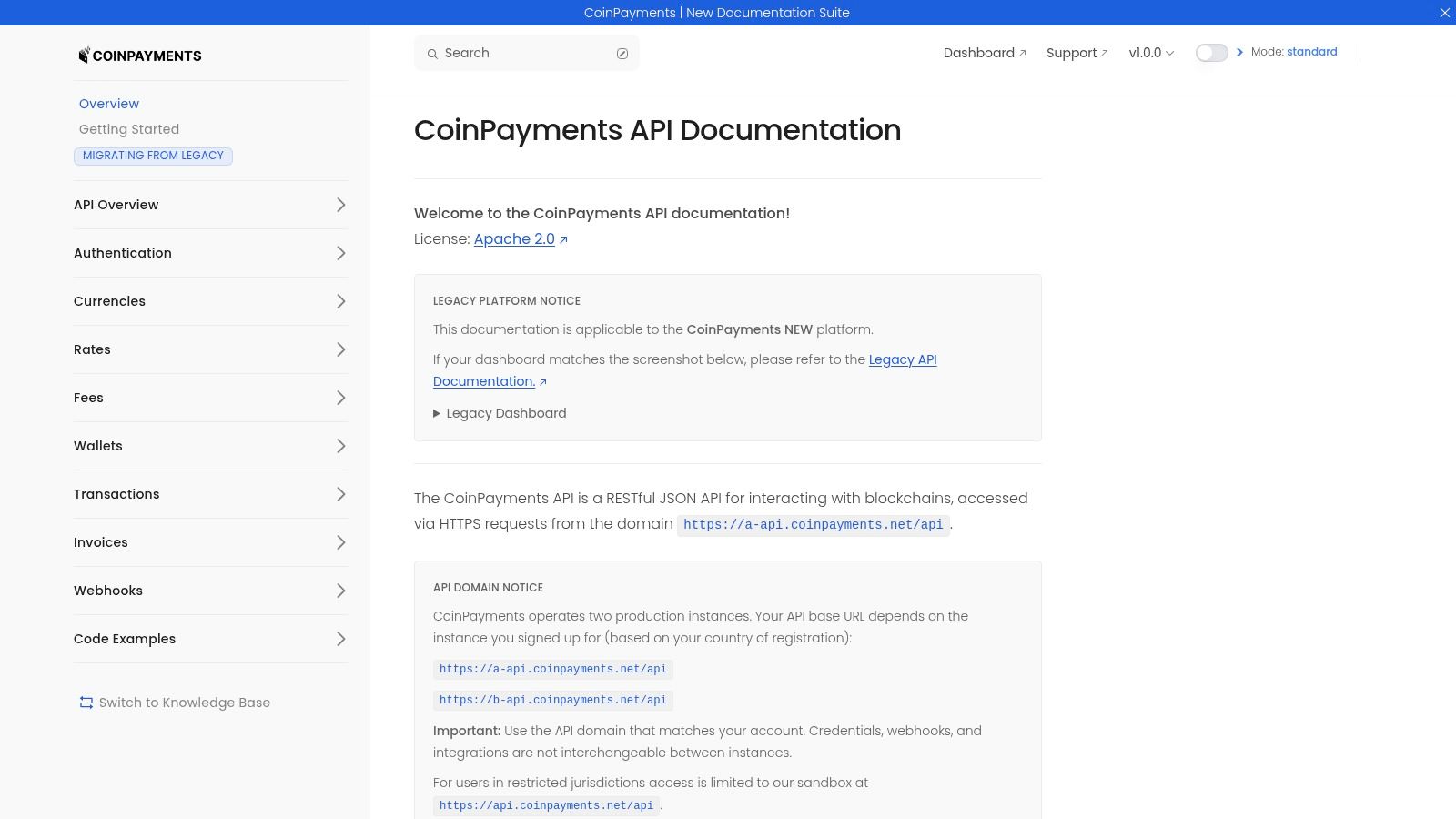
This gateway stands out for its broad asset coverage and multiple integration pathways, making it one of the best stablecoin payment APIs for merchants prioritizing flexibility. It supports both ERC-20 and TRC-20 token standards, among others. Merchants can settle payments in crypto or, depending on their jurisdiction and partner availability, convert to fiat currency. A sandbox environment is also available for developers to test their integrations thoroughly.
Key Features & Considerations
- Supported Assets: Extensive support for USDC, USDT, and numerous other stablecoins and cryptocurrencies across multiple blockchains.
- Settlement: Flexible settlement options allow merchants to receive funds as crypto or fiat, though fiat conversion is partner-dependent and varies by region.
- Integration: Offers a v2 REST API, webhooks, and pre-built plugins for popular e-commerce platforms like Shopify, WooCommerce, and Magento.
- Developer Tools: Provides comprehensive developer documentation and a sandbox environment with test coins for integration trials.
Our Take: CoinPayments is an excellent option for merchants who require broad coin support and multiple integration methods. Its long operating history and low-friction onboarding are appealing, but businesses must be mindful of jurisdictional restrictions that affect service availability, supported currencies, and settlement options. The existence of legacy and new documentation can sometimes create confusion for developers.
Website: https://a-docs.coinpayments.net/api/
6. CoinGate
CoinGate is a Lithuania-based payment gateway that offers a comprehensive suite of tools for merchants looking to integrate stablecoin payments. The platform distinguishes itself with a strong focus on e-commerce and a proactive approach to regulatory compliance, particularly within the EU's MiCA framework. This makes it an excellent choice for online businesses seeking a reliable processor that prioritizes both usability and adherence to evolving digital asset regulations.
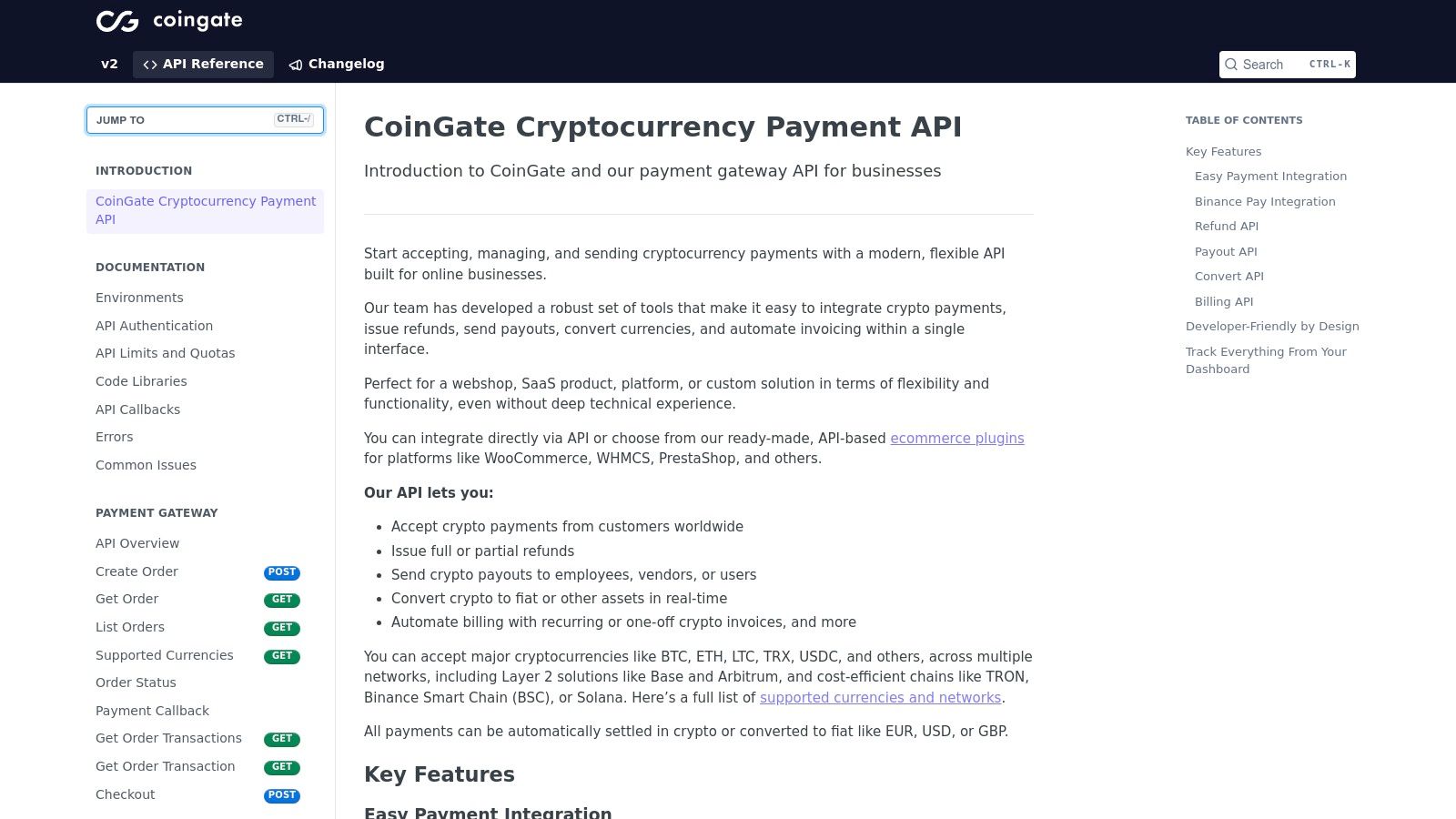
The platform provides an API for creating orders, handling refunds, and initiating payouts, supported by extensive developer documentation. CoinGate enables merchants to accept stablecoins like USDC across multiple networks and offers straightforward fiat settlement options, converting crypto payments into EUR, USD, or other currencies. This blend of features positions it as one of the best stablecoin payment APIs for European e-commerce stores and international merchants.
Key Features & Considerations
- Supported Assets: Primarily focuses on USDC across various networks including Ethereum, Polygon, Base, and Arbitrum. Other stablecoin availability may be impacted by EU regulations.
- Settlement: Offers flexible settlement in fiat currencies (EUR, USD) or the original cryptocurrency, giving merchants control over their funds.
- Integration: Provides dedicated plugins for popular e-commerce platforms like WooCommerce, WHMCS, and PrestaShop, simplifying integration for non-technical users.
- Payouts: The API supports both individual and mass payouts, useful for businesses needing to disburse funds in stablecoins.
Our Take: CoinGate is a top-tier choice for EU-based e-commerce merchants who need a compliant, user-friendly solution with robust tooling. Its clear regulatory stance provides peace of mind, though merchants outside the EU should verify feature availability. The platform’s ability to handle cross-border transactions makes it a versatile tool for global commerce. Discover how you can use stablecoins to pay overseas in 2025 with platforms like CoinGate.
Website: https://developer.coingate.com/
7. CoinsPaid
CoinsPaid provides a comprehensive crypto payment ecosystem designed for operational scale, with a strong focus on stablecoin processing. The platform offers a suite of tools including APIs, e-commerce plugins, and manual invoices, enabling businesses to accept digital assets like USDC. Its key value proposition lies in its ability to automate the entire payment lifecycle from acceptance to fiat settlement.
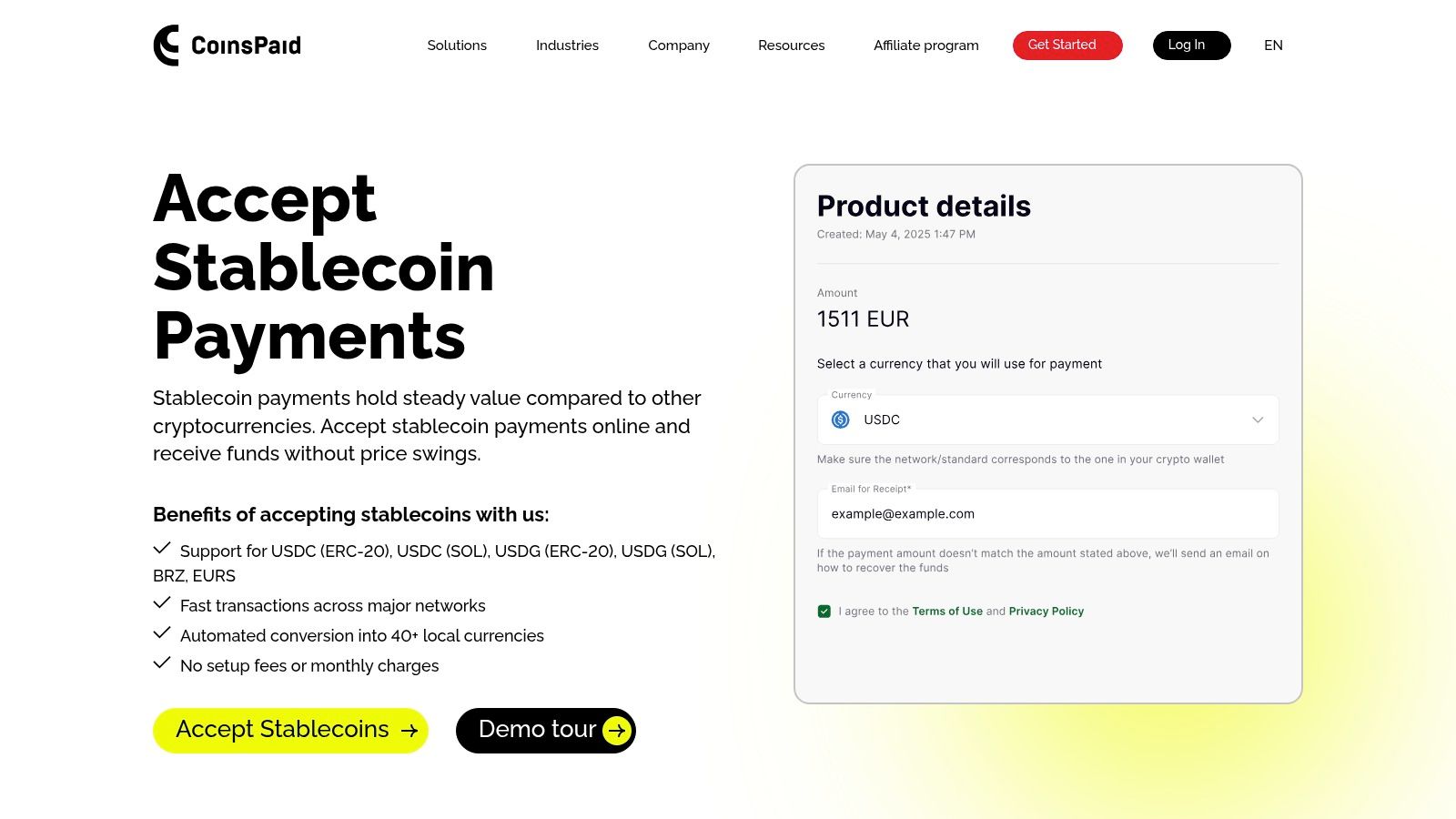
This makes CoinsPaid one of the best stablecoin payment APIs for businesses requiring robust conversion and multi-currency payout capabilities. The system is engineered to handle high transaction volumes, featuring automatic conversion of crypto to a choice of over 40 fiat currencies. This feature, combined with a rate-lock mechanism, protects merchants from market volatility while simplifying global treasury management.
Key Features & Considerations
- Automatic Conversion: Instantly converts incoming stablecoin payments into a wide range of fiat currencies, mitigating crypto exposure.
- Global Payouts: Supports settlement to bank accounts in over 40 different fiat currencies, ideal for international operations.
- Integration Tools: Provides a flexible API, payment links, and ready-made plugins for major e-commerce platforms like Shopify and WooCommerce.
- Compliance & Support: Features built-in KYB/AML tooling and offers dedicated merchant onboarding with 24/7 customer support.
Our Take: CoinsPaid is an excellent solution for high-volume businesses and global platforms that need more than just a payment gateway. The extensive fiat payout options and OTC desk services are significant differentiators. However, merchants must complete a full KYB process before going live, and service availability is subject to regional restrictions.
Website: https://coinspaid.com/accept-crypto-payments/stablecoins/
8. NOWPayments
NOWPayments is a developer-friendly, non-custodial crypto payment gateway that offers a flexible and asset-rich environment for merchants. Its API allows businesses to accept a vast array of cryptocurrencies, including popular stablecoins like USDC on various networks, and automatically convert them to a preferred asset. This platform is tailored for businesses that want direct control over their funds without relying on a third-party custodian.
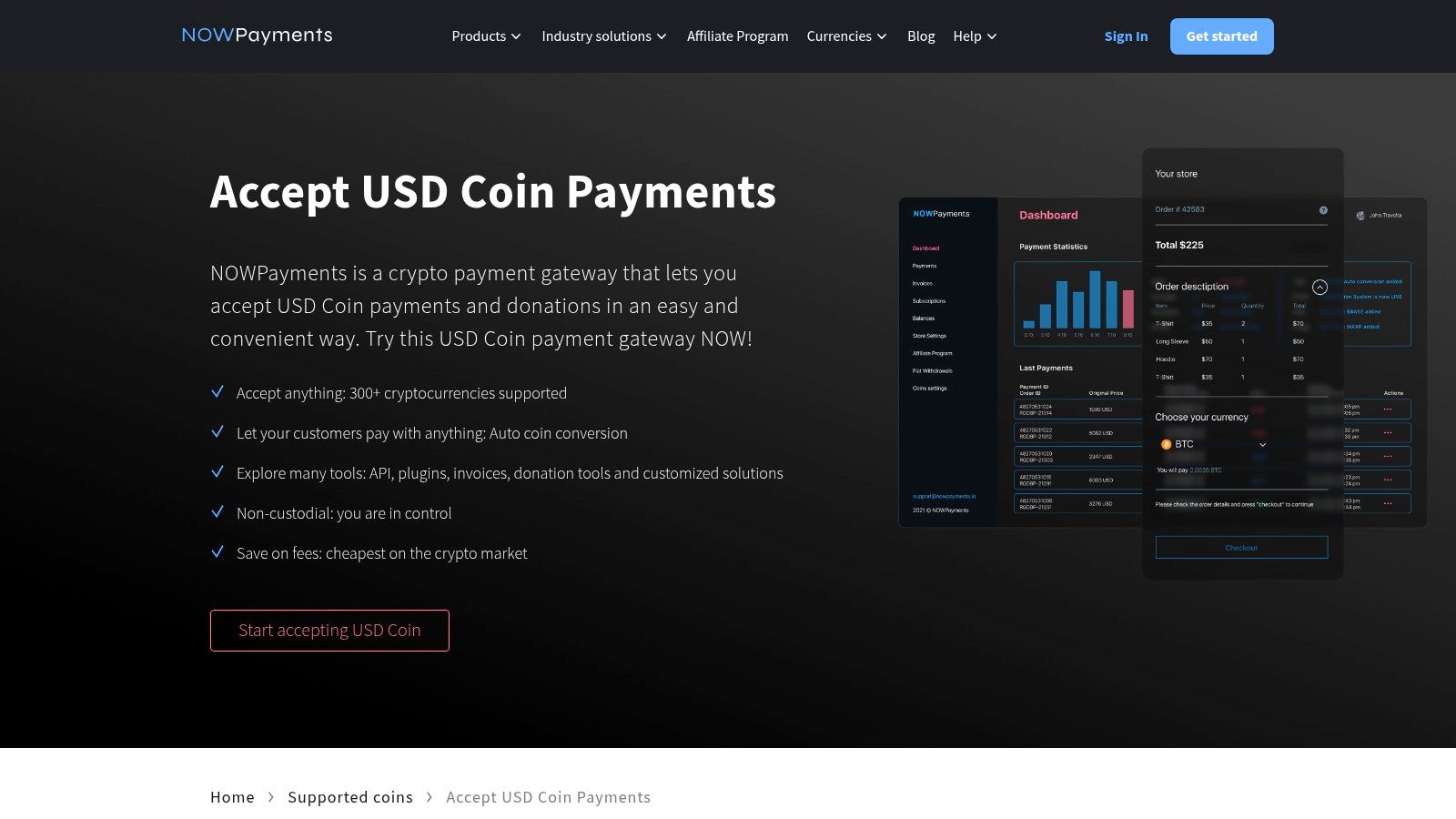
The non-custodial model is a key differentiator, making NOWPayments one of the best stablecoin payment APIs for users prioritizing self-sovereignty. Integration is streamlined through its API, various e-commerce plugins, invoices, and dedicated donation tools. Merchants simply provide their destination wallet address, and payments are sent directly there after processing, giving them full control and responsibility over asset security.
Key Features & Considerations
- Supported Assets: Extensive support for over 300 digital assets, with an auto-conversion feature to consolidate payments into a single chosen stablecoin or other cryptocurrency.
- Settlement: As a non-custodial gateway, payments are forwarded directly to the merchant's private wallet. The merchant is responsible for all subsequent fund management.
- Integration: Offers a well-documented API, alongside a suite of plugins for major platforms like Shopify, WooCommerce, and OpenCart, plus simple tools for creating payment links and donation buttons.
- Control: The non-custodial approach provides complete control over private keys and funds, which is a critical feature for businesses with established digital asset management protocols.
Our Take: NOWPayments is an excellent choice for crypto-native businesses, developers, and online merchants who are comfortable with self-custody and want maximum flexibility. The sheer number of supported assets and the simplicity of its API make it easy to get started, though this control comes with the trade-off of managing wallet security and network fees internally.
Website: https://nowpayments.io/supported-coins/usdc-payments
9. MoonPay Commerce (formerly Helio)
MoonPay Commerce, which acquired and rebranded Helio, offers a Web3-native payment solution specializing in USDC across Solana and major EVM chains. The platform is designed for rapid deployment in e-commerce, digital goods, and subscription models, providing pre-built checkouts, payment links, and a developer-friendly API. This makes it an excellent choice for creators and online merchants aiming for a quick entry into stablecoin payments.

The platform leverages its heritage from Solana Pay and popular e-commerce integrations to streamline the user experience. By focusing on multi-chain USDC acceptance and incorporating on-ramp capabilities at checkout, it bridges the gap for customers who may not already hold stablecoins. This dual focus on both crypto-native users and newcomers makes it one of the more versatile stablecoin payment APIs available today.
Key Features & Considerations
- Supported Assets: Primarily focused on USDC across Solana, Ethereum, Polygon, and Base.
- Integration: Offers no-code payment links, pre-built checkouts, and a full API with webhooks for custom integrations. It is known for its Shopify plugin.
- On/Off-Ramps: Provides on-ramps at checkout and facilitates automated off-ramps to fiat through partner flows, though this may require additional KYC and fees.
- Use Cases: Optimized for e-commerce, subscriptions, digital content sales, and creator monetization.
Our Take: MoonPay Commerce is a strong contender for e-commerce businesses and creators, especially those within the Solana ecosystem, who need a fast, low-cost way to accept USDC. Its pre-built tools dramatically lower the barrier to entry. However, businesses should be mindful of potential branding remnants from Helio in documentation and confirm current SDKs and pricing terms directly.
Website: https://www.hel.io/
10. Crypto.com Pay for Business
Crypto.com Pay for Business extends the company's well-known consumer brand into the merchant services space, offering a versatile crypto payment gateway. It enables businesses to accept stablecoins like USDC alongside other cryptocurrencies through APIs, e-commerce plugins, or a simple hosted checkout page. This flexibility caters to both tech-savvy developers and merchants seeking a no-code solution.
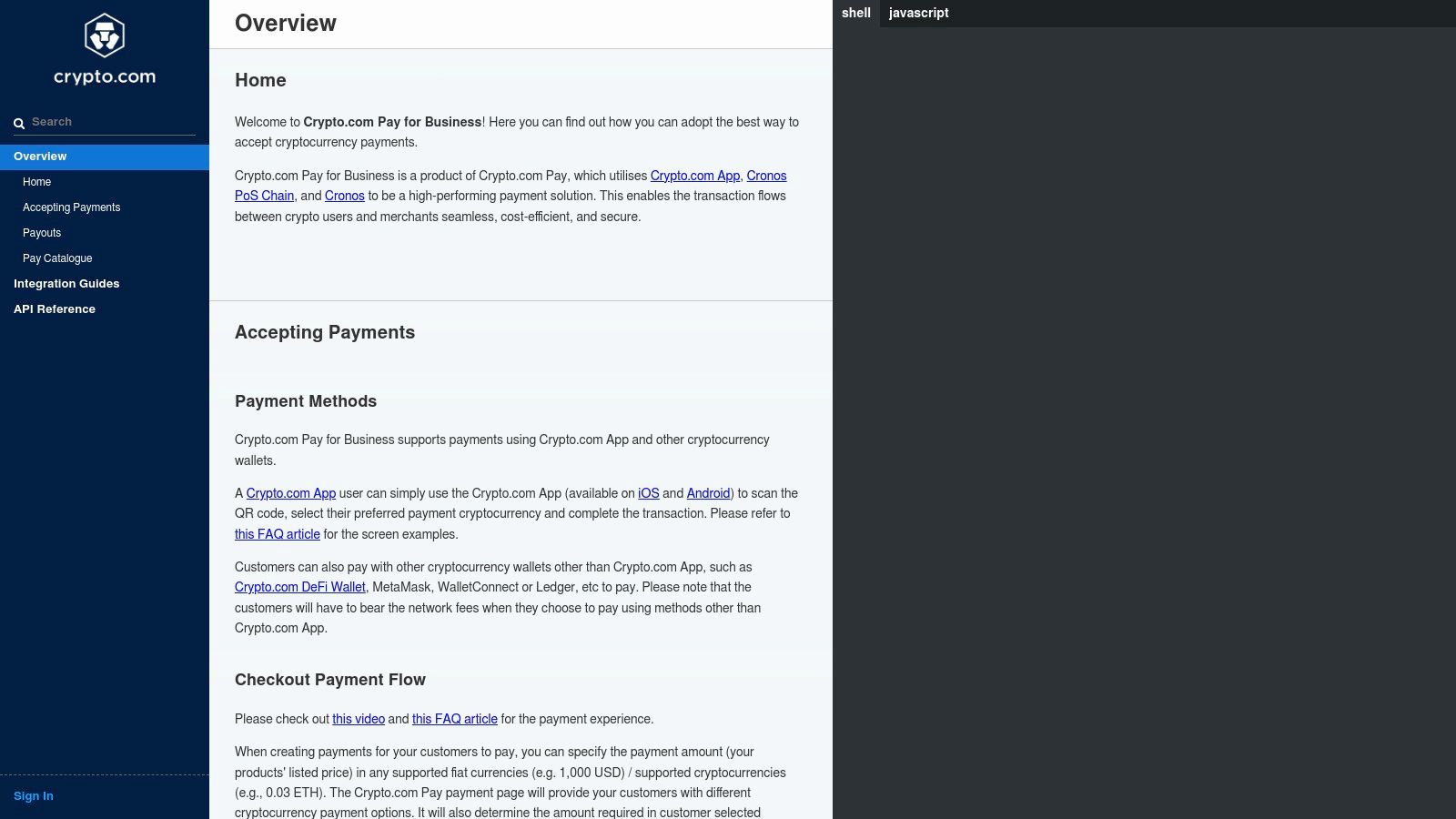
A key differentiator is the choice it offers in settlement. Merchants can opt for automatic conversion and settlement in fiat currencies like USD or EUR, eliminating volatility risk entirely. Alternatively, they can choose to receive and hold stablecoins directly, giving them full control over their digital assets. This makes it one of the best stablecoin payment APIs for businesses wanting to tap into Crypto.com's large user base while retaining settlement flexibility.
Key Features & Considerations
- Supported Assets: Accepts USDC, USDT, and a wide range of other cryptocurrencies.
- Settlement: Flexible options to settle payments in fiat (USD, EUR) or crypto, including stablecoins.
- Integration: Provides a REST API, plugins for major platforms like Shopify and WooCommerce, and a hosted checkout solution.
- Features: Supports both one-time and recurring subscription payments, managed through a dedicated merchant dashboard.
Our Take: Crypto.com Pay for Business is an excellent choice for merchants aiming to attract the platform's millions of retail users. The dual settlement option is a powerful feature, catering to both crypto-native and traditional businesses. However, be aware that some features are tied to the Crypto.com app ecosystem, and regional availability can vary.
Website: https://pay-docs.crypto.com/
11. Triple-A
Triple-A is a licensed crypto payment gateway regulated by the Monetary Authority of Singapore (MAS), positioning itself as a highly compliant solution for enterprises. It offers both payment acceptance and marketplace payout services, with robust support for major stablecoins like USDC and USDT. The platform is designed for businesses that prioritize regulatory adherence and require streamlined payout workflows.
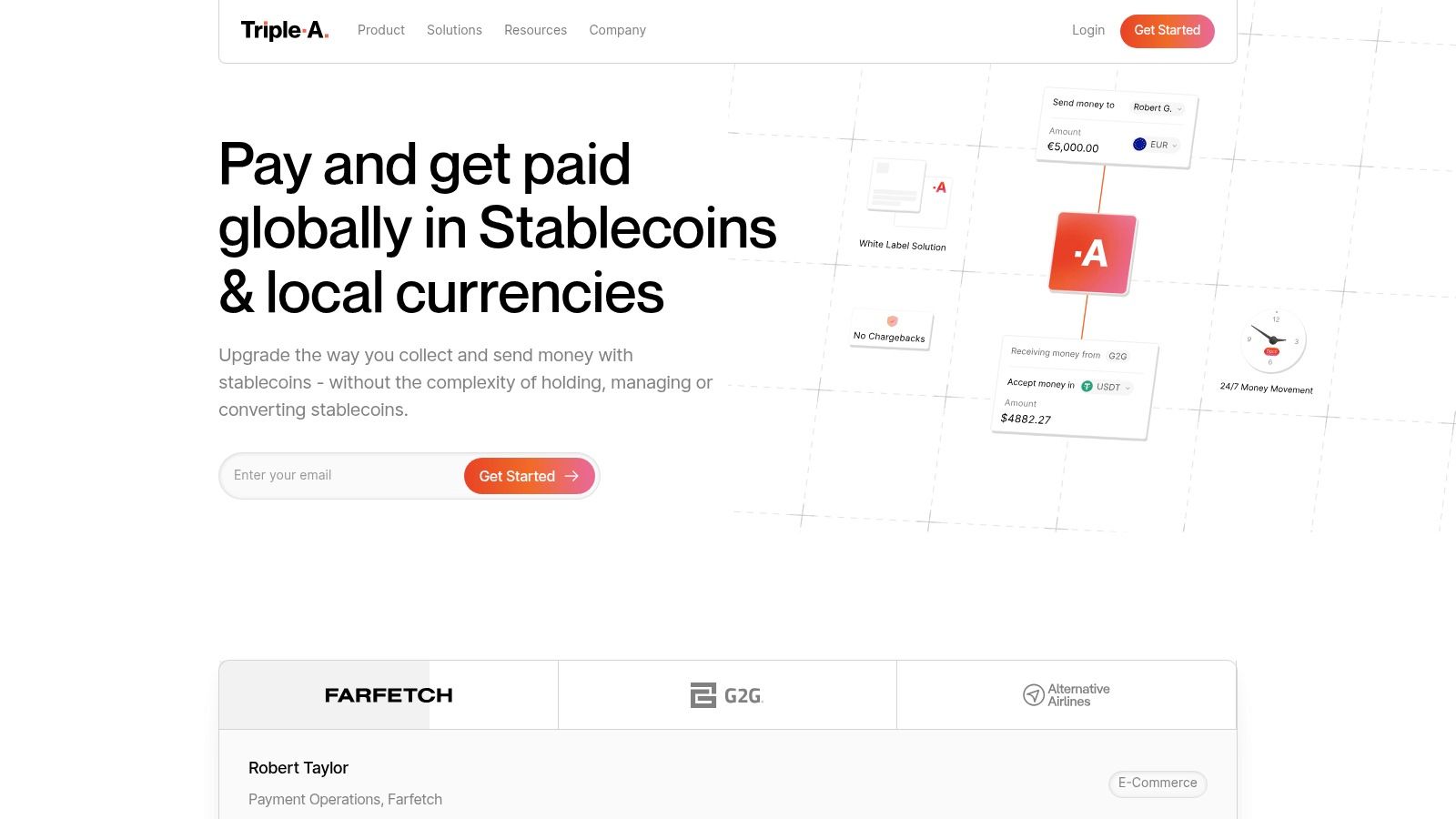
Its focus on AML/KYC processes and licensed operations makes it a strong contender among the best stablecoin payment APIs for marketplaces and platforms needing regulated rails. Triple-A's chargeback-free transactions and optional next-day bank settlements in select regions provide a blend of crypto efficiency and traditional finance reliability.
Key Features & Considerations
- Regulated Operations: Licensed as a Payment Institution by MAS, ensuring high compliance and AML/KYC standards.
- Acceptance & Payouts: Provides APIs for both accepting stablecoin payments from customers and executing bulk payouts to sellers or partners.
- Marketplace Tools: The platform includes dashboard tools specifically designed for managing complex seller payout flows and marketplace operations.
- Settlement Options: Offers next-day bank settlements in select jurisdictions, providing flexibility between crypto and fiat.
Our Take: Triple-A is an excellent choice for marketplaces, platforms, and regulated businesses that need a compliant partner for stablecoin operations. Its strength lies in enterprise-grade payout workflows and a clear regulatory framework, though its quote-based pricing and regional feature variations mean it is less suited for small, self-serve integrations.
Website: https://www.triple-a.io/
12. Request Finance
Request Finance provides a comprehensive B2B finance stack and API tailored for stablecoin treasury operations. Unlike consumer-focused gateways, it excels at managing invoicing, accounts payable/receivable, and payroll. The platform empowers businesses to programmatically create, send, and accept invoices in stablecoins like USDC, USDT, and DAI, automating crucial financial workflows.
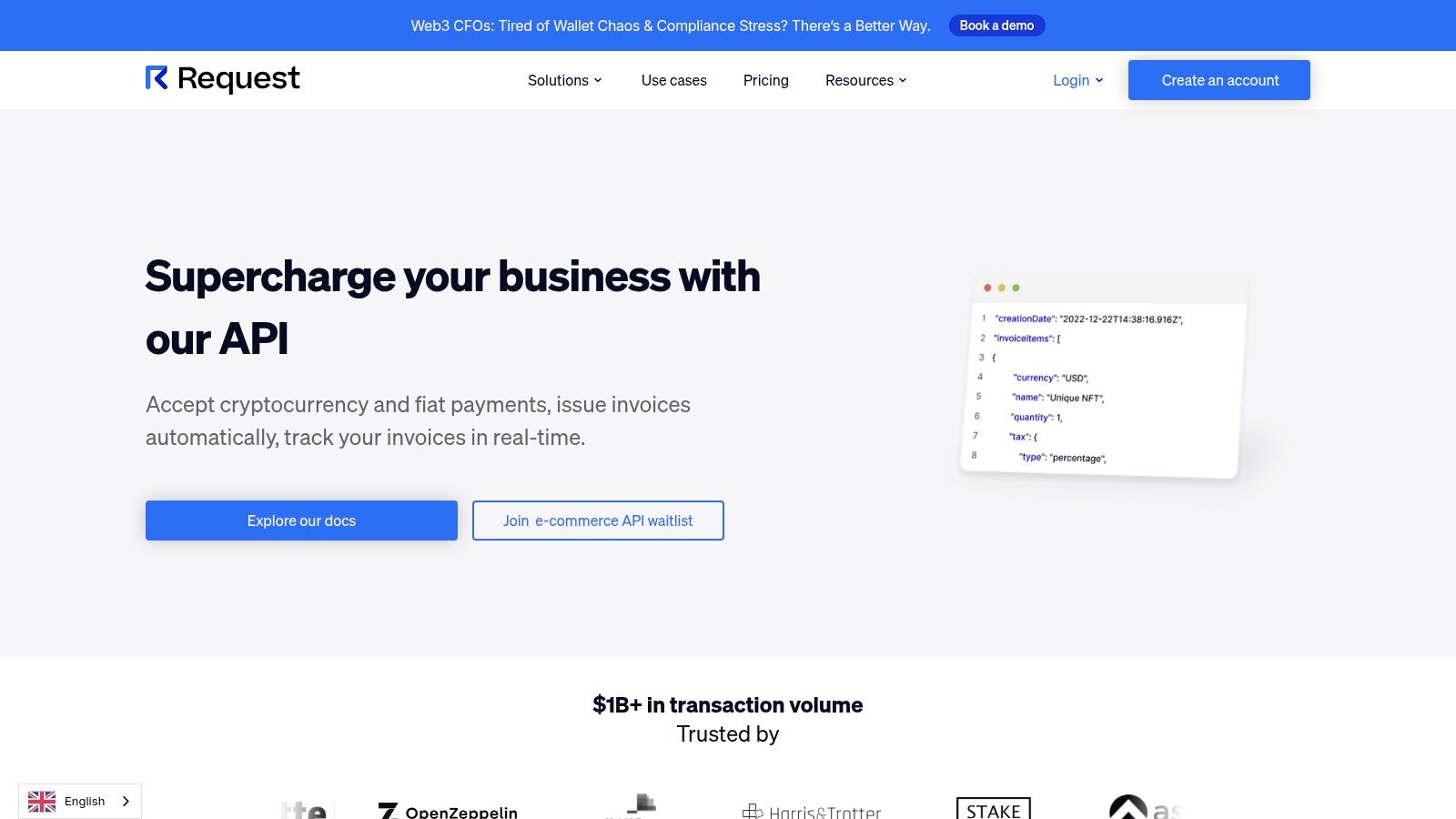
This focus on operational finance makes Request Finance one of the best stablecoin payment APIs for companies managing complex B2B transactions. It streamlines treasury management with features designed for finance teams, including bulk payouts, approval workflows, and direct integrations with accounting software like QuickBooks and Xero. The platform also offers on- and off-ramp services to connect digital asset flows with traditional bank accounts.
Key Features & Considerations
- Supported Assets: Extensive support for over 350 assets, including more than 20 stablecoins across numerous blockchains.
- Core Use Cases: Purpose-built for B2B invoicing, vendor payments, payroll, and expense management rather than retail checkouts.
- Automation: API enables programmatic control over accounts receivable and payable, with automated reconciliation and accounting exports.
- Pricing: Requires paid plans for significant volume, with starting plans around $600 per month. On- and off-ramp services incur additional transaction fees.
Our Take: Request Finance is the ideal solution for businesses embedding stablecoin payments into their core financial operations. Its strength lies in automating B2B workflows and providing the necessary tooling for accounting, reconciliation, and treasury management, which is a clear differentiator from checkout-focused APIs.
Website: https://www.request.finance/api
Top 12 Stablecoin Payment APIs Comparison
| Provider | Key features | Settlement & custody | Best for | Strengths (USP) | Limitations & price |
|---|---|---|---|---|---|
| Stripe – Stablecoin payments | Accepts USDC/USDP/USDG across major networks; Checkout/Elements/Payment Intents; Connect payouts | Settles as USD into Stripe balance; refunds return in stablecoin; merchant no custody required | U.S. merchants already on Stripe, enterprise sellers | Enterprise-grade risk, reporting, dispute handling; broad USDC network support | Public preview (U.S. only, approval needed); USD-only settlement by default; some features not yet supported |
| Coinbase Commerce / Coinbase Payments | On‑chain acceptance, gasless UX, SDKs, webhooks, merchant ledgering | Guaranteed settlement to USDC; on‑chain flows require wallets/ops | Merchants wanting native USDC settlement and ecosystem integrations (e.g., Shopify) | Trusted U.S. provider, strong wallet/ecosystem reach | Requires crypto operations for advanced flows; regional feature variation; fees vary by product |
| Circle – USDC/EURC APIs | Mint/redeem APIs, programmatic mint/redeem, wires/SEPA, issuer liquidity | Direct issuer mint/redeem 1:1; first‑party liquidity, reduced third‑party risk | Institutions, platforms needing treasury-level USDC/EURC controls | Issuer-level compliance/transparency; programmatic treasury flows | Institutional onboarding required (KYB), onboarding can take weeks; not plug‑and‑play for SMBs |
| BitPay – Payment gateway and payouts | Hosted checkout, invoices, plugins, BitPay Send payouts, POS support | Settlement to bank (ACH) or crypto (incl. USDC); daily settlements | Merchants needing fiat or crypto settlement, invoicing, POS | Mature tooling, accounting/export features, multiple settlement options | Fees and supported assets vary; less web3-native developer experience |
| CoinPayments | REST APIs, multi‑chain stablecoin support, plugins, sandbox testing | Settlement in crypto or fiat via partners (jurisdiction-dependent) | Merchants needing wide token support and quick onboarding | Broad coin/network coverage, extensive developer docs | Service/coins and fees vary by country; legacy docs can confuse integrators |
| CoinGate | APIs, e‑commerce plugins, multi‑network USDC, refunds/payouts | Fiat settlement and conversion options; EU regulatory posture (MiCA-aware) | EU e‑commerce merchants and regulated sellers | Compliance-focused, strong docs, e‑commerce integrations | Some stablecoins limited in EU; cross-border banking/settlement variability |
| CoinsPaid | APIs, auto conversion, OTC desk, 24/7 support, multi‑fiat payouts | Auto conversion to fiat with rate lock; wide fiat payout coverage; KYB required | High-volume merchants requiring conversion & global payouts | Operational scale, 24/7 support, automatic conversion & multi‑fiat payouts | Regional restrictions, full KYB onboarding required; pricing varies by region/account |
| NOWPayments | Non‑custodial gateway, 300+ assets, auto conversion, plugins | Non‑custodial — merchants control destination wallets; auto-convert options | Merchants wanting custody control and fast setup | Fast integration, wide asset support, merchant retains custody | Merchant responsible for wallet security; support and SLAs vary vs larger PSPs |
| MoonPay Commerce (formerly Helio) | Prebuilt checkouts, payment links, multi‑chain USDC, on/off‑ramp partners | Onramp/offramp via partners; off‑ramp needs partner KYC/setup | Creators, e‑commerce and Solana/EVM merchants seeking rapid checkout | Rapid integration, low fees reported in cases, on/off‑ramp options | Some docs/SDKs may use legacy Helio names; auto off‑ramp adds KYC/fees |
| Crypto.com Pay for Business | APIs, plugins, hosted checkout, subscriptions, settlement choices | Settlement in fiat (USD/EUR) or crypto (incl. USDC) via Crypto.com rails | Merchants wanting exposure to Crypto.com retail base and app users | Large retail ecosystem, fiat settlement removes price risk | Features tied to Crypto.com ecosystem; regional variability in merchant features |
| Triple‑A | MAS‑licensed gateway, acceptance + bulk stablecoin payouts, marketplace UX | Regulated PSP rails; bank next‑day settlements in select regions; AML/KYC enforced | Marketplaces and enterprise platforms needing regulated payout rails | Strong compliance/regulatory posture, marketplace payout controls | Quote-based pricing; feature/settlement availability depends on jurisdiction |
| Request Finance | B2B invoicing, AR/AP, payroll, accounting integrations, batch payouts | On/off‑ramp to bank accounts; supports 350+ assets and many stablecoins | Finance teams, treasury ops, platforms automating vendor/payroll flows | Purpose-built B2B finance automation, reconciliation and accounting exports | Not for consumer checkout; paid plans for higher volumes; on/off‑ramp fees apply |
Choosing Your Integration Partner: Final Thoughts and Next Steps
Navigating the landscape of the best stablecoin payment APIs can feel complex, but as we've explored, the ecosystem is rich with diverse and powerful solutions. From established fintech players like Stripe cautiously embracing stablecoins to crypto-native powerhouses like Circle and Coinbase setting the standard, the options cater to nearly every conceivable business model. We've seen how providers like BitPay and CoinPayments offer extensive coin support for merchants, while platforms such as Crypto.com Pay and MoonPay Commerce are building seamless, user-friendly experiences for the next wave of adoption.
The journey through these tools reveals a clear trend: stablecoin payments are no longer a niche experiment. They are a mature, viable solution for global commerce, payroll, B2B invoicing, and treasury management, offering unparalleled speed, cost-efficiency, and accessibility compared to traditional financial rails.
Synthesizing Your Decision: Key Takeaways
Your final choice will not hinge on finding a single "perfect" API, but on identifying the provider that best aligns with your specific operational needs, technical capabilities, and strategic goals. The critical decision points we've analyzed throughout this guide boil down to a few core considerations:
- Business Model vs. API Features: An e-commerce store needing a simple checkout plugin has vastly different requirements than a global firm executing cross-border payroll. Match the API's core strengths (e.g., Request Finance for invoicing, NOWPayments for broad coin support) directly to your primary use case.
- Settlement and Custody: Do you want to receive final settlement in fiat, or do you prefer to hold stablecoins on your balance sheet? Your answer will immediately narrow the field. APIs like Stripe and BitPay excel at instant fiat conversion, while Circle’s APIs are built for businesses comfortable with direct digital asset management.
- Developer Experience and Ecosystem: The quality of documentation, the availability of SDKs in your preferred programming language, and the responsiveness of technical support are paramount. A powerful API is useless if it's too difficult or time-consuming to integrate.
- Compliance and Regional Availability: Regulatory adherence is non-negotiable. Ensure your chosen partner is fully licensed in all your target operating regions and provides robust KYC/AML tools. This is a crucial step in your due diligence process to mitigate risk.
Your Actionable Path Forward
Armed with the detailed analysis from this article, your next steps should be methodical and focused. Don't let the sheer number of options lead to paralysis. Instead, follow this structured approach to confidently select and implement your chosen solution.
- Define Your MVP: What is the absolute minimum functionality you need to launch? Is it accepting USDC payments on a Shopify store? Or is it programmatically sending EURC payouts to European contractors? Start with a clearly defined, simple goal.
- Shortlist 2-3 Providers: Based on your MVP, select the top two or three candidates from our list that appear to be the best fit. For example, if you prioritize ease of integration and fiat settlement, your shortlist might include Stripe, Coinbase Commerce, and Triple-A.
- Engage the Sandbox: Before writing a single line of production code, thoroughly test each shortlisted provider's sandbox environment. This is your opportunity to assess the API's reliability, intuitiveness, and developer support without any real-world risk.
- Model Total Cost of Ownership: Look beyond the advertised transaction fees. Factor in potential costs for setup, KYC checks, fiat withdrawal fees, and the developer hours required for integration and ongoing maintenance. A slightly higher transaction fee might be worth it if the API saves significant development time.
The integration of stablecoin payments is a strategic move that can unlock new markets, streamline operations, and future-proof your business. The tools are ready, the networks are proven, and the opportunity is here. By carefully weighing the factors discussed, you can confidently choose an integration partner that not only meets your current needs but also scales with you into the future of digital finance.
Stay ahead of the curve in the rapidly evolving world of digital currencies. For the latest research, in-depth market analysis, and expert commentary on all things stablecoins, follow Stablecoin Insider. We provide the critical intelligence you need to navigate the future of finance, directly from the leading source for digital asset analysis. Visit us at Stablecoin Insider.