Table of Contents
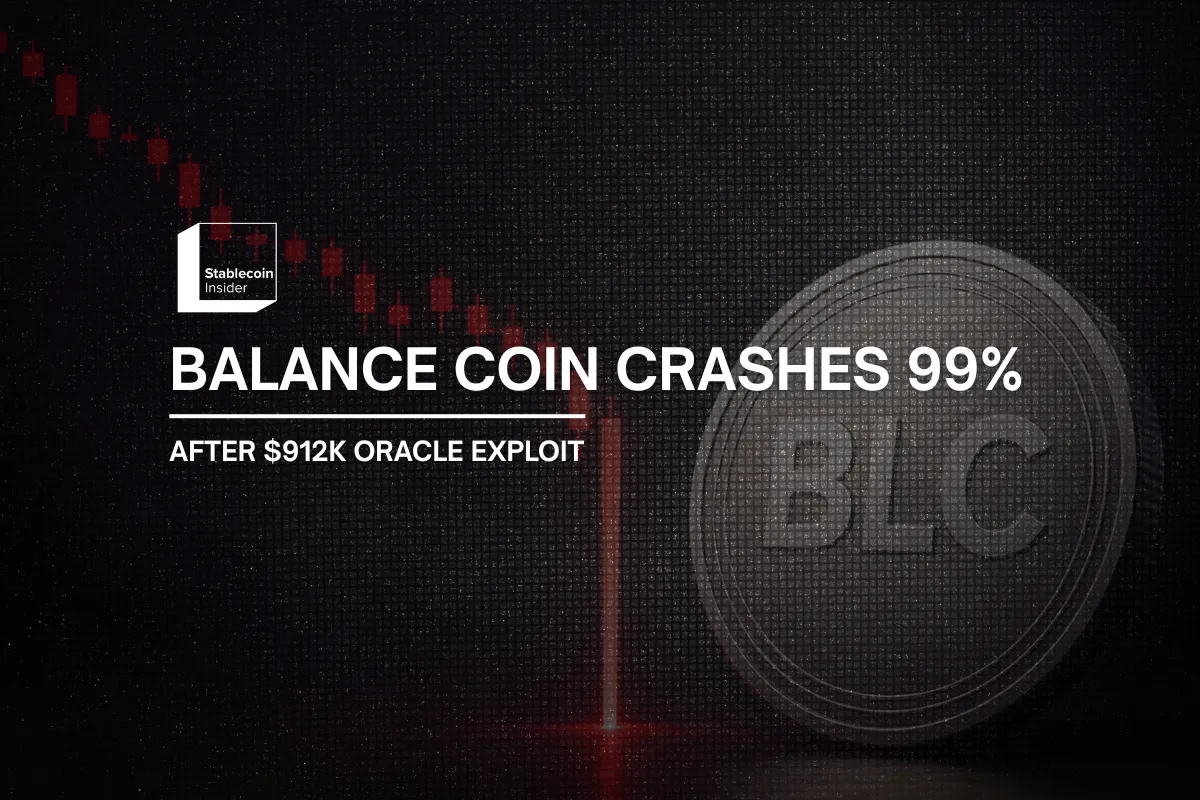
Balance Coin (BLC), an algorithmic stablecoin built on BNB Chain, lost more than 99% of its value on July 22, 2026, after an attacker manipulated the protocol's Bitcoin price feed and liquidated collateral vaults that were never eligible for liquidation.
The token traded near its $1 peg the previous day. Within hours, it fell to roughly $0.0014, wiping out nearly all of its approximately $3.5 million in nominal market value.
Security firms SlowMist and PeckShield put the attacker's take at $912,000 to $915,000, drained from 42DAO, the governance entity behind Balance Protocol. The entire attack was executed in a single transaction.
The exploit required no sophisticated code break. It required only the ability to write a false price into a system that never checked whether the price was plausible.
Key Takeaways
- BLC crashed 99.75% from its $1 peg to roughly $0.0014 on July 22.
- Attacker fed a fake low BTCB price into Balance Protocol's Median Oracle.
- Roughly $912,000 drained from governance entity 42DAO in one transaction.
- Missing price validation and liquidation delay made the attack trivially cheap.
- Smart contract audits do not cover oracle configuration, a widening blind spot.
How the Attack Worked
Balance Protocol is a MakerDAO-style lending system. Users lock Bitcoin-backed collateral, primarily BTCB on BNB Chain, into vaults and mint BLC against it, with vaults liquidated automatically if collateral value falls below a threshold.
According to SlowMist's analysis, the attacker exploited an abnormally low BTCB price sourced from the protocol's Median Oracle, delivered through the Spotter poke and Dog bark functions. That falsified price made healthy, overcollateralized vaults appear insolvent.
The lending contract accepted the price without validating it against a reasonable range and without imposing any liquidation delay. The attacker liquidated multiple vaults that should never have been eligible, seized the collateral, and swapped it for profit.
PeckShield reported that roughly 4.5 million BLC were minted during the sequence, with liquidity drained through PancakeSwap. On-chain data confirms the exploit executed atomically in a single BNB Chain transaction.
Two Missing Safeguards Made It Possible
The technical failure comes down to two protections that are considered baseline in DeFi lending design, and neither was present.
The first is price validation, a sanity check that rejects oracle inputs falling outside a plausible range. Without it, any price the oracle reports is treated as authoritative, including one that claims Bitcoin lost most of its value in a single block.
The second is a liquidation delay, a time buffer between a price update and the execution of liquidations. That delay gives the system a window to detect anomalous data before irreversible action is taken.
Balance Protocol copied MakerDAO's architecture without inheriting the guardrails MakerDAO added over years of operation. The fork carried the mechanism but not the accumulated defensive engineering.
Why the CertiK Audit Did Not Catch It
Balance Protocol held a smart contract audit, which is the detail with the widest implications for the industry.
Smart contract audits review on-chain code for programming vulnerabilities: reentrancy bugs, integer overflows, access control flaws. They generally treat oracle inputs as trusted external data and do not evaluate whether price bounds, sanity checks, or liquidation delays are configured correctly.
The 42DAO exploit targeted the oracle configuration layer rather than the contract code itself. OWASP's Smart Contract Top 10 for 2026 lists oracle manipulation as SC-03, yet most audit engagements are still not scoped to assess oracle infrastructure.
This is the same verification gap we examined in our guide to how stablecoins are backed. A passed audit and a secure system are not the same claim, whether the subject is reserve accounting or oracle plumbing.
Part of a 2026 Pattern
The Balance Coin incident fits a trend that has defined DeFi exploits this year: attackers moving away from contract bugs and toward the oracles, governance rules, and infrastructure surrounding the code.
Recent months have seen the Ostium Perpetuals vault drained through manipulated oracle reports and the Bonzo lending protocol exploited via a third-party feed supplying a forged price. The vulnerable layer is increasingly the one that determines what a protocol believes an asset is worth.
The scale remains modest relative to the broader market. June 2026 recorded 40 DeFi incidents totaling $75.87 million, following $81.7 million in May, with BLC's sub-$1 million loss sitting well below those monthly averages.
What distinguishes this case is the product category. A lending protocol losing money is a security failure, while a stablecoin losing its peg is a failure of the one property holders accepted lower returns to obtain.
What It Means for Algorithmic Stablecoins
BLC was never a systemically significant token. Its $3.5 million market value is a rounding error beside USDT and USDC, and no major venue held meaningful exposure.
The relevance is structural rather than financial. Algorithmic and crypto-collateralized stablecoins depend on automated mechanisms and accurate market data rather than segregated cash and Treasury reserves, which means their peg inherits every weakness in the data feeding those mechanisms.
That distinction is now embedded in regulation. The GENIUS Act restricts permitted U.S. payment stablecoins to reserves held in cash, short-dated Treasuries, and repo, and excludes uncollateralized algorithmic designs from the framework entirely.
Incidents like this one supply the empirical case for that line. We covered the broader category exposure in our analysis of key stablecoin risks in 2026, where oracle dependency ranks among the most underpriced.
Conclusion
Balance Coin's collapse is a small loss with a clear lesson. The protocol did not fail because its code was broken, but because the data entering the code was never checked.
As of publication, 42DAO has not issued a detailed public statement explaining the exploit or outlining compensation for affected holders. BLC continues to trade near zero.
For the rest of the market, the takeaway is about verification scope rather than this particular token. Any stablecoin whose peg depends on external price data is only as reliable as the weakest feed it trusts, and a completed audit does not automatically mean that feed was examined.
FAQ:
1. What happened to Balance Coin?
Balance Coin (BLC), an algorithmic stablecoin on BNB Chain, fell more than 99% from its $1 peg to roughly $0.0014 on July 22, 2026. An attacker manipulated the protocol's Bitcoin price oracle to trigger improper liquidations and drained approximately $912,000 from governance entity 42DAO.
2. How did the oracle exploit work?
The attacker wrote an abnormally low BTCB price into Balance Protocol's Median Oracle, making overcollateralized vaults appear insolvent. The lending contract accepted that price without range validation or liquidation delay, allowing the attacker to liquidate ineligible vaults and seize collateral in a single transaction.
3. How much was stolen?
SlowMist estimated the loss at approximately $912,000, while PeckShield put it closer to $915,000. The token's nominal market value of roughly $3.5 million was largely erased, though the attacker's actual profit was the smaller figure drained from 42DAO.
4. Was Balance Protocol audited?
Balance Protocol held a smart contract audit, but such audits review on-chain code for programming vulnerabilities and typically treat oracle inputs as trusted. The exploit targeted the oracle configuration layer, which most audit engagements are not scoped to evaluate.
5. Does this affect USDT or USDC?
No. USDT and USDC are fiat-backed stablecoins holding cash and Treasury reserves rather than relying on price oracles and automated liquidations to maintain their peg. Balance Coin's failure mode does not exist in reserve-backed stablecoin designs.
Disclaimer:
This content is provided for informational and educational purposes only and does not constitute financial, investment, legal, or tax advice; no material herein should be interpreted as a recommendation, endorsement, or solicitation to buy or sell any financial instrument, and readers should conduct their own independent research or consult a qualified professional.