
Table of Contents
Stablecoin transaction volume hit $33 trillion in 2025, a 72% increase year-over-year. B2B stablecoin payments specifically grew 733% over the same period, driven by cross-border supplier payments, treasury operations, and payroll.
The total market cap is projected to exceed $2 trillion by end of 2026.
For businesses evaluating stablecoin infrastructure, the question is no longer whether to integrate. It's which API to build on.
This guide covers the best stablecoin APIs for businesses in 2026, what each one does best, and how to choose based on your use case.
Key Takeaways
- Stablecoin transaction volume hit $33 trillion in 2025, a 72% year-over-year increase.
- The right API depends on use case: Circle for USDC-native flows, Bridge for full-stack fintech infrastructure, Fireblocks for institutional custody, Lightspark for end-to-end cross-border payment flows.
- CCTP V1 is deprecated. Its phase-out begins July 31, 2026, any USDC cross-chain integration still on V1 needs to migrate now.
- Compliance is architectural. APIs without built-in KYC/KYB, AML screening, and audit reporting will lose enterprise adoption as GENIUS Act and MiCA solidify.
- B2B stablecoin payments grew 733% year-over-year in 2025.
What to Look For in a Stablecoin API in 2026
Before comparing providers, these are the criteria that actually matter for enterprise and mid-market deployments:
- Multi-chain coverage: Ethereum, Solana, Base, Arbitrum, and Polygon are table stakes. Broader coverage gives you routing flexibility.
- Fiat on/off ramps: APIs that only handle on-chain transfers solve half the problem. Full payment infrastructure connects stablecoins to ACH, SEPA Instant, PIX, UPI, and FedNow.
- Compliance tooling: KYC/KYB, AML screening, and sanctions monitoring built into the platform versus bolted on.
- Settlement speed: USDC on Solana settles in approximately 6 seconds. Providers without real-time infrastructure aren't competitive for global payroll or treasury operations.
- Developer experience: Documentation quality, sandbox environments, and time-to-production determine how fast your team ships.
With those criteria in mind, here are the leading stablecoin APIs for businesses in 2026.
1. Circle: Best for USDC-Native Infrastructure
Use case: USDC payments, cross-chain transfers, stablecoin issuance
Circle is the issuer of USDC, which at approximately $76 billion market cap is the second-largest stablecoin and the dominant choice for institutional and fintech deployments.
Circle's developer platform gives businesses direct access to USDC infrastructure through clean REST APIs, fully audited smart contracts, and a growing multi-chain network.
The flagship infrastructure product is CCTP (Cross-Chain Transfer Protocol), now in V2. CCTP V2 uses a burn-and-mint mechanism that moves native USDC across chains without wrapped tokens or liquidity pools. As of late 2025, CCTP V2 is live on 17 blockchains with additional expansions expected in 2026. CCTP contracts have processed over $110 billion in cumulative volume across both versions.
Circle's Bridge Kit SDK simplifies CCTP V2 integration to a few lines of code. It supports both Standard Transfer (matching source chain finality) and Fast Transfer (near-instant settlement for latency-sensitive use cases like trading and treasury). The Hooks feature enables post-transfer automation, triggering smart contract logic on the destination chain without requiring additional user signatures.
Important note for developers: CCTP V1 is now legacy. Its manual phase-out begins July 31, 2026. Any USDC cross-chain integrations still on V1 need to migrate before that date.
Circle is also the most regulated stablecoin issuer globally, licensed in 46 US states, NYDFS BitLicense, and the first major MiCA-compliant issuer in Europe.
Best for: Payment service providers, enterprises requiring high-volume USDC processing, cross-border remittance platforms, and any application building USDC-specific cross-chain flows.
2. Bridge (via Stripe): Best for Fintechs and Full-Stack Stablecoin Infrastructure
Use case: Embedded stablecoin payments, fiat on/off ramps, branded stablecoin issuance
Bridge was acquired by Stripe in early 2025. Its technology is now being integrated across Stripe's issuing, payouts, and treasury products, making it one of the most strategically significant stablecoin API platforms in the market.
Bridge provides full-stack stablecoin infrastructure through a single API: receive, store, convert, issue, and spend stablecoins.
The Orchestration APIs integrate stablecoin payments directly into existing fund flows without requiring a full stack rebuild. The Open Issuance platform has reduced the complexity of launching a branded stablecoin to an API call, significant for enterprises seeking differentiated financial products.
Bridge handles on-chain security, gas management, and cross-border settlement, with funds settling in minutes across international markets. It supports USD and Euro accounts for consumers and businesses globally, along with card issuance for local spend.
Developer experience is strong, the API is clean and well-documented, and Stripe's backing provides enterprise-grade reliability and uptime guarantees that earlier-stage infrastructure providers can't match.
Best for: Fintech companies, neobanks, enterprises needing stablecoin infrastructure with fiat on/off ramps, and businesses already in the Stripe ecosystem.
3. Fireblocks: Best for Institutional Custody and Treasury Operations

Use case: Enterprise custody, high-volume settlement, institutional treasury management
Fireblocks is the institutional standard for digital asset infrastructure. Organizations including BNY Mellon, Revolut, Worldpay, and Galaxy use Fireblocks to manage custody, settlement, and treasury operations.
The platform processes over $200 billion in stablecoin transaction volume per month and has secured more than $10 trillion in cumulative digital asset transactions.
The platform supports 100+ blockchains and 50+ exchanges and protocols, the broadest multi-chain coverage of any provider in this guide.
Its MPC (Multi-Party Computation) custody model, combined with policy engines and audit trails, meets the security requirements of regulated financial institutions.
Fireblocks launched Fireblocks Network for Payments in 2025, connecting payment providers, banks, and fintechs with compliant stablecoin settlement. A strategic collaboration with Circle (announced September 2025) integrates Circle Gateway, providing a unified USDC balance for instant cross-chain liquidity, directly into Fireblocks' institutional infrastructure.
For enterprises running programmatic, high-volume stablecoin flows, Fireblocks offers the deepest compliance stack of any API provider in this guide.
Best for: Banks, payment institutions, enterprises with $100M+ AUM, and organizations requiring bank-grade custody with comprehensive compliance frameworks.
4. Lightspark: Best for Full-Cycle Payment Infrastructure

Use case: Fiat-to-stablecoin, stablecoin-to-fiat, cross-border settlement
Lightspark's Grid API provides a single integration for the complete stablecoin payment lifecycle (fiat to stablecoin, stablecoin to fiat, and stablecoin to stablecoin), with locked quotes, transparent fees, and built-in compliance.
Settlement covers 65 countries via local instant payment rails.
The key differentiator is fiat-rail integration. Grid connects to SEPA Instant (Europe), PIX (Brazil), UPI (India), Faster Payments (UK), and FedNow (US). This matters for businesses serving users who need to receive local currency payouts from stablecoin-based treasury operations.
An API that handles on-chain transfers but requires a separate banking integration for last-mile delivery doubles your infrastructure complexity.
Lightspark handles the full payment flow in both directions: users can fund via bank transfer and receive stablecoins (on-ramp), or sell stablecoins and receive local currency in their bank account (off-ramp).
The compliance layer is embedded, not a separate integration.
Best for: Cross-border payment companies, remittance platforms, and B2B businesses that need end-to-end fiat-to-stablecoin infrastructure with multi-country local rail coverage.
5. BVNK: Best for B2B Stablecoin Settlement and PSPs
Use case: B2B payments, PSP infrastructure, fiat-stable conversions
BVNK is an API-first platform purpose-built for high-throughput stablecoin settlement with direct bank and account connectivity. It's the preferred option for payment service providers and B2B operations that need programmable flexibility for embedding stablecoin payments into custom applications.
BVNK processes approximately $12 billion in annualized stablecoin payments volume (as of mid-2025) and operates as a licensed intermediary for PSPs lacking their own crypto asset licenses. Its platform handles multi-stablecoin support (USDC, USDT, and others) with instant fiat conversion, particularly useful for cross-border treasury operations where counterparties settle in different currencies.
BVNK's 2026 Stablecoin Utility Report identified lower fees, security, and global access as the primary adoption drivers, and complexity, excessive transaction steps, and network confusion as the main friction points. The platform's design reflects this: the developer experience prioritizes speed of integration and reducing operational steps.
Note the architectural consideration: BVNK is in the direct flow of funds and performs full KYC on all wallets. This limits flexibility for businesses with non-standard operating models but simplifies compliance for PSPs that need a fully managed solution.
Best for: Payment service providers, B2B fintechs, and marketplaces that need programmable stablecoin infrastructure with bank connectivity and don't want to manage a separate crypto asset license.
6. Cobo: Best for High-Volume Payouts and Cross-Border Treasury
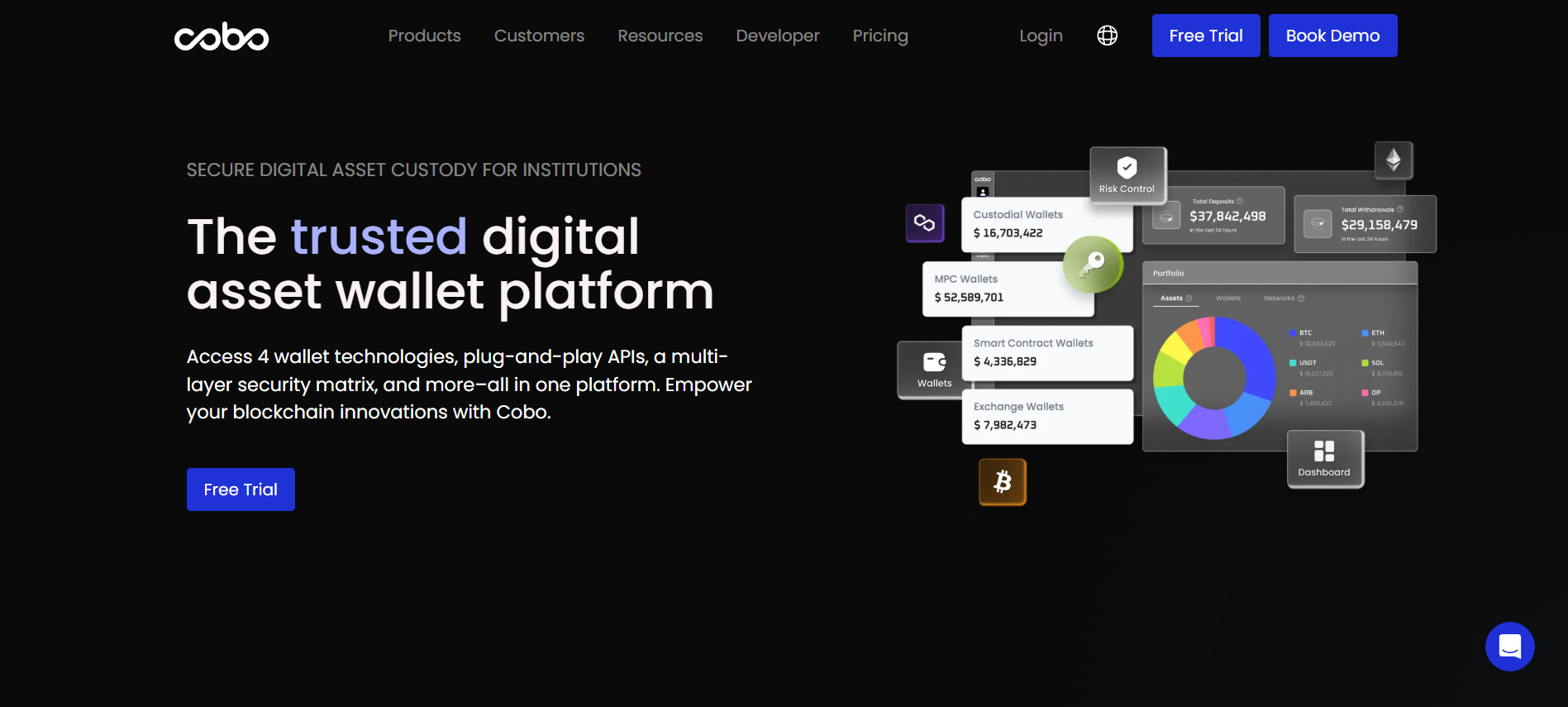
Use case: Mass payouts, cross-border settlement, treasury automation
Cobo is enterprise stablecoin infrastructure built for high-volume scenarios: contractor payouts, treasury rebalancing across entities, and B2B settlement at scale.
The platform supports 80+ blockchains with MPC custody, workflow automation, and policy controls.
For businesses running programmatic payout operations, gig platforms, global payroll, marketplace disbursements, Cobo's architecture combines security with the automation tooling needed to run payment operations without manual intervention at each transaction.
Best for: Enterprises running high-volume, multi-geography payout operations where custody security and workflow automation are priorities.
Quick Comparison: Stablecoin APIs for Businesses in 2026
| Provider | Primary Use Case | Chain Coverage | Fiat Rails | Best For |
|---|---|---|---|---|
| Circle | USDC payments, cross-chain | 17+ (CCTP V2) | Limited native | USDC-native apps, PSPs |
| Bridge (Stripe) | Full-stack stablecoin infra | Multi-chain | Yes (ACH, SEPA, more) | Fintechs, neobanks |
| Fireblocks | Institutional custody | 100+ | Multi-rail | Banks, $100M+ AUM institutions |
| Lightspark | End-to-end payment flows | Multi-chain | 65 countries, local rails | Cross-border, remittance |
| BVNK | B2B settlement, PSPs | Multi-chain | Direct bank connectivity | PSPs, B2B fintechs |
| Cobo | High-volume payouts | 80+ | Multi-currency | Mass payouts, treasury |
How to Choose the Right Stablecoin API
The right answer depends on your architecture, volume, and compliance requirements.
- If you're building USDC-specific: Start with Circle's developer platform and CCTP V2. The Bridge Kit SDK is the fastest path to cross-chain USDC transfers in production.
- If you're a fintech or neobank: Bridge (via Stripe) gives you full-stack infrastructure with fiat rails included. The Stripe backing removes significant counterparty and reliability risk.
- If you're an institution or bank: Fireblocks is the standard. MPC custody, 100+ chain coverage, and a proven compliance stack at enterprise scale.
- If you need end-to-end fiat-to-stablecoin payment flows across multiple countries: Lightspark's Grid API handles the full payment lifecycle with local rail integration that most other providers require you to build separately.
- If you're a PSP or marketplace: BVNK or Bridge, depending on whether you need a fully managed compliance solution (BVNK) or more architectural flexibility (Bridge).
- For high-volume payouts at scale: Cobo's combination of broad chain coverage, MPC custody, and workflow automation is built for this.
The Market Context in 2026
A few trends are reshaping how businesses should evaluate stablecoin APIs this year:
1. CCTP V1 sunset:
Circle's V1 deprecation begins July 31, 2026. Any USDC cross-chain integrations on legacy infrastructure need to migrate to CCTP V2 before that date.
2. Embedded compliance is becoming standard:
As GENIUS Act and MiCA frameworks solidify globally, APIs without built-in KYC/KYB, AML screening, and audit-ready reporting will lose enterprise adoption. Evaluate compliance as a core feature, not an add-on.
3. Branded stablecoin issuance is now accessible:
Bridge's Open Issuance platform has lowered the barrier to launching a business's own stablecoin to an API call. More enterprises will pursue branded stablecoins as a treasury and payment product in 2026.
4. Visa's stablecoin settlement volumes hit a $4.5 billion annualized run rate by January 2026:
Institutional settlement on stablecoin rails is live at scale. The infrastructure decision you make now determines whether you're positioned to capture this shift or catching up to it.

Bottom Line
The stablecoin API landscape in 2026 is mature, segmented, and genuinely competitive.
The choice between Circle, Bridge, Fireblocks, Lightspark, BVNK, and Cobo isn't a ranking, it's a match between your specific use case, compliance requirements, and engineering priorities.
What's no longer a viable option: waiting.
With B2B stablecoin payments growing 733% year-over-year and settlement infrastructure now operating at institutional scale, the question is which API fits your architecture, not whether to integrate at all.
Read Next:
- Ethena's USDe Q1 2026 Report
- Best Stablecoin Settlement Tools For Marketplaces in 2026
- The Biggest Stablecoin Trends In 2026
FAQs:
1. What is a stablecoin API?
A stablecoin API is a set of developer endpoints that lets businesses send, receive, convert, and settle stablecoins without managing blockchain nodes or wallet infrastructure directly.
2. What is the best stablecoin API for businesses in 2026?
The best stablecoin API for businesses in 2026 depends on it's use case. Circle leads for USDC-native flows. Bridge is best for fintechs needing full-stack infrastructure with fiat rails. Fireblocks is the institutional standard for custody at scale. Lightspark is the strongest option for end-to-end cross-border payment flows with local rail coverage.
3. What is the difference between a stablecoin API and a crypto payment gateway?
A stablecoin API is built for commerce, disbursements, and treasury, not trading. It handles fiat on-ramps, off-ramps, multi-chain routing, and connects to rails like ACH, SEPA, and PIX. A crypto payment gateway typically focuses on merchant checkout and may only support on-chain transfers.
4. Which stablecoin API is best for cross-border payments?
The best stablecoin API for cross-border payments is Lightspark Grid, because it covers 65 countries with local instant rails including SEPA Instant, PIX, UPI, and FedNow. Bridge and BVNK are strong alternatives for API-first fintechs that need fiat conversion without managing separate banking integrations.
5. What is CCTP V2 and why does it matter?
CCTP V2 is Circle's infrastructure for moving native USDC across blockchains via burn-and-mint, no wrapped tokens, no liquidity pools. V2 adds Fast Transfer, post-transfer automation via Hooks, and support for 17+ blockchains. CCTP V1 deprecation begins July 31, 2026. Businesses on V1 need to migrate before that date.
Disclaimer:
This content is provided for informational and educational purposes only and does not constitute financial, investment, legal, or tax advice; no material herein should be interpreted as a recommendation, endorsement, or solicitation to buy or sell any financial instrument, and readers should conduct their own independent research or consult a qualified professional.