
Table of Contents
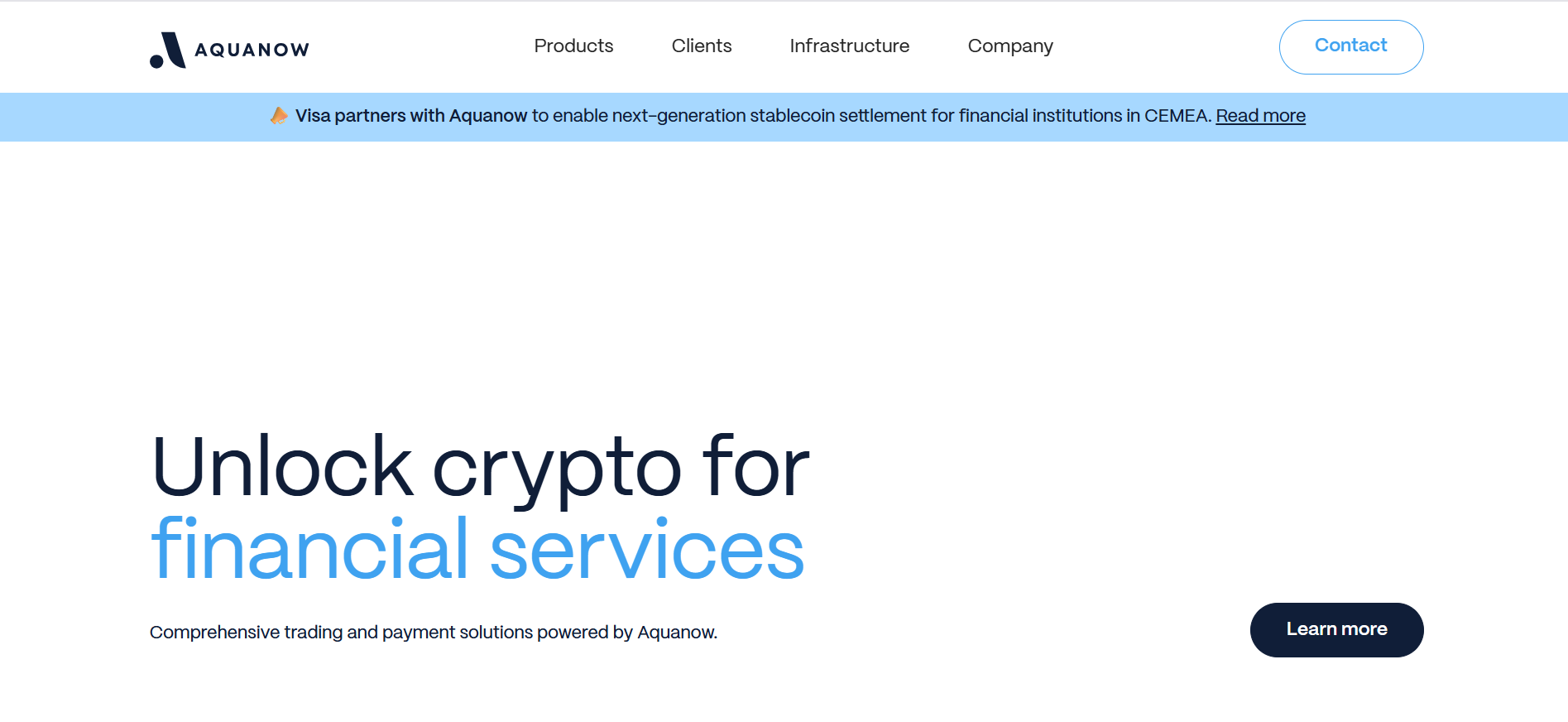
Visa, the $600 billion payments giant, has officially integrated Canadian digital-asset infrastructure provider Aquanow to enable near-instant stablecoin settlements.
Announced today, November 27, 2025, the partnership allows Visa’s banking and fintech clients to settle transactions in Circle-issued USDC in as little as 3–5 seconds, effectively turning stablecoins into a production-grade, 24/7 payment rail for one of the world’s fastest-growing economic corridors.
The move builds on Visa’s 2023 USDC settlement pilot, which quietly surpassed a $2.5 billion annualized run rate earlier this year, and signals the clearest commitment yet from a legacy payments titan to blockchain-native money movement.
Key Takeaways
- 3–5 second final settlement in USDC is now commercially available across Visa’s CEMEA network via Aquanow.
- Traditional cross-border corridors that once took days and cost 3–7% are being reduced to seconds and fractions of a percent.
- The partnership scales Visa’s earlier $2.5B USDC pilot into a multi-region production system capable of handling tens of billions annually.
- Marks the strongest signal yet that Tier-1 payment networks view regulated stablecoins as the default future rail for high-value, low-latency transfers.
- Early adopters in CEMEA gain massive first-mover cost and speed advantages in remittances, trade finance, and treasury operations.
How the Integration Actually Works

Aquanow provides deep institutional liquidity pools, regulated off-ramps, and real-time conversion engines that plug directly into Visa’s existing issuer and acquirer rails.
When a transaction is initiated, participating financial institutions can elect to settle in USDC instead of traditional correspondent banking channels.
The result: funds move in seconds instead of days, with dramatically lower intermediary fees and full 365-day availability, even on weekends and holidays.
“Think of it as upgrading the back-end rails of global finance to internet speed,” said Godfrey Sullivan, Visa’s Head of Crypto. “Stablecoins like USDC are now stable, scalable, and regulatorily compliant enough to run real commercial volume.”
Aquanow CEO Phil Sham added: “We’re giving Visa’s clients the same liquidity and execution quality institutions expect in forex markets, but for digital dollars.”
Why CEMEA, and Why Now?
The CEMEA corridor is home to some of the world’s highest remittance and B2B cross-border volumes, with the World Bank estimating over $150 billion in annual inflows.
Legacy settlement systems in the region often take 2–5 business days and carry fees that can exceed 6%. Stablecoins collapse that timeline and cost structure overnight.
The timing also aligns with exploding institutional demand: Circle reported USDC circulation topped $55 billion in Q3 2025, while global stablecoin transfer volume eclipsed $8 trillion annualized, surpassing PayPal and closing in on Visa’s own card network.

Remaining Hurdles and the Road Ahead
Regulators in parts of CEMEA remain cautious about stablecoin adoption, and not every bank is ready to hold digital assets on balance sheet. Visa and Aquanow counter that all activity occurs within existing licensed entities, with full KYC/AML and reserve transparency via Circle’s monthly attestations.
Industry sources indicate the companies are already in advanced talks to expand the model to Asia-Pacific and Latin America by mid-2026, with hybrid fiat-stablecoin settlement layers under consideration.
Conclusion
Today’s announcement is not another crypto pilot, it’s the moment stablecoins graduated from experiment to core infrastructure at one of the world’s largest payment networks.
For businesses and banks operating in CEMEA, the message is clear: the era of multi-day, high-cost wires is ending faster than anyone predicted.
Red Next:
- USDT vs. USDC vs. BUSD: Which Fiat-Backed Stablecoin Is Safest in 2025?
- Stablecoin Tax Guide 2025: Reporting and Tools for Compliance
- The Future of Stablecoins: What's Next in 2026 and Beyond
FAQs:
1. What exactly is the Visa-Aquanow partnership?
It’s a live integration that lets Visa’s banking clients in CEMEA settle transactions using USDC stablecoin in 3–5 seconds through Aquanow’s regulated liquidity and infrastructure layer.
2. How fast are these USDC settlements compared to traditional methods?
Traditional cross-border wires in CEMEA typically take 1–5 business days. The new system delivers finality in 3–5 seconds, 24/7/365.
3. Has Visa used stablecoins for settlements before?
Yes, Visa’s 2023 pilot with Crypto.com and others already surpassed $2.5 billion in annualized USDC settlement volume. This Aquanow partnership is the scaled, multi-region production rollout.
4. Is it safe and regulated?
All activity runs through licensed financial institutions and regulated stablecoin issuers (USDC by Circle). Reserves are 1:1 backed and independently attested monthly.
5. Which regions and clients can use it right now?
Live today for select Visa issuer and acquirer partners across Central & Eastern Europe, Middle East, and Africa, with broader rollout continuing into 2026. Expansion to Asia and LatAm is already in planning.