Table of Contents
No stablecoin in 2026 has generated as much capital inflow, congressional scrutiny, institutional deal flow, or raw political intrigue as USD1.
Issued by World Liberty Financial (WLFI), a DeFi protocol co-founded by President Donald Trump and his sons, the dollar-pegged token crossed a market cap of approximately $4.52 billion with a circulating supply of over 4.52 billion USD1 coins, making it the fastest-growing major stablecoin on the market by any metric that matters.
The numbers are only part of the story. In Q1 2026, USD1 moved from being a politically charged novelty to an instrument of institutional deal flow. A $2 billion investment by Abu Dhabi-based MGX into Binance was settled using USD1 as the official stablecoin, placing the token at the center of the largest stablecoin-settled transaction in crypto history.
This report documents every material development in the USD1 ecosystem through Q1 2026: the growth, the deal flow, the regulatory posture, the controversy, and the key questions that remain open as the quarter closes.
Key Takeaways
- USD1 reached a ~$4.7B market cap in Q1 2026, up 50%.
- World Liberty Trust Company filed for a federal OCC bank charter in January.
- A House probe demanded records on a secret $500M UAE stake.
- The World Liberty Forum at Mar-a-Lago drew Goldman Sachs, Nasdaq, and the CFTC.
- A governance proposal passed granting BD access for $5M token holders.
Market Cap Trajectory: From $3B to Nearly $4.7B in One Quarter
USD1 entered 2026 already holding records. The token crossed $3 billion in circulating supply for the first time, with CEO Zach Witkoff describing it as being adopted as "the stablecoin of choice for pioneering enterprises everywhere."
BitGo called it the fastest rise from zero to $1 billion in stablecoin history.
Q1 2026 accelerated that trajectory sharply. On January 26, 2026, USD1 overtook PYUSD's market cap, signaling competitive growth, followed the next day by Binance launching new TRX/USD1 and USD1/U spot trading pairs to enhance liquidity and trading flexibility.
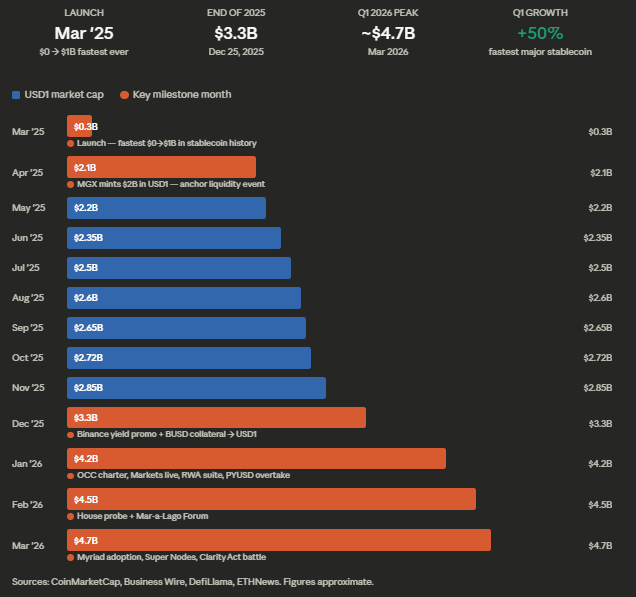
Although USDT and USDC plateaued, the overall stablecoin market remained historically high at an estimated $300–320 billion as of February 2026.
USDT still commanded a dominant 60.64% share. Meanwhile, USD1 expanded by roughly 50%, a notable outlier during a broader period of stablecoin consolidation.
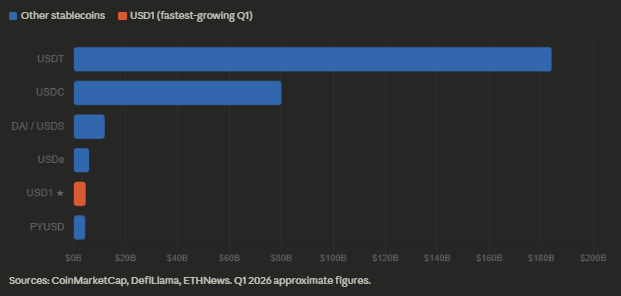
The January surge coincided with three structural catalysts running in parallel:
- The World Liberty Markets lending platform launch on January 12
- The real-world asset suite rollout
- The debit card pilot program
All targeting an expansion of USD1's utility beyond simple trading into structured finance and everyday payments.
Institutional Deal Flow: Abu Dhabi, Binance, and the $2B Anchor
The single event that defined USD1's institutional positioning was the MGX–Binance deal.
Abu Dhabi-backed investment firm MGX used USD1 to close a $2 billion investment in Binance, the world's largest cryptocurrency exchange by trading volume.
WLFI co-founder Zach Witkoff confirmed at the TOKEN2049 conference in Dubai that USD1 had been selected as the official digital currency to close the transaction.
MGX could have settled the deal in any currency, USDC, USDT, or otherwise. By routing through USD1, the stablecoin received $2 billion in fresh liquidity shortly after its launch.
WLFI is also estimated to earn between $60 - $80 million in annual yield, provided Binance does not redeem the funds. Binance, meanwhile, gained a direct financial interest in ensuring the Trump family stablecoin maintains its peg.
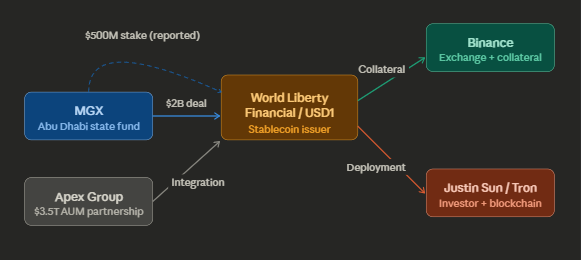
Binance's elevation of USD1 extended beyond the MGX deal. The exchange integrated USD1 into several of its most active spot markets and announced it would convert all collateral assets backing Binance-Peg BUSD into USD1 at a 1:1 ratio, making USD1 an integral part of Binance's updated collateral structure.
The Apex Group collaboration announced in Q1 2026 represented a different institutional vector entirely. World Liberty Financial announced a strategic collaboration with Apex Group, a leading global financial services firm operating in 52 countries and servicing over $3.5 trillion in assets, to explore integrating USD1 across subscriptions, distributions, and redemptions of tokenized assets.
"We are excited to announce today that USD1 has been selected as the official stablecoin to close MGX's $2 billion investment in Binance. We thank MGX and Binance for their trust in us, and I think it's only the beginning." - Zach Witkoff, Co-Founder & CEO, World Liberty Financial
Q1 2026: A Chronology of Key Events
January 7 - OCC National Trust Bank Charter Filed:
WLTC Holdings LLC submitted a national trust bank charter application to the OCC to establish the World Liberty Trust Company, National Association, an entity purpose-built for stablecoin operations, supporting enterprise clients with near-instant cross-border payments, tokenized settlement, and programmable payouts.
January 12 - World Liberty Markets Goes Live:
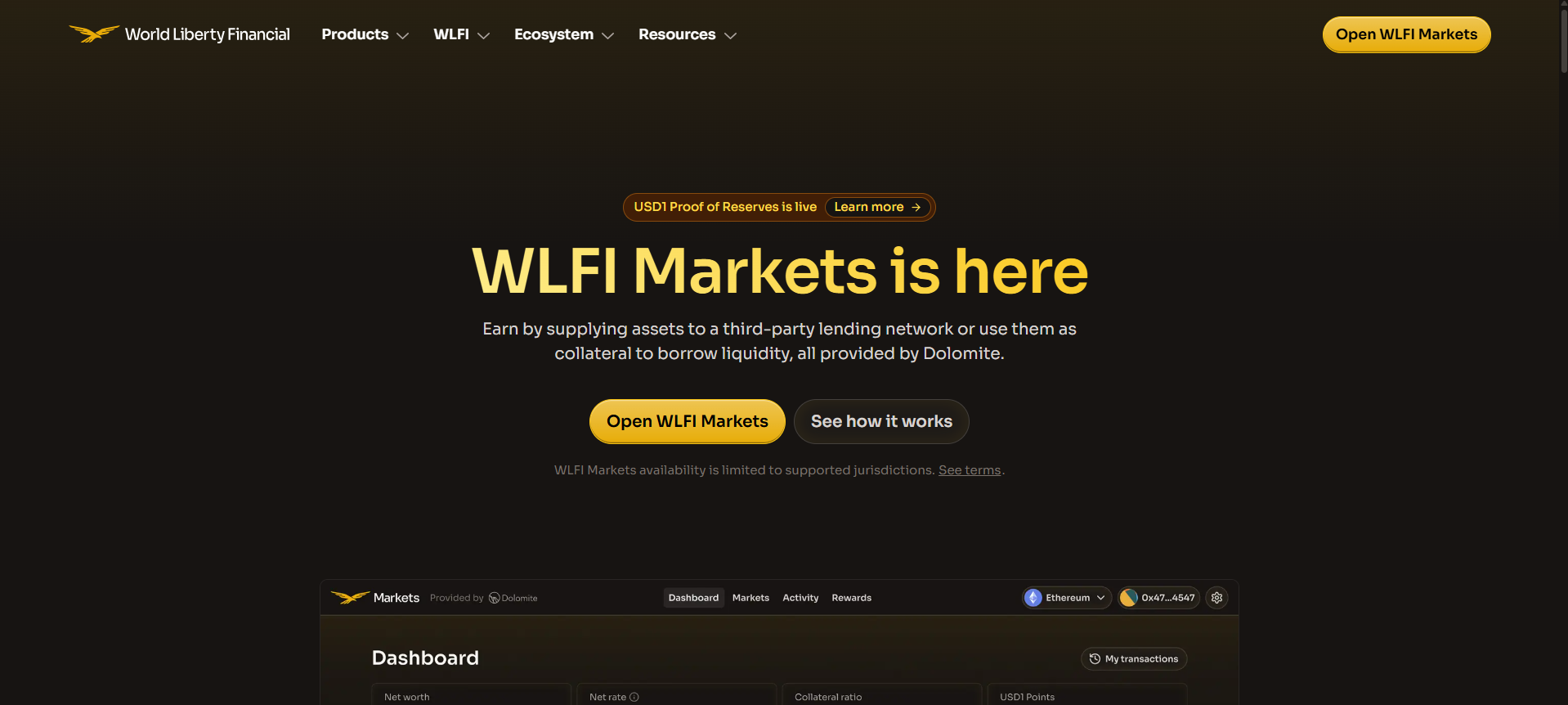
World Liberty Financial launched World Liberty Markets, a DeFi lending and borrowing platform powered by Dolomite's infrastructure, where USD1 can be supplied to earn yield or used as collateral.
January (mid) - RWA Product Suite Rollout:
World Liberty Financial announced the launch of a real-world asset tokenization product suite including on-chain instruments backed by commodities such as oil, gas, cotton, and timber, paired with USD1 as the settlement layer, bridging DeFi with traditional markets through institutional-grade, yield-generating assets.
January 20 - World Liberty Forum Announced at Capacity:
World Liberty Financial announced its inaugural World Liberty Forum was fully booked, with nearly 400 confirmed participants set to convene at Mar-a-Lago on February 18, 2026, bringing together leaders from global finance, technology, sports, media, and government.
January 26 - USD1 Overtakes PYUSD Market Cap:
USD1 surpassed PayPal's PYUSD in market capitalization, a milestone highlighted by Eric Trump as evidence of the stablecoin's growing lending integrations and regulatory strategy.
Late January - $500M UAE Stake Publicly Reported:
At the end of January 2026, it was reported that days before Trump's inauguration, Tahnoun bin Zayed Al Nahyan's interests had agreed to buy 49% of WLFI for half a billion dollars.
WLF did not disclose the acquisition, nor did it disclose that two Tahnoun affiliates, the general counsel and CEO of G42, had been placed on its board.
February 5 - House Congressional Investigation Launched:
Rep. Ro Khanna sent a formal letter demanding ownership records, payment details, and governance records from WLFI, including whether $187 million flowed to Trump family entities and how the Emirati vehicle Aryam Investment 1 was involved.
The inquiry also covered WLFI's role in the $2 billion Binance deal and any involvement in discussions preceding Trump's pardon of Binance founder Changpeng Zhao.
Records were due by March 1.
February 18 - World Liberty Forum at Mar-a-Lago:
The inaugural World Liberty Forum reached capacity with nearly 400 attendees including leaders from Goldman Sachs, Nasdaq, the CFTC, and FIFA, focusing on finance, digital assets, AI, and policy.
March 4 - Eric Trump Attacks Banks Over Stablecoin Yield:
Eric Trump publicly criticized major U.S. banks for lobbying to block Americans from receiving higher yields on savings, accusing them of targeting crypto and stablecoins where platforms planned to offer 4–5% yields. President Trump posted on the same day urging Congress to advance the Clarity Act.
March 11 - Myriad Prediction Market Adopts USD1:
Prediction market platform Myriad announced it would use USD1 as its exclusive settlement asset on BNB Chain, part of a shift to a central limit order book model designed to create a faster, unified user experience.
March (mid) - "Super Nodes" Governance Proposal Passes:
A World Liberty Financial governance proposal approved a Super Nodes program requiring a six-month lock-up of 50 million WLFI tokens, granting stakers "guaranteed direct access" to the business development team for partnership discussions, plus a 2% yield for participating in votes.
The proposal passed with 99% approval from 1,786 votes cast.
Reserve Structure, Custody, and Technical Infrastructure
USD1 is a fiat-backed digital asset designed to maintain a 1:1 equivalence with the U.S. dollar.
The stablecoin is issued and legally managed by BitGo, a regulated trust entity based in South Dakota, ensuring full compliance with U.S. regulatory standards.
Users can deposit U.S. dollars directly into BitGo-managed accounts to mint USD1 tokens and redeem them for fiat currency, typically within two business days.
Unlike traditional stablecoins, USD1 seeks to reduce friction in converting between fiat and crypto by eliminating transaction fees on minting and redemption.
Smart contract infrastructure was audited by Peckshield with no critical vulnerabilities identified, and transactions require multi-signature approvals distributed across geographically dispersed signers.
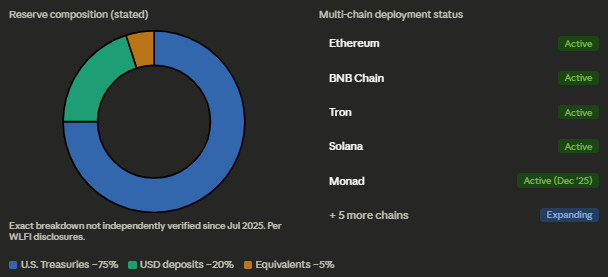
One material concern heading into Q1 2026 was the gap in reserve attestation reporting. USD1 had not published monthly attestation reports since July 2025, according to NYDIG, a significant red flag for institutional and retail holders, especially as regulatory scrutiny increases.
World Liberty Financial's official product page promises monthly reserve reports, making the lapse a live compliance issue.
Political Controversy and Congressional Scrutiny
USD1 is the first major stablecoin issued by a sitting U.S. president's family, and that fact generated political and regulatory friction with no precedent in the stablecoin market.
By Q1 2026, multiple congressional investigations were underway and prominent Democratic lawmakers had made WLFI central to stablecoin legislation debates.
1. The House Investigation
A significant portion of Rep. Khanna's inquiry focused on USD1, which was used to settle MGX's $2 billion investment in Binance.
Lawmakers sought documentation on how USD1 was selected, the revenue generated by the transaction, and whether company personnel were involved in discussions regarding the later presidential pardon of Binance founder Changpeng Zhao.
2. The UAE Stake and Governance Disclosure Failure
WLF did not disclose that Tahnoun had purchased the 49% share, nor did it disclose to the public that two Tahnoun affiliates, Martin Edelman, general counsel of G42, and Peng Xiao, CEO of G42, had been put on the board of WLF.
3. The Warren and Merkley Critique
Senators Warren and Merkley sent letters to the CEOs of MGX and Binance requesting documents related to their use of USD1 to settle the $2 billion investment deal, asking directly: "Why, beyond the obvious benefit of gaining favor, directly or indirectly, with the Trump Administration, did you select USD1, a newly-launched, untested cryptocurrency with no track record?"
4. WLFI's Defense
World Liberty Financial maintained that stablecoins, including USD1, help bolster the strength of the dollar, arguing that absent USD1, the MGX capital would have exited the U.S. financial sphere entirely and moved offshore, likely settling in UAE dirhams.
5. The Justin Sun Dimension
Justin Sun invested $30 million into World Liberty and an SEC investigation into Sun's companies was subsequently dropped shortly after Trump took office.
In 2025, Sun's total investment grew to at least $75 million. The relationship then fractured when WLFI blacklisted Sun's wallet address in September 2025, freezing more than $100 million in cryptocurrency he had purchased from the project.
Despite the breakdown, USD1 remains live on the Tron blockchain that Sun founded.
"The launch of a stablecoin directly tied to a sitting President who stands to benefit financially from the stablecoin's success is itself an unprecedented conflict of interest presenting significant threats to our financial system." - Senators Warren and Merkley, letter to World Liberty Financial
Risk Assessment
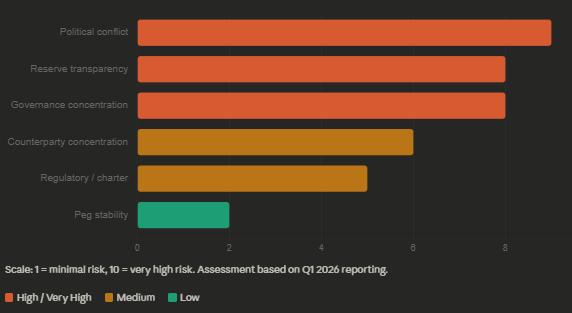
Reserve transparency is a live operational risk. Political associations and treasury governance can influence holder confidence and peg stability, and for a stablecoin, confidence is paramount. Any significant doubt can trigger redemptions and test the reserve backing.
Counterparty concentration is structural. A large majority of USD1's circulating supply originates from the MGX–Binance deal.
WLFI earns an estimated $60–$80 million annually, provided Binance doesn't try to redeem the funds. If Binance were to restructure or redeem that position, it would represent a material supply shock.
On the upside, peg stability has been a consistent strength. USD1 is 100% backed by U.S. cash, U.S. government money market funds, and other cash equivalents, designed to ensure stability and liquidity at all times. No material depegging events occurred through Q1 2026.
Conclusion
USD1 closes Q1 2026 as the stablecoin market's defining story. In under 12 months, it settled the largest stablecoin transaction in crypto history, attracted a reported $500 million sovereign equity stake, and reached fifth place globally by market cap.
Its Binance collateral integration and Apex Group partnership suggest structural staying power, but two unresolved issues will determine its next chapter: the lapse in reserve attestation reporting and a governance structure critics argue is built to concentrate, not distribute, power.
The OCC charter decision is the central catalyst to watch. Approval signals legitimacy. A prolonged review hands ammunition to every opponent.
The tension between state power, institutional capital, and regulatory accountability that defined Q1 2026 is not going away.
Read Next:
FAQs:
1. What is USD1 and who issues it?
USD1 is a dollar-pegged stablecoin issued by World Liberty Financial, co-founded by President Trump and his sons. It is issued and managed by BitGo Trust Company in South Dakota, backed by U.S. cash and government money market funds, with zero-fee minting and redemption.
2. What was USD1's market cap in Q1 2026?
USD1's market cap in Q1 2026 was around $4.52 - $4.58 billion, with a circulating supply of over 4.58 billion tokens. USD1 expanded its market value by roughly 50% in early 2026, the fastest growth rate among major stablecoins that quarter.
3. What was the MGX–Binance deal and why does it matter?
The deal was that Abu Dhabi's MGX used USD1 to close a $2 billion investment in Binance, the largest stablecoin-settled institutional transaction in crypto history. It gave USD1 $2 billion in immediate liquidity and generates an estimated $60–$80 million in annual yield for WLFI, while giving Binance a direct interest in maintaining USD1's peg.
4. What is the $500 million UAE stake in WLFI?
Days before Trump's inauguration, Tahnoun bin Zayed Al Nahyan's interests agreed to buy 49% of WLFI for $500 million, undisclosed publicly. Two Tahnoun affiliates were placed on the WLFI board without announcement. The revelation became the focus of a House congressional investigation in February 2026.
5. What is the OCC charter application?
WLTC Holdings filed with the OCC to establish a national trust bank offering fee-free USD1 issuance and redemption, fiat on- and off-ramps, and custody and conversion services for USD1 and other stablecoins. The OCC is targeting approximately 120-day review windows for conditional approvals.
Disclaimer:
This content is provided for informational and educational purposes only and does not constitute financial, investment, legal, or tax advice; no material herein should be interpreted as a recommendation, endorsement, or solicitation to buy or sell any financial instrument, and readers should conduct their own independent research or consult a qualified professional.