
Table of Contents
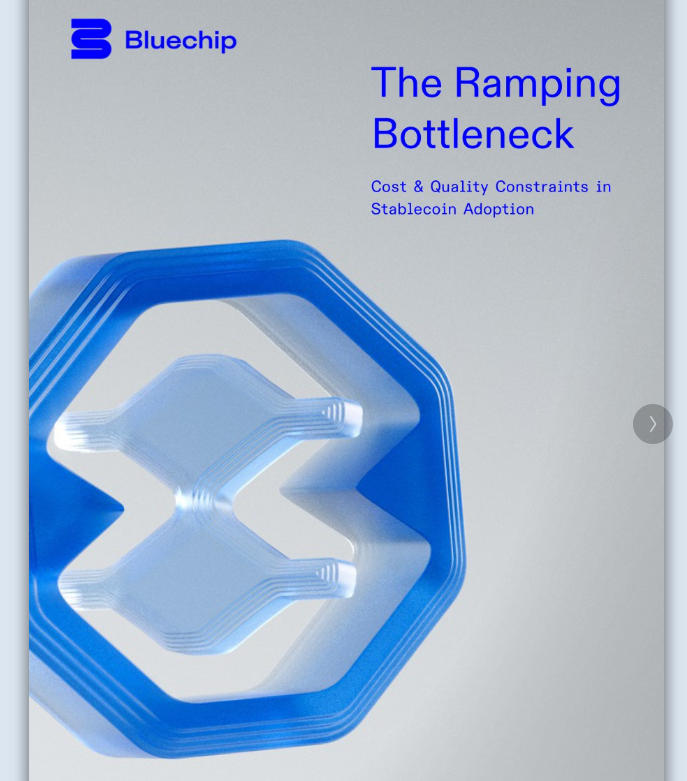
In a timely analysis addressing the critical hurdles in cryptocurrency adoption, Bluechip announced on December 18, 2025, the release of its comprehensive report titled: "The Ramping Bottleneck: Cost & Quality Constraints in Stablecoin Adoption."
Authored by Vaidya Pallasena, Co-Founder of Bluechip, the 63-page document delves into the infrastructure enabling fiat-to-stablecoin conversions, highlighting how improved ramps could unlock broader global use cases for stablecoins.
This report arrives amid surging institutional interest in stablecoins, fueled by milestones like Stripe's acquisition of Bridge, Circle's successful IPO, and U.S. legislation such as the GENIUS Act. It positions ramps as the key bottleneck, emphasizing that while stablecoins excel in moving money faster and cheaper, adoption is constrained by high costs, complexity, and quality issues in on- and off-ramps.
Details of the Report
The report breaks down the stablecoin ramp ecosystem across eight sections, including an executive summary, contributor insights, and in-depth explorations of ramp models, value chains, and barriers to scale.
Key data points include all-in ramping costs ranging from 0-0.3% for bank-funded options in the US, EU, and UK, to 7-10% for card-based ramps in emerging markets, and up to 15-20% in parts of Africa. It compares stablecoin transfers to traditional methods, noting 50-90% cost savings in high-volume corridors and settlement times under 30 minutes versus T+5 days.
The analysis covers six primary ramp models:
CEX order books, CEX conversions, issuer windows, standalone ramps, OTC desks, and P2P platforms, tailored to audiences from retail users to institutions.
It examines the full value chain, from issuers and liquidity providers to orchestration platforms like Bridge and BVNK, which simplify integrations and compress costs.
Strategic Context and Timing
The release coincides with stablecoins' growing role in remittances, B2B payments, treasury management, and financial inclusion, as institutions integrate them into mainstream finance. Pallasena's report underscores that concerns over reserves and governance have diminished due to regular attestations and regulatory clarity, shifting focus to ramp efficiency.
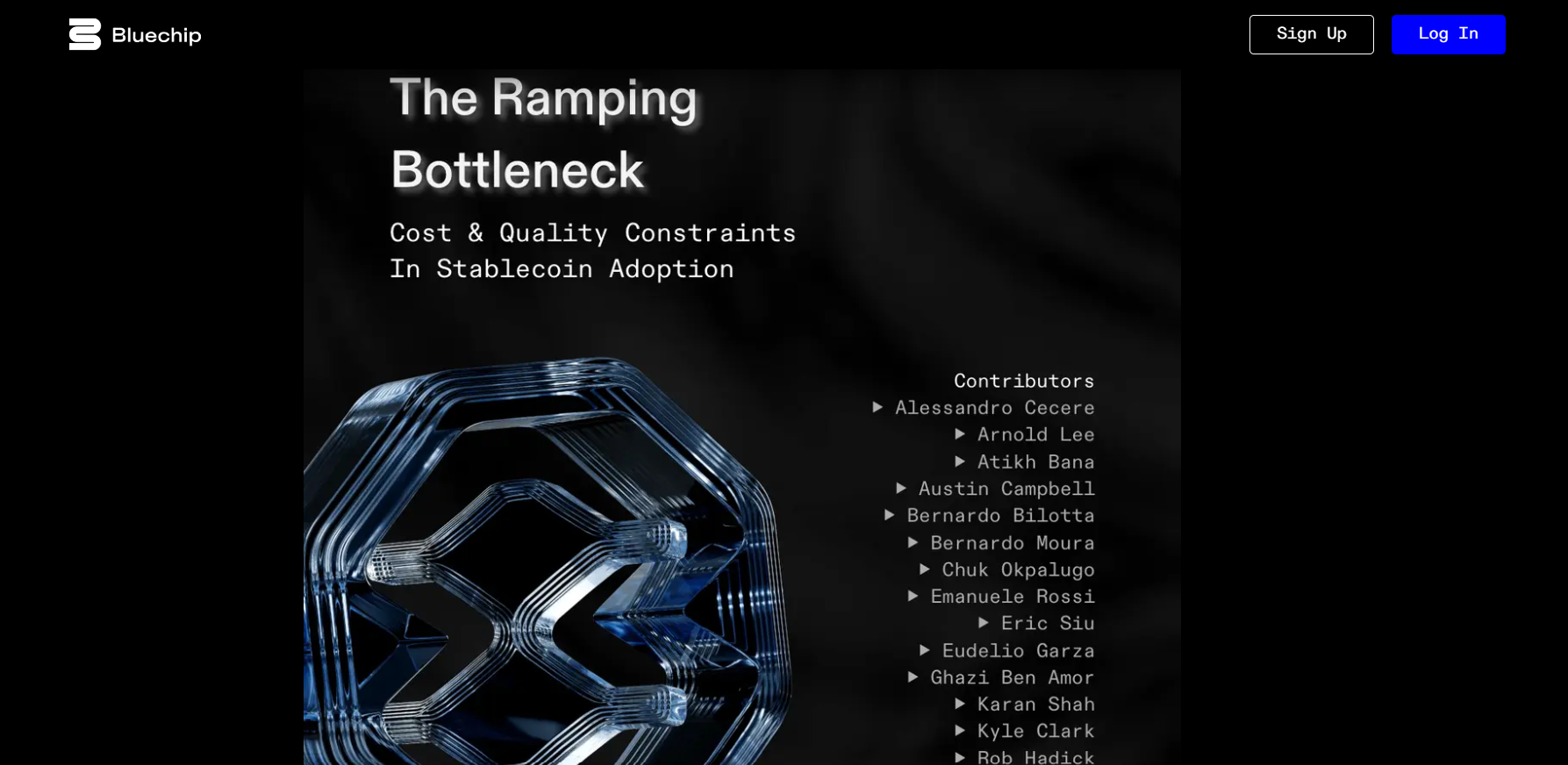
Bluechip, a leader in stablecoin infrastructure, draws on contributions from industry experts at firms like Sphere Labs, Anchorage Digital, and the Ethereum Foundation to provide a global perspective. The timing aligns with regional developments, such as maturing ramps in Asia-Pacific and Latin America, where P2P and local payment integrations are driving adoption amid FX volatility and inflation.
Key Features and Insights
- Cost and Speed Advantages: Stablecoins outperform traditional rails in high-cost corridors (e.g., Africa and Southeast Asia) by 58-94%, with instant settlements enabling real-time use cases.
- Ramp Models Breakdown: From low-cost institutional issuer windows (0-0.1%) to variable P2P options (0.1-0.5%), the report details economics, complexity, and audience fit.
- Barriers and Solutions: Identifies fragmented licensing, compliance overheads, and UX friction as key challenges, proposing full-stack orchestration, reusable ID verification, and bank partnerships as paths forward.
- Global Coverage: Spans North America, Europe, Africa, Asia-Pacific, and Latin America, highlighting leaders like Coinbase, Bitso, and Yellow Card.
Regulatory Compliance
The report discusses fragmented licensing landscapes, with operators using greenfield applications, acquisitions, and license-as-a-service models to navigate regions.
It advocates for clearer frameworks to enhance fiat-stablecoin fungibility.
Geographic Scope
Worldwide, with focused insights on underserved markets like Africa and Latin America, where P2P and mobile-money ramps are pivotal.
Market Implications
This report challenges the industry to prioritize ramp innovation, potentially accelerating stablecoin volumes beyond current levels. By compressing end-user prices and improving success rates, it could empower fintechs and PSPs to build on stablecoins for non-speculative applications.
Competitors in the space, including exchanges and orchestration platforms, may respond with enhanced integrations, while issuers like Circle and Tether could see deeper liquidity.
The findings suggest stablecoins could disrupt traditional cross-border payments, slashing costs in B2B corridors and enabling programmable money for broader financial services. Early reactions on platforms like X indicate strong interest from fintech leaders, with the report poised to influence policy and product roadmaps.
Challenges and Industry Sentiment
Despite optimism, the report warns of persistent barriers like high retail costs in emerging markets, settlement delays from prefunding, and onchain fees. It notes that in established corridors, stablecoins may not always win on price but dominate on speed. Stakeholders emphasize the need for institutional-grade privacy and simpler UX to avoid alienating mainstream users.
Looking Ahead
Bluechip anticipates that advancements in orchestration and the stablecoin tech stack will drive the next wave of fintech breakthroughs. The report calls for banks as first-class ramps and reusable identity solutions to scale adoption.
As stablecoins evolve, expect integrations with traditional rails to further reduce friction, positioning them as a core tool for global money movement.
For more stablecoin news visit stablecoininsider.org