
Table of Contents
December 3, 2025, 04:30 AM GMT
In a move that sent crypto Twitter into a frenzy before sunrise, the STBL Protocol, founded by Reeve Collins, the original co-founder and first CEO of Tether (USDT), officially activated its long-awaited Stablecoin 2.0 infrastructure.
The core promise: for the first time in history, yields generated by real-world assets backing stablecoins will flow to users and ecosystems instead of centralized issuers.
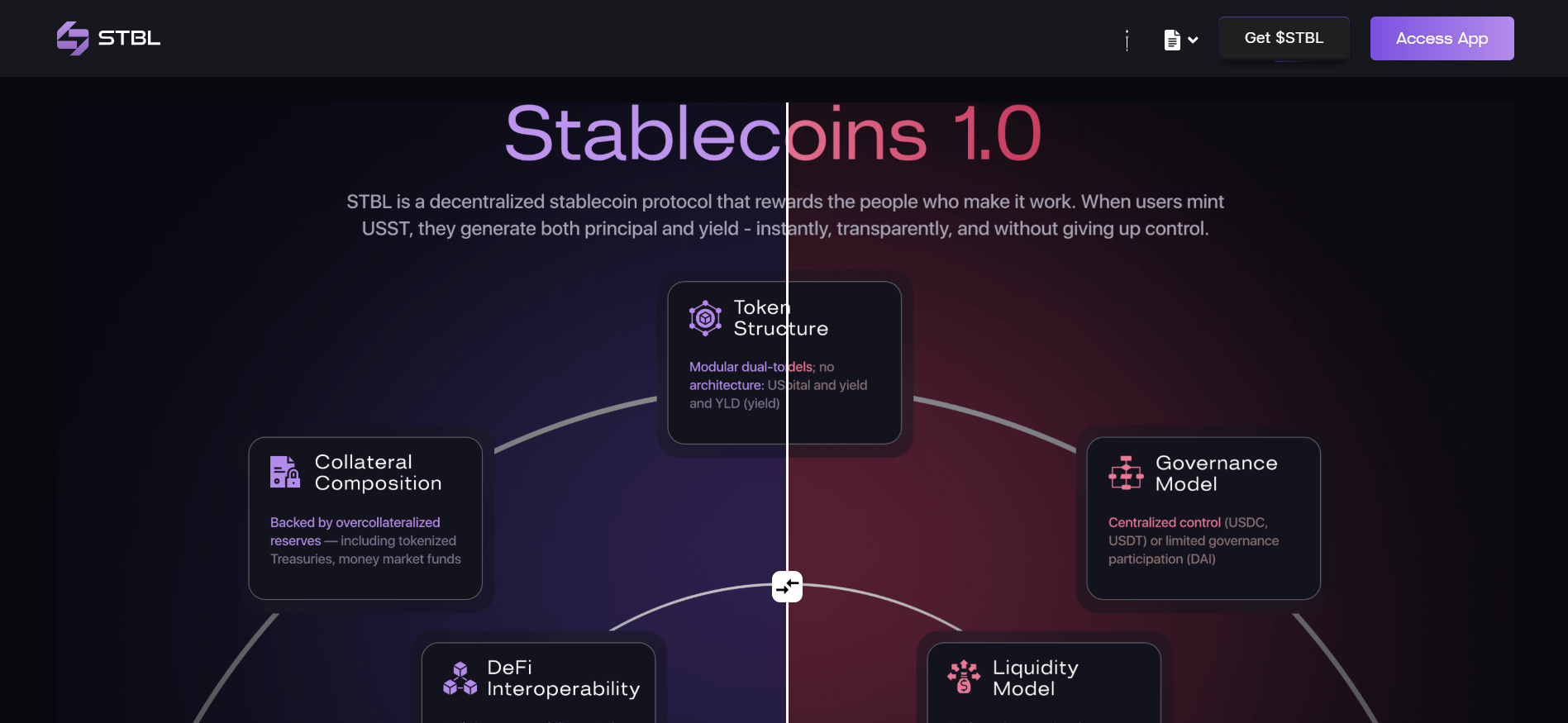
At precisely 04:30 GMT, the protocol’s smart contracts began accepting deposits of tokenized U.S. Treasuries and other RWAs, instantly splitting them into two components: USST (a 1:1 USD-pegged stablecoin) and non-transferable YLD NFTs that capture 100 % of the underlying interest.
Key Takeaways
- STBL is the first stablecoin protocol that routes 100 % of RWA yield to users and ecosystems instead of issuers.
- Backed by the original architect of Tether and $300M in funding, it carries unmatched institutional credibility.
- $STBL holders govern everything from reserve composition to fee usage, with staking rewards amplified by holding USST.
- If STBL captures just 5 % of the $230B stablecoin market, it could redistribute over $1 billion in annual Treasury yields to the community.
- Minting is now live, early participants receive YLD NFTs that compound in real time with zero lockup.
The Genesis of STBL: From Tether Visionary to Stablecoin 2.0 Architect
Reeve Collins, who co-created Tether in 2013 and scaled USDT to become the world’s largest stablecoin, left the company in 2015 frustrated with the industry’s drift toward centralized profit extraction.
After years of quiet development, STBL emerged in 2024 with a $300 million pre-seed led by Wave Digital Assets.
The governance token $STBL launched on Binance Alpha and Kraken in September 2025, rocketing 200% in its first week to a $50 million market cap on $250 million in volume.
Core Innovation: Yield Redistribution - How STBL Flips the Script on Centralized Profits
Traditional stablecoin issuers like Tether and Circle have earned billions by investing reserves in U.S. Treasuries while paying users zero interest. Tether alone reported $4.9 billion in profits in Q2 2025.
STBL eliminates that model entirely.
When a user deposits a yield-bearing RWA (BlackRock’s BUIDL, Franklin Templeton’s BENJI, or Ondo’s USDY), the protocol performs an atomic “bond-stripping” operation:
- Principal → instantly minted as USST (fully tradeable and redeemable 1:1)
- All future interest → captured in a soul-bound YLD NFT that accrues value in real time
Protocol fees (0.05–0.20 %) are used exclusively for $STBL buybacks, burns, and multi-factor staking rewards, creating a self-reinforcing flywheel that rewards governance participants and liquidity providers.
Market Impact: Why This Matters Now in a $225B Stablecoin Boom
Tokenized real-world assets crossed $25 billion in 2025, a 308% year-over-year surge, with U.S. Treasury products alone surpassing $7.4 billion.
STBL positions itself as the modular base layer for the next generation of enterprise and community stablecoins, already compliant with the newly passed GENIUS Act’s transparency requirements.
Early X sentiment is explosive, with influencers calling it “the biggest alignment upgrade since Uniswap v3.”
Challenges and Future Roadmap
The protocol is not without risks. USST briefly de-pegged to $0.982 during October stress tests but recovered within hours via automated liquidity injections from partner Ondo Finance.
STBL counters regulatory and stability concerns with settle-band oracles (eliminating noisy price feeds) and full on-chain reserve attestation every six hours.
The Q4 2025 roadmap includes the public launch of the Ecosystem Stablecoin Standard (ESS), enabling branded variants (think AmazonCoin, SingaporeDollar, or even city-backed tokens), all inheriting STBL’s yield-redistribution engine.

Conclusion
Twelve years after helping invent the stablecoin category, Reeve Collins has returned with a protocol that fixes what he believes was its original sin: misaligned incentives.
As one X user wrote minutes after the 04:30 GMT activation: “Tether took the yields. STBL gives them back. Game over.”
The stablecoin wars just entered a new era, and the users finally have a weapon.
Read Next:
FAQs:
1. What is STBL Protocol and how does it advance Stablecoin 2.0?
STBL Protocol, founded by ex-Tether co-founder Reeve Collins, is the first decentralized infrastructure that redistributes 100 % of real-world-asset yields to users and ecosystems through its USST stablecoin + YLD NFT split model – marking the transition to “Stablecoin 2.0.”
2. Who is Reeve Collins and why does his involvement matter?
Reeve Collins co-founded Tether (USDT) in 2013 and served as its first CEO. His decade-plus experience scaling the world’s largest stablecoin gives STBL instant regulatory and technical credibility.
3. How does STBL’s yield redistribution actually work?
Deposit a yield-bearing asset (e.g., tokenized Treasuries) → protocol instantly splits it into USST (principal, fully liquid) + YLD NFT (all future interest). No staking or lockups required.
4. What are the main risks of using STBL right now?
Primary risks are short-term peg volatility (already stress-tested and resolved in October) and evolving global regulation. These are mitigated by over-collateralization, settle-band oracles, and GENIUS Act-compliant transparency.
5. How do I start earning yield with STBL today?
Connect your wallet to app.stbl.xyz, deposit supported RWAs (BUIDL, USDY, etc.), receive USST + YLD instantly, and optionally stake $STBL (available on Kraken/Binance) for governance and extra rewards. Minting is live as of December 3, 2025.