Table of Contents
Last week, BlackRock released one of its most important papers in years: a formal blueprint for how tokenized finance is likely to scale from a $2B experiment today into a multi-trillion-dollar global market.
But buried inside the institutional language is a much bigger story, one that BlackRock doesn’t say outright, but is impossible to ignore:
Tokenized finance cannot work without a stablecoin-layer.
Stablecoins, not banks, are positioned to become the default settlement rail.
This week, we break down what BlackRock got right, what they underestimated, and why their tokenization roadmap actually accelerates the stablecoin narrative more than any crypto report this year.
1. BlackRock’s Thesis in One Sentence
BlackRock sees blockchain settlement becoming infrastructure, not speculation.
And if blockchain becomes infrastructure, the cash leg of every transaction must be instant, global, and programmable.
That rules out banks.
It rules out ACH, SWIFT, and card networks.
It even rules out tokenized deposits (too siloed, too jurisdiction-bound).
It leaves stablecoins, specifically regulated, transparent, high-liquidity stablecoins, as the only viable global cash rail.
2. The Tokenized Finance Stack BlackRock Envisions
BlackRock breaks tokenized finance into three layers:
1. Tokenized Assets
(t-bills, funds, credit, MMFs)
This is where institutions will live. BlackRock tokenizing their own funds is inevitable.
2. Market Infrastructure
(custody, identity, compliance, clearing)
This will be split among banks, fintechs, and blockchains.
3. Settlement Layer
(the money that moves when these assets trade)
This is the part BlackRock glosses over, and where stablecoins dominate.
Tokenized funds only work if the cash moves instantly.
Redemptions must settle in minutes, not days.
Collateral transfers must be atomic.
Margin calls must be real-time.
BlackRock outlined a map, but the roads already exist, and they’re stablecoin rails.
3. The Stablecoin Reality
Here are the numbers BlackRock didn’t include:
- Stablecoin settlement volume: $11T+ in the last 12 months
- 10-20M daily active stablecoin users globally
- On many days, USDT alone processes more value than Visa
- 70%+ of all crypto transactions on leading chains involve stablecoins
- Emerging markets now rely on stablecoins for FX more than local banks
Tokenized T-bills might reach $50B next year.
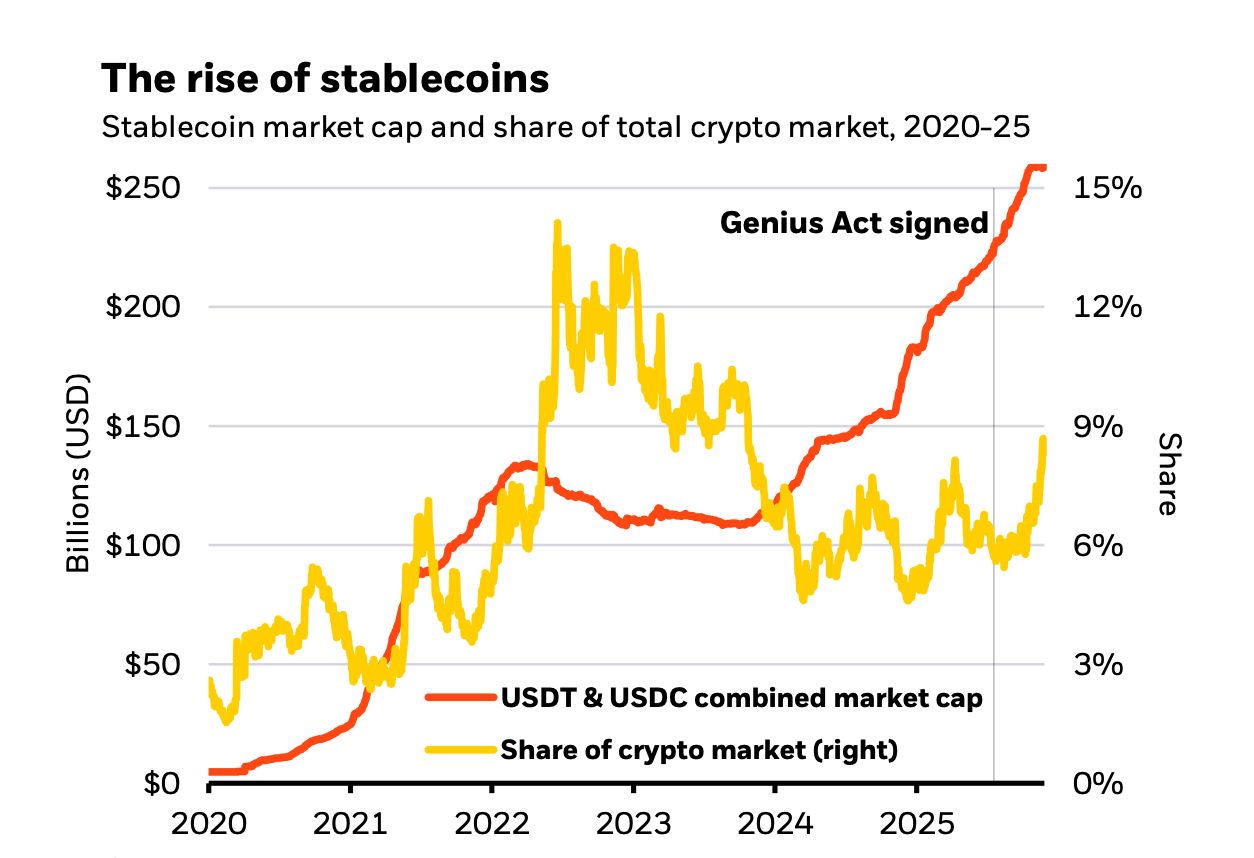
Stablecoins already sit at $160B+ in supply and trillions in flow.
BlackRock is arriving after the market has already chosen a dollar standard.
4. Tokenized T-Bills vs. Stablecoins: The Convergence
Will tokenized treasuries replace stablecoins?
The likely answer:
They merge into a unified dollar spectrum.
Low-volatility cash → Stablecoins
Low-risk yield → Tokenized T-bills
Institutional settlement → Yield-bearing stablecoins / programmable MMFs
We are watching the formation of:
The On-Chain Money Market Layer
And the players that win it are those who control:
- Liquidity
- Distribution
- Banking partners
- Regulatory alignment
- Chain-level integrations
- Real-world usage
Circle, Paxos, and a few regulated issuers are perfectly positioned here.
USDT will dominate velocity.
USDC will dominate institutional compliance.
And tokenized funds will plug directly into their rails.
5. Ethereum and Solana: The Real Settlement Winners
BlackRock didn’t name chains, but the implications are clear.
Ethereum
Becomes the compliance-heavy settlement environment for institutional tokenization.
Permissioned subnets. KYC-enabled rails. Tokenized funds. MMFs.
Solana
Becomes the high-velocity cash layer, especially for stablecoins, payments, FX, and AI-agent transactions.
In other words:
Ethereum settles assets.
Solana settles dollars.
And both feed the same liquidity ecosystem.
6. The Coming “Tokenized Dollar Race”
BlackRock’s paper accelerates a battle already underway:
1. Regulated Dollar Stablecoins
USDC, PYUSD, GUSD, Paxos, aligned with auditors, banks, and institutions.
2. Tokenized Deposits & Bank Coins
JPM Coin, Citi Coin — but remain walled gardens.
3. Tokenized MMFs / T-Bills
BlackRock BUIDL, Franklin BUIDL, Ondo OUSG will grow rapidly but stay institution-focused.
4. Retail Stablecoins (global adoption)
USDT, sDAI, USDe dominate velocity, remittances, and emerging market demand.
Together, they form the first real global competition for the U.S. dollar’s distribution layer in 40 years.
Tokenization is not creating new markets, it’s revealing how broken the old ones already were.
7. The Most Important Line in the BlackRock Report
The paper includes a single sentence that almost no one highlighted.
“Tokenized markets will require atomic settlement to reach full efficiency.”
- Settlement must be stablecoin-level fast.
- Banks cannot do this.
- Tokenization only works if cash moves on public blockchains.
BlackRock didn’t say it directly.
They didn’t have to.
8. What This All Means for 2026
Here are our forward-looking predictions based on BlackRock’s roadmap:
- Stablecoin supply reaches $500B+ by 2027
- Tokenized treasuries hit $150B-$200B
- USDC becomes the default institutional settlement asset
- USDT continues leading global retail FX liquidity
- Public blockchains integrate with custodians and market infrastructures
- AI agents transact almost exclusively using stablecoins
- Tokenized credit markets finally emerge
- BlackRock launches its first consumer-facing tokenized product
But the biggest shift:
Stablecoins become the universal cash leg for tokenized finance.
Final Thoughts
BlackRock’s new paper isn’t a forward-looking roadmap for institutions, it’s a confirmation of what the stablecoin market has already demonstrated at scale.
Tokenization is now inevitable, and stablecoins have clearly emerged as the dominant settlement layer for on-chain finance.
Public blockchains are becoming the underlying infrastructure that moves value, and the U.S. dollar is rapidly migrating on-chain through stablecoins and tokenized assets.
Together, these shifts mark the beginning of the most significant transformation in global finance in the past fifty years.
Related Reports
- The Neobank Transition Report
- 2025 Stablecoin Spending Report
- Who Is Winning the Stablecoin Infrastructure Race?
Partner/Advertise with Stablecoin Insider
Fill out this form to partner and advertise on the only publication, dedicated entirely to the Stablecoin ecosystem.
See you next week,
- The Stablecoin Insider team