Table of Contents
While traditional finance yields often struggle to keep pace with inflation, the world of digital assets presents compelling alternatives. The search for stablecoins with 10%+ APY has become a primary strategy for investors seeking to generate substantial, passive income on their dollar-equivalent holdings. This is not about chasing speculative gains; it's about deploying a calculated approach to maximize returns on stable capital. The core challenge, however, lies in navigating the complex ecosystem of platforms and protocols to identify legitimate, sustainable opportunities while managing inherent risks.
This practical guide is designed to cut through the noise. We provide a curated roundup of seven distinct platforms and protocols where you can currently find stablecoins with 10%+ APY. Our analysis moves beyond surface-level claims, offering a comprehensive breakdown for each option. You will learn the exact mechanisms generating these yields, whether through lending, liquidity provision, or sophisticated DeFi strategies.
We will equip you with the actionable information needed to make informed decisions. Each item in this listicle includes:
- A direct link to the platform and a source for verifying the current APY.
- Step-by-step instructions, complete with screenshots, to get you started.
- A transparent assessment of the associated counterparty and smart-contract risks.
- Key considerations regarding tax implications and the evolving regulatory environment.
Our goal is to provide a clear, data-driven roadmap. We will explore user-friendly centralized options like Coinbase alongside decentralized powerhouses such as Curve Finance, Pendle, and Morpho. By the end of this article, you will have a clear understanding of where and how to securely deploy your stablecoins for double-digit returns.
1. Coinbase: The Mainstream Gateway to DeFi Yield
Coinbase, a household name in the crypto space, has strategically positioned itself as a secure bridge for mainstream users to access decentralized finance (DeFi) yields. For those wary of the complexities of self-custody and interacting directly with protocols, Coinbase offers a simplified, custodial solution. It integrates directly with vetted DeFi protocols, allowing users to earn variable APY on their USDC without ever leaving the familiar and regulated Coinbase ecosystem.
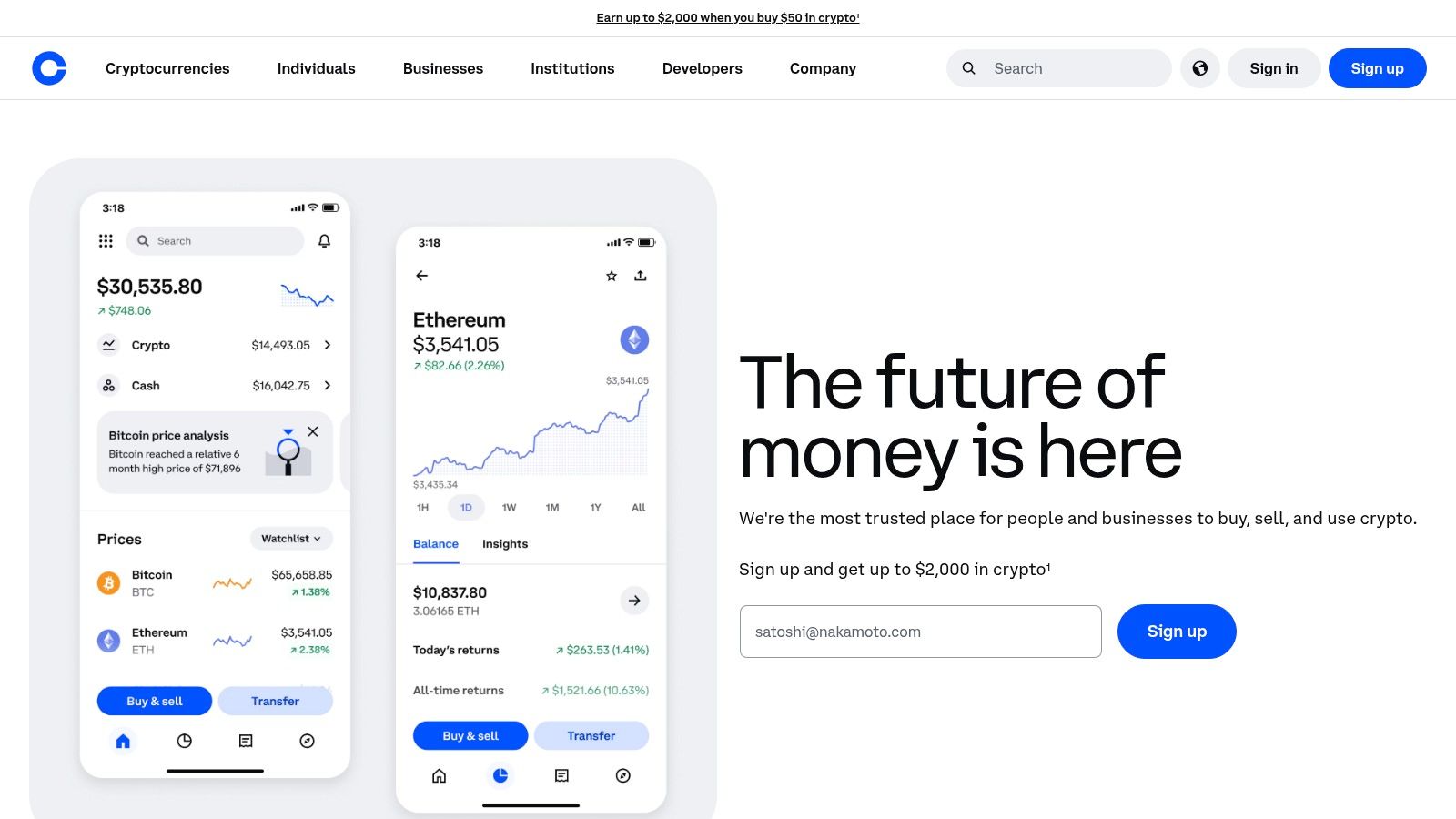
This offering is a standout because it abstracts away the most intimidating parts of DeFi. Coinbase manages the creation of a smart contract wallet on your behalf, handles the gas fees (transaction costs), and allocates your funds to lending pools on protocols like Morpho. This makes earning stablecoins with 10%+ APY significantly more accessible to a broader audience.
Yield Mechanism and Rate Source
The yield is generated by lending your USDC to over-collateralized borrowers on established DeFi lending markets. Coinbase acts as an intermediary, placing user funds into curated vaults that interact with these protocols.
- Yield Source: USDC lending via the Morpho protocol.
- Current Rate: The APY is variable and depends on market demand for borrowing USDC. Rates are displayed in real-time within the Coinbase app and can fluctuate significantly. Historically, these rates have often surpassed 10% during periods of high market activity.
- Payout: Interest accrues on-chain and is paid out when you withdraw your funds from the lending pool.
How to Access and Eligibility
Accessing this feature is straightforward for eligible users, designed to be as simple as buying crypto on the platform.
- Eligibility: You must have a verified Coinbase account and reside in an eligible U.S. jurisdiction. The feature is not available in all states due to varying regulations.
- Steps: Navigate to the "Earn" or "Lend" section of the Coinbase app or website, select USDC, and choose the amount you wish to supply. Coinbase handles the rest of the on-chain transactions.
Key Insight: While Coinbase simplifies access, it's crucial to understand that your funds are being deployed to on-chain smart contracts. This introduces smart contract risk, even though Coinbase curates the protocols it integrates with.
Risks and Safety Considerations
- Smart Contract Risk: Your funds are exposed to the risks of the underlying DeFi protocol (e.g., Morpho). A bug or exploit in the protocol's code could result in a loss of funds.
- Counterparty Risk: While lending is over-collateralized, a black swan event causing a rapid de-pegging of collateral assets could lead to bad debt in the protocol.
- Regulatory Risk: The regulatory landscape for crypto lending is still evolving. Changes in regulations could impact the availability or terms of this service. For more details on the institutional side of this, you can explore the topic of stablecoin yield through Coinbase Prime.
Website: https://www.coinbase.com
2. Pendle Finance: Tokenizing Yield for Fixed Rates
Pendle Finance introduces a novel approach to decentralized finance (DeFi) by tokenizing yield-bearing assets. This unique mechanism allows users to separate the principal from the future yield, creating two distinct tokens: Principal Tokens (PT) and Yield Tokens (YT). This innovation provides sophisticated strategies for managing yield, most notably the ability to lock in a fixed APY on stablecoins until a specific maturity date, a rare feature in the typically volatile DeFi space.
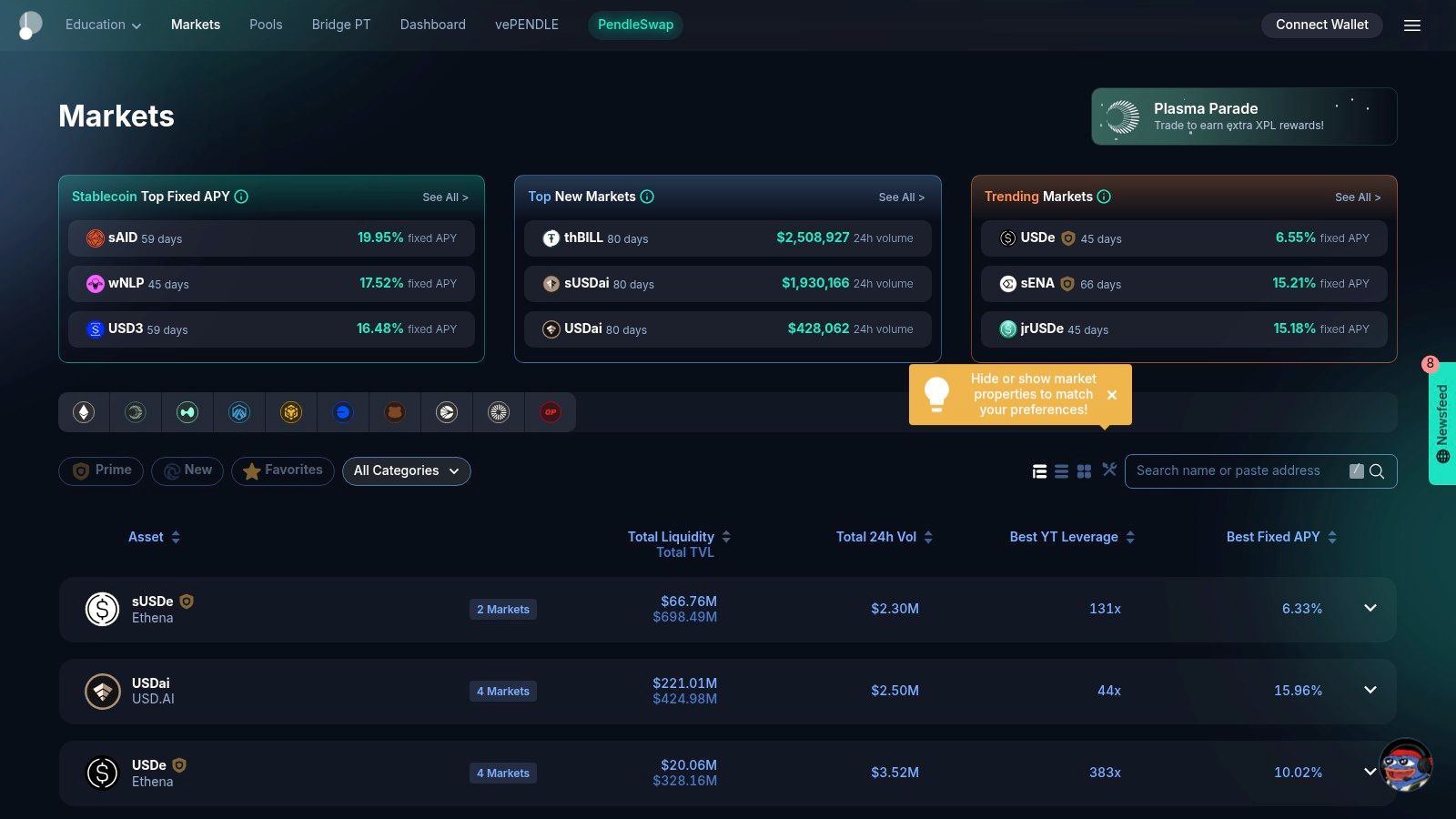
This platform stands out because it empowers users to move beyond variable rates. Instead of just earning a fluctuating APY, you can buy a Principal Token (like PT-USDC) at a discount to its face value. By holding it to maturity, you are guaranteed to redeem it for its full value, effectively securing a fixed rate. This makes it a powerful tool for those seeking predictable returns and a way to secure stablecoins with 10%+ APY without being subject to market whims.
Yield Mechanism and Rate Source
The yield on Pendle is derived from the underlying yield-bearing assets that are deposited into its protocol. Users can then trade the principal and yield components of these assets on Pendle's custom automated market maker (AMM).
- Yield Source: Yield is generated from underlying DeFi strategies, such as lending pools (e.g., Aave, Compound) or liquidity provider (LP) positions.
- Current Rate: The fixed APY is determined by the market price of the Principal Token (PT). For example, a PT alUSD market has previously shown a fixed APY of 18.6%. Rates are transparent, on-chain, and vary by asset and maturity date.
- Payout: The "payout" for fixed-yield seekers is realized at the maturity date when the PT can be redeemed for its full face value (e.g., 1 PT-USDC redeems for 1 USDC).
How to Access and Eligibility
Accessing Pendle requires a self-custody wallet and is open to anyone without KYC, embracing the permissionless nature of DeFi.
- Eligibility: Anyone with a web3 wallet (like MetaMask or Rabby) and the necessary crypto assets can interact with the protocol. It is available on multiple blockchains, including Ethereum, Arbitrum, and BNB Chain.
- Steps: Connect your wallet to the Pendle app, navigate to the "Markets" section, and find a stablecoin pool with your desired maturity date. You can then swap your stablecoin for the corresponding PT to lock in the displayed fixed yield.
Key Insight: The core concept is buying an asset (PT) for less than its future value. The difference between your purchase price and the redemption value at maturity constitutes your fixed, guaranteed profit.
Risks and Safety Considerations
- Smart Contract Risk: As with any DeFi protocol, there is an inherent risk of bugs or exploits in Pendle's smart contracts.
- Underlying Protocol Risk: Your yield is dependent on the safety and performance of the underlying protocols where the assets are deployed. A failure in a source protocol (like Aave) would impact the associated Pendle pool. To learn more about how protocols generate these returns, you can read about strategies for farming stablecoin incentives.
- Market Risk: While the yield is fixed if held to maturity, selling your PT before the maturity date will expose you to market price fluctuations. Gas fees and transaction slippage can also affect your final return.
Website: https://app.pendle.finance
3. Curve Finance: The Bedrock of Stablecoin Liquidity and Yield
Curve Finance is a cornerstone of the DeFi ecosystem, renowned for its highly efficient stableswap automated market maker (AMM) design. It specializes in creating deep liquidity pools for assets with similar price points, primarily stablecoins. This focus allows it to offer low-slippage trades and generate substantial fee revenue for liquidity providers, making it a go-to destination for earning yield.
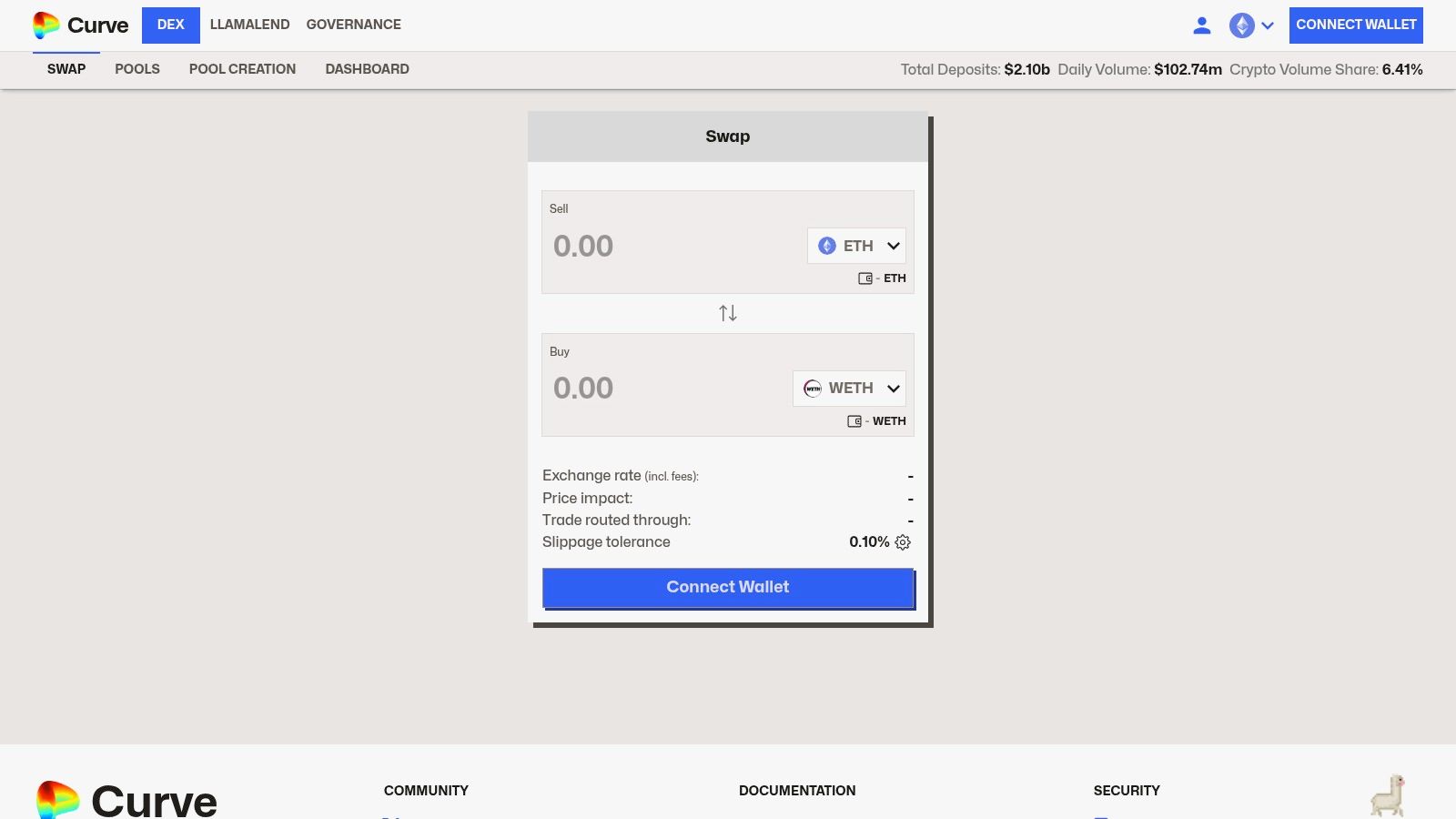
What sets Curve apart is its multifaceted approach to yield generation. Users can earn from trading fees, token incentives (CRV emissions), and by participating in its newer lending market, Llamalend. This variety of options means that finding stablecoins with 10%+ APY is often possible by identifying the right pool or lending market, especially during periods of high trading volume or when specific pools are being incentivized.
Yield Mechanism and Rate Source
Yield on Curve is primarily generated through two main avenues: providing liquidity to its stableswap pools and lending assets on its Llamalend protocol. The rates are dynamic and influenced by several market factors.
- Yield Source: A combination of trading fees from liquidity pools (LPs), CRV token emissions for "gauges" (incentivized pools), and interest from lending stablecoins via Llamalend.
- Current Rate: APYs are highly variable and pool-specific. Rates can range from low single digits to well over 10%. Yields are often presented as a base APY (from fees) plus a range for CRV rewards, which can be boosted by locking CRV tokens.
- Payout: Trading fees accrue in real-time within the pool. CRV rewards can be claimed periodically, typically on a weekly basis.
How to Access and Eligibility
Engaging with Curve requires a non-custodial wallet and a willingness to interact directly with DeFi protocols.
- Eligibility: Anyone with a supported crypto wallet (like MetaMask) and the necessary stablecoins can participate. There are no geographic or KYC restrictions at the protocol level.
- Steps: Connect your wallet to the Curve.fi app, select a stablecoin pool, and deposit your assets to receive LP tokens. To earn CRV rewards, you must then stake these LP tokens in the corresponding gauge.
Key Insight: The highest yields on Curve are often unlocked by participating in its governance. By locking CRV tokens for veCRV, you can boost your rewards from liquidity pools by up to 2.5x, significantly increasing your potential APY.
Risks and Safety Considerations
- Smart Contract Risk: Curve is one of the most battle-tested protocols in DeFi, but like any smart contract, it carries inherent risk. An exploit in the core contracts or a specific pool's contract could lead to a loss of funds.
- Impermanent Loss Risk: While minimal for stablecoin-to-stablecoin pools, there is still a risk if one of the stablecoins in the pool de-pegs from its $1 value.
- Incentive Dependency: High APYs are often dependent on CRV token emissions. A decrease in the price of CRV or a change in the allocation of rewards can significantly reduce the overall yield. For a deeper analysis, you can learn more about top stablecoin liquidity providers in 2025.
Website: https://curve.fi
4. Morpho (Morpho Blue): The Optimized On-Chain Lending Layer
Morpho is a next-generation decentralized lending protocol designed to offer more efficient rates by directly matching lenders and borrowers. While platforms like Coinbase use Morpho as their backend infrastructure, advanced users can interact with it directly using a self-custody wallet, potentially unlocking higher yields by cutting out the intermediary. Its innovative Morpho Blue architecture provides a permissionless and efficient foundation for lending markets.
Morpho Blue acts as a simple and immutable primitive, a base layer upon which more complex, user-facing applications (called "MetaMorpho Vaults") can be built. This design allows users to choose curated vaults with specific risk parameters or interact directly with isolated lending markets. For those seeking stablecoins with 10%+ APY, this direct access can be highly effective, especially in high-demand markets for stablecoins like USDC, USDT, or DAI.
Yield Mechanism and Rate Source
The yield on Morpho is generated purely from on-chain borrowing and lending activity. Lenders supply their stablecoins to a specific lending pool (e.g., USDC lent against wstETH collateral), and borrowers pay interest to access that liquidity. Morpho's efficiency aims to provide lenders with a rate closer to what borrowers are paying.
- Yield Source: Direct peer-to-protocol lending of stablecoins in isolated markets.
- Current Rate: The APY is highly variable and determined by the utilization rate of each specific market. Higher demand for borrowing a particular stablecoin against a certain collateral drives the APY up. Rates can and have surpassed 10% in various stablecoin markets during periods of high leverage demand.
- Payout: Interest accrues in real-time on-chain and is realized when you withdraw your supplied assets.
How to Access and Eligibility
Interacting directly with Morpho requires a self-custody wallet and a degree of DeFi knowledge, as you are managing your own funds on-chain.
- Eligibility: Anyone with a compatible self-custody crypto wallet (like MetaMask or Rabby) and the necessary assets can access Morpho. There are no geographic or KYC restrictions at the protocol level.
- Steps: Connect your wallet to the Morpho dApp, select a market (e.g., a specific stablecoin/collateral pair or a curated MetaMorpho Vault), and supply your stablecoins by signing a transaction.
Key Insight: Morpho Blue's isolated market design means risk is not socialized across the protocol. If a market with specific collateral experiences an issue, it does not affect other, separate markets on the platform, offering a more granular approach to risk management.
Risks and Safety Considerations
- Smart Contract Risk: As a DeFi protocol, Morpho's smart contracts are the ultimate custodian of your funds. An undiscovered bug or exploit could lead to a complete loss of assets within a specific market.
- Liquidation Risk: The protocol relies on liquidations to remain solvent. A "black swan" event causing extreme market volatility and network congestion could impair the liquidation process, potentially leading to bad debt in a market you've supplied to.
- Market Risk: The APY is not fixed and can drop significantly if borrowing demand falls. You must actively monitor the rates and risk parameters of the markets you participate in.
Website: https://app.morpho.org
5. Beefy Finance: The Multi-Chain Yield Optimizer
Beefy Finance operates as a decentralized, multi-chain yield optimizer that allows users to earn compound interest on their crypto holdings. The platform automates yield farming strategies through a system of "vaults," which aggregate user funds and deploy them into various liquidity pools, lending platforms, and other yield-generating opportunities across the DeFi ecosystem. Beefy’s core value is its ability to automatically and frequently compound the rewards earned, which maximizes APY.
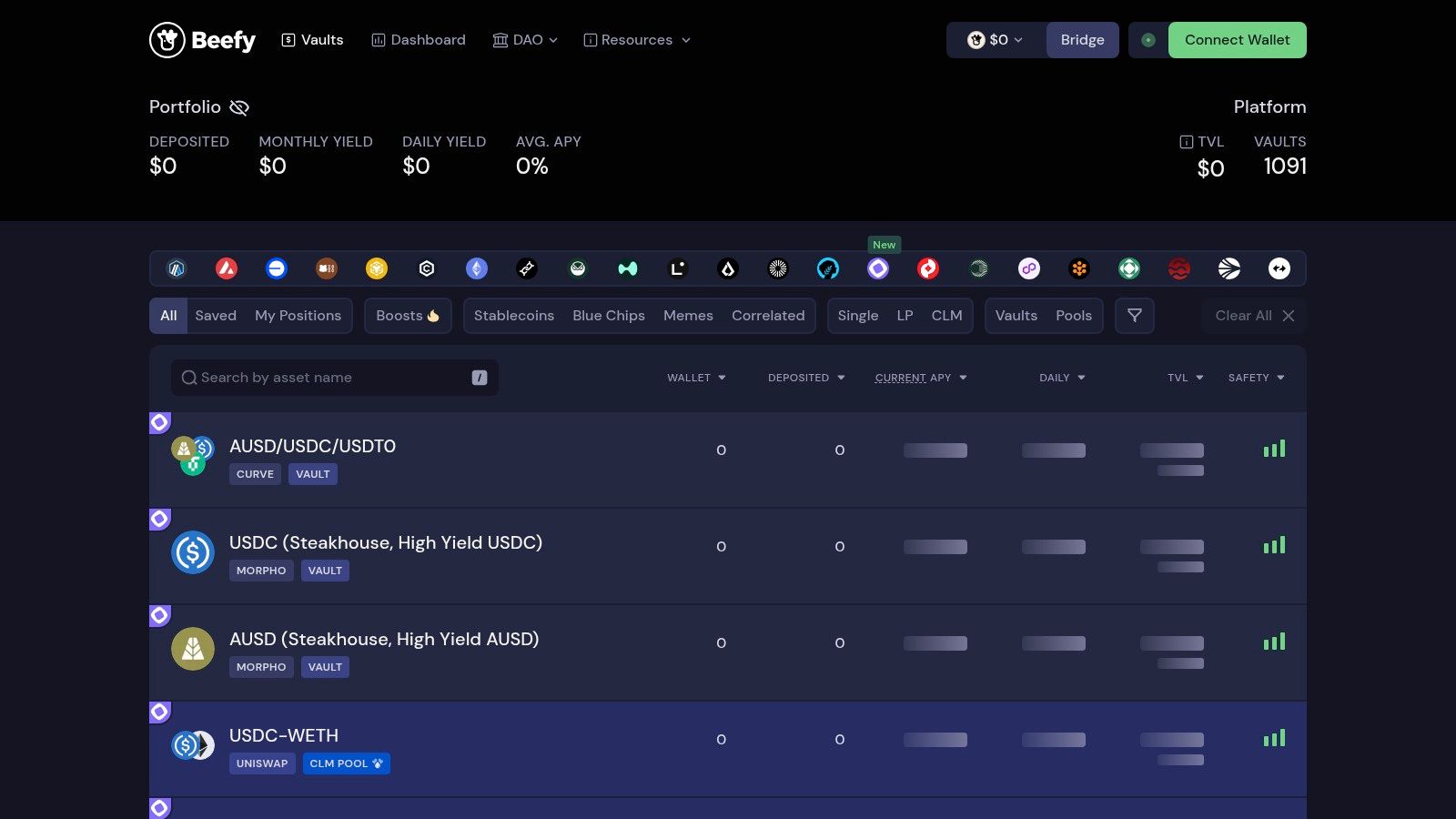
What makes Beefy a powerful tool for finding stablecoins with 10%+ APY is its agility. The platform constantly lists new vaults that capitalize on temporary, high-yield opportunities, often driven by protocol incentives or token emissions. While these boosted rates may not be permanent, they provide savvy users with chances to capture significant returns by rotating between different stablecoin vaults as opportunities arise.
Yield Mechanism and Rate Source
Beefy's yield is generated by deploying user assets into underlying DeFi protocols. The vaults auto-compound by harvesting rewards, swapping them for more of the underlying asset (e.g., stablecoins), and re-depositing them into the strategy, creating a compounding effect.
- Yield Source: Varies by vault. Sources include liquidity providing fees on decentralized exchanges (DEXs), lending interest, and token rewards from partner protocols.
- Current Rate: APYs are highly dynamic and specific to each vault and chain. Rates are displayed in real-time on the Beefy app and can fluctuate based on trading volume, protocol incentives, and total value locked (TVL).
- Payout: Rewards are automatically compounded back into your deposited principal. You realize your gains when you withdraw from the vault.
How to Access and Eligibility
Beefy is a decentralized application (dApp) and is permissionless, meaning anyone with a compatible web3 wallet can use it.
- Eligibility: No geographic or KYC restrictions. Users need a self-custody wallet (like MetaMask or Trust Wallet) and the native token of the chosen blockchain (e.g., ETH, BNB, ARB) for gas fees.
- Steps: Connect your wallet to the Beefy app, select your preferred blockchain, browse the stablecoin vaults, and deposit your assets. Beefy's smart contracts handle all subsequent compounding actions.
Key Insight: The headline APY on Beefy often includes rewards paid in other tokens, which the vault auto-sells. This can introduce price volatility risk on the reward token, even when your base asset is a stablecoin.
Risks and Safety Considerations
- Smart Contract Risk: Your funds are exposed to the risk of both Beefy's vault contracts and the underlying protocols they interact with. A bug in either could lead to a loss of funds.
- Strategy Risk: The performance of a vault depends on the underlying yield farming strategy. Changes in market conditions or token incentives can cause the APY to drop suddenly.
- Economic Risk: Many high-yield opportunities depend on inflationary token rewards from other protocols. If the value of these reward tokens collapses, the APY will fall dramatically. You can explore a deeper analysis of this model with this overview on a stablecoin yield aggregator.
Website: https://app.beefy.com
6. Vaults.fyi: The Independent Yield Aggregator and Discovery Tool
Vaults.fyi operates differently from other platforms on this list; it's not a direct yield-bearing protocol but a powerful, independent aggregator. It functions as a discovery engine, scanning thousands of on-chain yield pools across multiple blockchains to curate and highlight the most attractive opportunities, often featuring stablecoins with 10%+ APY. This makes it an essential tool for yield farmers looking to efficiently find and compare opportunities without manually checking dozens of different dApps.
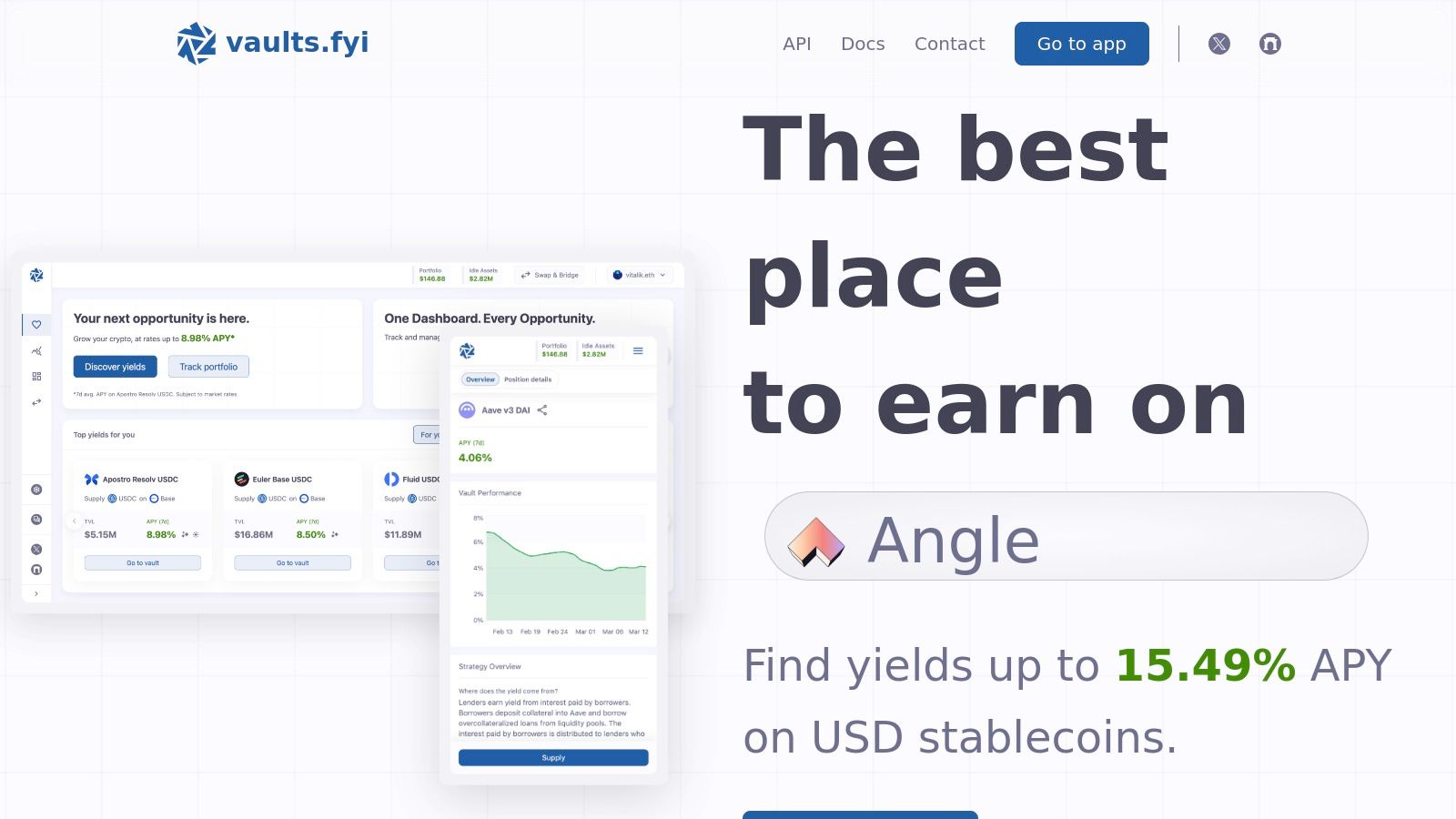
The platform’s standout feature is its curated "Yields of the Week" roundup, which provides timely insights into high-performing pools. By providing cross-protocol and cross-chain comparisons complete with APY and Total Value Locked (TVL) filters, Vaults.fyi empowers users to make data-driven decisions. It helps hunters of stablecoins with 10%+ APY avoid chasing unsustainable yields in tiny, high-risk pools by focusing on more established options.
Yield Mechanism and Rate Source
Vaults.fyi does not generate yield itself. Instead, it aggregates and displays data from the underlying DeFi protocols where the yield is actually generated through mechanisms like lending, liquidity provision, or staking.
- Yield Source: Varies depending on the protocol. Sources can include lending interest on Aave, trading fees from Uniswap LPs, or rewards from new protocols.
- Current Rate: The platform displays real-time or near-real-time APYs pulled directly from the smart contracts of the listed protocols. These rates are highly variable and dynamic.
- Payout: Payout schedules and mechanisms are determined by the specific protocol you choose to deposit into, which is accessed via a direct link from Vaults.fyi.
How to Access and Eligibility
Using Vaults.fyi is permissionless and straightforward, serving as a launchpad for your yield farming activities.
- Eligibility: Anyone with a web browser and a self-custodial wallet (like MetaMask) can access and use the site. There are no geographic or KYC restrictions to use the aggregator.
- Steps: Browse the curated lists or use filters to find a suitable stablecoin pool. Click on the opportunity to be taken directly to the underlying protocol's deposit page where you can connect your wallet and complete the transaction.
Key Insight: Vaults.fyi is a research tool, not a custodian. You are always in control of your funds but are also fully responsible for vetting the underlying protocols it links to. Use its TVL filters as a first line of defense against smaller, riskier pools.
Risks and Safety Considerations
- Smart Contract Risk: The primary risk lies with the third-party protocol you choose to deposit into. Vaults.fyi does not audit or guarantee the safety of the protocols it lists.
- Counterparty Risk: As an aggregator, it removes direct counterparty risk with itself, but you inherit all the risks of the platform you ultimately use. This includes risks of bad debt, exploits, and de-pegging events. For more on this, it's worth reviewing a broader analysis of the highest APY stablecoins and their associated risks.
- User Responsibility: The platform is designed for users who understand how to interact with DeFi protocols. You are responsible for your own due diligence before depositing funds into any listed vault.
Website: https://vaults.fyi
7. Resolv: Engineered Yield Through Clustered Strategies
Resolv is an innovative stablecoin and yield platform known for its aggressive strategy engineering. It frequently appears on yield aggregator leaderboards by offering clustered strategies and partner-integrated vaults for stablecoins like USDC. By combining multiple yield sources and layering seasonal reward programs, Resolv has consistently produced opportunities for users to earn on stablecoins with 10%+ APY.
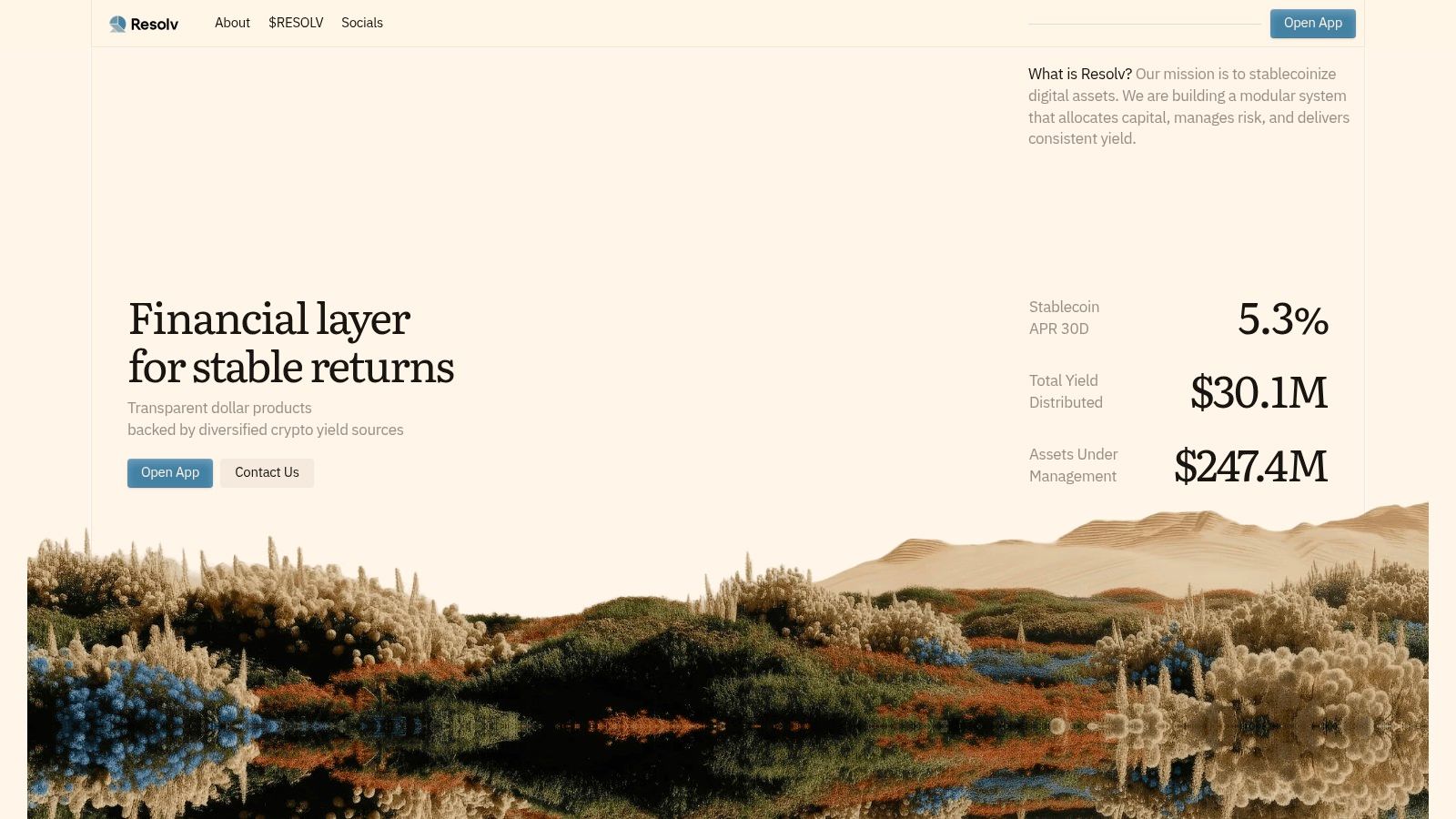
This platform stands out due to its programmatic approach to yield generation. Instead of relying on a single lending market, Resolv bundles various strategies into "clusters," like its USR and stUSR products. This method, combined with active platform development and seasonal points systems, creates dynamic and often high-yielding opportunities for DeFi-savvy users comfortable with self-custody.
Yield Mechanism and Rate Source
Resolv generates yield by integrating with various partner protocols and creating its own structured products. The final APY is a composite of base yield from underlying strategies plus additional incentives.
- Yield Source: The yield comes from a combination of lending, liquidity provision, and strategy vaults integrated with partner protocols. Additional yield is often provided through Resolv's own seasonal reward or points programs.
- Current Rate: APYs are highly variable and strategy-specific. Users should check Resolv's app and partner dashboards for real-time rates. During 2025, third-party trackers frequently showed Resolv-linked USDC vaults with double-digit APYs.
- Payout: Payout schedules depend on the specific vault or strategy. Base yield typically accrues on-chain, while incentive rewards may have a separate claim or vesting process.
How to Access and Eligibility
Accessing Resolv requires a self-custody wallet and direct interaction with its on-chain smart contracts.
- Eligibility: Anyone with a Web3 wallet (like MetaMask or Rabby) and the necessary assets can interact with the protocol. There are no geographic or KYC restrictions at the protocol level.
- Steps: Connect your wallet to the Resolv dApp, browse the available vaults and strategies, and deposit your USDC or other stablecoins into your chosen product.
Key Insight: A significant portion of Resolv's high APY can come from its points or rewards system. It's crucial to understand how these points accrue, their potential value, and whether the base yield alone meets your investment goals.
Risks and Safety Considerations
- Smart Contract Risk: As a multi-protocol platform, risk is layered. An exploit in Resolv's own contracts or any of its integrated partner protocols could lead to a loss of funds.
- Yield Sustainability Risk: Yields boosted by temporary incentives or points programs are not permanent. The APY may drop significantly once these programs end. Monitor the platform’s Total Value Locked (TVL) as a gauge of its health.
- Complexity Risk: Understanding the clustered strategies requires a deeper knowledge of DeFi. Users must do their own research on the underlying protocols Resolv integrates with to fully grasp the risk profile.
Website: https://resolv.xyz
Stablecoins (10%+ APY): Top 7 Provider Comparison
| Platform | Implementation complexity | Resource requirements | Expected outcomes | Ideal use cases | Key advantages |
|---|---|---|---|---|---|
| Coinbase | Low — custodial in‑app flow | Coinbase account; no self‑custody; US (ex NY) availability | Variable advertised yields (up to ~10.8% at launch); net APY may fluctuate | Mainstream users wanting easy access to DeFi yields without managing keys | Easiest, custodial access to double‑digit stablecoin APY inside a familiar app |
| Pendle Finance | High — PT/YT mechanics and maturities | Self‑custody wallet, gas fees, understanding tokenized yield markets | Can lock fixed double‑digit APY via PT markets; tradable future yield exposure | Users seeking fixed‑rate stablecoin exposure or yield trading strategies | Ability to secure fixed yields and separate principal from future yield |
| Curve Finance | Medium — DeFi LPs and gauge mechanics | Self‑custody, gas, capital for LPs; monitoring incentives/TVL | Variable yields; often >10% when incentives/fee revenue align | Experienced LPs and yield hunters aiming for boosted stablecoin returns | Deep liquidity, multiple earning avenues (LP, boosted gauges, lending) |
| Morpho (Morpho Blue) | Medium — on‑chain lending layer | Self‑custody wallet, gas; integration knowledge for curated vaults | Improved lending rates vs. baseline markets; occasional double‑digit APYs | Lenders wanting transparent on‑chain lending with efficient matching | Efficient borrower‑lender matching and institutional curation (used by Coinbase) |
| Beefy Finance | Medium — vault management and auto‑compounding | Self‑custody, gas; monitor vaults and incentive cycles | Auto‑compounded yields that can reach double digits during incentive waves | Users preferring automated compounding and quick access to incentivized vaults | Aggregates strategies and auto‑compounds across chains for convenience |
| Vaults.fyi | Low — discovery aggregator (no custody) | Web access; self‑custody to deposit on linked protocols | Identifies high‑yield opportunities (often >10%) but does not hold funds | Researchers and yield seekers who want cross‑protocol discovery and filters | Fast discovery, cross‑chain scanning and TVL/APY filtering |
| Resolv | Medium — strategy clusters and seasonal programs | Self‑custody, interact with platform strategies, monitor reward programs | Aggressive, often double‑digit APYs tied to engineered strategies and incentives | Yield‑seeking users comfortable with incentive‑driven products | Programmatic yield engineering and recurring high‑APY listings on aggregators |
Balancing Ambition with Prudence: Your Next Steps in High-Yield Stablecoin Investing
Navigating the landscape of stablecoins with 10%+ APY reveals a dynamic and rewarding, yet complex, ecosystem. We have journeyed through a spectrum of opportunities, from the regulated and user-friendly yields on platforms like Coinbase to the intricate, on-chain strategies offered by protocols such as Pendle Finance, Morpho, and Resolv. Each presents a unique pathway to generating significant returns on your dollar-pegged assets.
The central takeaway is that high yield is not a monolithic concept; it is the output of diverse mechanisms. Whether it's lending to over-collateralized borrowers, providing liquidity to deep pools on Curve, or engaging in sophisticated yield tokenization, the source of the return directly dictates its risk profile. The promise of double-digit APY is enticing, but it demands a proportional level of diligence from you, the investor.
Synthesizing Your Strategy: From Knowledge to Action
The journey from reading this article to deploying capital requires a structured approach. Your primary task is to bridge the gap between the opportunities presented and your personal financial context. A strategy that is perfect for a seasoned DeFi user might be entirely inappropriate for someone new to non-custodial wallets.
To translate these insights into a concrete plan, consider the following framework:
- Risk Tolerance Assessment: How comfortable are you with smart contract risk versus counterparty risk? A platform like Coinbase centralizes risk with a single, regulated entity. In contrast, a yield aggregator like Beefy Finance exposes you to the smart contract risks of multiple underlying protocols. Be honest about what level of risk allows you to sleep at night.
- Technical Proficiency: Do you understand how to use a wallet like MetaMask, approve transactions, and track your positions on a block explorer? If not, starting with a custodial solution is a prudent first step. If you are comfortable with these mechanics, platforms like Morpho or Pendle unlock a higher degree of control and potentially higher returns.
- Investment Horizon & Liquidity Needs: Are you looking for a short-term yield opportunity or a long-term "set and forget" strategy? Some strategies, especially those involving liquidity provision, may have impermanent loss considerations or require longer lock-up periods to maximize rewards. Ensure the strategy's liquidity profile matches your personal financial needs.
A Practical Checklist for Your First High-Yield Deployment
Before you allocate funds to any of the platforms discussed, from Vaults.fyi to Resolv, run through this final safety and verification checklist. This is not just a suggestion; it's a critical process for safeguarding your assets.
- Verify the Source: Always navigate directly to the protocol's official website. Do not click links from unverified sources like Discord DMs or Twitter replies.
- Conduct a "Test Transaction": Start with a small, almost trivial amount of capital ($20-$50). Go through the entire process: deposit, earn yield for a short period, and then successfully withdraw. This confirms you understand the mechanics and that the contracts function as expected.
- Review Security Audits: Look for the "Audits" section on the protocol's website. Reputable projects will have multiple audits from well-known security firms. While not a guarantee against all exploits, it's a fundamental sign of a project's commitment to security.
- Assess Total Value Locked (TVL) and Volume: A protocol with deep liquidity and high trading volume is generally more resilient than one with a low TVL. Use analytics tools to gauge the health and activity of the platform.
The pursuit of stablecoins with 10%+ APY is an active, not a passive, endeavor. The yields are high because the market rewards those who are willing to do the research, manage the risks, and actively participate in this innovative financial frontier. By balancing your ambition for high returns with a prudent, security-first mindset, you can effectively harness the power of decentralized finance to grow your stablecoin holdings. The tools are available; the next step is yours to take.
The world of stablecoin yields changes daily, with new protocols and rates emerging constantly. Stay ahead of the curve with Stablecoin Insider, your essential resource for real-time data, in-depth strategy guides, and security alerts on the best stablecoin opportunities. Visit Stablecoin Insider to ensure your high-yield strategy is always built on the most current and reliable information.