
Table of Contents
In 2024 alone, stablecoin transaction volume exceeded $25–30 trillion, outpacing traditional card networks like Visa and Mastercard in total volume.
In the first half of 2025, on-chain stablecoin volume already surpassed $8.9 trillion, and stablecoins account for roughly 30% of all on-chain crypto transaction volume.
Most of that volume still runs through Layer-1s and Layer-2s. But the architecture that actually makes sub-cent fees and real-time UX viable for stablecoin payments at internet scale is emerging one layer deeper: Layer-3 rollups and appchains.
Layer-3s (L3s) are not just another branding exercise. They’re specialized execution environments that sit on top of Layer-2s but inherit security from Ethereum or other base layers.
What they buy you is simple: dedicated throughput, predictable performance, and transaction costs in the $0.0001–$0.001 range for many workloads.
This article breaks down how stablecoins actually behave on L3s, why fees can realistically drop below a cent, and what this means for real-world payments, remittances, and enterprise settlement.
Key Takeaways
- Stablecoins are already a multi-trillion-dollar payment rail, with >$25T in volume in 2024 and $8.9T+ in H1 2025 alone.
- Layer-3 chains offer sub-cent fees and near real-time UX for many use cases (≈$0.0001–$0.001 per transaction reported on several L3-style chains and zk chains).
- Compared to Ethereum L1, where stablecoin transfers often cost $1–$15, L2s and L3s cut costs by 10–1,000x.
- L3s inherit security from their parent L2/L1 while giving stablecoin apps dedicated blockspace and custom logic (gas tokens, fee models, compliance hooks).
- The biggest constraint today is not the tech but liquidity and awareness: most stablecoin volume still lives on L1/L2, even though the economics of L3s are already better for many payment workloads.
Why Stablecoins Need More Scalable Infrastructure
Stablecoins have moved from DeFi niche to core settlement layer for:
- Trading and liquidity
- Cross-border payments and remittances
- Merchant payments and e-commerce
- On/off-ramp infrastructure and treasury operations
In 2024, stablecoin aggregated trading volume exceeded $25.8T, with average daily volume up 237% year-on-year.
Another analysis from Coinbase’s CEO pointed to more than $30T in stablecoin transaction volume over the same period.
At that scale, the limitations of current infrastructure become obvious:
- Congestion and cost on L1s.
- Ethereum average transaction fees have fluctuated from sub-$1 to several dollars, and ERC-20 transfers like USDC or USDT often cost $1–$15+ depending on gas prices.
- L2s have helped, but are becoming crowded.
- L2 rollups like Arbitrum, Optimism, Base, and zkSync cut costs dramatically, with average fees often around $0.01–$0.04 per transaction.
- Stablecoin adoption is outpacing infra upgrades.
- Stablecoin supply grew ~59% in 2024 and reached around $190B market cap by late 2024.
For real-time consumer payments, point-of-sale systems, and machine-to-machine micro-transactions, even $0.01–$0.05 can be too much, especially in low-margin markets.
That’s where Layer-3s step in.
What Exactly Is a Layer-3?
Rollups and the “Layer N” Stack
Rollups (L2s) are blockchains that execute transactions off-chain, then periodically post compressed data and proofs back to a base chain like Ethereum, inheriting its consensus and data availability.
This design drastically reduces cost and increases throughput while maintaining security.
Layer-3s extend the same idea:
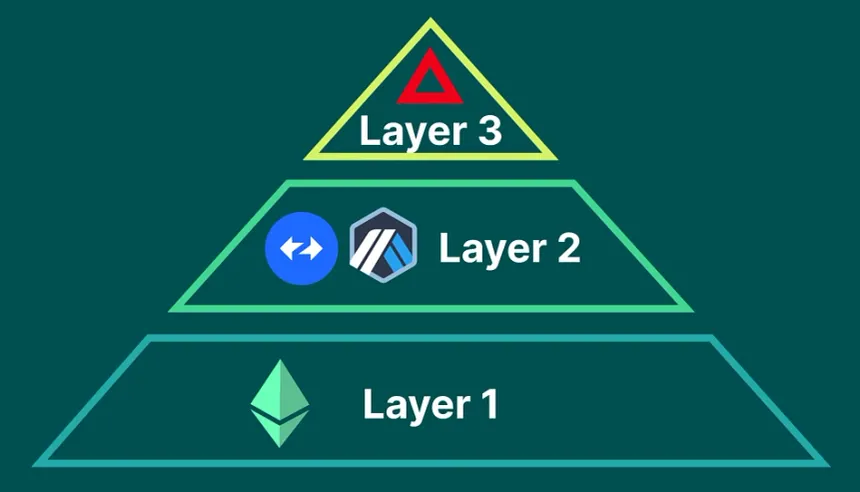
- L1 (e.g., Ethereum): consensus + data availability + ultimate settlement.
- L2 (e.g., Base, Arbitrum One, zkSync Era): general-purpose scaling layer with much lower fees.
- L3 (e.g., appchains and hyperchains on top of L2s): application-specific or domain-specific rollups that inherit security from the L2/L1 but are optimized for a particular type of workload (payments, gaming, knowledge graphs, etc.).
Zeeve, for instance, describes L3 rollup chains as a third layer built on top of L2 and L1 to deliver “absolute scalability” for app-specific use cases.
Base’s documentation explains L3 appchains as rollups that settle to Base (L2), which itself settles to Ethereum, giving apps dedicated performance with Ethereum-grade security.
Why Layer-3s Are a Natural Fit for Stablecoins
For stablecoin payments, L3s offer:
- Dedicated blockspace: no competing with NFT mints or memecoins.
- Custom fee models: apps can choose gas tokens, optimize fee markets, or cross-subsidize key flows.
- Better UX control: wallets and payment apps can mask complexity while still inheriting settlement security from Ethereum.
- Modular compliance: app-specific rollups can integrate KYC, blacklist logic, or AML rules if needed (especially for enterprise use cases), without changing the core L2.
For stablecoins, this translates into predictable, ultra-cheap payment lanes that feel much closer to traditional card networks, but with faster settlement and 24/7 availability.

The Performance Breakthrough: Sub-Cent Fees
Where Fees Are Today
Across major networks, current fee ranges look roughly like this:
- Ethereum (L1):
- Average transaction fee around $0.44 as of August 2025, but stablecoin transfers typically cost $1–$15 depending on congestion.
- L2s (Arbitrum, Optimism, Base, zkSync Era):
- Average fees in the $0.008–$0.03 range for standard transactions.
- USDC transfers on Arbitrum/Optimism are reported between $0.04 and $0.35.
- High-throughput L1s (Solana, Polygon):
- Solana and Polygon fees are often fractions of a cent to a few tenths of a cent for simple transfers.
For large transactions, the savings are dramatic.
One analysis found that transferring $1M could cost around $17.47 on Ethereum, but just $1.11 on Base, $0.35 on Arbitrum, and $0.0005 on Solana.
What Changes at Layer-3?
Several production-grade and emerging L3 systems highlight how fees can realistically drop below $0.01:
- ZKsync chains (Hyperchains / zkStack)
- Documentation cites transaction costs around $0.0001 per transaction, a ~99% reduction relative to typical L1s.
- Arbitrum-stack L3s via AnyTrust / Orbit
- Ankr’s scaling services note sub-cent transaction fees for chains using Arbitrum AnyTrust data availability.
- The Orbit stack is explicitly designed for dedicated L2/L3 rollups with optimized fee and DA options.
- Base L3 appchains (e.g., B3, Intuition Network)
- B3, an L3 built on Base, targets ≈$0.001 per transaction for gaming-grade workloads.
- Intuition Network, an L3 on Base using Orbit tech, explicitly emphasizes sub-cent transaction costs to support high-frequency attestations.
Put simply: L2 moved us from dollars to cents; L3 moves us from cents to fractions of a cent for many stablecoin transfer patterns.
The mechanism is straightforward:
- L3 batches are aggregated and proven on L2, which itself aggregates to L1.
- Fractal scaling and recursive proofs reduce overhead per transaction as more activity is packed into each proof.
- App-specific rollups keep the state surface small (fewer contracts, limited functionality), lowering data and computation cost per transaction.
For stablecoins, a typical “send XYZ” transaction does not require complex logic. That simplicity fits L3s extremely well.
Speed: Matching or Beating Real-World Payment Latency
Fees are only half the story. Stablecoins compete not just on cost, but on speed and reliability.
Traditional cross-border transfers can take 1–5 days and cost 2–7% in fees. Stablecoin payment rails, by contrast, can settle nearly instantly and typically cost <$0.01 per transaction on efficient networks, according to infrastructure providers like Helius and analyses from McKinsey.
L3s push this even further:
- zkSync’s Airbender prover advertises sub-second block proofs and real-time UX for zkSync chains, with costs around $0.0001 per transfer.
- Base-anchored L3s like B3 are optimized for gaming and interactive workloads, where near-instant confirmation is required for a usable product.
While exact latency numbers depend on network configuration and app design, the direction is clear: L3s are engineered to support near real-time UX with negligible marginal cost per transaction.
For stablecoin payments, that means:
- Instant checkout for e-commerce and in-app purchases.
- Viable micro-transactions (tips, streaming payments, machine-to-machine billing) where even a $0.01 fee would be too high.
- Reduced volatility risk, because settlement happens so quickly that FX and price fluctuation windows shrink dramatically.
Security and Liquidity: Are L3 Stablecoin Payments Safe?
Security Inheritance
Rollups are “child chains” that post their data and proofs to a parent chain and inherit its consensus and data availability.
For L3s:
- An L3 on Base inherits security from Base (L2), which in turn inherits from Ethereum (L1).
- An Arbitrum Orbit L3 can settle on Arbitrum One or Nova, which themselves settle on Ethereum.
As long as the rollup is correctly implemented and sequencer / prover assumptions are reasonable, a stablecoin transfer on an honest L3 chain enjoys the same final settlement security as the underlying L1, after proofs are verified.
Liquidity Routing
The other piece of the puzzle is liquidity:
- Today, most stablecoin liquidity still sits on Ethereum, Tron, and a handful of L2s/L1s. One 2025 report notes that Ethereum and Tron’s dominance in hosting stablecoins has fallen from 90% to 83%, with Base, Solana, Arbitrum, and Aptos capturing much of the share.
- Base briefly accounted for over 30% of global stablecoin volume in late 2024, with stablecoin volume on the network exploding from $620M to $55B in a single month and reaching 18% market share.
L3s typically do not hold the deepest liquidity themselves. Instead, they rely on:
- Stablecoin bridges and routers between the L3 and its parent L2/L1.
- Shared liquidity hubs on the parent network (e.g., major DEXs, payment routers).
- Canonical stablecoin contracts that can be minted/burned across the stack.
From a user’s POV, the ideal experience is that “USDC on an L3” just works, with any necessary bridge or routing abstracted away by wallets and payment processors.
Architecturally, L3s are well-aligned with this: they can be tightly integrated into L2 liquidity hubs without fragmenting markets beyond recovery, especially when designed as part of a coherent stack (Base + appchains, zkSync Era + Hyperchains, Arbitrum One + Orbit, etc.).
Examples of Layer-3 Ecosystems Tailor-Made for Payments
While we’re still early in the L3 adoption curve, several concrete ecosystems illustrate how this will look for stablecoins.
zkSync Hyperchains (zkStack)
zkSync’s vision is a network of Hyperchains, sovereign chains built with zkStack, each secured by zk proofs and capable of interoperating trustlessly with each other.
zkStack documentation points to:
- ~$0.0001 transaction fees as a design target,
- Up to 1000x cheaper transactions compared to generic rollups,
- Native account abstraction and trustless bridges between chains.
For stablecoins, that means dedicated chains for:
- Retail payments
- DeFi-heavy trading venues
- Enterprise B2B payments and invoicing
…all sharing proofs and settlement security.
Base Appchains (e.g., B3, Intuition Network)
Base, Coinbase’s L2, already hosts a huge amount of stablecoin volume. On top of that, the Base docs describe L3 appchains that roll up to Base:
- B3 is pitched as a Layer-3 consumer ecosystem built for games and high-frequency apps, targeting around $0.001 per transaction.
- Intuition Network, another L3 on Base, emphasizes sub-second transaction speeds for high-frequency knowledge graph updates, illustrating how low-value, high-volume operations can shift to L3.
The same architecture can be applied to stablecoins:
- One appchain for merchant payments,
- Another for loyalty points or tokenized rewards,
- Another for embedded finance experiences, all settling back to Base and Ethereum.
Arbitrum Orbit L3s
Arbitrum Orbit provides a framework for building custom L2/L3 rollups using Arbitrum technology. L3 chains can choose:
- Their own gas token,
- Custom governance,
- Specialized DA layers (e.g., AnyTrust) for high throughput and sub-cent fees.
For stablecoin issuers and payment companies, Orbit-based L3s enable:
- Dedicated settlement layers for specific customer segments,
- Fine-grained control over who can access the chain,
- Strong guarantees about costs and capacity.
Real-World Payment Use Cases on L3 Stablecoin Rails
Given the cost and speed characteristics, the natural applications for stablecoins on L3 include:
1. Merchant Checkout and Point-of-Sale
- Card rails often cost 2–3% plus fixed fees.
- Blockchain-based stablecoin payments can reduce this to 0.5–2% (including ramp and spread), with chain transaction fees often below $0.01.
- L3s push the on-chain component down to fractions of a cent, making it feasible to compress margins even further or offer discounts for on-chain settlement.
2. Micropayments and Streaming
Because L3 fees can be $0.0001–$0.001 per transaction, stablecoin micro-payments in the range of $0.01–$1 become realistic without fee domination.
That unlocks:
- Pay-per-article or pay-per-second content,
- In-game purchases priced at a few cents,
- Machine-to-machine billing for IoT or cloud resources.
3. Global Payroll and Contractor Payments
Stablecoins are already widely used for:
- Paying remote teams in USDC/USDT,
- Avoiding slow and expensive SWIFT transfers,
- Bypassing local banking friction in under-banked markets.
McKinsey highlights that stablecoin-style tokenized cash can deliver nearly instant, low-cost payments with almost 100% uptime (McKinsey & Company).
L3-based stablecoin rails keep the marginal cost of each salary or invoice payment negligible, even for high-frequency payouts (e.g., weekly or daily streaming salaries).
4. Treasury and B2B Settlement
For businesses moving large notional amounts, the percentage cost matters more than cents per transaction, but:
- When transferring $1M, the difference between $1–2 and $20–30 is still meaningful at scale.
- L3s provide predictable, programmable settlement rails for recurring B2B flows: suppliers, distributors, franchises, etc.
Why Nobody Is Really Talking About It (Yet)
Despite clear technical and economic advantages, stablecoins on L3s are still under-discussed compared to L2 narratives.
Reasons include:
- Infrastructure is still maturing: Many L3s are in early production or specialized niches (gaming, attestations, etc.), not yet in mainstream payments.
- Liquidity and network effects lag behind: Most market makers, on/off-ramps, and DeFi protocols still anchor to L1/L2 liquidity pools. Stablecoin issuers primarily focus on L1/L2 contract deployments.
- Complexity of mental model: For most users, “L1 vs L2 vs L3” is already too much; wallets and apps often abstract away the distinction, so no marketing push emerges around “L3 stablecoin payments.”
- Regulatory and operational priorities: Policy debates and standards (e.g., reserve attestations, reporting obligations, tokenized cash frameworks) target stablecoins and their issuers, not the transport layers they run on.
But as trading, remittances, and payment volumes keep climbing, with stablecoin annual volumes already in the tens of trillions, the economic logic will steadily push high-frequency, low-value transactions toward the cheapest, fastest rails.
Architecturally, that means L3-style rollups and appchains are poised to become the default environment for stablecoin micro-transactions, even if users never see the “Layer-3” branding.
The Future: Stablecoins as the Internet’s Default Payment Layer
Putting the pieces together:
- Stablecoins are already core transactional assets on public blockchains, with $8.9T+ in on-chain volume in H1 2025 and ~30% of all crypto transaction volume.
- Blockchain fee markets across L1s, L2s, and high-throughput L1s consistently show a trend toward fractions-of-a-cent fees as throughput and compression improve.
- L3 rollups and appchains already advertise $0.0001–$0.001 per transaction and sub-second UX in production-grade or near-production settings.
In that context, it’s reasonable to expect:
- High-value settlement (treasury, large trades) to stay on L1/L2.
- High-volume, low-value consumer and machine payments to migrate to L3s.
- Most of this to happen behind the scenes, users pay and get paid in “USDC” or “USDT,” while the wallet routes via an L3 they never hear about.
If public blockchains become the default multiplayer backend for money, stablecoins will be the units flowing through them, and L3s will be the invisible plumbing making those flows fast enough and cheap enough to work for everything from a $0.03 tip to a $3,000 invoice.

Conclusion
Stablecoins have already proven they can move trillions in value faster and more efficiently than traditional payment systems. But to scale into everyday consumer commerce, global remittances, and real-time digital settlement, they must operate with sub-cent fees, millisecond latency, and guaranteed liquidity.
Layer-3 architectures deliver exactly that: dedicated blockspace, programmable payment logic, and settlement security inherited from Ethereum and major L2s.
As L3 networks mature and stablecoin liquidity extends beyond L1 and L2 hubs, most users won’t even realize they’re interacting with a “Layer-3.” They’ll simply experience instant, low-cost stablecoin transactions that feel like the internet.
In that shift, L3s emerge as the invisible infrastructure powering the next decade of blockchain-based financial services: the rails where stablecoins become the default way money moves online.
Read Next:
- USDT vs. USDC vs. BUSD: Which Fiat-Backed Stablecoin Is Safest in 2025?
- Stablecoin Tax Guide 2025: Reporting and Tools for Compliance
- The Future of Stablecoins: What's Next in 2026 and Beyond
FAQs:
1. What is a Layer-3 blockchain, and how is it different from a Layer-2?
A Layer-3 blockchain is a rollup or appchain that settles on a Layer-2, which itself settles on a Layer-1 like Ethereum. L2s provide general-purpose scaling, while L3s are usually application-specific, offering dedicated blockspace, custom fee models, and ultra-low-cost transactions, all while inheriting security from the underlying L2/L1.
2. Why are stablecoin transactions cheaper on L3s?
Stablecoin transfers on L3s benefit from fractal scaling and batching: many transactions are aggregated into a single proof, which is posted to an L2 and then to L1. This setup reduces the per-transaction data and computation cost, enabling fees in the $0.0001–$0.001 range on several zk and L3-style chains.
3. Are stablecoin payments on Layer-3 networks secure?
Yes, assuming the rollup implementation is sound, L3 stablecoin transfers ultimately inherit the security of their parent L2 and base L1, because transaction data and proofs are periodically posted and verified on those layers. Security guarantees follow the same principles as standard rollups.
4. How do fees on L3 stablecoin payments compare with traditional payment rails?
Traditional cross-border or card-based payments can cost 2–7% or more when you include FX spreads and fixed fees. Stablecoin rails on efficient chains can bring this down to 0.5–2% total, with the actual on-chain fee component often below $0.01, and on L3s, even fractions of a cent.
5. Are there already live stablecoin projects using Layer-3s?
Most stablecoin volume today is still concentrated on L1s and L2s, especially Ethereum, Tron, Base, Solana, and Arbitrum. However, several L3 ecosystems (zkSync Hyperchains, Base appchains like B3 and Intuition, Arbitrum Orbit chains) are live or in production-grade pilots, and they’re architected to support exactly the kind of ultra-cheap, high-frequency traffic that stablecoin payments require.