
Table of Contents
Imagine sending money across the globe as easily as you send an email. No waiting, no surprise fees, just a secure, instant transfer. That’s the simple, powerful idea behind a stablecoin payment gateway.
These gateways are the missing link between your everyday business operations and the world of blockchain, letting you accept digital dollars—stablecoins—from anyone, anywhere.
Why Stablecoin Gateways Are Reshaping Global Commerce
For years, we've just accepted that international business is slow and expensive. Wire transfers get stuck in limbo for days, credit card fees eat into your margins, and currency conversion always seems to work against you. It's a system full of friction, a major headache for any company with customers outside its own borders.
A stablecoin payment gateway is like building a new, high-speed rail line right over that old, clunky infrastructure. It gives businesses a direct path to accept payments using tokens like USDC or USDT, which are pegged 1:1 to real-world currencies like the U.S. dollar. This one change completely rewrites the rules of global money movement.
The Problem with Traditional Payments
The old way of doing things is a mess of delays and hidden costs that we've all been forced to tolerate. If you run a business, you know the pain points all too well:
- Delayed Settlement: Bank transfers can take 3-5 business days to finally show up. That’s capital you can't use and a major drag on your cash flow.
- High Transaction Costs: When you add up all the correspondent bank charges, SWIFT fees, and lousy exchange rates, a single cross-border payment can easily cost you 5% or more.
- Operational Complexity: Juggling different banking partners, navigating unique compliance rules for each country, and managing multiple currency accounts is a full-time job in itself.
- Lack of Transparency: Ever tried to track an international wire transfer? It often feels like shouting into the void, with neither you nor your customer knowing exactly where the money is.
A New Model for Global Transactions
Stablecoin payment gateways turn that entire model upside down. Instead of navigating a maze of intermediary banks, payments fly directly from point A to point B on a blockchain network. It's less like a bank wire and more like handing someone digital cash.
By leveraging blockchain technology, stablecoin gateways can settle cross-border transactions in minutes instead of days, offering a level of speed and cost-efficiency that traditional financial systems struggle to match. This capability is not just an incremental improvement; it's a foundational shift in how global commerce operates.
This direct approach gives merchants a serious competitive edge. Getting a handle on the core benefits of stablecoins is the first step to seeing just how much this technology can boost your bottom line by cutting costs and getting you paid faster.
So, How Does a Stablecoin Payment Actually Work?
To really get why a stablecoin payment gateway is such a game-changer, you have to look under the hood. From the outside, the customer experience feels just like using a credit card. But behind the scenes, a clunky, multi-day process gets replaced with one that settles in minutes.
Let's break it down. Imagine a customer in Europe buying from a U.S. online store. They hit "Pay with Stablecoin" at checkout, and that single click kicks off a whole sequence of events on the blockchain.
This diagram contrasts the old way of doing things—slow, expensive bank wires—with the clean, direct path of a stablecoin payment.
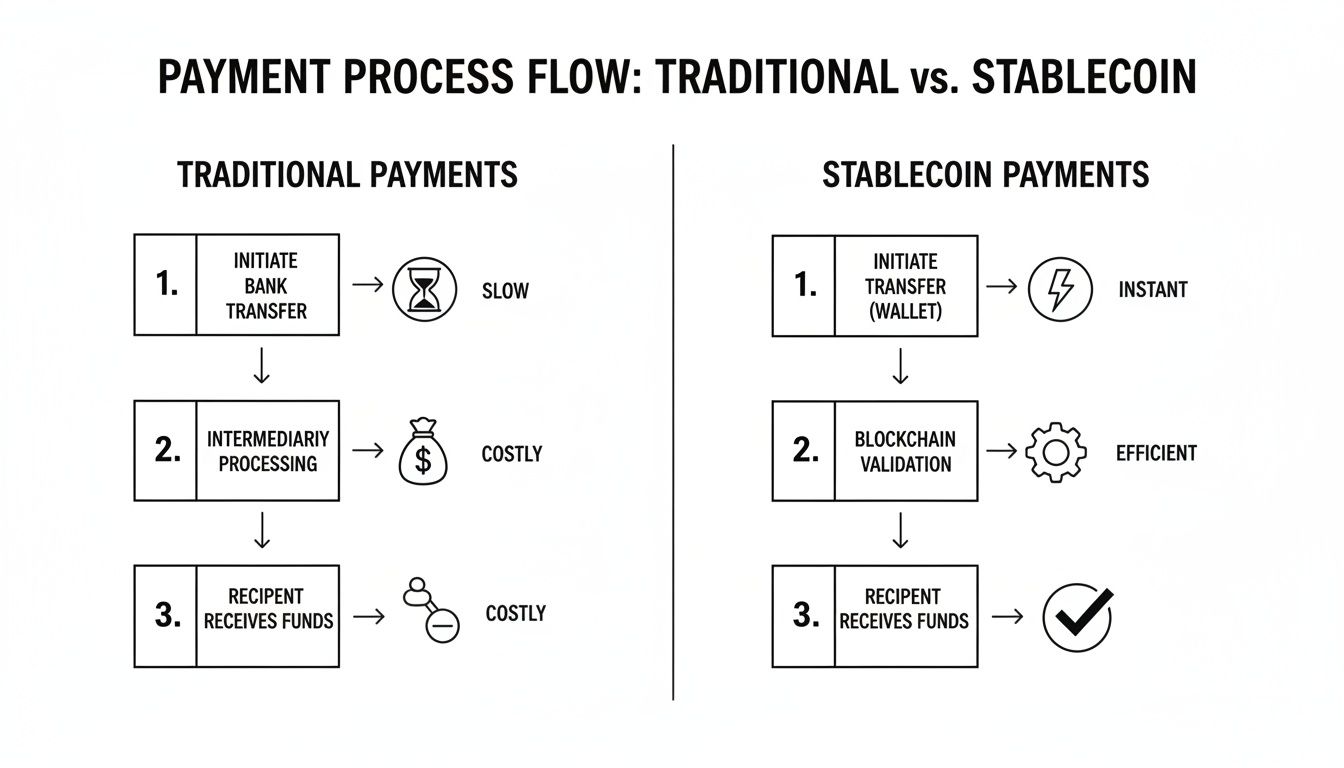
As you can see, stablecoins cut out the middlemen that bog down traditional finance, making the whole process faster and cheaper.
The On-Chain Journey of a Payment
Once your customer confirms their purchase, the gateway instantly generates a payment request. This isn't just an invoice; it's a precise instruction with the exact amount of stablecoins (like USDC or USDT) and the specific digital wallet address for your business.
The customer then uses their own crypto wallet to approve the payment. This action sends the transaction details out to the blockchain network, whether it's Ethereum, Solana, or another. This is the on-chain part of the process—it creates a public, permanent record showing the funds moving from their wallet to yours.
- Block Confirmation: Specialized computers on the network, known as miners or validators, verify the transaction and add it to a new "block" on the digital ledger.
- Settlement Finality: Once the block is confirmed—which usually takes just a few minutes—the funds are officially in your wallet. That's it. There’s no "pending" period, and the risk of chargebacks essentially disappears.
This direct, wallet-to-wallet settlement is what makes the technology so powerful. It’s not just a niche concept, either. Stablecoins have already processed over $8.9 trillion in on-chain volume in the first half of the year alone, proving they are a major force in global payments. This figure shows a massive shift in how money moves, blowing past the speed and cost of old-school banking. To dive deeper into these numbers, you can read the full breakdown from Rise Works here.
Custody Models: Who Holds the Keys?
Okay, so the stablecoins have landed in your wallet. What's next? This is where you have to make a key decision about custody—who is responsible for holding and managing these digital assets?
Custody isn't just about where you store your funds. It’s about who has control, what security measures are in place, and how much operational work you want to take on. Your choice here directly shapes your company's risk and resource planning.
You really have two main paths to choose from:
- Self-Custody: You hold the keys, you have the control. In this model, the merchant manages the private keys to their own digital wallets. It gives you complete autonomy, but it also means all the security responsibility falls on your shoulders. You’ll need the technical know-how to protect those keys from hackers and mistakes.
- Third-Party Custody: Let an expert handle it. Here, the stablecoin payment gateway or a specialized digital asset custodian holds the private keys for you. This is a much simpler route and is the go-to for most businesses that don't want to become crypto security experts overnight. The provider handles all the heavy lifting, often with institutional-grade security and insurance.
Picking the right custody model is a strategic move. For any business just dipping its toes into digital assets, a third-party custodial solution is often the safest and most practical way to start. Before you decide, it’s worth understanding the fundamentals of these digital dollars. Our guide on how stablecoins work is a great place to start. This entire behind-the-scenes flow, from payment to custody, is what’s powering the future of commerce.
Choosing the Right Gateway for Your Business
Alright, we’ve covered the "what" and "how"—now it’s time to put that knowledge into action. Picking the right stablecoin payment gateway isn't about finding a one-size-fits-all solution. It's about finding the perfect fit for your business.
Make the wrong call, and you could be stuck with integration nightmares and missed opportunities. But get it right, and you can open up new markets and seriously streamline your financial operations.
Before you even start looking at vendors, take a step back and define your goal. Are you an e-commerce shop wanting to add a crypto checkout button? Or maybe a B2B company trying to simplify cross-border invoicing? Your answer here will guide every single decision that follows.

Key Evaluation Criteria
To make a smart choice, you need to assess a few mission-critical features. Think of it as a pre-flight checklist before you take off with stablecoin payments. A provider might shine in one area but fall short in another, so a balanced look is essential.
Here’s where to focus your attention first:
- Blockchain and Stablecoin Support: Which networks does the gateway actually run on? Ethereum, Solana, and Polygon all come with different transaction speeds and fee structures. You'll also want to confirm which specific stablecoins they support—think USDC or USDT—as customer preferences can change dramatically from one region to another.
- Integration Options: How easily will this plug into your current setup? You need flexibility. Look for robust APIs if you’re doing a custom build, SDKs for mobile apps, or simple, pre-built plugins for platforms like Shopify or WooCommerce.
- Fiat Off-Ramp and Settlement: This is a big one. Can the gateway automatically convert incoming stablecoins into your local currency (like USD or EUR) and deposit them straight into your bank account? Dig into the settlement speed—are we talking instant, or will you be waiting days for your money?
Comparing Gateway Provider Types
The market is full of different kinds of providers, and each one is built for a specific type of business. Understanding who they cater to helps you quickly narrow down the field.
To help with this, we've created a comparative table to highlight the key differences. This table provides a snapshot of what you can expect from different categories of gateway providers, from those built for developers to those tailored for large enterprises.
Stablecoin Payment Gateway Feature Comparison
| Feature | Gateway Type A (Developer-Focused) | Gateway Type B (Merchant-Focused) | Gateway Type C (Enterprise-Grade) |
|---|---|---|---|
| Primary Goal | Maximum flexibility and control | Simplicity and speed to market | Scalability, security, and compliance |
| Integration Method | Primarily APIs and SDKs | Plugins and hosted checkout pages | Custom APIs, dedicated integrations |
| Ideal User | Tech companies, fintech startups | E-commerce stores, small businesses | Large corporations, global platforms |
| Technical Skill | High (requires developers) | Low (plug-and-play) | High (requires dedicated tech teams) |
| Fiat Settlement | Often manual or API-driven | Automated and seamless | Fully automated with multi-currency |
| Support Model | Community forums, ticket system | Email/chat support | Dedicated account manager, SLAs |
| Pricing | Usage-based, lower per-transaction | Flat-rate or tiered percentage fees | Custom enterprise pricing |
This comparison shows that the best choice really depends on your resources and goals. For a deeper dive into specific companies, our guide on the top stablecoin payment processors offers a detailed vendor breakdown.
Your business model is the ultimate guide. A developer-centric platform offering raw API access is perfect for a fintech startup, but it would be overly complex for a small online retailer who just needs a simple checkout plugin.
Final Questions to Ask a Potential Provider
Once you have a shortlist, it’s time to get specific. Don’t be shy about asking direct questions. The quality and transparency of their answers will tell you a lot about their service and expertise.
Make sure to ask these questions:
- What are your complete transaction fees? Get past the headline number. Ask about costs for currency conversion, fiat withdrawals, and any other "hidden" charges that might pop up.
- How do you handle customer support? If you're a large enterprise, a dedicated account manager is a must. For a smaller shop, 24/7 chat support might be all you need. Know what you’re getting.
- What are your security and compliance credentials? Ask them to verify their licenses in your key markets. You’ll also want to know about their asset custody solution and if they've had recent security audits.
Choosing the right partner is a strategic move that will shape your cash flow, customer experience, and operational workload for years. By taking the time to evaluate these factors carefully, you can pick a stablecoin payment gateway that not only solves today's problems but also grows with you tomorrow.
Real-World Examples of Stablecoin Payments in Action
The theory behind a stablecoin payment gateway is great, but its real power shines when you see how actual businesses are using it to fix some of their biggest operational headaches. This isn't just a niche experiment anymore. Companies in all sorts of industries are turning to this technology to speed up cash flow, cut costs, and open up new markets around the world.
Let's move past the technical jargon and look at a couple of real-world scenarios. By seeing how others are using stablecoins—from paying a global team to settling massive B2B invoices—you can get a much clearer picture of what’s possible.
Paying a Global Freelance Workforce Without the Headaches
Picture a big online marketplace connecting businesses with freelancers—designers, writers, developers—from every corner of the globe. Paying this scattered workforce used to be a logistical nightmare, riddled with delays and steep fees.
Imagine a freelancer in Argentina waiting a week for a wire transfer, only to see 5-7% of their hard-earned money disappear into bank fees and bad exchange rates. That kind of experience causes a lot of frustration and makes it tough for the platform to attract the best talent from developing countries.
By plugging in a stablecoin payment gateway, the entire payout system was transformed.
Now, the platform can shoot USDC payments straight to its freelancers' digital wallets. Instead of waiting days, the money shows up in minutes. This move didn't just cut transaction costs down to almost nothing; it gave freelancers immediate access to their earnings in a stable, dollar-pegged currency.
The impact was huge. The platform saw freelancer happiness skyrocket and watched sign-ups from places like Latin America and Southeast Asia jump by 20%—regions where old-school banking is often a slow, unreliable mess.
Speeding Up B2B Invoice Settlements
Here’s another great example: a B2B supplier of manufacturing parts that sells to clients internationally. Their payment terms were Net 30, but cross-border wire transfers often tacked on another 5-7 business days to actually get the money. These delays were a constant strain on their cash flow, locking up capital they desperately needed for inventory and day-to-day operations.
Once they started letting clients pay invoices through a stablecoin gateway, that settlement delay vanished.
- The Old Way: A client in Europe would send a wire transfer. The payment would bounce between several correspondent banks before finally, maybe a week later, showing up in the supplier's account.
- The New Way: That same client can now settle a $50,000 invoice with USDC. The funds are confirmed on the blockchain and available in the supplier's account within minutes.
This has been a game-changer for the company's working capital. The finance team can now reconcile payments almost in real-time, saving them from the frustrating job of chasing down missing international wires. This isn't just for small players, either; big names like MoneyGram have integrated with Fireblocks for stablecoin settlements, showing how legacy financial firms are using this tech to get more efficient.
For the B2B supplier, this one change meant they could put their money back into the business faster, helping them grow without needing to take on more debt. These examples prove that a stablecoin payment gateway is much more than just a new payment method—it's a business tool for building a leaner, more efficient, and truly global operation.
Navigating Security and Regulatory Essentials
Whenever you bring a new payment technology into your business, two big questions immediately pop up: Is it safe? And is it legal? A stablecoin payment gateway is no different. While the tech promises incredible speed and lower costs, its foundation must be built on rock-solid security and a thorough understanding of financial regulations. For any serious business, these aren't just nice-to-haves; they're deal-breakers for protecting your funds, your customers, and your reputation.
When you start accepting stablecoin payments, you're fundamentally trusting a provider with your money. That means their security has to be verifiable and robust. Think of it as a digital bank vault—you need to be certain it can fend off any threat. It all starts with how they handle the cryptographic keys, the digital equivalent of the keys to the kingdom.
Core Security Pillars to Demand
A top-tier gateway doesn’t just talk about security; it proves it with its architecture. As you evaluate different providers, look for a defense-in-depth strategy that includes a few key components. Each layer is designed to eliminate single points of failure, making it exponentially harder for a bad actor to breach their systems.
These features should be non-negotiable:
- Cold Storage: The overwhelming majority of digital assets should be kept in cold storage. These are wallets completely disconnected from the internet, creating an "air gap" that shields funds from online attacks.
- Multi-Party Computation (MPC): This is a sophisticated cryptographic method that splits a private key into multiple shards, distributed among different parties. To sign off on a transaction, a specific number of parties must cooperate, meaning no single person or compromised server can authorize a withdrawal on their own.
- Third-Party Audits: A credible gateway will regularly bring in independent security firms to hammer on their systems through penetration tests and smart contract audits. You should be able to review these reports to verify their defenses are sound and their code works as advertised.
If a provider gets vague or can't clearly explain their approach to these fundamentals, consider it a major red flag. For a deeper dive into the risks, our guide on stablecoin security is a great resource.
The Compliance Checklist: AML and KYC
Beyond the technical nuts and bolts, a trustworthy stablecoin payment gateway has to act like a responsible financial institution. That means following global standards for Anti-Money Laundering (AML) and Know Your Customer (KYC). These aren't just bureaucratic hoops to jump through; they are crucial for preventing financial crime and maintaining the integrity of the payment network.
A gateway’s commitment to compliance is a direct reflection of its long-term viability. Providers who cut corners on AML/KYC expose their clients to significant regulatory and reputational risk.
A compliant gateway will have automated systems in place to screen transactions for suspicious patterns and a solid process for verifying merchant identities. This is what protects you from inadvertently doing business with sanctioned individuals or illicit organizations.
The explosive growth of stablecoins has put them squarely on regulators' radar. The total stablecoin supply has ballooned from just $5 billion five years ago to well over $305 billion. Meanwhile, payment volumes are now hitting a staggering $5.7 trillion annually, putting them on par with traditional payment giants. With that kind of scale, strict compliance isn't optional—it's an absolute necessity.
Tax and Regional Regulations
Finally, a good gateway should give you the tools and reports you need to stay compliant where you operate. This includes generating detailed transaction histories that make accounting and tax preparation much simpler. After all, businesses using stablecoins must navigate the evolving regulatory world, especially the tax implications of cryptocurrency.
Rules can change dramatically from one country to the next. A provider with a global presence needs to show they understand these regional nuances and hold the right licenses to operate legally in your most important markets. By choosing a partner that puts security and compliance first, you can embrace stablecoin payments with confidence, knowing your business is on a secure and legitimate footing.
Your Step-By-Step Implementation Plan
Bringing a stablecoin payment gateway into your business is a big move, but it doesn't have to be a complicated one. Think of it as a project with a clear beginning, middle, and end. This checklist breaks down the entire process into manageable stages, guiding you from the initial idea all the way to a successful launch.
It's tempting to jump right into the tech, but the real work starts with your business foundation. Before integrating any new financial tool, you have to get the basics right. For many, this includes navigating the company formation process to ensure your corporate structure is solid. With that in place, you’re ready to build.
Phase 1: Define and Select
This first phase is all about homework. It’s where you map out what you actually need and find a partner who can deliver it. If you rush this part, you risk ending up with a provider that doesn't fit your business down the road.
Outline Your Goals: Get specific. What problem are you trying to solve? Are you looking to slash cross-border fees for international sales? Or maybe you want to give a tech-savvy audience a payment method they prefer? Write down your target stablecoins (like USDT or USDC), estimate your transaction volume, and decide on your settlement needs—for instance, do you need instant conversion to your local currency?
Evaluate and Shortlist Providers: With your requirements list in hand, start vetting potential gateways. Compare them based on the critical points we've already covered: security track record, regulatory standing, fee structures, and how easy they are to integrate. Don't just read their marketing materials—schedule demos and grill them on their settlement times and customer support.
Perform Due Diligence: Once you’ve narrowed it down to your top choice, it’s time for a final, deep dive. Ask to see their licenses and third-party security audits. Read reviews and, if possible, talk to some of their current clients. Make sure their service level agreements (SLAs) guarantee the uptime and support your business can't live without.
Phase 2: Integrate and Test
Now for the technical part. You've chosen your partner, and it's time to connect the dots. This stage is all about making sure everything works perfectly behind the scenes before a single customer clicks "pay."
A great integration isn’t just about making an API call work. It's about designing a checkout flow that feels so natural and secure that your customers don't think twice. The goal is to remove every ounce of friction from that final, crucial step.
This is where your developers need to work closely with the gateway’s tech support team.
Technical Setup: Your dev team will get to work with the provider’s tools—usually an API, SDK, or a pre-built plugin—to wire the gateway into your website or app. This includes setting up your wallets and configuring webhooks, which are essential for getting instant notifications about payments.
Sandbox Testing: This is non-negotiable. Use the provider's test environment (the "sandbox") to run through every possible scenario. Simulate everything: successful payments, declined transactions, refunds, and even weird edge cases like a customer sending the wrong amount or using the wrong blockchain.
Design the User Experience (UX): Keep it clean. Your checkout page should clearly show which stablecoins you accept, display any exchange rates in real-time, and provide simple, foolproof instructions.
Phase 3: Launch and Train
With the tech locked in, it’s time to prepare your people and your customers for the big reveal.
Train Your Team: Your customer support and finance teams are on the front lines. Make sure they know the ropes. They need to be comfortable tracking stablecoin payments on a block explorer, know how to handle refund requests, and be ready to answer common questions from customers who might be new to crypto.
Communicate the Launch: Don't just flip a switch and hope people notice. Announce your new payment option everywhere—send out an email blast, post about it on social media, and put up banners on your website. Be sure to highlight the benefits that matter most to your customers, whether that's lower fees, faster transactions, or simply more choice.
Your Questions Answered: Getting Practical with Stablecoin Gateways
Even after seeing the benefits on paper, you've probably got some real-world questions buzzing around. Let's tackle the most common ones that businesses ask when they're thinking about jumping in, so you can clear up those last few uncertainties.
How Is This Different From Using Stripe or PayPal?
From your customer's perspective, the checkout flow might look pretty familiar. But under the hood, it’s a completely different engine.
Traditional gateways like Stripe or PayPal are built on top of the old-school banking system. That means your money has to hop between multiple banks and processors, leading to settlement delays of 2-3 days (or more for international payments) and a stack of fees along the way.
A stablecoin gateway sidesteps all of that. It uses the blockchain for a direct, near-instant transfer from your customer to you. Think of it as a direct flight versus one with multiple layovers. By cutting out all those intermediary banks, you slash both the settlement time and the cost, especially when dealing with international customers.
Can I Still Get Paid in Dollars in My Bank Account?
Yes, absolutely. In fact, this is a non-negotiable feature for most businesses. The best stablecoin gateways come with an automated fiat off-ramp, which is just a fancy way of saying they immediately convert the stablecoins they receive into regular currency for you.
It works seamlessly. A customer pays you in USDC, the gateway instantly converts it into US dollars at a clear exchange rate, and then deposits the cash directly into your business bank account. Often, this all happens on the same day.
This setup gives you the best of both worlds: you get the speed and low cost of a blockchain payment without ever having to touch or hold crypto on your company’s books. It removes all the volatility risk and accounting headaches.
Who Actually Pays the Blockchain Transaction Fees?
Good question. Those small network fees, usually called gas fees, are what you pay to have the transaction confirmed on the blockchain. How they’re handled really depends on the gateway you choose.
Here are the common setups:
- The Customer Pays: This is the most standard approach. When the customer initiates the payment from their wallet, the gas fee is calculated and included.
- The Gateway Absorbs It: Some gateways will roll this tiny fee into their overall transaction percentage to keep things simple for everyone.
- The Merchant (You) Pays: Less common, but in certain situations like B2B invoicing or processing payouts, a business might choose to cover the gas fee themselves.
Your provider will have a default way of handling this, but the good news is that on efficient networks like Solana or Polygon, these fees are typically just pennies.
What Happens If a Customer Sends Crypto to the Wrong Network?
This is a legitimate worry. Sending funds to the wrong blockchain address is the crypto equivalent of wiring money to a non-existent bank account—it can be lost for good.
Thankfully, enterprise-level gateways have built-in safety nets for this exact problem.
Many now include what's called wrong-chain correction technology. If a customer accidentally sends USDC on the Polygon network to your Ethereum address, the system is smart enough to spot the mistake. It can then automatically intercept and recover the funds. This is a crucial feature that protects both you and your customers from simple but costly human errors.
At Stablecoin Insider, we provide the latest news and in-depth analysis on the digital assets shaping global finance. To stay ahead of the curve, explore more insights at https://stablecoininsider.com.