

Table of Contents
When you hear the term "liquidity" in the context of stablecoins, think of it as the lifeblood of the digital asset market. It’s a simple but powerful concept: how easily can you buy or sell a stablecoin at its pegged price, without your own transaction causing the price to wobble?
In a market with deep liquidity, you can trade massive amounts of a stablecoin like USDC or USDT instantly and efficiently, knowing the price you see is the price you'll get. It's the engine that keeps the entire crypto economy running smoothly.
What Is Stablecoin Liquidity and Why Does It Matter?
Picture a huge, bustling foreign exchange market that’s open 24/7. Here, you can swap millions of U.S. dollars for euros or yen in a heartbeat, and the exchange rate barely budges. That’s the real-world equivalent of a highly liquid market. Stablecoin liquidity applies this exact principle to the crypto world.
This isn’t just a niche topic for high-frequency traders. It's the foundational layer that gives decentralized finance (DeFi) protocols, institutional investors, and everyday users the confidence to transact. Without deep liquidity, the crypto market would feel more like a small-town flea market than a global financial system—slow, expensive, and totally unpredictable. Every large trade would send prices spiraling, making it impossible to trust stablecoins as a reliable way to hold or move value.
The Bedrock of the Digital Economy
Strong liquidity is what transforms a stablecoin from a neat idea into an indispensable financial tool. It’s the assurance that when you need to cash out, pay a bill, or move funds, you can do it at a fair and predictable price. This reliability is precisely why stablecoins have become so essential.
Think about the critical roles they play:
- Fueling DeFi: Lending platforms, decentralized exchanges (DEXs), and yield farms all run on stablecoin liquidity. It’s the core ingredient.
- Enabling Efficient Trading: It allows large traders to move in and out of positions without suffering from slippage—the costly difference between the expected price and the execution price.
- Powering Global Payments: Deep liquidity makes fast, low-cost international payments a reality, sidestepping the slow and expensive legacy banking system.
"Stablecoins can be understood as a bridge between volatile digital assets and traditional monetary systems. Their appeal lies in functioning as a blockchain-based money equivalent which is liquid, globally transferable, and perceived as a stable and solid store of value."
You don’t have to look far to see their importance. Stablecoins have become a true powerhouse, now accounting for 30% of all on-chain crypto volume in 2025. The transaction activity has been staggering, hitting over $4 trillion from January to August alone—a massive 83% jump from the same period in 2024.
Source: Artemis
For a closer look at these market dynamics, you can explore our detailed guide on stablecoin market share.
Liquid vs. Illiquid Markets At a Glance
The difference between a liquid and an illiquid market isn't just academic; it has a huge impact on every user's experience. This table breaks down the practical differences you'd encounter.
| Feature | High Liquidity Market | Low Liquidity Market |
|---|---|---|
| Price Stability | Prices are stable and absorb large orders easily. | Prices are volatile and swing wildly with big trades. |
| Slippage | Minimal. You get a price extremely close to what you expect. | High. The final price can be way off from what was quoted. |
| Transaction Speed | Trades execute instantly. Finding a counterparty is never an issue. | Delays are common. It can take time to find a buyer or seller. |
| Market Confidence | High. Everyone trusts they can get in and out reliably. | Low. Fear of price swings and getting stuck deters traders. |
Ultimately, a highly liquid stablecoin feels seamless and dependable, just like using cash. In an illiquid market, every transaction is a gamble.
How Stablecoin Liquidity Actually Works
To really get what makes stablecoin liquidity tick, you have to pop the hood and look at the engines driving digital asset trading. These are the core systems that let value move smoothly and predictably across the decentralized economy.
From clever, automated pricing systems to old-school bidding wars, each model offers a different way to make a trade. Understanding how they all work is the first step to appreciating just how sophisticated modern liquidity has become.
Automated Market Makers: The Smart Vending Machine
The most popular engine for on-chain liquidity is the Automated Market Maker (AMMs). Picture a smart vending machine, but instead of snacks, it trades digital assets. It doesn't have fixed prices; instead, it uses a math formula to figure out an asset's price on the fly, based on how much it has in stock.
When you want to swap USDC for DAI, you’re not waiting for another person to accept your trade. You're dealing directly with the AMM's smart contract, which gives you a price instantly. This hands-off, always-on system means you don't need traditional buyers and sellers, creating a market that’s constantly open for business.
This diagram shows how stablecoin liquidity is the foundation for the key pillars of the crypto economy: DeFi, trading, and payments.
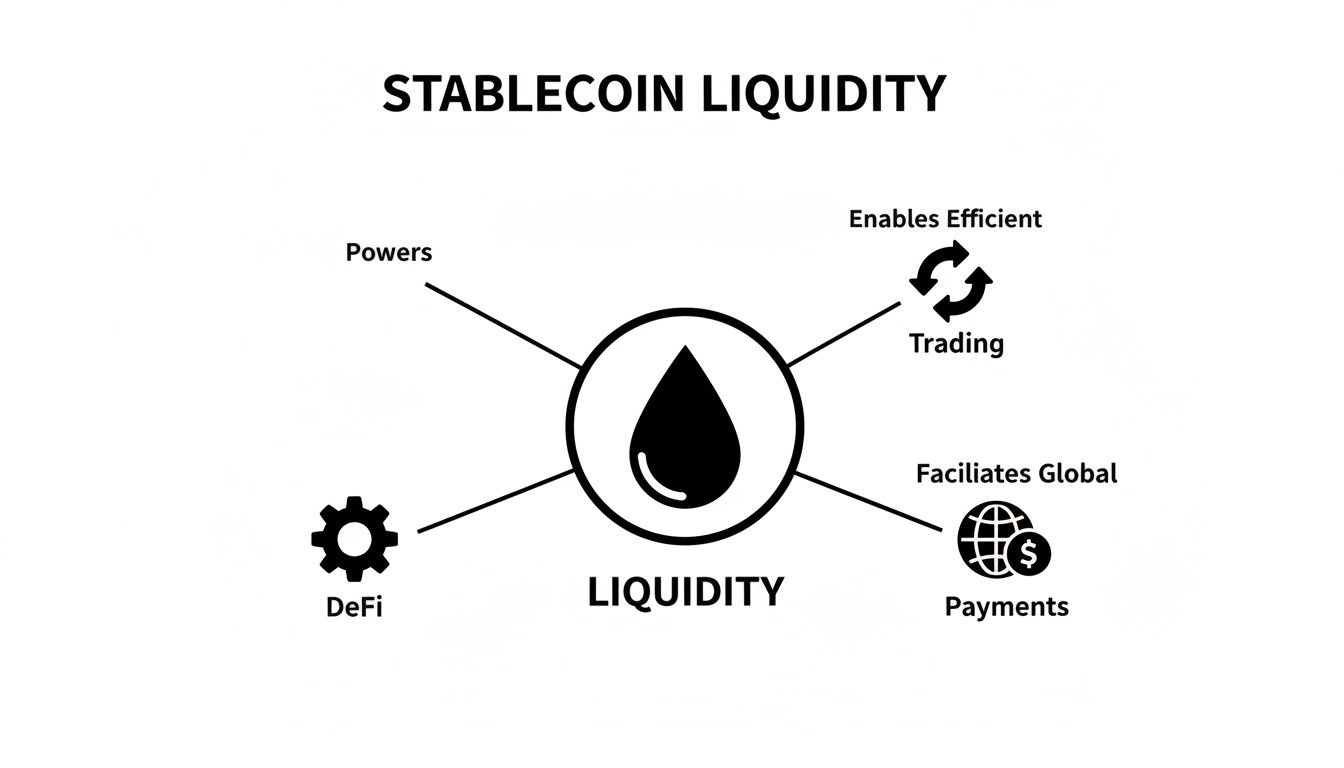
As the visual makes clear, deep pools of liquidity are what make complex financial apps, efficient exchanges, and frictionless global payments possible in the first place.
Liquidity Pools: The Vending Machine's Stockroom
So where does this "vending machine"—the AMM—get its assets from? They come from liquidity pools, which are basically big, shared pots of funds locked up in a smart contract. Think of these pools as the stockroom for the AMM.
Anyone can become a liquidity provider (LP) by depositing a pair of assets—say, an equal value of USDC and USDT—into one of these pools. For contributing their assets and making trades possible, LPs earn a cut of the transaction fees from that pool. It’s this incentive that pulls in capital and builds the deep reserves needed for solid stablecoin liquidity.
By pooling assets together, users create a decentralized market that can handle large trades with minimal price impact. This collaborative model is the very bedrock of decentralized finance.
Platforms like Curve Finance are masters at this, creating super-efficient liquidity pools designed specifically for stablecoins to keep slippage incredibly low for traders. The underlying stablecoin infrastructure is what makes these powerful DeFi applications a reality.
Order Books: The Traditional Auction House
While AMMs run the show in DeFi, the classic order book model is still the engine behind most centralized exchanges. An order book is more like a chaotic, real-time auction house. It’s simply a live list of all the buy (bid) and sell (ask) orders for an asset at different price levels.
For a trade to go through, a buyer's bid has to meet a seller's ask. Liquidity here is all about the density of orders. If you see tons of buyers and sellers clustered around a specific price, the market is liquid. But if the order book is thin, with big gaps between the bids and asks, the market is illiquid—and one large trade can send the price swinging wildly.
Wrapped Assets: The Universal Passport
Finally, let's talk about wrapped assets. These are the key to connecting liquidity across completely different blockchains. Let's say you have Bitcoin but want to use it in an Ethereum liquidity pool. Since Bitcoin can't just show up on the Ethereum network, you need a way to represent it.
A wrapped asset, like Wrapped Bitcoin (WBTC), is like a universal passport for your crypto. You lock your original BTC in a digital vault, and in return, an equal amount of WBTC—an ERC-20 token—is created on Ethereum. This new token is fully backed by your original Bitcoin and can be used anywhere in Ethereum's DeFi world to provide liquidity.
This clever mechanism lets value jump from one blockchain to another, unlocking huge new sources of liquidity and making the entire crypto space more connected and efficient.
Understanding On-Chain and Off-Chain Liquidity Sources
When we talk about stablecoin liquidity, it's easy to picture one giant pool of money. The reality is far more nuanced. Liquidity exists in two distinct but interconnected worlds: on-chain and off-chain. Getting a grip on this split is the first step to truly understanding how stablecoins function and hold their value.
Think of on-chain liquidity as the wild, transparent frontier of DeFi. Every single transaction is etched onto a public blockchain for anyone to see. It’s a world built on code, community, and decentralized protocols.
On the flip side, off-chain liquidity is the world of high-speed, private trading floors. These are the centralized giants—the exchanges and trading desks—that move enormous sums of money behind the scenes, offering a level of speed and discretion you simply can't get on-chain.

The Transparent World of On-Chain Liquidity
On-chain liquidity lives and breathes directly on blockchains like Ethereum, Solana, and Polygon. It’s the raw fuel for decentralized finance (DeFi), sourced not from traditional market makers, but from automated, user-driven protocols.
The main hubs for on-chain liquidity are:
- Decentralized Exchanges (DEXs): Platforms like Uniswap and Curve are the poster children here. They use automated market makers (AMMs) and liquidity pools where everyday users can deposit their stablecoins to earn trading fees, creating a crowdsourced, self-sustaining market.
- Lending Protocols: Think of Aave and Compound. Users deposit stablecoins to earn interest or to use as collateral for loans. These protocols create massive capital pools that become a foundational source of liquidity for the entire DeFi ecosystem.
The real magic of on-chain liquidity is its composability—what some call "money legos." Different protocols can seamlessly plug into one another. A stablecoin pool on a lending protocol can be used by a DEX to help execute a massive swap, for example. This powerful interconnectedness is amplified by tools that can tap into liquidity across multiple blockchains; you can see how this works by exploring a cross-chain aggregator like Symbiosis Finance.
The Private Realm of Off-Chain Liquidity
Off-chain liquidity operates inside the walled gardens of centralized companies. It might be less transparent, but this is where the lion's share of large-scale stablecoin trading happens. This sector is the critical bridge connecting traditional finance with the crypto economy.
The key players here include:
- Centralized Exchanges (CEXs): Household names like Binance, Coinbase, and Kraken run on traditional order books, just like the stock market. They attract deep liquidity from professional market-making firms and institutional clients, allowing them to handle billion-dollar trades with very little price slippage.
- Over-the-Counter (OTC) Desks: These are private brokerage services for funds and high-net-worth individuals who need to move huge amounts of money quietly. An OTC desk matches a buyer and a seller directly, keeping the trade off public order books to prevent market-moving price swings.
Off-chain venues are the essential on-ramps and off-ramps for fiat. They are the primary gateways for turning U.S. dollars into stablecoins and, just as importantly, for turning stablecoins back into dollars in a bank account.
Comparing On-Chain vs. Off-Chain Sources
Both on-chain and off-chain liquidity are vital for a healthy stablecoin market. They simply serve different purposes and come with their own sets of trade-offs. One isn't better than the other; they're two sides of the same coin, each crucial for the ecosystem's overall stability and usefulness.
| Feature | On-Chain Liquidity | Off-Chain Liquidity |
|---|---|---|
| Transparency | High. All transactions are public on the blockchain. | Low. Trades are private and settled internally. |
| Accessibility | Permissionless. Anyone with a wallet can participate. | Permissioned. Requires KYC/AML and account approval. |
| Primary Mechanism | Automated Market Makers (AMMs) & Liquidity Pools | Traditional Order Books & OTC Desks |
| Key Players | Retail Users, DeFi Protocols, Liquidity Providers | Institutional Traders, Market Makers, CEXs |
| Main Advantage | Decentralization, transparency, and composability. | High volume, speed, and privacy for large trades. |
At the end of the day, a truly resilient stablecoin needs deep liquidity in both arenas. On-chain liquidity drives DeFi innovation and financial access for everyone, while off-chain liquidity provides the sheer scale and institutional trust needed for mainstream adoption.
Okay, let's move from theory to practice. To really get a handle on a stablecoin’s liquidity, you need to know which numbers actually matter. Think of these metrics as the vital signs of a stablecoin's ecosystem—they tell you if it's genuinely healthy and active, or just looks good on the surface.
Learning to read these indicators is what separates a casual observer from someone who truly understands the market. They give you a hard-data way to measure risk and spot which stablecoins have built their house on a solid foundation.
Market Capitalization and Trading Volume
At first glance, Market Capitalization looks like the big one. It's just the total value of a stablecoin in circulation (supply multiplied by its $1 peg). A huge market cap feels like a sign of widespread trust and adoption.
But market cap on its own can be a vanity metric. What good is a billion-dollar market cap if all those coins are just sitting idle in wallets? That’s where Trading Volume comes in. This metric shows you the total value of the stablecoin that actually changed hands over a set period, usually 24 hours.
High trading volume is a sign of a healthy, buzzing market. It proves the stablecoin is being used for what it was designed for—trading, payments, and powering DeFi. It confirms the liquidity isn't just sitting there; it's active and accessible.
Total Value Locked (TVL)
To get a clearer picture of on-chain activity, we look at Total Value Locked (TVL). This metric tells you how much money is deposited into DeFi protocols, especially in liquidity pools and lending platforms.
When a stablecoin has a high TVL in major protocols like Aave or Curve, it's a huge vote of confidence. It means that stablecoin is the lifeblood of lending, borrowing, and swapping across DeFi. A rising TVL is a clear signal that the community's trust and use of that stablecoin are growing.
You can find this data on analytics platforms pretty easily. Here’s a great example from DeFiLlama that breaks down the market share of the top stablecoins.
This dashboard instantly shows you who the dominant players are, like USDT and USDC, and where their supply lives across different blockchains. It’s a great way to see where liquidity is concentrated at a glance.
Price Stability and Slippage
At the end of the day, a stablecoin has one job: hold its peg. Price Stability is the measure of how well it does that, especially when the market gets chaotic. Even tiny wobbles away from the $1 mark can be an early warning sign of liquidity problems.
A closely related concept is Slippage. This is the difference between the price you expect to get for a trade and the price you actually get. In a deeply liquid market, you could swap a few million dollars' worth of a stablecoin with almost no slippage. Try that in an illiquid market, and you could lose thousands of dollars just to the trade itself.
A stablecoin that holds its peg tight and lets you execute large trades with minimal slippage is the real deal. It’s showing you it has true, functional liquidity—the kind that can absorb big market moves without breaking a sweat.
For a deeper dive into these trends, our analysis of stablecoin stats for Q4 2025 offers a lot more context. The market's growth has been staggering. In 2025, the total stablecoin market cap leaped from around $205 billion to over $300 billion by October. That's a nearly $100 billion jump in just nine months. This surge, as highlighted in research from Arkham Intelligence, underscores just how much demand there is for solid stablecoin liquidity across the entire crypto economy.
Navigating the Inherent Risks in Stablecoin Liquidity

While deep, reliable liquidity is the bedrock of the digital asset economy, it’s not without its fault lines. Understanding these potential dangers is non-negotiable for anyone operating in this space. These aren't just abstract threats; they are real-world vulnerabilities that have been tested under fire, revealing just how delicate the balance of stability can be.
An honest look at these issues isn't meant to scare you. It's about equipping you with the knowledge to navigate the ecosystem intelligently. By understanding what can go wrong, you can better appreciate the mechanisms designed to keep things right—and make smarter choices about where you place your trust and your capital.
Depegging: The Anchor Chain Snaps
The single most critical risk for any stablecoin is a depeg event. Think of the one-dollar peg as a ship's anchor chain holding it steady in a storm. Depegging is what happens when that chain snaps, and the ship is cast adrift. The stablecoin's value, once reliably fixed at $1.00, suddenly starts to fluctuate, often dropping like a stone.
So, what causes this? A depeg is almost always triggered by a sudden, massive loss of confidence. This crisis can come from a few places:
- Reserve Doubts: Fears that the issuer doesn't actually hold enough high-quality assets (like cash or U.S. Treasuries) to back every coin in circulation.
- Regulatory Crackdowns: Unexpected legal action against an issuer can spook the market, triggering a mass exodus.
- Smart Contract Exploits: A hack or vulnerability in the underlying code can drain value and destroy trust in an instant.
Once a depeg starts, a vicious cycle can ignite. As the price falls below $1.00, more users rush to sell, adding more downward pressure and turning a small problem into a full-blown crisis.
Concentration Risk: Too Many Eggs in One Basket
Another major vulnerability is concentration risk. This is what happens when the entire crypto ecosystem becomes overly reliant on a single stablecoin, a single exchange, or even a single type of asset backing a stablecoin. Imagine if an entire city’s water supply came from just one pipeline. A break in that single pipe would create a city-wide catastrophe.
This risk plays out in a couple of key ways:
- Dominant Stablecoin Failure: If one stablecoin makes up a huge portion of all DeFi liquidity, its collapse could trigger a domino effect, freezing lending markets and causing widespread liquidations.
- Centralized Points of Failure: Relying too heavily on a few large, centralized exchanges for liquidity means a hack, outage, or regulatory shutdown at one of them could severely disrupt the entire market.
While the stablecoin market has shown remarkable growth, projected to hit $293 billion by September 2025 after 24 straight months of expansion, this growth hasn't been spread evenly. USDT, for instance, grew to $172 billion over 25 consecutive months. And while its market dominance has slipped a bit to 58.8%, its sheer size still represents a significant point of concentration. You can dig into more data on this resilient demand from the European Central Bank.
The Digital Bank Run: A Modern Crisis
Finally, we have the risk of a digital bank run. The concept is a near-perfect mirror of its traditional finance counterpart. It’s a crisis of confidence where a huge number of users all try to redeem their stablecoins for fiat currency at the exact same time.
A digital bank run is pure market psychology in action. Fear, whether rational or not, becomes a self-fulfilling prophecy. As users see others rushing for the exits, they join the stampede, draining liquidity reserves and threatening the issuer's ability to honor redemptions.
This is the ultimate stress test of an issuer's liquidity management. Even if the reserves are fully backed, they might not be liquid enough to sell instantly to meet a massive wave of redemption requests. If an issuer is forced to pause redemptions, it can shatter market confidence completely, turning a liquidity crunch into a full-blown solvency crisis. For a more detailed breakdown of these scenarios, you can read our complete overview of stablecoin risks.
The Future of Stablecoin Liquidity and Its Impact
The world of stablecoin liquidity is turning a corner, entering a new chapter that will be shaped less by crypto-native speculation and more by powerful outside forces. To get a clear picture of where things are headed, we need to look at the big shifts on the horizon—from new government rules to major tech breakthroughs.
One of the most powerful catalysts will be regulation. As governments finally get around to creating clear frameworks for stablecoins, that clarity will bring a new wave of institutional confidence and, more importantly, institutional capital. This kind of formal oversight is what’s needed to transform stablecoin liquidity from a niche crypto concept into a trusted, globally recognized piece of financial plumbing.
New Frontiers in Asset Tokenization
At the same time, we're seeing the rise of real-world asset (RWA) tokenization, which is poised to pour trillions of dollars in value onto blockchains. Think about things like mortgages, corporate bonds, or even fractions of commercial real estate living as digital tokens.
These assets will need a stable, reliable medium of exchange, and stablecoins are the obvious answer. This creates a feedback loop: tokenized assets will demand deeper stablecoin liquidity, and in turn, will provide new, high-quality collateral to back those very stablecoins. It’s a fusion that will dramatically expand what stablecoins are used for, making them the default settlement layer for a much wider universe of assets.
Then there’s the elephant in the room: Central Bank Digital Currencies (CBDCs). While it’s easy to see them as competition, it’s more likely they will coexist with private stablecoins. The introduction of CBDCs will likely force the private market to get more creative, pushing issuers to offer features, privacy, and yields that a central bank simply can’t or won’t.
A More Robust Financial Foundation
So what does a future with deeper, more reliable stablecoin liquidity actually look like for the people using it? The impact is pretty significant across the board.
For Investors: It means finally getting access to new tokenized assets with far more predictable trading. Deeper liquidity slashes slippage and helps manage risk, giving you confidence that you can enter or exit a position without causing a market tremor.
For Developers: A solid liquidity layer is the bedrock for innovation. Builders can dream bigger, creating more complex and ambitious dApps knowing that the financial plumbing underneath is sound and can handle serious transaction volume.
The evolution of stablecoin liquidity isn’t just about bigger pools of money; it’s about building a more resilient, efficient, and interconnected global financial system. As it solidifies, it cements its role as the essential infrastructure for the future of finance.
Ultimately, as these trends play out, the very nature of stablecoin liquidity will change. It will feel less like a speculative trading tool and more like a core utility—the quiet, dependable engine powering everything from global payments to institutional asset management.
Common Questions Answered
Diving into stablecoin liquidity can definitely spark a few questions. Let's clear up some of the most common ones to give you a practical handle on how this market really works.
How Does Liquidity Keep a Stablecoin at $1?
Think of liquidity as a stablecoin's first line of defense. It’s what keeps the price anchored to $1 during the chaos of real-world trading. When a massive sell order comes in, deep liquidity ensures there are enough buyers waiting to snap those coins up without the price having to crash to find them.
Without that buffer, even a small wave of selling can exhaust all the buy orders. The price then starts to slip below $1 as sellers get more desperate—that's a depeg. So, a stablecoin's resilience under pressure is a direct test of its liquidity.
Aren't Liquidity and Reserves the Same Thing?
This is a really common point of confusion, but the distinction is critical. Getting this right is key to judging how stable a stablecoin actually is.
- Reserves are the assets backing the coin. They're the real-world dollars or U.S. Treasuries sitting in a bank account that give each stablecoin its $1 claim.
- Liquidity is about how easily you can trade that stablecoin for another asset right now. It lives in the order books of centralized exchanges and the trading pools of decentralized ones.
You can have a perfectly reserved stablecoin that's almost impossible to trade. Imagine an issuer has $1 billion in reserves, but only a few thousand dollars worth of its stablecoin is actually available to trade on major platforms. The backing is there, but in practice, its peg is incredibly fragile and its utility is near zero.
Why Are Some Stablecoins So Much More Liquid Than Others?
Liquidity tends to snowball. It pools around the biggest, most trusted names, creating a powerful network effect that's tough for newcomers to break. Stablecoins like USDT and USDC dominate for a few solid reasons.
First off, reputation is huge. Traders, developers, and institutions stick with the coins that have a long history of holding their peg. Second, it's all about integration. The more places a stablecoin is accepted—from DeFi protocols to major exchanges—the more useful it becomes. This utility drives more people to hold and trade it, which in turn deepens its liquidity.
A stablecoin’s liquidity is a reflection of its usefulness and the market's confidence in it. The more it's woven into the fabric of crypto, the more liquid it becomes, making it the default choice for everyone else.
Finally, the issuers themselves play a huge role. They actively build partnerships with market makers and create incentive programs to ensure there are always deep pools of their stablecoin on the most important trading venues. It’s a deliberate strategy to make their token a reliable, go-to asset for the entire ecosystem.
At Stablecoin Insider, we provide the latest news and in-depth analysis to help you stay ahead in the digital asset space. Explore our insights at https://stablecoininsider.com.