
Table of Contents
Imagine holding a digital claim check for a specific amount of real, physical gold locked away in a high-security vault. That's the simplest way to think about a stablecoin backed by gold. Each token you hold is a direct digital title to a piece of actual gold, neatly bridging the ancient, time-tested value of precious metals with the speed and efficiency of modern blockchain technology.
Decoding Digital Gold and Its Appeal
At its heart, a stablecoin is a cryptocurrency engineered to hold a steady value by pegging it to another asset. While the big players in the market are usually tied to fiat currencies like the U.S. dollar, a fascinating and growing category uses physical gold as its anchor. To really get a handle on this, it helps to first understand what stablecoins are in a broader sense.
A gold-backed stablecoin is essentially a digital receipt. For every single token created and sent out onto the blockchain, an equivalent amount of real gold—usually one troy ounce or one gram—is physically held in reserve by a secure, trusted custodian. This 1:1 physical backing is what anchors the token's value, ensuring its price moves in lockstep with the global market price of gold.
Why Choose Gold-Backed Tokens?
So, why are investors getting more interested in these digital assets, especially when the market gets choppy? It really comes down to getting the best of both worlds.
- Intrinsic Value: Unlike tokens backed by government-issued currency or complex algorithms, these are collateralized by a tangible asset that has been a reliable store of value for thousands of years.
- Accessibility and Liquidity: They let you own, trade, and transfer gold 24/7 without the headaches of physical storage, security arrangements, or expensive transportation.
- Inflation Hedge: Gold has always been the classic go-to for protecting wealth against inflation and currency devaluation. Tokenizing it just makes this powerful strategy available to a much wider audience.
This structure offers a compelling alternative for anyone looking for stability that isn't tied to the policies of a central bank. By anchoring value to a universally recognized commodity, a stablecoin backed by gold can shield its holders from the inflationary risks that often plague fiat-based assets. You can dig deeper into the core mechanics in our guide on how stablecoins work.
Think of it as owning gold with the benefits of crypto. You get the security and historical stability of the metal itself, combined with the speed, divisibility, and transferability of a digital asset.
In essence, these tokens are digitizing one of the world's oldest and most trusted forms of money. This simple but powerful innovation unlocks entirely new ways to use gold in our financial system, from speeding up cross-border payments to acting as collateral in decentralized finance (DeFi). This unique fusion of ancient value and modern tech is exactly why the stablecoin backed by gold is steadily gaining ground with smart investors.
To make the distinction even clearer, let's break down how these tokens stack up against their more common fiat-backed cousins.
Gold-Backed vs Fiat-Backed Stablecoins at a Glance
This table offers a quick comparison of the fundamental differences between stablecoins collateralized by gold versus those backed by fiat currencies like the US Dollar.
| Feature | Gold-Backed Stablecoin | Fiat-Backed Stablecoin |
|---|---|---|
| Underlying Asset | Physical gold held in a vault | Fiat currency (e.g., USD, EUR) held in a bank |
| Value Peg | Tied to the market price of gold | Pegged 1:1 to a specific fiat currency |
| Source of Stability | Intrinsic value of a tangible commodity | Trust in the issuing government and financial system |
| Inflation Hedge | Strong; value tends to rise with inflation | Weak; value erodes with the inflation of the pegged currency |
| Counterparty Risk | Custodian of the physical gold | Banks holding the fiat reserves |
| Typical Use Case | Store of value, wealth preservation, diversification | Medium of exchange, trading, DeFi collateral |
While both aim for price stability, their foundations are completely different. Your choice between them really depends on what you're trying to achieve—whether it's preserving wealth against economic uncertainty or simply having a stable digital dollar for trading and transactions.
The Lifecycle of a Gold-Backed Token
So, how does a solid bar of gold, locked away in a high-security vault, become a digital token you can trade in an instant anywhere in the world? The journey from physical metal to a blockchain asset isn't magic; it's a precise, auditable lifecycle. This whole process is designed to ensure every single stablecoin backed by gold is genuinely collateralized, building a solid bridge between the tangible world of precious metals and the digital one.
It all starts with the gold itself. The issuer—the company creating the token—buys physical, investment-grade gold bars, typically from refiners accredited by the London Bullion Market Association (LBMA). This isn't just any old gold; it has to meet strict standards for purity (99.5% or higher) and weight.
Once purchased, the gold is shipped to a secure, third-party custodian. We're talking about specialized vaulting services like Brinks or Loomis, which are insured and trusted globally. The gold doesn't sit in a company safe; it's held in a segregated, independently audited vault. This step is the bedrock of the entire system's integrity, protecting the asset from theft, loss, or even the issuer's own financial troubles.
From Vaulted Gold to Minted Tokens
With the gold securely vaulted and accounted for, the tokenization can begin. This is where the physical asset gets its digital twin through a process called minting. The issuer uses a smart contract—essentially self-executing code on a blockchain—to create new digital tokens. Each token is programmed to represent a specific, fixed amount of gold, like one troy ounce or one gram.
Let's say an issuer locks 1,000 troy ounces of gold in their vault. They can then mint exactly 1,000 tokens, with each one representing a single troy ounce. This one-to-one relationship is non-negotiable. It guarantees the total supply of tokens in circulation never outpaces the actual physical gold held in reserve.
This diagram shows you the foundational process at a glance—a physical gold bar is secured in a vault, which then allows for the creation of a corresponding digital token.
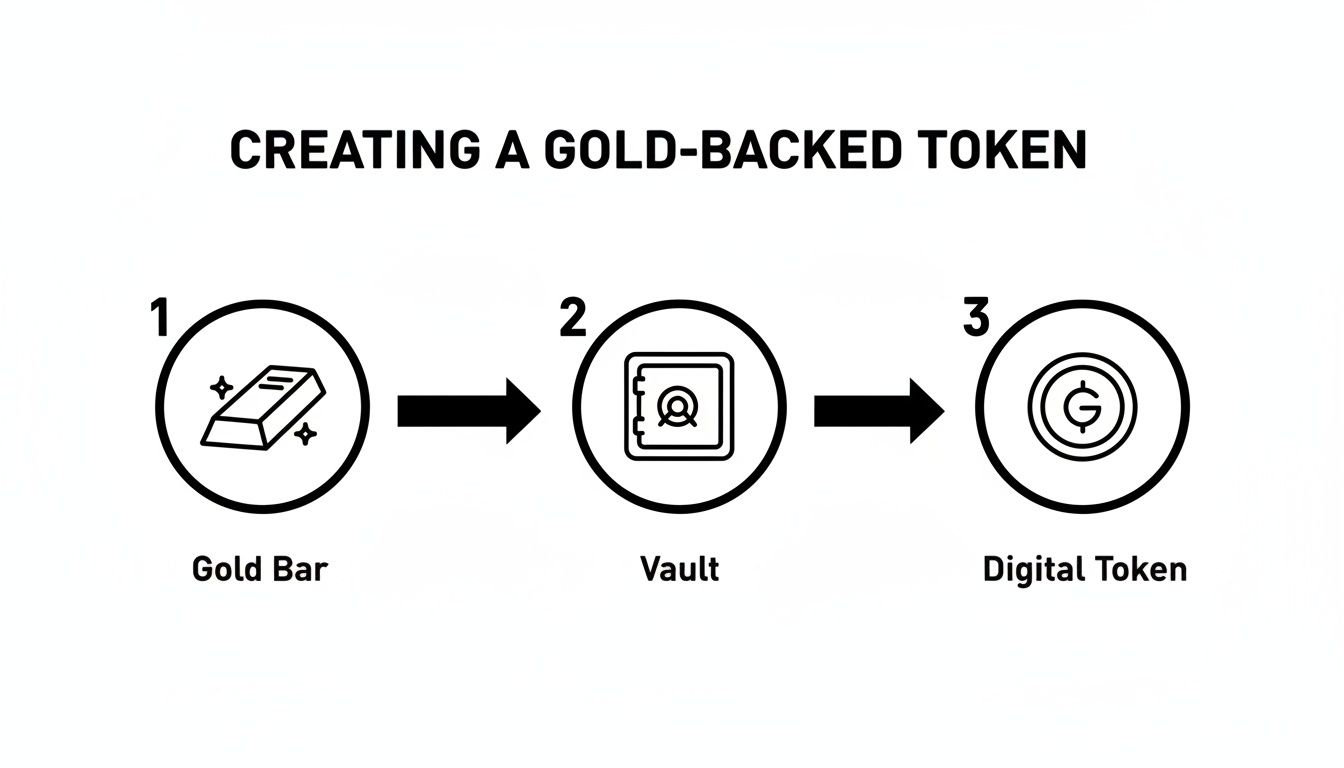
This simple flow—physical asset, secure storage, digital representation—is the core mechanic that gives a gold-backed stablecoin its value and makes it trustworthy.
Once minted, these tokens enter the crypto ecosystem. You can buy them on exchanges, send them between wallets, or even use them in Decentralized Finance (DeFi) protocols, all while knowing they carry the inherent value of the gold they represent.
The Final Step: Redemption and Burning
A gold-backed token's lifecycle is a complete circle, and it ends with redemption. A token holder can decide to exchange their digital asset back for the physical gold it represents. This right to redeem is what truly anchors the token's value to the price of gold.
Typically, redemption happens in one of two ways:
- Direct Physical Redemption: An investor holding a large number of tokens—enough to equal a full gold bar, like 400 tokens for a 400-ounce bar—can request physical delivery of the gold straight from the custodian's vault.
- Cash-Value Redemption: More often, a holder can redeem their tokens with the issuer for the equivalent amount in cash, based on the current spot price of gold.
When a token is redeemed, the issuer "burns" it, which means it's permanently removed from circulation. This is the exact opposite of minting. If you redeem one token representing one ounce of gold, that token is digitally destroyed, and the total token supply shrinks by one. This burn mechanism is critical for maintaining the 1:1 backing at all times, preventing the token supply from ever becoming inflated against the gold reserves.
Think of each token as a digital claim check for a specific piece of gold. You can trade that claim check with anyone, anytime. But at the end of the day, a qualified holder can always walk up to the issuer, hand in the check, and claim the underlying asset. That's what completes the cycle.
This constant loop of minting and burning, tied directly to the deposit and withdrawal of physical gold, is what keeps the entire system honest and stable. It ensures every digital token remains a true, verifiable claim on a real-world asset.
Audits and Custody: Proving the Gold is Actually There
Let's be clear: a stablecoin backed by gold is only as good as its promise. And that promise is that for every token you hold, there's a real, physical piece of gold sitting in a vault somewhere. Without total trust in that promise, the token is just digital noise.
This trust isn't built on wishful thinking. It's built on two unshakeable pillars: high-security custody and relentless, transparent audits.
Think of it like the foundation of a skyscraper. If the concrete is weak or you're not even sure it was poured, the whole building is a catastrophe waiting to happen. That’s why serious issuers don't just stash gold bars in a closet. They partner with world-class, third-party custodians.
We're talking about specialized, high-security vaulting services, usually in global financial centers like Switzerland or the UK. Big names like Brinks and Loomis are popular for a few key reasons:
- Segregated Storage: The issuer's gold is kept completely separate from any other assets. This means it can't be loaned out, mixed with other funds, or touched by the custodian's creditors.
- Full Insurance: Every ounce is insured against theft, damage, or loss. This protects investors from the physical risks of storing precious metals.
- Fort Knox-Level Security: These places are fortresses. They have 24/7 surveillance, armed guards, and brutally strict access protocols.
This professional custody model is the first line of defense, making sure the gold is physically safe and accounted for.
The Power of Proof of Reserves Audits
But just knowing the gold is in a safe place isn't enough. You need proof. This is where Proof of Reserves (PoR) audits are absolutely critical. A PoR is simply an independent check-up by a reputable auditing firm.
The mission is straightforward: confirm that the amount of physical gold held in the vault matches the number of tokens in circulation. This isn't a one-and-done deal, either. Any project serious about transparency will provide these reports regularly—at least quarterly, but ideally every single month.
A Proof of Reserves report is the ultimate "show, don't tell" for a gold-backed stablecoin. It's the hard evidence that separates a trustworthy asset from a risky gamble. Without it, you’re operating on blind faith.
When you look at an audit report, you're searching for a clear confirmation of two numbers: the total troy ounces of gold held in reserve and the total supply of tokens. Those numbers must be a 1:1 match. A legitimate report will be issued by a known accounting firm and should be easy to find on the issuer's website.
Reading the Fine Print: What to Look For
Digging into these reports is a non-negotiable part of your due diligence. A transparent issuer will make this simple, but it’s still on you to know what to look for—and what red flags to run from.
Here’s your checklist:
- Auditor Reputation: Is the audit from a well-known, independent firm? An audit from "Bob's Accounting & Tacos" isn't going to cut it.
- Report Frequency: How often do they publish these? Monthly is the gold standard and shows a real commitment to staying accountable.
- Clarity and Detail: Does the report give you crisp, clear numbers for the gold reserves and token supply on a specific date? Any fuzzy language is a massive red flag.
- Accessibility: Can you find and download the reports easily? If they're buried five clicks deep or require a sign-up, the issuer might be hiding something.
These verification methods are becoming more important by the day as regulators start to pay closer attention. As the market matures, the bar for transparency and accountability will only get higher. You can get up to speed on this evolving landscape in our detailed guide on stablecoin regulation.
At the end of the day, a project’s dedication to rock-solid custody and frequent, clear audits is the best signal you have of its legitimacy and long-term potential.
Exploring Market Growth and Adoption
The market for gold-backed stablecoins is quickly shedding its niche status and becoming a serious contender in the digital asset space. What was once seen as a curious experiment—blending ancient value with modern tech—is now gaining serious traction, and it's happening for very clear reasons.
This isn't just a passing trend. Investors are actively seeking out a stablecoin backed by gold to navigate today's tricky economic waters. They're looking for a solid hedge against inflation, a tangible way to diversify their crypto holdings, and a reliable safe haven when the rest of the market gets choppy. This is a sign of a maturing industry, one that's carving out a permanent place for itself.
Key Drivers Fueling the Surge
The growing interest comes down to two things: widespread economic uncertainty and the sheer utility of tokenized assets. When the value of traditional currencies starts to wobble or crypto markets go on a rollercoaster ride, an asset with thousands of years of history and intrinsic value looks incredibly appealing. Gold's stability doesn't depend on any single government or bank.
Tokenizing gold just amplifies these benefits, making it more practical than ever:
- Effortless Portfolio Diversification: You can add gold exposure to your digital wallet without the headache of finding a secure vault for physical bars.
- A True Safe Haven: During crypto downturns, traders often flee to safety. Gold-backed tokens offer a robust alternative to fiat-pegged stablecoins, which carry their own set of risks.
- The RWA Revolution: The tokenization of gold is a flagship example of the Real-World Asset (RWA) movement. This is all about bringing tangible things, from real estate to precious metals, onto the blockchain to unlock new forms of liquidity and ownership.
It's a simple, powerful value proposition: you get the timeless security of gold combined with the speed and accessibility of a digital currency. It’s a perfect match for the modern investor.
The market data tells a story of explosive growth. For a detailed breakdown of the numbers and trends shaping the stablecoin world, you can check out our comprehensive stablecoin market report for 2025.
Quantifying the Market Expansion
The numbers speak for themselves. The entire gold-backed stablecoin sector has seen its market cap balloon, showing a massive influx of capital and growing confidence. We’re not talking about a slow, steady climb here—this is a rapid expansion led by a few key players.
To put it in perspective, the total market cap for these tokens shot past $4 billion in 2025. That’s a nearly threefold increase from the $1.33 billion it started the year with. This surge was primarily powered by the two giants in the space, PAX Gold (PAXG) and Tether Gold (XAUT). This remarkable growth highlights just how fast investors are flocking to this asset class, especially with gold prices on the rise.
This isn't just a theoretical concept anymore. A stablecoin backed by gold is now a practical financial tool used by thousands of people around the world. As our digital and traditional financial worlds continue to merge, tokenized gold is poised to play an even bigger role.
How to Evaluate the Top Gold-Backed Stablecoins
When you’re thinking about putting money into a stablecoin backed by gold, remember that they are definitely not all created equal. The digital token is just a wrapper; the real substance comes from the quality of the gold itself and the trustworthiness of the company that issued the token. A little bit of homework can be the difference between a rock-solid investment and a risky bet.
The big players in this space are undoubtedly Paxos Gold (PAXG) and Tether Gold (XAUT). Their dominance reflects a growing confidence in these assets, with the total market for gold-backed stablecoins hitting an impressive $1.5 billion in March 2025. Much of that growth came from Tether Gold, which reached a $654 million market cap while its combined trading volume with PAXG shot past $1.6 billion on DeFi platforms alone.
But a big market cap is only one part of the story. To make a smart choice, you need to know what to look for under the hood.
The Four Pillars of Due Diligence
Your evaluation should really boil down to four critical areas. Think of these as the pillars holding up the token's value and security. They give you a solid framework for comparing your options and finding the one that best fits your strategy.
- Gold Quality and Storage: First things first: what kind of gold is it, and where is it being kept? You want to see tokens backed by London Bullion Market Association (LBMA) Good Delivery bars. This is the industry benchmark, guaranteeing at least 99.5% purity. Just as important is the vault's location—reputable custodians in secure jurisdictions like Switzerland or London provide a huge layer of protection.
- Audit Transparency and Frequency: How do you know the gold is actually there? The issuer needs to prove it, and they should do it often. Monthly, third-party audits are the gold standard. These reports should be easy to find on their website and clearly confirm that the gold reserves fully collateralize every token in circulation.
- Custodian Reputation: Who’s actually guarding the vault? The physical gold shouldn’t be held by the token issuer themselves. Look for world-class, fully insured custodians like Brinks or Loomis. This separation of duties is crucial—it protects the assets if the issuing company ever runs into trouble.
- Fee Structure: What’s this going to cost you? Dig into all the potential fees. This includes transaction fees for moving tokens on the blockchain, any storage or custody fees (which should be zero for top-tier tokens), and redemption fees for when you want to cash out for physical gold or its equivalent value.
A great way to think about this is like buying a diamond. You wouldn't just take the seller's word for its quality. You'd insist on seeing a grading report from a trusted gemological lab. An audit report for a gold-backed token serves the exact same purpose—it's your independent, third-party verification of its value.
Feature Comparison of Leading Gold-Backed Tokens
An overview of the key differences between popular gold-backed stablecoins to help investors choose the right option.
When we apply this four-pillar framework, the differences between tokens become crystal clear. And it's not just about the big names; understanding these details is vital as new projects like the gold-backed PMUSD stablecoin come onto the scene, each with a slightly different model.
Let's break down how the leading options compare on the features that matter most.
| Feature | Paxos Gold (PAXG) | Tether Gold (XAUT) | Other Examples |
|---|---|---|---|
| Gold Standard | LBMA Good Delivery 400 oz bars | LBMA Good Delivery 400 oz bars | Always check that the gold is investment-grade from an accredited source. |
| Storage Location | Approved vaults in London (e.g., Brinks) | Secure vaults in Switzerland | Stick to politically stable countries with strong property rights laws. |
| Audit Frequency | Monthly attestations by a top accounting firm | Real-time reserves data available online | Anything less frequent than quarterly audits is a major red flag. |
| Transaction Fees | Small fee (~0.02%) for on-chain transfers | Zero on-chain transfer fees | Fees can eat into your returns, so compare them carefully. |
| Storage Fees | Zero storage fees for token holders | Zero storage fees for token holders | Watch out for smaller issuers who might charge annual "holding" fees. |
| Redemption | Redeemable for physical bars or cash value | Redeemable for physical gold (min. 1 full bar) | Always check the minimum redemption amounts and associated costs. |
By working through these points, you can cut through the marketing noise and base your decision on verifiable facts. Whether your main goal is minimizing fees, ensuring top-notch transparency, or having flexible redemption choices, this structured approach will help you pinpoint the gold-backed stablecoin that’s right for you.
Navigating the Risks and Performing Due Diligence
The idea of a digital asset with the timeless stability of gold is definitely appealing. But before you jump in, it's crucial to understand that a stablecoin backed by gold comes with its own unique set of challenges.
Protecting your investment means having a clear-eyed view of the potential pitfalls and a solid process for doing your own research. In this space, blind trust is a recipe for disaster. Diligence is everything.
The risks really boil down to three main areas. Getting a handle on each one is the first step toward making a smart decision and steering clear of costly mistakes.
- Counterparty Risk: This is a big one. It's the risk that the company issuing the token simply fails. What happens to your "gold" if the issuer mismanages its funds or goes bankrupt? Look for a strong legal framework and segregated asset custody as your best defense.
- Custody Risk: The physical gold is the entire foundation of the token's value. If that gold is stolen, lost, or can't be accounted for, the token's value could plummet. This is why the reputation and security protocols of the third-party custodian are just as critical as the issuer itself.
- Regulatory Risk: The rules for digital assets are still a work in progress globally. A sudden regulatory shift could hamstring an issuer's ability to operate, change the token's legal standing, or even freeze redemptions. This isn't a "set it and forget it" risk; it's a moving target that needs to be monitored.
These aren't just abstract ideas—they are real vulnerabilities that can hit your bottom line. To get a broader perspective, you can check out our detailed overview of common stablecoin risks and see how they play out across the entire market.
Your Practical Due Diligence Checklist
Knowing the risks is one thing; acting on that knowledge is another. You need a systematic way to evaluate any gold-backed stablecoin that catches your eye. This checklist is your framework for digging into the details that actually matter and spotting red flags before you commit any capital.
Think of this checklist as your pre-flight inspection. You wouldn't take off without confirming the plane is sound, and you shouldn't invest without confirming the asset's fundamentals are solid.
Follow these steps to guide your research:
- Scrutinize the Audit Reports: Don't just see the word "audit" and move on—actually read the reports. Are they from a reputable, independent firm? Do they happen at least quarterly, or even better, monthly? The key is to confirm the gold reserves match or exceed the token supply. No excuses.
- Investigate the Issuer and Custodian: Dig into the track record and reputation of both the company behind the token and the firm vaulting the physical gold. Are these established players with a known history of reliability and transparency? Or did they just pop up yesterday?
- Confirm the Gold's Quality: The project needs to be crystal clear that its reserves are LBMA Good Delivery gold bars. This is the global standard for investment-grade bullion, and it guarantees purity and weight. Anything less is a major compromise on the quality of the underlying asset.
- Analyze the Fee Structure: Get a complete picture of every potential cost. This means on-chain transaction fees, creation and redemption fees, and any storage or management fees that might be tucked away in the fine print. Hidden costs are a silent killer for returns.
- Test Customer Support and Accessibility: A legitimate project won't hide from you. Check their website for clear documentation, easy-to-find audit reports, and a straightforward process for asking questions about redemption. If you can't get a straight answer, that's a red flag.
By methodically working through these points, you can build a solid understanding of a project's integrity and how well it's run. This disciplined approach is your best defense against risk and the key to investing with confidence.
Got Questions? We've Got Answers
Even after digging into the mechanics, it's perfectly normal to have a few lingering questions about stablecoins backed by gold. Let's tackle some of the most common ones to help clear things up.
Is a Gold-Backed Stablecoin Just Another Name for a Gold ETF?
Not at all. While they both give you exposure to gold, they operate in completely different worlds. A Gold ETF (Exchange-Traded Fund) is a traditional financial product. You buy and sell shares through a brokerage account, and you're limited to standard market hours.
A gold-backed stablecoin, on the other hand, is a native digital asset. It’s a direct claim on physical gold that lives on a blockchain, meaning you can send it to anyone, anywhere, 24/7. This opens up a world of possibilities for peer-to-peer payments and integration with DeFi that an ETF simply can't match.
Can I Actually Get My Hands on the Physical Gold?
Yes, but it's not as simple as cashing out a few tokens at a local bank. The ability to redeem for physical gold is a core feature for most major issuers like PAXG and XAUT, but there are some important strings attached.
You'll almost always need to hold a minimum amount, typically enough tokens to cover a full, standard gold bar (that's usually 400 troy ounces). If you hold less, the standard procedure is to redeem your tokens for the cash equivalent. Always read the fine print in the issuer's terms and conditions so you know exactly what your options are.
The right to redeem is what truly anchors the token's value. It’s the ultimate backstop, ensuring the digital asset is always tied to the real-world commodity and holding the issuer accountable.
Are These Stablecoins a Good Way to Fight Inflation?
Gold has been a go-to inflation hedge for centuries. When the value of fiat currencies like the dollar drops, the price of gold often goes up. A stablecoin backed by gold directly inherits this quality.
Holding a token pegged to gold is a straightforward way to protect your wealth from being eaten away by inflation. It's a modern tool for the age-old practice of wealth preservation.
We've seen this play out in a big way, especially in emerging economies. Back in 2025, on-chain transaction volumes for gold-backed stablecoins exploded to $4 trillion, driven by massive adoption in countries like Nigeria, India, and Indonesia. In Nigeria, where 11.9% of the population turned to stablecoins to escape a failing currency, tokenized gold became a financial lifeline. You can dive deeper into the strategic rise of transparent gold-backed stablecoins.
At Stablecoin Insider, we provide the in-depth analysis you need to understand the digital asset economy. For the latest news and expert insights on stablecoins and their role in global finance, visit us at https://stablecoininsider.com.