

Table of Contents
A stablecoin API is a set of programming instructions that lets your software application talk directly to stablecoin networks and services. Think of it as a toolkit for developers to programmatically handle stablecoin transfers, look up balances, and plug digital dollar payments into their apps—all without having to build and maintain their own complex blockchain infrastructure.
What a Stablecoin API Does for Your Application
At its heart, a stablecoin API is the essential bridge connecting your application to the world of blockchain finance. Instead of getting bogged down in the weeds of managing private keys, calculating gas fees, or broadcasting transactions on-chain yourself, you can just make simple, familiar REST API calls. It’s an abstraction layer that makes a world of difference, seriously lowering the barrier to entry for any business wanting to get started with stablecoin technology.
This approach brings some major wins for developers and businesses:
- Less Complexity: You don't need a team of blockchain experts. This frees up your developers to focus on building the features that make your product great.
- Quicker Development: Integrating a ready-made stablecoin API is worlds faster than building, testing, and securing your own blockchain interaction code from the ground up.
- Stronger Security: Good API providers take on the heavy lifting of securely managing wallets and private keys. This significantly cuts down the risk of a catastrophic security breach on your end.
- Better Scalability: These APIs are designed to handle a high volume of transactions and manage the headaches of fluctuating network fees, giving you a much more reliable setup than a manual solution.
Core Functions of a Stablecoin API
The rise of this technology is happening for a simple reason: stablecoin usage is exploding. Recently, stablecoin transaction volumes soared to an incredible $5.7 trillion, which puts them right up there with traditional payment giants. This kind of growth is a clear signal that the on-chain economy is maturing, and it's why understanding how stablecoins work has become so important for developers.
The concept map below breaks down the main functions you'll find in a stablecoin API.
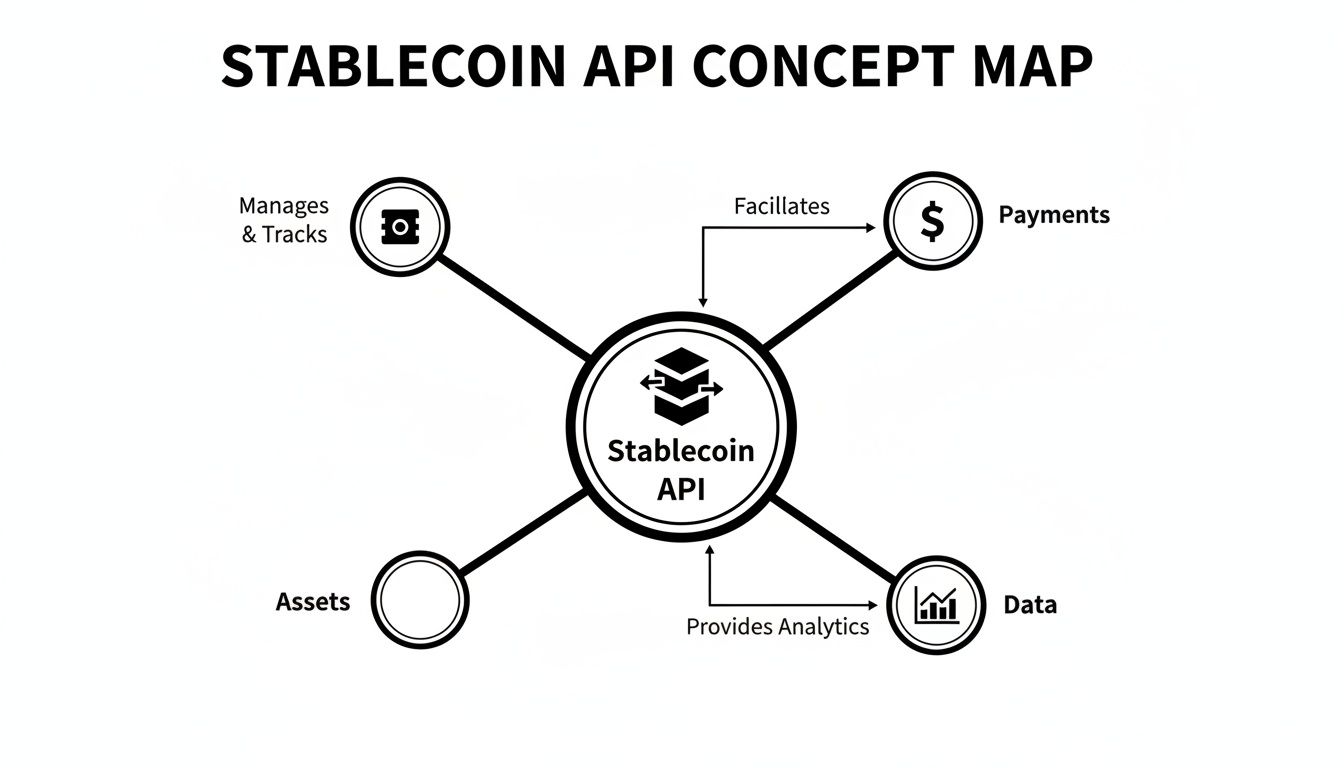
As you can see, these APIs act as a central command center for managing assets, making payments, and pulling crucial on-chain data for everything from analytics to reporting.
Quick Reference of Stablecoin API Categories
To help you find what you need quickly, we've broken down stablecoin APIs into a few key categories. Each one is built for a different job, whether you're issuing a new stablecoin or just accepting them for payments.
| API Category | Primary Function | Common Use Cases |
|---|---|---|
| Minting & Redeeming | Creates new stablecoins or burns existing ones in exchange for reserve assets. | For stablecoin issuers managing supply, large-scale treasury operations. |
| Payments & Wallets | Manages wallets, sends/receives funds, and tracks transaction history. | E-commerce checkouts, peer-to-peer payments, global payroll, B2B invoicing. |
| Oracle / Price Feeds | Provides reliable, real-time price data for stablecoins against other assets. | DeFi protocols, exchanges, financial dashboards, risk management systems. |
| Compliance & KYC | Verifies user identities and screens transactions against regulatory watchlists. | Onboarding users to a financial service, meeting AML/CFT requirements. |
| Custody | Securely stores and manages large quantities of digital assets on behalf of others. | For institutions, exchanges, and fintechs needing enterprise-grade security. |
This table should give you a solid starting point for figuring out which type of API fits your project. As we go through this guide, we'll dive deeper into the specific endpoints and features you can expect from each category.
Integrating Payment and Transfer APIs
When it comes to stablecoin APIs, payment and transfer functions are where most developers start. This is the most common and practical application, letting businesses send, receive, and manage digital dollar payments around the globe. These APIs do the heavy lifting by hiding the raw complexity of the blockchain, so you can build powerful payment systems with simple function calls you already know.
For anyone working in e-commerce, payroll, or B2B invoicing, this is a huge deal. It means faster, cheaper transactions without the headache. You get to skip the nitty-gritty of managing crypto wallets and calculating gas fees yourself. Instead, you just execute payments through well-documented endpoints, which is not only faster for development but also a lot more secure. Your API provider handles things like storing private keys and other sensitive infrastructure on their end.
Core Payment API Endpoints
Most stablecoin payment APIs are built around a handful of core endpoints that cover the entire transaction lifecycle. While the exact names might differ a bit from one provider to the next, the fundamental functions are almost always the same. Getting a handle on these is the first real step to building a solid payment system.
Here’s a quick reference table of the most critical endpoints you’ll run into.
| Endpoint | Purpose | Key Parameters | Expected Response |
|---|---|---|---|
POST /v1/payments |
Creates and kicks off a new stablecoin payment from a managed wallet. | amount, currency, recipient_address, network |
A payment object with a unique payment_id and an initial status (like 'pending'). |
GET /v1/payments/{payment_id} |
Fetches the current status and other details for a specific payment. | payment_id (URL parameter) |
The complete payment object, including an updated status (e.g., 'confirmed', 'failed'). |
POST /v1/payouts |
Starts a withdrawal or sends a payout to an external blockchain address. | amount, currency, destination_address, network |
A payout object containing a unique payout_id and initial status. |
Practical Integration Patterns
Just calling endpoints isn’t enough for a production-ready system. To do it right, you need to account for the asynchronous nature of blockchain transactions. Things don't happen instantly.
The best way to handle this is with webhooks. Instead of constantly asking the API for a transaction's status by polling an endpoint, you set up a webhook URL. The API provider then sends your system a real-time notification as soon as something happens.
What's a webhook? Think of it as an automated message an application sends when a specific event occurs. For payment APIs, this means you get instant alerts for things like 'transaction confirmed' or 'payment failed'. It's far more efficient than checking over and over.
This event-driven model lets your application react instantly. You can credit a user's account the moment a payment is confirmed or flag a failed payout for your support team to investigate. It’s a common pattern, especially for e-commerce platforms that have to manage complex payment states, similar to how platforms deal with Shopify payment holds.
Sample Code for a Stablecoin Transfer
Let's make this tangible. Here is a simple Python example showing how you might create a payment with a hypothetical stablecoin API. This snippet sends $100 in USDC on the Polygon network. It’s surprisingly straightforward.
If you want to see what different providers offer, take a look at our guide to the https://stablecoininsider.org/best-stablecoin-payment-ap-is/.
import requests
import os
API_KEY = os.environ.get("STABLECOIN_API_KEY")
BASE_URL = "https://api.provider.com/v1"
headers = {
"Authorization": f"Bearer {API_KEY}",
"Content-Type": "application/json"
}
payment_data = {
"amount": "100.00",
"currency": "USDC",
"recipient_address": "0x123...abc",
"network": "polygon"
}
response = requests.post(f"{BASE_URL}/payments", headers=headers, json=payment_data)
if response.status_code == 201:
payment_info = response.json()
print(f"Payment created successfully! Payment ID: {payment_info['id']}")
else:
print(f"Error creating payment: {response.text}")
This code authenticates with an API key, builds the payment details in a JSON object, and sends it off with a POST request. Notice the error handling—it checks the response status code, which is essential for managing both successful and failed API calls in your application.
Using Oracle and Price Feed APIs
In the world of DeFi, exchanges, and financial analytics, getting accurate and timely price data isn't just a nice-to-have; it's the bedrock of the entire system. Oracle and price feed APIs are the critical bridges that carry real-world financial data—like the current price of a US dollar—onto the blockchain. Smart contracts absolutely rely on this data to execute loans, swaps, or settle derivatives correctly.
The integrity of this data is everything. A single faulty or manipulated price feed can trigger a cascade of disastrous losses. This is why any robust stablecoin API for price data must pull its information from multiple, high-quality sources, not just one. Relying on a single feed creates a dangerous point of failure. You can get a deeper understanding of the risks by reading about common stablecoin oracle manipulation vectors.

Key Oracle API Endpoints
At their core, oracle APIs typically serve two main functions: fetching the latest price and pulling historical data. Think of these endpoints as the fundamental Lego blocks for building financial applications that are both responsive and smart enough for users to trust.
You'll almost always find some variation of these endpoints:
GET /v1/price/{asset_pair}: This is your workhorse endpoint. It gives you the latest aggregated price for a specific pair, like USDC/USD.GET /v1/history/{asset_pair}: Need to look back in time? This endpoint is for querying past price data. You can usually filter by a time range or interval, which is perfect for building charts or backtesting a trading algorithm.
Even though they're simple, these two endpoints power a huge range of features, from displaying a user's real-time portfolio value to calculating collateral ratios in a complex lending protocol.
Comparing Oracle API Providers
Here’s the thing: not all oracle APIs are built the same. When you're picking a provider, you need to dig into the details that directly affect your application's reliability and security. The best choice really hinges on your specific needs—a high-frequency trading bot needs millisecond updates, while a simple portfolio dashboard might be fine with a refresh every few minutes.
Here’s a quick breakdown of what to look for when you're comparing providers.
| Feature | Description | Why It Matters |
|---|---|---|
| Data Sources | The number and quality of exchanges and aggregators the API gets its data from. | More sources create a more resilient price feed that's much harder to manipulate. |
| Update Frequency | How often the price is refreshed (e.g., in real-time or every 15 seconds). | Crucial for time-sensitive applications like derivatives trading where small price moves count. |
| Security Mechanism | How the oracle protects its data, like using decentralized nodes or cryptographic signatures. | This ensures the data you receive hasn't been tampered with on its way to your application. |
Example Price Feed Request and Response
So, how does this look in practice? Let's say your application needs to fetch the current price of USDC against the US Dollar. It's a simple GET request to the price endpoint.
// Request:
GET /v1/price/USDC-USD
// Response:
{
"assetPair": "USDC-USD",
"price": "0.9998",
"timestamp": "1672531200",
"source": "Aggregated"
}
The JSON response gives you exactly what you need: the price, a Unix timestamp showing when it was recorded, and confirmation that the price is an aggregate from multiple sources. By integrating this kind of data, your platform can operate with a high degree of confidence in its underlying asset valuations.
4. Navigating Compliance and Custody APIs
As the stablecoin market grows up, so does the scrutiny. Regulatory oversight and secure asset management have moved from being nice-to-haves to absolute necessities. If you're building a serious application, you can't afford to ignore compliance and custody—it's foundational for managing risk and earning user trust.
This is where specialized APIs come into play. They give you the tools to handle a tricky legal landscape and safeguard user funds. Compliance APIs are all about Know Your Customer (KYC) and Anti-Money Laundering (AML) rules. They help you automatically verify identities and flag suspicious transactions. Think of them as your first line of defense. On the other hand, Custody APIs provide the heavy-duty infrastructure for storing and managing digital assets, often using sophisticated methods like multi-party computation (MPC) to keep private keys safe.
Key Compliance API Endpoints
To stay on the right side of regulations, your API needs to screen both users and their transactions. These checks aren't an afterthought; they happen before a transaction ever hits the blockchain, creating a proactive shield against illicit finance. The whole point is to catch high-risk activity early, before it can cause legal headaches or damage your reputation.
You'll run into these common endpoints all the time:
POST /v1/screen_address: This is your go-to for checking a blockchain address against risk profiles. It scans for connections to sanctions lists, known scams, or hacked funds.GET /v1/transaction_risk/{tx_hash}: Once a transaction is complete, this endpoint gives it a risk score based on where the funds came from and where they're going. It's essential for your ongoing monitoring efforts.
Building these checks into your platform is non-negotiable if you want to avoid accidentally becoming a conduit for illegal activity. Regulators are paying close attention. To get ahead of the curve, it's worth reading up on what's next in stablecoin compliance in 2026.
Understanding Custody API Functions
While compliance APIs protect your platform from bad actors, custody APIs protect the assets themselves. These are built for businesses that manage funds for their users but don't want the massive security risk of holding private keys directly.
A good custody API takes the most vulnerable parts of asset management off your plate. Instead of sticking private keys on a server—creating a glaring single point of failure—it uses distributed security models to sign off on transactions. This makes a successful theft exponentially more difficult.
This security is delivered through a few core functions:
- Wallet Creation: The ability to programmatically create secure, individual wallets for every user.
- Policy Management: The power to define transaction rules, like requiring multiple sign-offs for withdrawals above a certain amount.
- Secure Transfers: A system for initiating transfers through an authenticated process that never exposes the underlying private keys.
When you put these two API types together, you get a truly robust system. For instance, a payment flow might first hit the screen_address endpoint. If the destination address gets the green light, your application can then call the custody API to securely sign and broadcast the transaction. This kind of layered security is now the gold standard for building institutional-grade stablecoin applications.
Implementing API Security Best Practices
Working with any financial API requires a serious approach to security, and this is especially true for stablecoin APIs. A single weak point can open the door to major financial losses, so building a secure integration isn't just a good idea—it's absolutely essential. This section will walk you through the critical practices for locking down your API connections to protect your platform and your users' funds.
Your first layer of defense is solid authentication. Most stablecoin API providers will give you two main options to confirm that every request is legitimate.
- API Keys: These are basically secret passwords you send along with your requests, usually in the header. They're straightforward to use but need to be protected like cash.
- OAuth 2.0: This is a more advanced method that uses temporary access tokens instead of a single, permanent key. It's a bit more work to set up, but it dramatically lowers the risk if a credential ever gets exposed.
Ultimately, it doesn't matter which method you choose if you don't handle the credentials properly. Never, ever hardcode keys or secrets directly into your application's source code. That’s one of the first places an attacker will look.
Essential Security Measures
Beyond just proving who you are, a layered security strategy is your best defense. Think of it as putting multiple locks on the door. One of the most important steps is storing your credentials safely. For a deep dive on this, check out our guide on storing stablecoins securely.
IP whitelisting is another simple but powerful tool. You give your API provider a list of your server's IP addresses, and they'll block any requests that don't come from that list. It's an easy way to shut down unauthorized access attempts from random machines on the internet.
You also have to be mindful of rate limits. If you send too many requests too quickly, the provider might temporarily block you to protect their system. The best practice here is to build retry logic with exponential backoff, which means your app waits a bit longer after each failed attempt before trying again. This keeps you from overwhelming the API.
Don't forget to validate webhook signatures. When the API provider sends your server a notification (like for a new transaction), they'll "sign" it with a cryptographic key. Your job is to check that signature to make sure the message is authentic and hasn't been faked or altered by an attacker. This is critical for preventing someone from feeding your system false data.
Your Pre-Launch Security Checklist
Before you go live, run through a final security audit. This isn't exhaustive, but it covers the absolute non-negotiables for a secure stablecoin API integration.
- Secure Credential Storage: Are your API keys and secrets kept out of the codebase? You should be using a dedicated secrets management tool or environment variables.
- IP Whitelisting Enabled: Is your API account configured to only permit requests from your production servers' IP addresses?
- Webhook Signature Validation: Does your code verify the signature on every single webhook it receives before acting on the data?
- Transport Layer Security (TLS): Are you forcing all communication with the API over HTTPS to ensure the data is encrypted while it's in transit?
- Robust Error Handling: Does your app handle API errors gracefully? It should log them for you to review but never expose sensitive details to your end-users.
The stakes are getting higher all the time. The explosive growth of stablecoins like USDC means there's a huge amount of value flowing through these systems. Recent data shows USDC transfer volumes on Ethereum have climbed significantly, largely because more institutions are using them. You can find more insights on these stablecoin market trends on blog.amberdata.io.
Finally, remember that API security is just one piece of the puzzle. Protecting your whole system depends on applying broader software development security best practices to create a strong foundation for any financial application.
Frequently Asked Questions About Stablecoin APIs
Once you start digging into stablecoin APIs, a lot of practical questions pop up, especially when you're moving from a theoretical plan to actually writing code. This section tackles some of the most common things developers ask, helping you clear up any confusion and sidestep problems before they happen. Getting these details right is the key to a painless integration.

On-Chain Transactions Versus API Calls
So, what’s the real difference? A direct on-chain transaction means your application is doing all the heavy lifting. You're building, signing, and broadcasting every transaction straight to the blockchain yourself. That involves managing private keys, calculating gas fees in real-time, and interacting directly with smart contracts—a tricky process that requires deep blockchain knowledge and is easy to mess up.
A stablecoin API, on the other hand, handles all of that complexity for you. The provider takes care of the wallets, keys, and gas fee mechanics on their end. All you have to do is make a simple, standard REST API call to kick off a transfer. It's the perfect model for businesses that need to be reliable and scalable without turning into a team of blockchain infrastructure experts.
Choosing the Right API Provider
Picking the right provider is a big deal, and the best choice really boils down to your project's specific needs. To find the right fit, you'll need to weigh a few key factors.
Here’s what I recommend looking at:
- Supported Assets and Networks: Can they handle the stablecoins (like USDC or USDT) and blockchains (like Polygon or Tron) your users actually use?
- API Features: What do you really need? Just payments, or are you looking for more, like custody, compliance checks, or price feeds?
- Developer Experience: How good is their documentation? Is their support team actually helpful when you get stuck?
- Security and Compliance: Is the provider regulated? You'll want to see proof of regular security audits and a solid process for managing keys.
- Pricing Structure: Understand how you'll be charged. Is it a flat fee per transaction, a monthly subscription, or a cut of the transaction volume?
Don't just chase the lowest price. A thorough look at these points will save you from getting stuck with a service that doesn't fit your technical or business goals down the line. Think about the total value, which includes reliability and good support.
Handling Transaction Fees Through an API
How gas fees are handled is a huge variable between providers and can directly affect your bottom line. Some API providers wrap gas fees into a simple, flat fee for each transaction, which is great for predictable costs because they take on the risk of network congestion.
Others might go with a "gas tank" model. With this setup, you pre-load an account with crypto, and the provider just deducts the exact gas fees from that balance as you make transactions. Make sure you read their documentation closely to understand exactly how their fee model works, especially during network spikes, so you don't get hit with surprise costs.
Common Errors and How to Handle Them
You're going to run into errors—it's just part of the process when integrating any API. A smart implementation is all about having solid error-handling logic to manage these moments without breaking the user experience.
Here are a few common ones you'll see:
401 Unauthorized: This almost always means your API key is missing or invalid. Double-check it.400 Bad Request: Usually points to a mistake in your request body, like a missing parameter or the wrong data type.- Insufficient Funds: The sending wallet doesn't have enough stablecoins or native tokens to cover the transaction plus gas.
- Invalid Recipient Address: The destination address is badly formatted or just plain wrong.
Your application should always be checking the HTTP status code in the API response. If you get a client-side error (in the 4xx range), log the details and show the user a clear message. For server-side errors (5xx), it's a good idea to build in a retry mechanism with exponential backoff. Most providers also include detailed error messages in the JSON response body, which you should always log to make debugging way easier.
At Stablecoin Insider, we provide the latest news and in-depth analysis to help you stay ahead in the world of digital assets. Explore our resources to make more informed decisions. https://stablecoininsider.com