
Table of Contents
A single month rewrote the stablecoin settlement rankings. Here is what the February 2026 data actually says, and what it gets wrong.
February 2026 produced a milestone the stablecoin market had not seen before: Solana, not Ethereum, settled the most stablecoin volume of any blockchain in a single month.
The shift, confirmed by Grayscale Investments citing Allium data and independently verified by Visa on-chain analytics, has prompted wide coverage — some of it accurate, some of it overstated.
This article separates the verified data from the hype.
Key Takeaways
- Solana processed $650B in stablecoin volume in February 2026, the highest ever on any blockchain in a single month.
- That figure exceeded Ethereum's ~$551B for the month, marking the first time Solana has led on settlement volume.
- The total stablecoin market cap crossed $320B, driven by institutional demand and GENIUS Act tailwinds.
- USDC now accounts for ~70% of February volume — but the commonly cited "72%" figure is slightly inflated.
- Ethereum still leads in total stablecoin supply ($170B+) and tokenized real-world assets by a wide margin.
Solana's Stablecoin Transaction Volume
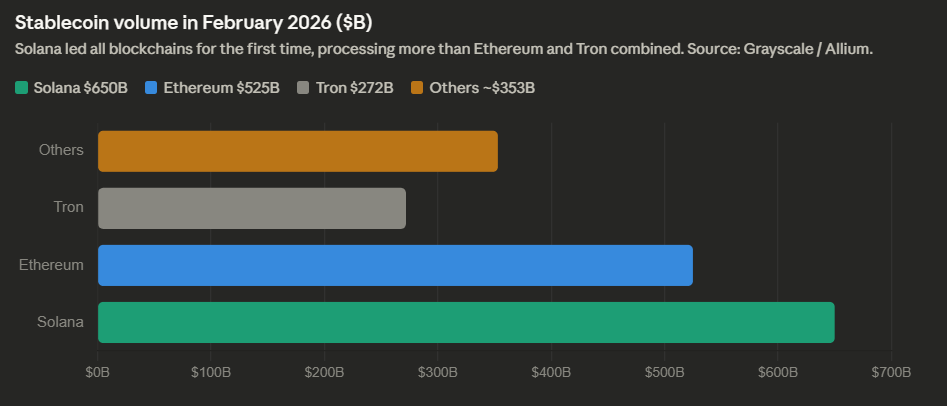
Solana processed approximately $650 billion in stablecoin transactions in February, more than double its previous monthly record set in October 2025.
Total stablecoin volume across all chains reached roughly $1.8 trillion that month, the highest figure on record.
The composition of Solana's stablecoin activity is also shifting. New products including Jupiter's JUPUSD and Western Union's USDPT contributed to volume growth alongside continued USDC dominance on the network.
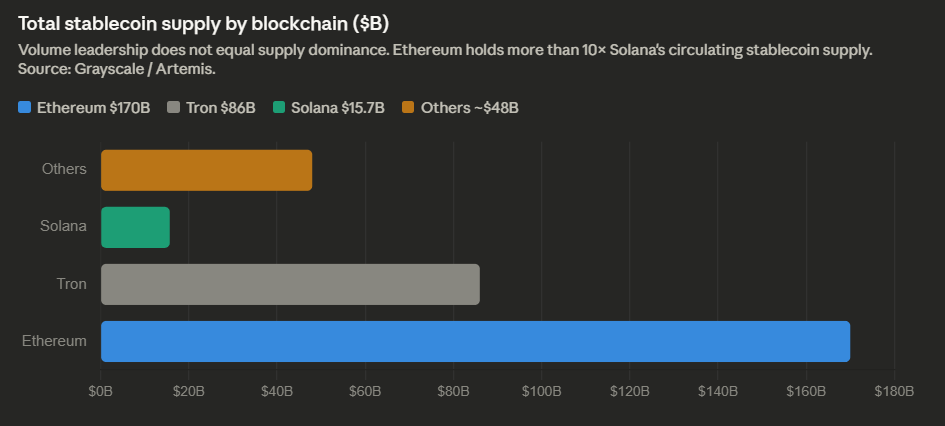
Solana's total stablecoin supply held near $15B through February, a fraction of Ethereum's, but its velocity is what matters here.
Ethereum' Stablecoin Volume
Ethereum processed roughly $525B in stablecoin volume in February, placing it second for the month. But Ethereum's decline is relative, not absolute, its total has grown significantly in two years. What changed is that Solana grew faster.
More importantly, Ethereum retains its lead where it matters most for institutional finance. Ethereum holds approximately $170B in total stablecoin supply versus Solana's $15.7B, and commands roughly $15.6B in tokenized real-world assets compared to Solana's $2B.
Settlement volume and settlement dominance are not the same thing.
The Stablecoin Market Cap Milestone
The $320B market cap figure is accurate, though the timing matters.
On-chain data from Dune confirms the threshold was crossed on February 25, 2026, driven by a $20B increase since the start of the year.
Institutional demand, particularly from APAC and LATAM corridors, and regulatory clarity from the GENIUS Act were primary contributors.
Tether remains dominant with over 60% of supply; USDC sits near $78B.
The USDC Shift is Real
You'll see 72% cited across a lot of coverage.
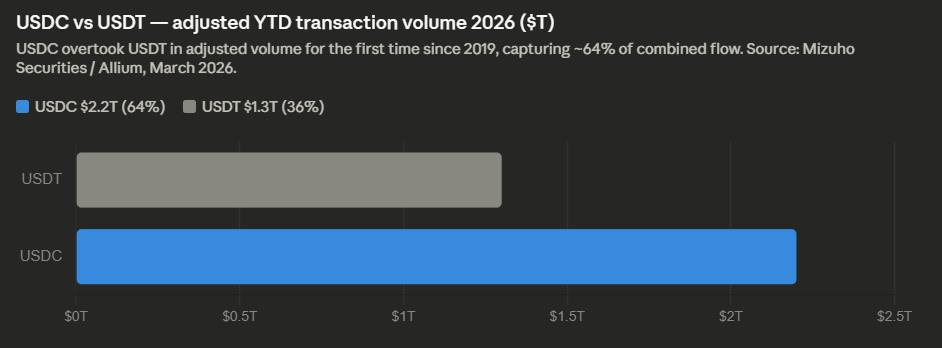
The more accurate number is closer to 70%, USDC moved roughly $1.26T of the $1.8T in total stablecoin volume recorded in February. On a year-to-date adjusted basis, stripping out non-economic activity, it sits at 64%, per Mizuho Securities' March 13 research note.
The direction is not in dispute.
USDC has overtaken USDT in adjusted transaction volume for the first time since 2019, and that is a meaningful structural shift. But volume is not the whole picture.
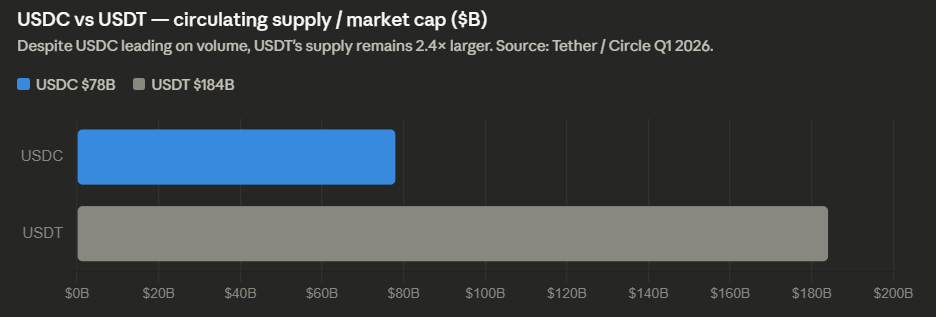
USDT still holds approximately $184B in circulating supply versus USDC's $78B. Moving more does not mean holding more, and in stablecoins, both metrics matter.
Bottom line
February 2026 marked a real shift, not a narrative one:
- Solana set a settlement record, the stablecoin market crossed $320B.
- USDC is now moving more volume than USDT for the first time in six years.
Those are the facts.
But calling this an Ethereum loss misreads the data, Ethereum's absolute volume grew, it just didn't grow as fast.
- Solana won on velocity.
- Ethereum still owns the institutional infrastructure layer.
Both things are true, and conflating them muddies an otherwise significant story.
Read Next:
FAQs:
1. Did Solana permanently overtake Ethereum in stablecoin settlement?
Not permanently, February 2026 is one month's data. Solana led on adjusted settlement volume for that period. Whether it sustains that position depends on continued product growth, network reliability, and whether Ethereum Layer 2s attract stablecoin activity back to the Ethereum ecosystem.
2. What drove Solana's $650B stablecoin volume in February 2026?
A combination of new stablecoin products launching on Solana (including JupUSD and USDPT), institutional flows via BlackRock's BUIDL clearing $550M on-chain, Circle minting approximately $750M USDC in a 24-hour window, and a broader macro rotation into stablecoins during a risk-off environment driven by global tariff announcements.
3. Is USDC replacing USDT?
In transaction volume, USDC has taken the lead for the first time since 2019. In total market cap and supply, USDT remains dominant at roughly $184B versus USDC's $78B. The shift reflects regulatory preference and institutional adoption of USDC, not a collapse in USDT demand.
4. What is the stablecoin market cap as of early 2026?
The total stablecoin market cap crossed $320B in late February 2026, per Dune on-chain analytics. It has since held in the $315–320B range through Q1. USDT and USDC together account for the majority of circulating supply.
5. How does the GENIUS Act affect stablecoin growth?
The GENIUS Act, passed in mid-2025, established the first U.S. federal regulatory framework for stablecoins. It has accelerated institutional integration by providing legal clarity on reserve requirements and oversight, and is widely cited as a tailwind for USDC specifically given Circle's compliance-first positioning.
Disclaimer:
This content is provided for informational and educational purposes only and does not constitute financial, investment, legal, or tax advice; no material herein should be interpreted as a recommendation, endorsement, or solicitation to buy or sell any financial instrument, and readers should conduct their own independent research or consult a qualified professional.