

Table of Contents
Rise’s latest market report shows stablecoin payroll is scaling through real employer demand, real worker payout behavior, and corridor-specific infrastructure adoption.
New York, April 7, 2026.
Rise's Q1 2026 Stablecoin Payroll Report shows that stablecoin payroll has reached structural scale, and Rise is now seeing that shift directly in platform-level payroll activity.
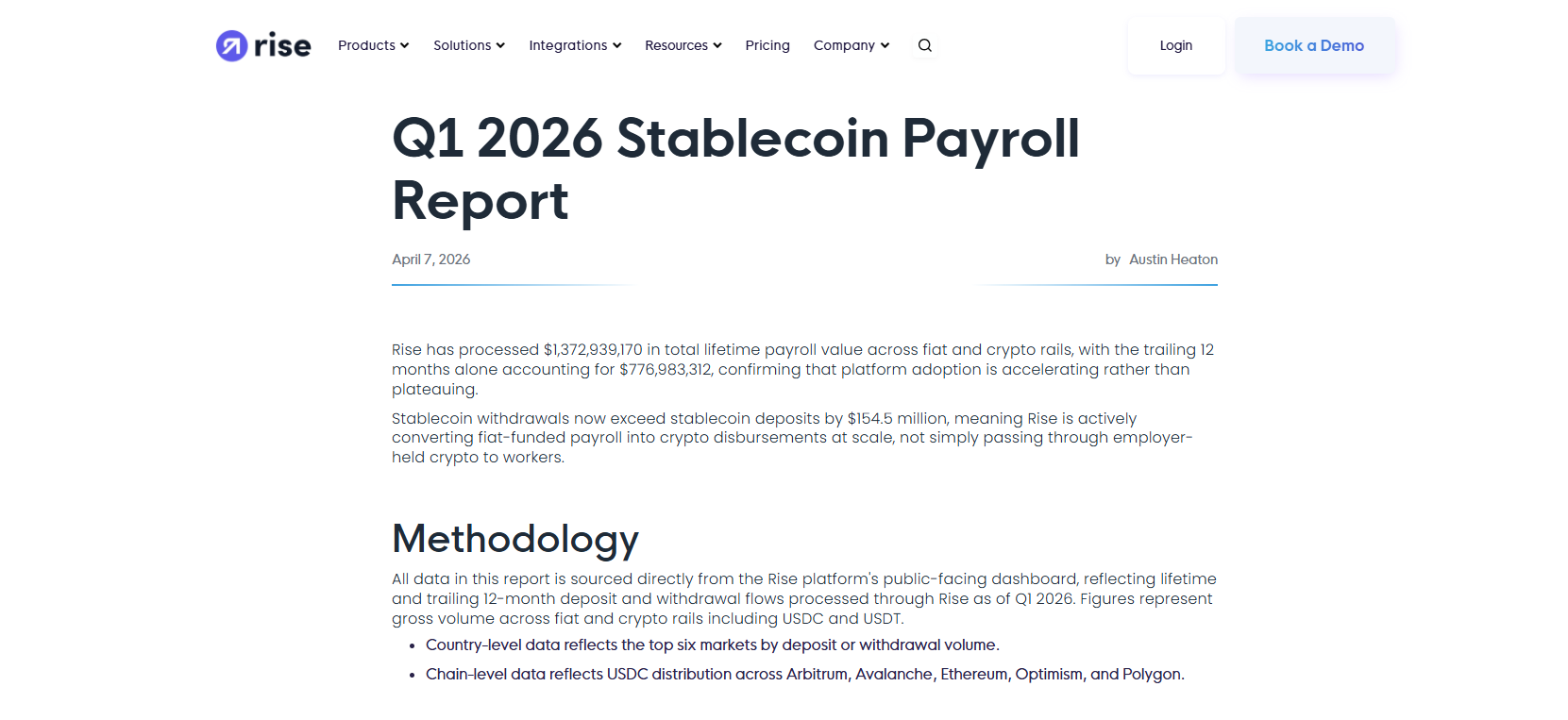
Rise has processed $1,372,939,170 in lifetime payroll volume, including $776,983,312 in the trailing 12 months, confirming that stablecoin payroll is now operating as real infrastructure across global workforce payments.
Key Takeaways
- Rise has processed more than $1.37 billion in lifetime payroll volume, showing that stablecoin payroll now operates at meaningful scale.
- Stablecoin withdrawals exceeding deposits by $154.5 million shows Rise is converting fiat-funded payroll into crypto payouts at scale.
- Corridor behavior now defines stablecoin payroll, with USDT leading outside the US and Arbitrum dominating disbursements on Rise.
Rise Says Stablecoin Payroll Has Moved Beyond Early Adoption
Rise’s Q1 2026 Stablecoin Payroll Report presents a clear market signal based on payroll activity processed through the Rise platform. The report shows that stablecoin payroll is no longer confined to crypto-native edge cases and now reflects scaled usage across global payroll flows.
More than half of all lifetime volume on Rise occurred in the trailing 12 months. That concentration confirms that adoption is accelerating through active production use rather than isolated pilot activity.
- Rise has processed $1,372,939,170 in lifetime payroll volume across fiat and crypto rails.
- The trailing 12 months account for $776,983,312 of total lifetime volume on the platform.
This establishes stablecoin payroll as a scaled operating category on Rise.
Rise Identifies Fiat-to-Crypto Conversion as the Defining Payroll Shift
The report’s most important finding is that stablecoin withdrawals now exceed stablecoin deposits by $154.5 million on Rise. That means Rise is not only routing employer-funded crypto payroll, but also converting fiat-funded payroll into stablecoin disbursements at scale.
This finding expands the definition of stablecoin payroll beyond crypto treasury employers. It shows that Rise is enabling a broader payroll model where employers fund in fiat and workers receive value through stablecoin rails.
Stablecoin withdrawals exceed stablecoin deposits by $154.5 million on Rise
- Rise is operating as a fiat-to-crypto payroll conversion layer, not only as a crypto payroll rail.
- Employers without crypto treasury exposure can still support stablecoin payouts through Rise.
This is the central signal in the report because it shows how stablecoin payroll is widening through practical infrastructure.
Rise Data Shows Stablecoin Payroll Is Differentiating by Corridor
Rise’s report shows that stablecoin payroll is not converging around one token, one chain, or one funding pattern. Employer funding behavior, worker withdrawal behavior, and settlement choices now vary by market, which makes corridor-specific infrastructure the defining layer of payroll design.
The UAE stands out as a leading employer-side stablecoin funding corridor, while India stands out as a leading worker-side crypto payout corridor.
- USDT leads worker-side stablecoin withdrawals in major non-US markets on Rise.
- Arbitrum is the dominant payout chain across tracked withdrawal corridors on the platform.
This confirms that stablecoin payroll is scaling through corridor specialization rather than universal standardization.
Rise Positions Itself at the Center of the Next Payroll Infrastructure Layer
Rise published the Q1 2026 Stablecoin Payroll Report to show how stablecoin payroll behaves in real operating conditions across employer funding and worker disbursement flows. The dataset provides a direct view into how payroll infrastructure is being shaped by liquidity, conversion, settlement efficiency, and worker payout preferences.
The report also positions Rise as a source of operating intelligence for the broader payroll market. As stablecoin payroll grows, platforms that abstract token, chain, and funding complexity cleanly will define the next generation of global workforce infrastructure.
$30.7 million in US stablecoin withdrawals on Rise routed through Arbitrum, the dominant disbursement chain in the platform’s largest withdrawal market
- Rise data shows how stablecoin payroll is functioning across real global corridors.
- The next phase of payroll infrastructure will be led by platforms that simplify multi-rail payroll execution.
This report positions Rise as both an operator and a data source in the stablecoin payroll market.
Executive Commentary
Stablecoin payroll is no longer a forward-looking concept inside global workforce payments. The data we see on Rise shows that employers and workers are already using stablecoin rails at meaningful scale, and that adoption is being shaped by real corridor behavior rather than abstract market assumptions.
What stands out most is that stablecoin payroll is expanding beyond crypto treasury companies.
The conversion of fiat-funded payroll into crypto payouts, combined with clear token and chain preferences by market, shows that the infrastructure layer is now becoming more specialized, more practical, and more global.
- Stablecoin payroll is now being driven by employer demand and worker preference at the same time.
- Rise is seeing infrastructure-level differentiation across funding flows, payout rails, and regional corridors.
This commentary reinforces the report’s thesis that stablecoin payroll has entered a structurally important phase of market development.
The Q1 2026 Stablecoin Payroll Report shows that stablecoin payroll has reached structural scale, and Rise data makes that shift measurable across volume, conversion, and corridor-level behavior.
About Rise
Rise is a global payroll, onboarding, and compliance platform built for modern teams, including companies paying contractors and employees across fiat and crypto rails. The platform supports flexible funding and payout infrastructure, enabling employers and workers to operate across multiple currencies, stablecoins, and payout preferences within one payroll system.
Read Next:
FAQs:
1. What is the Q1 2026 Stablecoin Payroll Report from Rise?
The Q1 2026 Stablecoin Payroll Report is Rise’s market report based on payroll activity processed through the Rise platform. It analyzes payroll volume, funding behavior, worker withdrawals, token usage, and chain distribution across fiat and stablecoin rails.
2. What is the biggest finding in the Rise Q1 2026 Stablecoin Payroll Report?
The biggest finding is that stablecoin withdrawals exceed stablecoin deposits by $154.5 million on Rise. That shows Rise is converting fiat-funded payroll into stablecoin payouts at scale.
3. How much payroll volume has Rise processed?
Rise has processed $1,372,939,170 in lifetime payroll volume. The trailing 12 months account for $776,983,312 of that total.
4. What does the report say about stablecoin payroll adoption?
The report shows that stablecoin payroll is now operating at meaningful scale on Rise. It also shows that adoption is accelerating through real employer usage and worker demand across global corridors.
5. Which stablecoin leads worker-side payouts on Rise?
USDT leads worker-side stablecoin withdrawals in major non-US markets on Rise. The report shows that token choice is being shaped by liquidity and off-ramp conditions in each corridor.
Disclaimer:
This content is provided for informational and educational purposes only and does not constitute financial, investment, legal, or tax advice; no material herein should be interpreted as a recommendation, endorsement, or solicitation to buy or sell any financial instrument, and readers should conduct their own independent research or consult a qualified professional.