
Table of Contents
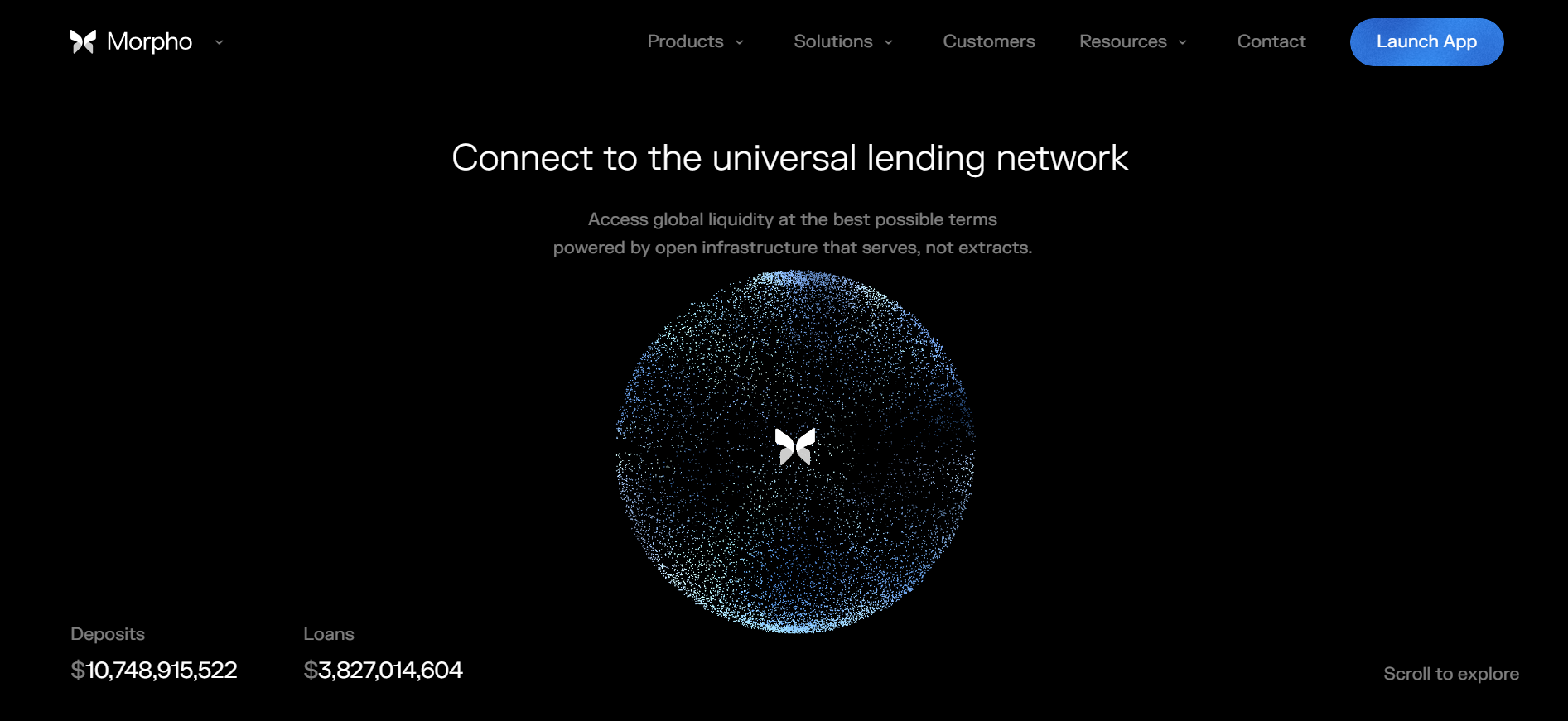
Morpho is a decentralized, permissionless, non-custodial lending protocol designed for overcollateralized crypto loans.
It operates as a universal lending network that connects lenders and borrowers to liquidity opportunities across Ethereum and other EVM-compatible chains, including Base.
What makes Morpho stand out in 2026 is its focus on isolated, customizable lending markets and its infrastructure-first approach: users can earn yield or borrow on defined parameters, while developers and businesses can build bespoke lending products on top of the same primitive.
Key Takeaways
- Morpho enables overcollateralized lending through isolated markets with customizable parameters such as collateral, oracle, and loan-to-value settings.
- Morpho operates at two levels: a user layer for lending and borrowing, and an infrastructure layer for developers building custom lending applications.
- Morpho improves capital efficiency via mechanisms like P2P matching on top of established protocols and via modular isolated markets through Morpho Blue.
- The MORPHO token is used for governance, but key protocol functions are also controlled through an owner role that governs specific configuration and fee controls.
- Morpho’s security posture emphasizes audits, formal verification efforts, and ongoing monitoring, but users still face smart contract, oracle, and liquidation risks.
What Is Morpho, and Who Should Use It?
Morpho is designed for participants who want on-chain lending and borrowing with granular control over risk and market design.
It supports overcollateralized loans, meaning borrowers post collateral worth more than what they borrow, and lenders earn yield from borrowers paying interest.
Best fit for
- Lenders who want exposure to curated strategies via vault-style products rather than manually selecting individual markets.
- Borrowers who want to use crypto collateral to access liquidity without selling assets, and who want to evaluate specific market parameters.
- Builders and businesses that need a modular lending stack to embed earn products, crypto-backed loans, or structured vaults into their own applications.
Not ideal for
- Users who require guarantees, insurance, or consumer-style protections typical of regulated bank products.
- Users who are unwilling to manage liquidation and oracle risks inherent to on-chain overcollateralized lending.
- Users who prefer simple pooled markets without needing to assess per-market configuration and risk.
How Morpho Works: Optimizer, Morpho Blue, and Vaults
Morpho’s product line can be understood as three layers:
- Optimization
- Primitives
- Curation
Morpho Optimizer
Morpho originally launched as an optimization layer that improved rates by matching lenders and borrowers peer-to-peer on top of existing lending protocols such as Aave and Compound.
The core idea is improving capital efficiency by reducing idle liquidity and tightening the spread between what borrowers pay and what lenders earn, when P2P matching is available.
Morpho Blue
Morpho Blue is Morpho’s permissionless lending primitive focused on isolated markets and modular risk management. Instead of a single pooled market design where many assets share risk and parameters, Morpho Blue supports immutable, isolated markets that can be configured with key inputs such as:
- Collateral asset
- Loan asset
- Oracle
- Loan-to-value style parameters (such as liquidation thresholds)
- Interest rate model
This isolation matters because risk is more explicitly scoped. Users can evaluate the rules of a specific market rather than relying on pooled governance decisions that affect a broad set of assets simultaneously.
MetaMorpho Vaults
MetaMorpho vaults are curated vault products that can allocate across one or more markets, enabling lenders to select a risk-reward profile without manually managing each position.
In practice, vaults shift part of the complexity from the end user to the curator strategy design, while the user remains exposed to underlying protocol and market risks.

Market Design and Risk Inputs: What You Must Evaluate Before Using Morpho
Morpho’s flexibility is the advantage, but it also means the user must understand the moving parts.
The main risk inputs are:
1. Collateral volatility and liquidation mechanics
Because loans are overcollateralized, the borrower’s collateral position must remain healthy relative to the debt. If collateral value drops (or debt value rises) beyond the liquidation threshold, liquidation can occur.
The practical takeaway: collateral quality and volatility matter as much as interest rate.
2. Oracle choice and pricing reliability
Oracles determine how collateral and loan assets are priced for health calculations. Oracle risk is one of the most material risks in DeFi lending: pricing disruptions or manipulation can cause improper liquidations or undercollateralized positions.
3. Interest rate model behavior
Interest rate models determine how borrowing costs and lending yields change as utilization rises. A market can look attractive at low utilization, then become expensive for borrowers or volatile for lenders under stress.
4. Isolated market implications
Isolation can reduce systemic spillover across unrelated assets, but it also means liquidity and risk are concentrated within each market. Some isolated markets may have thinner liquidity, which can amplify liquidation slippage during fast moves.
Quick checklist before supplying or borrowing:
- What is the collateral asset, and how volatile is it?
- What are the liquidation thresholds and incentives?
- What oracle is used, and what is the oracle’s failure mode?
- How does the interest rate model behave at high utilization?
- Is this a direct market position or a vault allocation, and who curates the vault?
Scale, Integrations, and Real-World Usage
As of January 2026, Morpho is positioned as one of the largest lending protocols by total value locked, with liquidity distributed across chains including Ethereum and Base.
It also reports large aggregate activity across deposits and loans, indicating active usage beyond passive TVL.
Morpho has also focused heavily on integrations and distribution through major platforms. Reported integrations and ecosystem touchpoints include major exchanges, wallet providers, and institutional-facing entities, as well as DeFi-native integrations for vault strategies and stablecoin yield tokenization.
What this means for users
- Better distribution typically improves market access and can strengthen liquidity and UX.
- Integrations do not remove core DeFi risks; they mainly reduce friction for onboarding and product packaging.
Security, Governance, and the MORPHO Token
Security posture
Morpho emphasizes transparency, security, and scalability, and reports multiple layers of security work such as audits and formal verification efforts. It also references ongoing security programs like bug bounties.
Even with strong security practices, no DeFi protocol can eliminate risk. Users should treat smart contract risk, oracle risk, and liquidation risk as fundamental.
Governance and admin controls
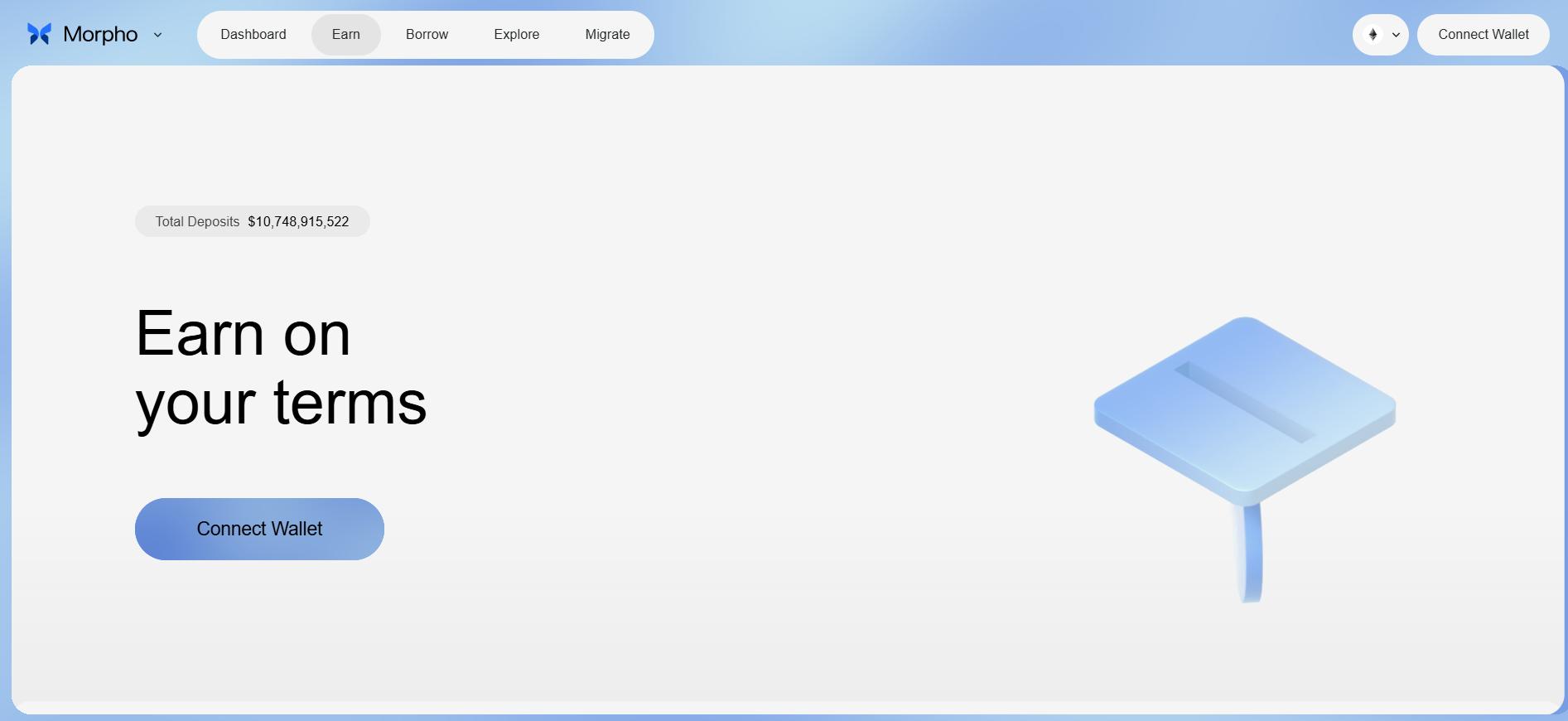
Morpho governance uses the MORPHO token for protocol decision-making through its DAO. However, Morpho also describes an owner role that controls key functions such as enabling certain configurations and managing fee-related settings.
From a user perspective, this is important because:
- Some protocol-level parameters can change over time.
- Fee settings and allowed configurations can be controlled at the protocol governance/admin layer, depending on how the system is structured.
Team and organization
Morpho was founded in August 2021 in Paris and launched on mainnet in December 2022. In 2024, it evolved with Morpho Blue.
In 2025, Morpho Labs SAS reportedly became a wholly-owned subsidiary of the Morpho Association, a French nonprofit, with the stated aim of aligning investors and tokenholders.
Pros and Cons (Quick Decision Block)
Pros
- Permissionless, non-custodial design aligned with DeFi-native ownership and composability
- Isolated market architecture supports more explicit, configurable risk
- Vault layer can simplify access to curated risk strategies
- Strong emphasis on security processes such as audits and formal verification efforts
- Built to support both end users and developers building lending products
Cons
- Higher complexity than simple pooled lending markets, especially for market-by-market evaluation
- Material oracle and liquidation risk, especially in volatile collateral environments
- Governance/admin configuration controls matter and should be understood before sizing positions
- DeFi lending remains sensitive to liquidity conditions and fast market moves
Morpho vs Aave vs Compound (High-Level Comparison)
| Feature | Morpho | Aave | Compound |
|---|---|---|---|
| Market structure | Isolated, customizable markets (plus vault curation) | Largely pooled markets with protocol-defined parameters | Pooled markets with protocol-defined parameters |
| Primary design goal | Capital efficiency + configurable lending primitive | Broad money-market access and liquidity depth | Simple, foundational money-market model |
| Risk evaluation | Per-market parameter review (collateral, oracle, model) | More standardized per-asset within pools | More standardized per-asset within pools |
| User experience | Can be simple via vaults, advanced via market selection | Generally straightforward pooled supply/borrow | Straightforward pooled supply/borrow |
| Key user tradeoff | More flexibility, more responsibility | Simplicity, shared pool assumptions | Simplicity, shared pool assumptions |
Conclusion
Morpho is best understood as a modular lending network: it serves end users who want to lend or borrow, and it also serves builders who want a configurable base layer for lending products.
Its key differentiator is the isolated market model paired with optional vault curation, which can improve precision in how risk is defined and packaged.
- If you want granular control over collateral rules, pricing inputs, and rate behavior, Morpho’s design is aligned with that goal.
- If you want the simplest possible experience and do not want to evaluate per-market risk, you may prefer a more standardized pooled market approach or to use curated vaults rather than direct markets.
Practical next step:
Pick a chain, choose either a curated vault or a specific market, then review collateral volatility, liquidation thresholds, oracle choice, and rate model behavior before sizing your position.
Read Next:
- 7 Best Stablecoin Liquidity Providers for 2026
- Best Crypto Cross-Chain Bridges in 2025
- Symbiosis Finance Cross-Chain Aggregator: Full Review and Guide (2025)
FAQs:
1) What is Morpho in simple terms?
Morpho is a non-custodial DeFi lending protocol where you can supply assets to earn yield or borrow assets by posting collateral, using overcollateralized loan markets.
2) How is Morpho Blue different from typical DeFi lending pools?
Morpho Blue is built around isolated markets with configurable parameters such as collateral type, pricing oracle, and risk settings, rather than relying only on large pooled markets where many assets share a common structure.
3) Can I lose money using Morpho?
Yes. Key risks include smart contract risk, oracle pricing failures, liquidation risk during volatility, and market liquidity risk. Overcollateralized lending reduces credit risk but does not remove protocol and market risks.
4) What is the MORPHO token used for?
The MORPHO token is used for governance, enabling holders to participate in protocol decision-making through the Morpho DAO, including decisions that can influence protocol configuration and fee-related settings.
5) Should I use a vault or choose markets manually?
If you want a simpler experience and prefer a curated risk profile, a vault approach is typically easier. If you want maximum control, selecting markets manually lets you evaluate each market’s collateral, oracle, and rate model directly, but it requires more diligence.
Disclaimer:
This content is provided for informational and educational purposes only and does not constitute financial, investment, legal, or tax advice; no material herein should be interpreted as a recommendation, endorsement, or solicitation to buy or sell any financial instrument, and readers should conduct their own independent research or consult a qualified professional.