

Table of Contents
Stablecoins and tokenized deposits have quietly turned into some of the heaviest settlement rails in finance.
By 2024, various studies estimated annual stablecoin transfer volumes in the tens of trillions of dollars, with figures ranging from about $10.8 trillion in 2023 to $18-28 trillion in 2024, exceeding or rivaling card networks like Visa and Mastercard.
At the same time, J.P. Morgan’s Kinexys platform (formerly Onyx), which powers JPM Coin and tokenized repo, has processed over $1.5 trillion in notional value since 2020 and now moves around $2 billion a day across its applications.
This activity doesn’t show up on Etherscan or in SWIFT statistics. It lives on permissioned ledgers and internal bank systems. That’s where the “secret” and “off the books” narrative comes from, not that flows are unaccounted for in bank balance sheets, but that the plumbing is increasingly invisible to the public.
On the DeFi side, projects like SIGUSD (SigmaUSD) on the Ergo blockchain provide an algorithmic, crypto-backed stable value token used in on-chain lending and structured strategies, again largely out of view of traditional payment statistics.
Key Takeaways
- Banks use JPM Coin as tokenized bank money to settle wholesale payments 24/7.
- Kinexys has already processed over $1.5 trillion in tokenized transactions for institutional clients.
- SIGUSD is an over-collateralized, algorithmic stablecoin on Ergo, not a bank-issued asset.
- “Off the books” really means off public block explorers and legacy rails, not outside bank accounting rules.
- Private blockchains and stablecoins together already move multi-trillion-dollar volumes, reshaping settlement risk and data visibility.
What JPM Coin and SIGUSD Actually Are
JPM Coin: Tokenized Bank Deposits on a Permissioned Ledger

JPM Coin is a tokenized deposit, a representation of a client’s U.S. dollar or euro deposit at J.P. Morgan that lives on the bank’s private blockchain infrastructure.
Key facts that are explicitly documented:
- Issuer & backing: J.P. Morgan issues JPM Coin; each token represents a claim on traditional deposits held at the bank.
- Network: It runs on Kinexys Digital Payments (originally part of the Onyx platform), a permissioned blockchain where only approved institutional clients can participate.
- Use case: It’s designed for wholesale payments and treasury, moving cash between corporate accounts, across regions, and into tokenized repo or other digital-asset workflows.
- Volume: As of late 2023, J.P. Morgan disclosed that JPM Coin was handling about $1 billion in payments per day.
By 2024, the broader Kinexys platform, which includes JPM Coin payments and tokenized repo, had processed more than $1.5 trillion in notional value, with average daily volumes above $2 billion.
So, JPM Coin is not a public stablecoin like USDC or USDT; it’s a closed-loop, bank-issued digital cash rail for large clients.
SIGUSD (SigmaUSD): An Algorithmic Stablecoin on Ergo
SIGUSD (SigmaUSD) is very different:
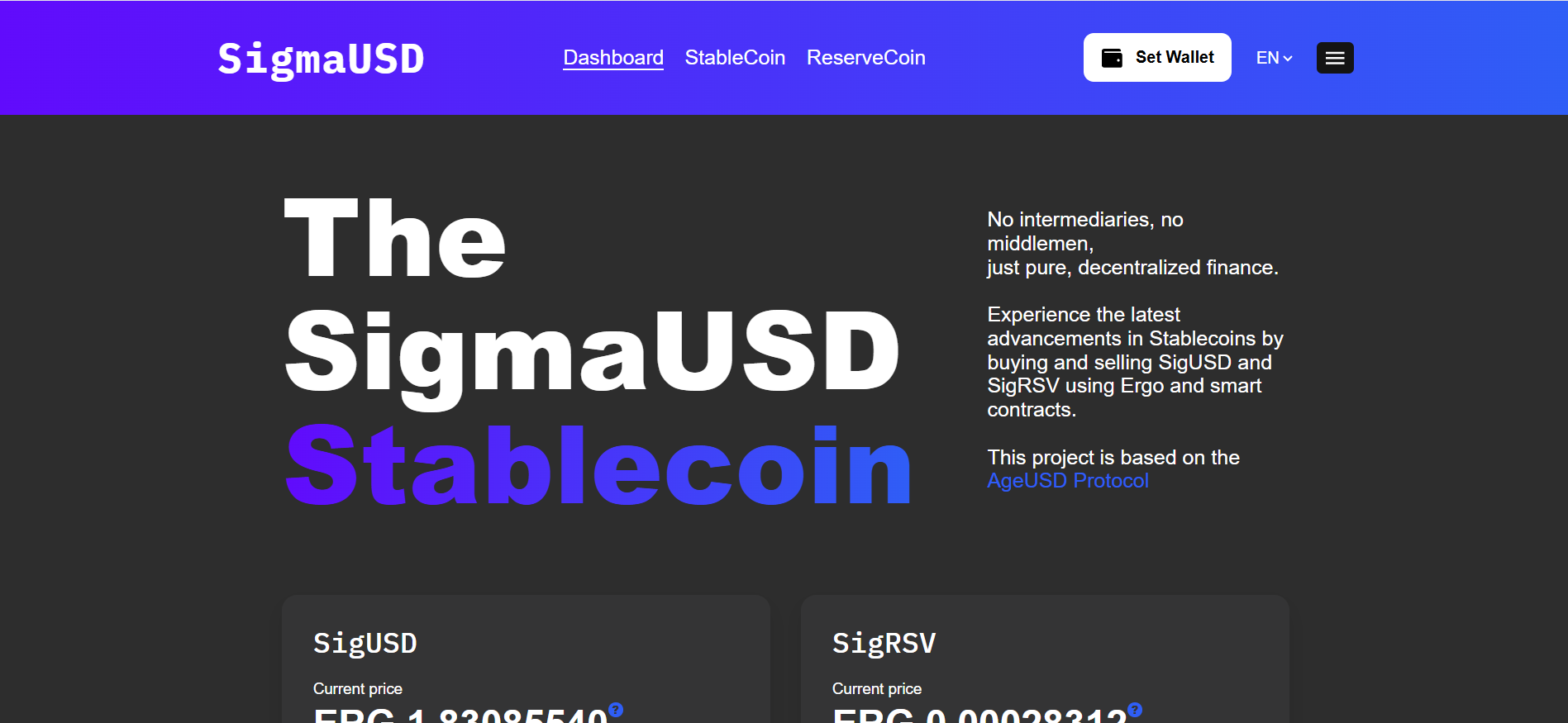
- It’s a decentralized, algorithmic stablecoin built on the Ergo blockchain, implementing the AgeUSD / Djed-style design.
- Users can mint SIGUSD by locking the native ERG token into a smart-contract “bank” as collateral. The protocol aims to keep SIGUSD close to $1 via over-collateralization and reserve tokens (SigRSV).
- The project emphasizes over-collateralization and transparent on-chain reserves, and Ergo sources highlight that SIGUSD has historically maintained its peg without catastrophic depegs as of the latest public commentary.
Critically:
There is no public evidence that major global banks directly use SIGUSD on their balance sheets or in regulated settlement systems.
SIGUSD instead lives in DeFi contexts: on-chain lending pools, DEX pairs, and structured yield strategies on Ergo.
For this article, SIGUSD serves as a case study in how programmable, algorithmic stable value can be used to build off-chain-like settlement and hedging inside a purely crypto-native system.
Bank Coins vs Public Stablecoins vs CBDCs
From a regulatory and risk point of view, it’s important to separate three categories:
- Bank coins / tokenized deposits (e.g., JPM Coin, SocGen’s stablecoins)
- Claim on commercial bank deposits, issued by a regulated bank.
- Live on permissioned or tightly controlled ledgers.
- Primarily used for wholesale settlement, repo, and securities settlement.
- Public fiat-backed stablecoins (e.g., USDC, USDT, SG-FORGE’s USD CoinVertible)
- Issued by non-bank entities or bank subsidiaries; backed by reserves like Treasuries and bank deposits and tradable on public blockchains.
- Dominant for crypto trading, cross-border retail remittances, and DeFi liquidity.
- Annual transfer volumes have been estimated in the $10–30+ trillion range in recent years, depending on methodology.
- CBDCs (central bank digital currencies)
- Direct claim on a central bank; still mostly in pilot or design phase.
Banks are increasingly exploring all three, but JPM Coin is firmly in category 1, whereas SIGUSD is in a crypto-native version of category 2/”algorithmic stablecoin”.
Why Banks Want a Shadow Settlement Layer
Legacy Rails Have Structural Limits
Traditional wholesale payments rely on infrastructure like SWIFT, correspondent banking networks, CHIPS, and RTGS systems.
These have three persistent frictions:
- Time limits: Most systems operate only in business hours and specific time zones, so cross-border liquidity can be locked up overnight or over weekends.
- Settlement lags: Final settlement can be T+1 or longer in some markets, creating intraday and overnight credit exposures.
- Operational complexity: Multi-hop correspondent chains add reconciliation work and operational risk.
Tokenized cash (including bank coins and regulated stablecoins) offers always-on, programmable settlement that directly addresses these pain points.
Off-Balance-Sheet vs Off-Ledger vs “Off the Books”
The phrase “off the books” is emotionally loaded, but we need to be precise:
- Accounting reality: If a bank issues a tokenized deposit like JPM Coin, the underlying deposit liability still sits on the bank’s balance sheet under IFRS/GAAP.
The token changes the payment rail, not the legal obligation.
- What can change is:
- Which ledger records the movement (Kinexys rather than SWIFT messages).
- Who can see it (participants and regulators, not public chain observers).
- How exposures net out intraday (internal netting before final end-of-day reconciliation).
So when people say banks are using JPM Coin to settle “off the books”, what they usually mean is:
These flows don’t show up on public blockchains or in traditional payment statistics, making them effectively invisible to outside observers even though they are fully accounted for in regulatory reporting.
How JPM Coin Is Used in Practice
Kinexys: JPMorgan’s Institutional Tokenized Money Stack
J.P. Morgan’s blockchain unit, originally branded Onyx, was rebranded as Kinexys in 2024.
Kinexys now has several components:
- Kinexys Digital Payments: the rail that powers JPM Coin for wholesale payments.
- Kinexys Digital Assets: the platform for tokenized collateral and intraday repo.
- Connectivity layers used in experiments with tokenized Treasuries and other assets.
Official and industry reports provide concrete data points:
- JPM Coin daily volume: Around $1 billion per day as of late 2023.
- Kinexys cumulative volume: Over $1.5 trillion in notional transactions across applications, averaging $2+ billion per day by 2024–2025.
- Tokenized repo: The intraday repo application alone has processed over $1.5 trillion of transactions since its launch in 2020.
These numbers are modest compared to J.P. Morgan’s ~$10 trillion in daily traditional payments but already represent a multi-trillion-dollar tokenized settlement layer over a few years.
Intraday Repo and Collateral Mobility
One of the clearest “off-grid” use cases is intraday repo:
- Banks and large institutions post tokenized securities on Kinexys Digital Assets and receive tokenized cash (linked to JPM Coin) for a few hours.
- Settlement and unwind can happen within the same day, often within a few hours, instead of the traditional 1–2 days.
- This allows more precise management of intraday liquidity and collateral, potentially lowering regulatory capital charges associated with intraday exposures.
Banks like DBS and OCBC in Asia have publicly disclosed using J.P. Morgan’s Onyx/Kinexys platform to execute intraday repo transactions using tokenized securities and JPM Coin.
From the outside, these flows are largely invisible:
Repo trades are recorded on a permissioned ledger and internal systems, not on a public chain.
Cross-Border Corporate Treasury Flows
On the payment side:
- JPM Coin initially supported USD and later expanded to euro payments, with Siemens announced as the first euro client.
- The system lets corporates move liquidity between J.P. Morgan accounts in different jurisdictions 24/7, bypassing traditional cut-off times.
Again, no public explorer shows these flows. Analysts typically see only the aggregate numbers provided by J.P. Morgan and occasional case studies.

SIGUSD as a Blueprint for Programmable Stable Value
While JPM Coin is a centralized, bank-issued token, SIGUSD shows what a crypto-native, algorithmic stable value system looks like when it is:
- Over-collateralized with the ERG token and reserve token SigRSV.
- Governed on-chain, with smart contracts and oracle pools controlling minting and redemption.
- Used as collateral and lending currency in DeFi protocols like Duckpools on Ergo, where SIGUSD lending pools have offered very high APYs at times.
This is relevant to banks because it demonstrates:
- How a dual-token design (stable token + risk-absorbing reserve token) can support a peg.
- How on-chain systems can track all balances and movements with full transparency, even if traditional financial statistics ignore them.
However, as of now:
There is no verifiable evidence that major regulated banks are directly settling positions in SIGUSD.
What banks are doing is:
- Exploring their own fiat-backed stablecoins (e.g., SocGen’s euro and dollar tokens, banking consortia exploring G7-pegged stablecoins, Japanese megabanks planning yen-pegged coins).
- Studying algorithmic and over-collateralized designs (like Djed/SIGUSD) as reference architectures for future on-chain cash instruments.
So SIGUSD is best viewed as a DeFi testbed whose concepts (over-collateralization, formal verification) could influence bank-grade systems, rather than as a current bank settlement asset.
Are These Flows Really “Off the Books”?
Accounting and Regulatory Treatment
For a bank like J.P. Morgan:
- A JPM Coin unit represents a claim on a deposit, so the underlying liability sits on the bank’s balance sheet just like traditional deposits.
- Tokenized repo positions are recorded as repo assets/liabilities and collateral positions under the existing regulatory framework, even if the settlement happens via Kinexys.
Regulators like the BIS and central banks are explicitly analyzing tokenized commercial bank money and stablecoins as part of the “next-generation monetary and financial system”, not as off-balance-sheet tricks.
So from an accounting perspective, “off the books” is misleading.
What Is Off the Public Radar
Where the “secret” part is real:
- Private visibility
- Kinexys is a permissioned network. Only participants, J.P. Morgan, and regulators see the full transaction graph.
- There is no public block explorer equivalent.
- Alternative settlement rails
- A cross-border payment settled in JPM Coin will not show up as a SWIFT message chain or as card volume.
- To outside analysts, it appears only as aggregate disclosures (“$1 billion per day”, “$1.5 trillion total notional”) or not at all.
- Data fragmentation
- Private bank coins (JPM Coin, SocGen tokens, future G7 bank stablecoins) and public stablecoins (USDT, USDC, PayPal USD, etc.) sit on different ledgers with different disclosure standards.
This is the real systemic issue:
Trillions in settlement volume are moving through environments that are transparent only to a subset of insiders and regulators, not to markets or the public.

Systemic Risk vs Efficiency
Efficiency Benefits
Documented benefits for banks and large corporates include:
- Instant or near-instant settlement for wholesale payments in USD and EUR, 24/7.
- Sharper intraday liquidity management via intraday repo and tokenized collateral.
- Lower operational risk and reconciliation costs by collapsing multi-hop correspondent chains into single-ledger updates.
For corporates like Siemens, case studies show practical use of programmable payments to automate treasury flows using JPM Coin.
Concentration and Opacity Risks
Risks highlighted by regulators and analysts include:
- Concentration risk: If large parts of wholesale settlement concentrate on a handful of private bank platforms (Kinexys, SG-FORGE, future bank stablecoin consortia), operational failures or legal disputes could become single-point-of-failure events.
- Run risk in public stablecoins: Major stablecoins hold large reserves in short-term Treasuries; sudden redemptions could stress money markets.
- Regulatory blind spots: Fragmentation across private and public ledgers complicates real-time monitoring of systemic liquidity and settlement risk.
For algorithmic stablecoins like SIGUSD, the risk profile is different, smart-contract bugs, collateral crashes, and oracle failures, but important as a design reference for what can go wrong if a system tries to maintain a peg without robust oversight.
What This Means for Public Stablecoins and CBDCs
Complement, Not Simple Competition
The real picture is layered:
- Public stablecoins already settle double-digit trillions per year and are becoming core to cross-border retail payments and crypto markets.
- Bank-issued coins like JPM Coin and SG-FORGE’s stablecoins extend tokenized settlement into regulated wholesale finance, repo, and securities settlement.
- CBDC designs increasingly assume coexistence with tokenized commercial bank money and private stablecoins, not their replacement.
In other words, the “off-the-books” rails are not a single system but an emerging mesh of:
- Private bank platforms (Kinexys, SG-FORGE, future G7 bank coins).
- Public stablecoins and DeFi platforms (USDC, USDT, SIGUSD, others).
The common theme:
Settlement is migrating to programmable digital cash, while the legal and accounting frameworks remain anchored in traditional bank money.

Conclusion
Putting the facts together, we can say:
- J.P. Morgan’s JPM Coin is already a live, production-grade wholesale settlement rail, handling about $1 billion per day on a closed, permissioned ledger and supporting trillions of dollars in cumulative tokenized repo and payments.
- SIGUSD is a crypto-native, over-collateralized stablecoin used in DeFi, not yet a tool of regulated banks, but a working example of fully on-chain, algorithmic stable value with formal design roots (Djed/AgeUSD).
- Across private and public systems, stable, on-chain cash instruments already move multi-trillion-dollar volumes annually, often without touching SWIFT, card rails, or public block explorers in a way that outsiders can easily aggregate.
So are banks “secretly using JPM Coin and SIGUSD to settle trillions off the books”?
- Yes, in the narrow sense that a growing share of institutional settlement flows through non-public, programmable ledgers that most people never see.
- No, in the sense that these flows are not hidden from regulators or absent from balance sheets; they are simply recorded in new systems under existing legal frameworks.
The real story is less about conspiracy and more about invisible infrastructure: programmable, tokenized cash rails that are rapidly becoming a core part of how money and collateral move, largely out of sight, but very much on the books.
Read Next:
- Stablecoins in Web3 Gaming: Why Every Major Title Pays in USDC Now
- Stablecoins on Layer-3s
- Stablecoin Tax Guide 2025: Reporting and Tools for Compliance
FAQs:
1. Is JPM Coin actually used at scale, or is it still experimental?
JPM Coin is live in production and handles roughly $1 billion in transactions per day, mainly for large corporate and institutional clients. It’s integrated into J.P. Morgan’s Kinexys (formerly Onyx) platform, which has processed over $1.5 trillion in notional value across payments and tokenized repo since 2020.
2. Are banks really hiding transactions “off the books” with JPM Coin?
No. When deposits are tokenized into JPM Coin, the underlying obligations remain on J.P. Morgan’s balance sheet under standard accounting rules. What changes is the settlement rail (Kinexys instead of SWIFT) and the visibility (permissioned ledger instead of public blockchain or publicly reported payment statistics).
3. Do any major banks currently use SIGUSD for settlement?
There is no public, verifiable evidence that major regulated banks use SIGUSD for settlement or treasury operations. SIGUSD is an Ergo-based, algorithmic stablecoin used within DeFi protocols and trading, not a regulated bank cash instrument.
4. How big are stablecoin and tokenized cash settlements compared to traditional rails?
Estimates vary by methodology, but multiple sources put annual stablecoin transfer volumes in the double-digit trillions of dollars, with some 2024 estimates around $18–30+ trillion, rivaling or exceeding card networks like Visa and Mastercard. At the same time, private platforms like Kinexys have processed over $1.5 trillion in tokenized institutional flows.
5. Are regulators comfortable with banks using stablecoins and tokenized deposits?
Regulators are cautious but increasingly engaged. BIS and central banks actively analyze tokenized commercial bank money, stablecoins, and CBDCs as part of a “next-generation monetary system.” At the same time, bodies like the ECB and national regulators warn about run risks, deposit flight, and money-market impacts from large stablecoin issuers. In the U.S., new laws like the GENIUS Act seek to impose stricter reserve, audit, and licensing requirements on stablecoin issuers.
6. What’s the difference between a bank-issued coin like JPM Coin and USDC or USDT?
- JPM Coin: tokenized deposit; claim on J.P. Morgan; permissioned ledger; only institutional clients can use it.
- USDC/USDT: public stablecoins; claims on reserves held by non-bank entities or bank affiliates; tradable on public blockchains by anyone who passes exchange KYC.
Both can be “used by banks”, but only bank-issued coins are directly integrated into regulated deposit and settlement systems.
7. Where is this all heading over the next 5–10 years?
Large banks are moving toward always-on, tokenized settlement that combines:
- Bank-issued stablecoins / tokenized deposits (like JPM Coin, SG-FORGE tokens, G7 bank consortia coins).
- Public stablecoins used for cross-border and DeFi liquidity.
- Future CBDCs as high-quality central bank settlement assets.
The emerging consensus in policy and industry research is that tokenized cash and stablecoins will coexist with traditional rails and gradually take a larger share of global settlement, but under more explicit regulation and oversight.