Table of Contents
If you've spent any time in DeFi, you've probably heard about farming stablecoin incentives. At its core, it's about putting your stablecoins—like USDC or DAI—to work in various protocols to earn rewards. You're essentially generating passive income on assets that are designed to hold a steady value, mostly through liquidity mining, staking, or earning interest on lending platforms.
Why Stablecoin Incentives Are So Popular
Stablecoin farming has quickly become a go-to strategy for earning yield in crypto, and for good reason. Unlike farming with volatile assets like Bitcoin or Ethereum, stablecoins are pegged to a stable asset, typically the U.S. dollar. This stability is the key; it lets you zero in on maximizing your yield without constantly worrying that the price of your underlying collateral will crash.
The whole concept is pretty straightforward. DeFi protocols need capital to operate. Lending platforms like Aave or Compound need a deep supply of assets to lend out, while decentralized exchanges (DEXs) need token pools so traders can swap efficiently. To get that capital, they offer incentives.
These rewards usually come in a few different flavors:
- Interest Payments: Simple interest earned from borrowers on lending platforms.
- Trading Fees: Your cut of the fees generated from swaps in a liquidity pool you've contributed to.
- Protocol Tokens: Extra rewards paid out in the platform's own token (think getting CRV from Curve) to attract liquidity.
When you stack these rewards together, the Annual Percentage Yields (APYs) can get pretty attractive—often blowing away what you'd find in traditional finance. If you want a deeper dive into what's achievable, our guide on a balanced approach to stablecoin yield is a great place to start: https://stablecoininsider.org/stablecoin-yield/
The Appeal of Predictable Returns
What really draws people in is the ability to forecast returns with a bit more certainty. When you provide liquidity to, say, a USDC-DAI pool, you sidestep the nasty risk of impermanent loss that plagues pools with volatile assets. You're just there to collect fees and incentives, which makes for a much more predictable income stream.
This isn't just a retail game, either. Big institutional players are all over it. For example, a major yield protocol like Pendle Finance was recently offering a 13.58% APY on a yield-bearing stablecoin. That kind of return helped it pull in over $11.85 billion in total value locked (TVL). It just goes to show how much appetite there is for solid, high-return opportunities in DeFi. You can find more examples by checking out the analysis of top stablecoin yields on BoxMining.
A Look At Real-World Opportunities
To see what's out there right now, you can turn to data aggregators for a live look at yields across different platforms and blockchains.
For instance, this snapshot from DeFiLlama shows a range of yield opportunities available for USDC.
As you can tell, APYs are all over the map, from the single digits to north of 20%. The final number depends on the protocol's risk profile, the blockchain it's on, and what its current incentive program looks like.
The real skill here is learning to tell the difference between a sustainable, long-term yield and a risky, short-term promotional rate that's bound to fizzle out. This guide will walk you through exactly how to do that.
Finding and Vetting Profitable Opportunities
The DeFi world is overflowing with opportunities, but not everything that glitters is gold. The single most important skill you can learn is how to tell a sustainable yield farm from a short-lived promotional gimmick. It’s all about looking past the flashy Annual Percentage Yield (APY) and digging into the real health of the protocol offering it.
Your search begins with discovery. Tools like DeFiLlama are your best friends here. They give you a bird's-eye view of the entire landscape, letting you filter opportunities by stablecoin (like USDC or DAI), blockchain, and the type of strategy. Think of this as your initial scouting mission to map out the terrain.
Looking Beyond the Big APY Number
Once you’ve got a shortlist of promising farms, it’s time to look beyond the headline APY. Honestly, a ridiculously high yield is more often a red flag than a green light. It usually points to a very risky protocol or an incentive program that’s bleeding inflationary tokens and is destined to collapse.
To get the real story, you need to focus on these metrics:
- Total Value Locked (TVL): Is the TVL on a steady, organic climb, or did it just shoot up because of some new, temporary incentive? A consistent upward trend is a good sign of genuine user trust. Sudden drops, on the other hand, can signal a crisis of confidence.
- Protocol Revenue: Is the platform actually making money from its core business, like trading fees or lending interest? A protocol that only pays rewards by printing its own token is on a collision course with reality. You need to find their dashboard and look for real earnings.
- The Source of Yield: Where is the APY really coming from? Is it mostly from trading fees (which is sustainable) or from token emissions (which is not)? A healthy mix is fine, but if you see a yield that's 95% token rewards, you should be extremely cautious.
A high APY is a marketing tool. A protocol's ability to generate real revenue is a sign of long-term health. Never confuse the two. Your capital depends on understanding this difference.
This process helps you tune out the noise and focus on opportunities built on a solid economic foundation. For a curated look at some of the more dependable options, you can explore our detailed breakdown of the stablecoins with the highest APY from reputable sources.
Audits and Tokenomics: The Real Due Diligence
After you've run the numbers, the next step is to get your hands dirty with the protocol's security and economic design. This is where you separate the professional operations from the reckless ones. Your capital is on the line.
First things first: security audits. Has the protocol been audited by a top-tier firm like Trail of Bits, OpenZeppelin, or CertiK? If there's no recent, comprehensive audit, just walk away. It's not worth the risk. An audit doesn't make a protocol invincible, but a lack of one is an open invitation for disaster.
Next, you have to become a student of the protocol's tokenomics, paying close attention to the emission schedule of whatever token they're paying you in.
- Inflation Rate: How many new tokens are minted every day just to pay for these rewards? High inflation creates constant sell pressure, which will systematically destroy the value of your earnings over time.
- Vesting Schedules: Are there massive token unlocks for the team or early investors coming up? A big unlock often leads to a massive sell-off, which can crash the token price and your real APY with it.
- Token Utility: Does the reward token actually do anything besides get farmed and dumped? If it gives holders governance rights, a share of protocol fees, or other tangible benefits, it has a much better shot at holding its value.
Let's make this real. Imagine you find a new DEX offering a juicy 200% APY on a USDC-DAI pool. You dig in and find the TVL is tiny, the protocol makes almost nothing in trading fees, and the entire yield comes from a super-inflationary governance token with no vesting for the founders. This is a textbook "farm and dump" setup. You get in, you get some tokens, and they become worthless before you can sell. Avoid.
Now, contrast that with an established protocol like Curve or Balancer. They might offer a more modest 8% APY, but that yield is backed by billions in TVL, real trading fee revenue, and a token model that the market understands. This is the kind of vetted opportunity that becomes a building block for a durable stablecoin farming strategy.
A Practical Walkthrough of Farming Incentives
Theory is great, but nothing beats getting your hands dirty and putting some capital to work. Let’s walk through the entire process from start to finish—from funding your wallet to staking in a live DeFi protocol. We’ll use Balancer, a battle-tested protocol, as our example and focus on providing liquidity to a simple stablecoin pool.
The core of any good strategy is a repeatable process. You discover an opportunity, dig into its legitimacy, and finally, verify its security before ever connecting your wallet.
This simple three-stage workflow keeps you disciplined and helps you avoid costly mistakes.
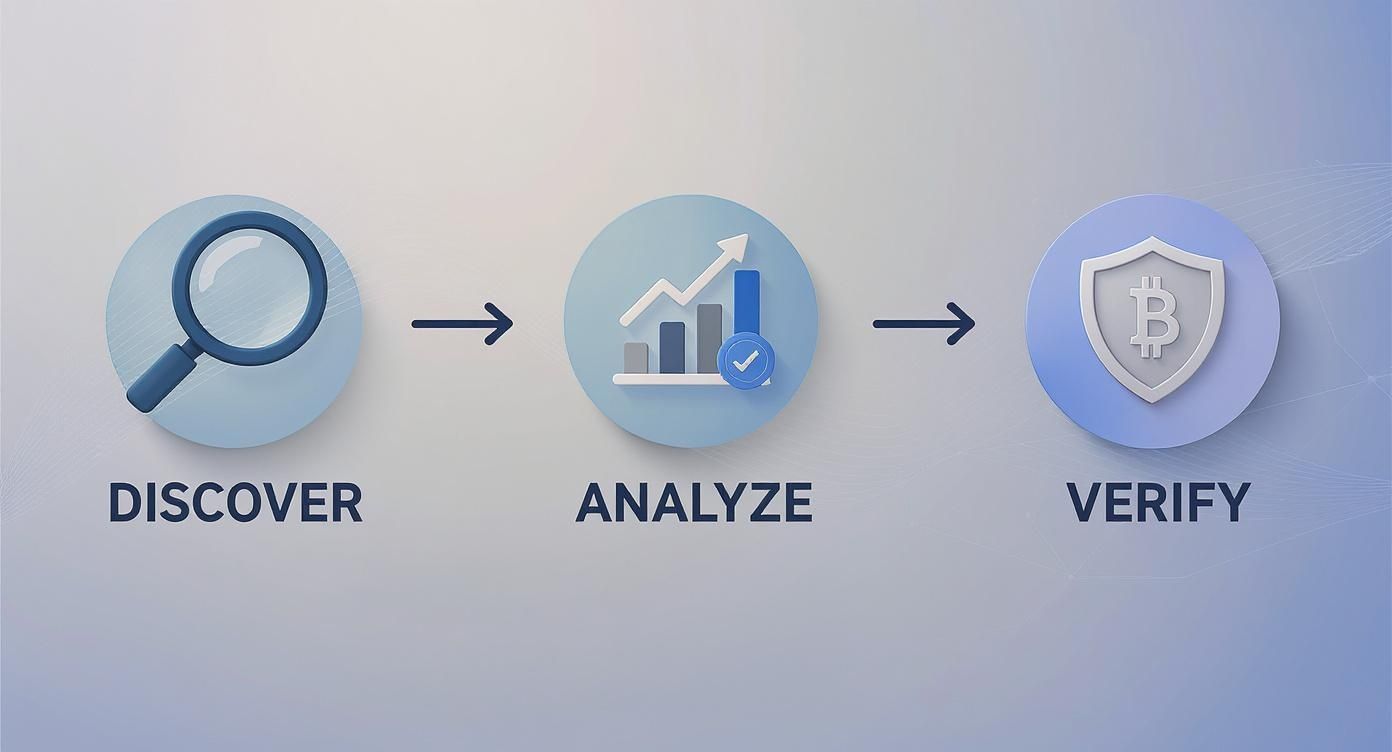
Think of it as a funnel. You start broad by scanning for opportunities, narrow it down with deep analysis, and only commit funds after a final security check.
Getting Your Foundation Set Up
Before you can even think about earning yield, you need the right tools. The absolute essential is a self-custody wallet—this is where you, and only you, hold the keys. MetaMask is the industry standard for a reason; it’s a simple browser extension that connects you to the world of DeFi.
With your wallet installed, you’ll need to load it up with two things:
- Your Stablecoins: For our Balancer pool example, let's assume we need both USDC and DAI. You can buy these on a major exchange like Coinbase or Kraken and then withdraw them to your wallet address.
- Gas Money: Every single action on a blockchain costs a small transaction fee, known as "gas." If you’re operating on Arbitrum, for example, you'll need a bit of ETH to cover these costs.
One final check. DeFi protocols often live on multiple blockchains. If your chosen Balancer pool is on Arbitrum but your funds are still on the Ethereum mainnet, they won't show up. You'll need to move them across. For a full breakdown of this, check out our guide on how to bridge tokens between different networks.
Depositing Liquidity and Staking
Alright, now for the fun part. With your wallet funded on the correct network, navigate over to the Balancer app. The first thing you'll do is connect your MetaMask wallet, which simply lets the site see your public address and balances.
From there, head to the "Pools" section to find the stablecoin pool you researched—let’s say it’s a USDC/DAI pool. You'll see all the key stats right there: the current APY, the total value locked (TVL), and the specific assets. When you’re ready, click "Deposit."
The process boils down to two key transactions that you’ll have to approve in your MetaMask pop-up:
- Token Approval: This first step gives the Balancer smart contract permission to pull the specific amount of USDC and DAI you entered from your wallet. It's a standard security feature across all of DeFi.
- The Deposit: Once permission is granted, this second transaction officially sends your funds into the liquidity pool.
After the transaction confirms on the blockchain, you’ll see new tokens appear in your wallet: Liquidity Provider (LP) tokens. These are your digital receipt, representing your exact share of that pool.
Your LP token is your claim on your share of the pool's assets. You'll need it to withdraw your funds later. Keep it secure and never send it to an unknown address.
The job isn't done yet! To actually start earning rewards, you need to stake those LP tokens. Look for a "Stake" or "Farm" tab on the protocol. You’ll find your pool, approve the staking contract to handle your LP tokens, and then sign one last transaction to lock them in.
Once staked, you're officially earning. You can watch your rewards pile up in real-time on the Balancer dashboard and claim them whenever you see fit.
Managing the Real Risks in DeFi
High yields in DeFi rarely come without strings attached. While the rewards from farming stablecoins can be incredible, your number one job is always capital preservation. This is your defensive playbook—a guide to understanding and navigating the very real threats you'll encounter in the wild west of DeFi.
It’s easy to get lured in by an eye-popping APY, but those numbers can mask significant underlying dangers. The key to long-term success isn't just about chasing the highest yield; it's about building a resilient strategy that can handle the inevitable shocks of a volatile market.
Let's break down the main risks and, more importantly, the practical steps you can take to keep your funds safe.
Confronting Smart Contract Vulnerabilities
Every DeFi protocol runs on smart contracts—self-executing code on the blockchain. If that code has a bug, it can create an opening for hackers to exploit, potentially draining every last dollar from the protocol. This isn't just a theory; exploits have led to billions of dollars in losses.
Your first line of defense is doing your homework. Before you even think about depositing funds, you need to confirm the protocol has been through multiple security audits from reputable firms. Look for names like Trail of Bits, OpenZeppelin, or CertiK. An audit isn't a bulletproof guarantee, but a lack of one is a massive red flag telling you to stay away.
Another great sign is an active bug bounty program. These programs pay ethical hackers to find and report vulnerabilities, which creates a powerful, ongoing incentive for a project to stay secure. A large bounty shows the team is serious about security.
The Ever-Present Risk of De-Pegging
Stablecoins are supposed to hold their value, but they're not infallible. A "de-peg" is when a stablecoin loses its 1-to-1 link with its target asset, like the U.S. dollar. This can be triggered by a crisis of confidence in the issuer's reserves, a flaw in an algorithmic design, or just pure, overwhelming market pressure.
The collapse of Terra's UST in 2022 is a brutal reminder of how fast things can unravel. Even fully-collateralized stablecoins can briefly wobble off their peg during moments of extreme market chaos.
The best way to manage this is diversification.
- Diversify Your Stablecoins: Never put all your eggs in one basket. Spread your capital across top-tier, well-audited options like USDC and DAI.
- Diversify Your Protocols: Similarly, don't concentrate all your farming in one protocol. Spreading your funds across several battle-tested platforms limits your exposure if one of them goes down.
Never allocate all your funds to a single stablecoin or protocol. Diversification is the only free lunch in DeFi, and it's your most effective defense against catastrophic failure.
Protecting Your Portfolio with DeFi Insurance
For an extra layer of security, you should seriously consider using decentralized insurance. Platforms like Nexus Mutual let you buy specific coverage against smart contract failures or stablecoin de-peg events for a particular protocol.
Think of it this way: if you have a large position farming on Aave, you can purchase a Nexus Mutual "cover." If Aave suffers a major hack and you lose money, you can file a claim to get reimbursed.
The cost of this insurance goes up and down based on the market's perceived risk of the protocol. While it will slightly eat into your yield, the peace of mind it offers is often worth it, especially for larger positions. It’s an essential tool for anyone serious about how to farm stablecoin incentives securely.
Of course, risk management isn't just about the protocols you use. It's also about nailing your own self-custody practices. Our guide on storing stablecoins securely covers the essential habits for protecting your assets at the wallet level. This complete approach—combining protocol vetting with personal security—is what separates successful farmers from the cautionary tales.
Fine-Tuning Your Yield with Advanced Strategies
Once you're comfortable providing liquidity and staking, you can start exploring the more powerful techniques that seasoned DeFi users employ. These advanced strategies layer on more complexity, but they can seriously boost your returns by tapping into the deeper mechanics of the ecosystem. They aren't for the faint of heart, but this is where the real optimization happens.
Let Yield Aggregators Do the Heavy Lifting
One of the best tools for leveling up your farming game is a yield aggregator. Think of platforms like Yearn Finance or Beefy as automated portfolio managers that work for you 24/7.
Instead of manually claiming rewards, swapping them, and re-depositing—a tedious process that eats into your profits with gas fees—these protocols handle it all. They automatically harvest the rewards from your LPs, convert them into more of your underlying assets, and put them right back to work in the pool.
This auto-compounding effect is what turns a simple APR into a much more compelling APY. It lets the power of compound interest kick in without you having to do a thing.
Play the Game of Bribes and Governance
Beyond just auto-compounding, some of the most interesting (and lucrative) opportunities are buried within protocol governance. Take Curve Finance for example. It uses a "vote-escrowed" model where you lock its CRV token to get veCRV, which gives you voting power to direct where future rewards go.
This created an entirely new market. Other protocols will literally bribe you to use your veCRV votes on their liquidity pools. Marketplaces like Convex Finance and Votium have sprung up to facilitate this. By participating, you can earn a whole extra layer of yield just for directing token emissions—on top of your base farming rewards.
This isn't passive farming anymore. It requires you to understand a bit of protocol politics, but it gives you a unique edge by letting you influence the flow of incentives.
Magnify Your Returns with Leverage (and Risk)
For those with a higher appetite for risk, leveraged yield farming offers a way to multiply your exposure and potential gains. The core idea is simple: you borrow additional stablecoins against your initial capital to farm with a much larger position.
Imagine this scenario:
- You start by depositing $1,000 of USDC into a lending protocol like Aave.
- You use that as collateral to borrow $3,000 worth of other stablecoins.
- You then take the full $4,000 and deposit it into a high-yield stablecoin farm.
If that farm is paying 10% APY, you’re suddenly earning that yield on $4,000, not just your original $1,000. Of course, there's no free lunch. The risks are magnified, too. You have to pay interest on the loan, and if the farm's yield plummets or your collateral value shifts, you could get liquidated. That means your entire position could be sold off to cover your debt.
Leveraged farming is a double-edged sword. It can dramatically boost your gains in a stable market, but it can also wipe out your entire principal in a volatile one. This is an expert-level strategy that should be approached with extreme caution.
The scale of these opportunities is a direct result of the sheer size of the stablecoin market, which recently hit a $166 billion market cap. In the first half of one year alone, over $8.9 trillion in on-chain volume was processed. This staggering amount of liquidity, flowing primarily through networks like Ethereum, Tron, and Solana, is what fuels the demand for these complex yield strategies. You can find more data on this incredible growth at RiseWorks.io.
Navigating Taxes and Regulatory Waters
Look, chasing yield in DeFi is exciting, but it’s not happening in a vacuum. Every reward you claim has real-world financial consequences, and tax authorities are definitely paying attention. Getting this wrong from the start can lead to some serious headaches down the line.
Think of it this way: what you see as a simple on-chain transaction, the IRS (or your local equivalent) often sees as a taxable event. This is a critical distinction for anyone serious about farming stablecoin incentives. This isn't financial advice, but you absolutely need to get your head around the rules of the game.
What Counts as a Taxable Event?
So, when are you actually on the hook? While the specifics can vary depending on where you live, a few actions are almost universally considered taxable in the stablecoin farming world.
Claiming Rewards: The second you hit that "claim" button for your farming rewards, you've likely generated income. The fair market value of those tokens at that exact moment is often treated as ordinary income.
Selling Your Rewards: Let's say you sell those reward tokens a month later. That's a second taxable event. Any change in value from when you claimed them to when you sold them is a capital gain or loss.
Swapping Crypto: Even just swapping your farmed tokens for something else, like USDC or ETH, is a taxable trade.
Pro Tip: Treat every single claim, sell, or swap as a taxable event. The only way to stay ahead is with obsessive record-keeping. It's not just good practice; it's your best defense.
Staying on the Right Side of the Rules
Trying to track all of this manually across different wallets and chains is a nightmare. Honestly, it's pretty much impossible. This is where dedicated crypto tax software becomes non-negotiable. It syncs with your wallets, pulls in your transaction history, and does the heavy lifting for you.
For a much deeper dive, we've put together a comprehensive stablecoin tax guide for 2025 that breaks down everything you need to know.
On the regulatory front, things are getting more serious—and that's a good thing. A recent survey showed that 88% of institutional players see clear rules as a positive development for the space.
Frameworks like Europe’s MiCA (Markets in Crypto-Assets) are providing the clarity we've needed for years, pushing protocols and users toward safer, more transparent operations. You can read more about these regulatory shifts and their market impact. The takeaway is clear: the days of the "wild west" are numbered, and treating your farming like a professional financial activity is the only way forward.
Questions I Hear All the Time About Stablecoin Farming
Even with the best-laid plans, you're going to have questions. It’s part of the process. I’ve been doing this for years, and these are the ones that come up again and again.
So, Are These Yields Guaranteed?
Absolutely not. This is probably the most critical thing to understand. Unlike putting money in a bank, DeFi yields are anything but fixed.
What you see today is just a snapshot. A juicy 12% APY can easily drop to 4% next month—or even next week. It all depends on things like borrowing demand, how much money is in the pool (the TVL), and whether a special incentive program is running. You have to keep an eye on your positions.
Which Stablecoins Are the Safest Bets?
If you're looking for stability, stick with the big names backed by transparent, audited reserves. I almost always start with coins like USDC, issued by Circle, or DAI from MakerDAO.
Why? They have a long history of holding their peg and are woven into the fabric of DeFi. Nothing is 100% risk-free, but these are about as close to "blue-chip" as you can get in this space.
How Much Money Do I Need to Get Started?
You really don't need to be a whale to get in the game. You can start with $50 or $100 on many platforms. There’s often no minimum, which is perfect for getting a feel for how everything works.
The golden rule is simple: only put in what you’re genuinely okay with losing. This is especially true when you're just starting out and building up your confidence.
Ready to master the stablecoin market? Stablecoin Insider provides the expert analysis and in-depth reporting you need to stay ahead. Dive deeper with Stablecoin Insider.