
Table of Contents
Picture a digital version of a dollar, one that you can send anywhere in the world in minutes, without a bank. That's the core idea behind a stablecoin. It’s a special kind of cryptocurrency designed to maintain a stable value by being pegged to a real-world asset, most commonly the U.S. dollar.
What Are Stablecoins and Why Do They Matter?
We’ve all seen the headlines about Bitcoin or Ethereum prices soaring one day and dropping the next. That kind of volatility is great for traders, but it makes these assets a poor choice for everyday use. Imagine buying a coffee for what you think is $3, only to find out it cost you $5 by the time the transaction clears. It just doesn't work.
Stablecoins were created to fix this. They act as a much-needed bridge, connecting the stability of traditional money with the powerful technology of the blockchain. Think of them as a dependable store of value and unit of account, making digital currency practical for more than just speculation.
The Role of Stability in a Digital Economy
A stablecoin's number one job is to hold its value. It sounds simple, but this reliability is what makes so many other things in the digital economy possible.
- Paving the Way for Digital Commerce: When you pay with a stablecoin, both you and the merchant can be sure the value won't shift unexpectedly. This confidence is essential for real-world transactions.
- Fueling Decentralized Finance (DeFi): Stablecoins are the backbone of DeFi. Traders use them to move in and out of riskier assets without cashing out to traditional currency, and they form the base layer for countless lending and borrowing platforms.
- Fixing Cross-Border Payments: Sending money overseas the old way is often a slow, expensive nightmare. Stablecoins can get the job done in minutes, not days, for a tiny fraction of the cost.
It's this blend of blockchain efficiency and price stability that has driven their explosive growth. We've seen the total market capitalization jump from around $205 billion to over $300 billion in just nine months. The space is largely dominated by giants like Tether (USDT), which holds about 58% of the market, and Circle (USDC) with around 25%. For a deeper dive into these market dynamics, you can check out this comprehensive report.
By providing a stable medium of exchange, these digital assets eliminate the price risk that has long been a barrier to the mainstream adoption of cryptocurrencies for payments and financial services.
Now, it’s important not to confuse stablecoins with government-backed digital currencies. To get a clearer picture, it helps to understand the key differences between stablecoins and Central Bank Digital Currencies (CBDCs), which are built on completely different principles of control and issuance.
At the end of the day, stablecoins matter because they make the promise of blockchain technology—speed, low fees, and global access—a practical reality for everyday finance.
Let's break down the mechanics into a simple table.
Quick Overview of How Stablecoins Work
This table summarizes the fundamental components that allow a stablecoin to function and maintain its value.
| Core Component | Simple Explanation | Primary Goal |
|---|---|---|
| Peg Mechanism | The method used to link the stablecoin's value to an external asset (e.g., USD). | To ensure the stablecoin trades at or very close to its target price (e.g., $1). |
| Collateral / Reserves | The assets held in a treasury to back the value of the stablecoins in circulation. | To provide confidence that every stablecoin is backed by real-world value. |
| Mint & Burn Process | The system for creating new stablecoins (minting) and destroying them (burning). | To adjust the supply in response to demand, helping maintain the peg. |
| Stabilization Protocol | Automated rules (often in a smart contract) that manage the peg during market stress. | To quickly correct any price deviations and restore stability. |
Understanding these four pillars is key to grasping how these digital assets achieve what was once considered impossible: a stable, reliable cryptocurrency.
The Three Ways Stablecoins Maintain Their Value
Stablecoins all aim for the same thing—a stable price—but they take wildly different paths to get there. Not all stablecoins are created equal. Their underlying designs force a trade-off between things like security, decentralization, and how efficiently they operate. To really get how stablecoins work in the wild, you first need to understand these core models.
There are three main ways a stablecoin holds its peg: it’s either backed by real-world currency, secured by other crypto assets, or managed by a hands-off algorithm. Each method is a unique answer to the tricky problem of creating price stability on a blockchain.
Fiat-Backed: The Digital Voucher
The most common and easiest-to-understand model is the fiat-backed stablecoin. Just think of these as digital IOUs or vouchers. For every single stablecoin token floating around, there’s supposed to be one unit of a traditional currency, like a U.S. dollar, sitting in a real bank account as a reserve.
This design is beautifully simple. If you want to buy $100 worth of a fiat-backed stablecoin, you send $100 to the company that issues it. They, in turn, "mint" (create) 100 new tokens and pop them into your digital wallet. Ready to cash out? You send the 100 tokens back, they "burn" (destroy) them, and you get your $100 back.
This direct 1-to-1 backing is what keeps the price from straying. Arbitrage traders are financially motivated to keep the peg in line. If the stablecoin’s price slips to $0.99, traders can swoop in, buy it on the cheap, and redeem it for a full $1 from the issuer, pocketing a small profit and pushing the price back up. If it climbs to $1.01, they can mint new tokens for $1 and sell them on the market for a profit, which adds to the supply and drives the price back down.
Of course, this model is only as strong as its reserves. The whole structure depends on this backing, and it’s overwhelmingly dominated by U.S. dollar assets—which account for roughly 99% of all stablecoins in circulation. The two giants in this space, Tether (USDT) and USD Coin (USDC), make up around 89% of the total market capitalization. Their reserves are mostly packed with safe assets like U.S. Treasury bills and cash, giving their value a solid foundation. You can dive deeper into reserve breakdowns in this report from the European Central Bank.
This diagram shows how stablecoins fit into the bigger picture, acting as a crucial bridge to traditional finance.
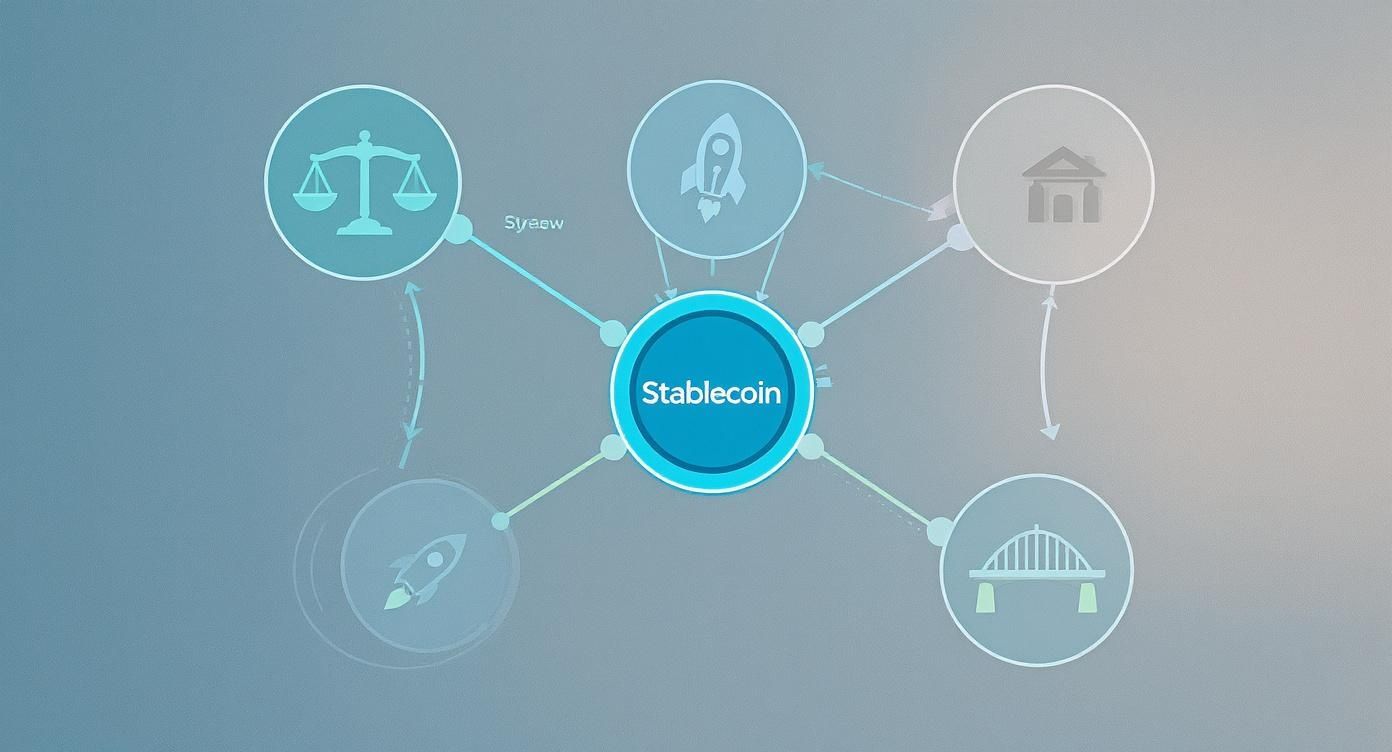
As the image illustrates, their core job is to provide stability and speed, connecting the old financial world with the new.
Crypto-Collateralized: The On-Chain Pawn Shop
The next flavor is the crypto-collateralized stablecoin, which takes a much more decentralized route. Instead of trusting a company to hold dollars in a bank, these stablecoins are backed by other cryptocurrencies locked up tight in a smart contract.
You can think of it like a digital pawn shop. To get a loan (in this case, stablecoins), you first have to deposit collateral—volatile cryptos like Ether (ETH). But here’s the catch: since the value of your collateral can swing wildly, you have to over-collateralize your position.
This means that to mint, say, $100 worth of a stablecoin, you might need to lock up $150 or even $200 worth of ETH. This extra cushion is there to protect the stablecoin’s value if the price of your collateral suddenly tanks.
If the value of your locked crypto drops below a certain point, the smart contract automatically sells it off to pay back the loan. This ensures the stablecoin remains fully backed. The entire process is managed on-chain without anyone in the middle, making it far more transparent and censorship-resistant than its fiat-backed cousins.
Algorithmic: The Central Bank in Code
Finally, we arrive at algorithmic stablecoins, the most ambitious and complex of the bunch. These tokens aren't backed by any collateral at all. Instead, they rely on smart contracts and algorithms to automatically tweak their supply to hold the peg.
Imagine a central bank run entirely by code. When the stablecoin’s price creeps above $1, the protocol mints new tokens and gets them into circulation, increasing supply and pushing the price down. If the price falls below $1, the protocol yanks tokens out of circulation to shrink the supply and nudge the price back up.
This is done through different clever mechanisms, like issuing bond-like tokens or creating a two-token system where one coin absorbs all the price swings to keep the other one stable. While brilliant in theory, this model has proven to be the most fragile in practice. With no hard assets to fall back on, they depend completely on market confidence and the flawless performance of their algorithm—a setup that can shatter under extreme market stress. Our detailed guide offers more insight into how algorithmic stablecoins work and their inherent risks.
Each pegging mechanism offers a different way to achieve the same goal: a stable digital dollar. To better visualize the trade-offs, let's compare them side-by-side.
Comparison of Stablecoin Peg Mechanisms
| Stablecoin Type | Peg Mechanism | Primary Pro | Primary Con |
|---|---|---|---|
| Fiat-Backed | 1:1 backing with fiat currency (e.g., USD) held in reserves. | Simple, intuitive, and generally very stable due to tangible asset backing. | Centralized; requires trusting a single entity to manage reserves properly. |
| Crypto-Collateralized | Over-collateralized with volatile crypto assets locked in a smart contract. | Decentralized and transparent; lives entirely on-chain without a central custodian. | Capital-inefficient (requires over-collateralization) and vulnerable to extreme crypto market crashes. |
| Algorithmic | Smart contracts manage token supply by expanding or contracting it based on price. | Highly decentralized and capital-efficient as it requires no collateral. | Very fragile; can enter a "death spiral" if market confidence is lost. |
Ultimately, choosing between these models boils down to a fundamental trade-off: do you prefer the trust and simplicity of a centralized system, or the transparency and risk that comes with a decentralized one?
How Stablecoins Are Made: Minting and Burning Explained
If you really want to get how stablecoins work, you have to look under the hood at two key processes: minting and burning. These aren't just technical terms; they are the very mechanisms that control a stablecoin's supply. This is how the system responds to market demand to keep the price locked to its target.
Think of it like a central bank's monetary policy, but instead of a boardroom, it’s all happening on a blockchain. How a stablecoin is created (minted) or destroyed (burned) is completely tied to its design—whether it’s backed by fiat, crypto, or an algorithm. Each approach comes with its own trade-offs in transparency, speed, and risk.

The Centralized Way: Fiat-Backed Coins
With fiat-backed stablecoins like USDT and USDC, the whole mint-and-burn process is managed by the company that issues them. It's surprisingly straightforward and works a lot like a digital bank deposit and withdrawal.
How New Coins Are Minted:
- Deposit Dollars: A user, typically a large institution, wires U.S. dollars to a bank account controlled by the issuer, like Circle or Tether.
- Verify Funds: The issuer confirms the deposit has cleared.
- Create Tokens: The company then uses its smart contract to mint the exact same amount of new stablecoins and sends them to the user's crypto wallet.
It's a direct, 1-to-1 exchange. Send $1 million, get 1 million stablecoin tokens. This simple process is what ensures every token is backed by a real dollar sitting in a bank somewhere, which is critical for maintaining the peg.
How Coins Are Burned:
The reverse, often called redemption, is just as simple.
- Request Redemption: A user sends their stablecoins back to the issuer's designated address.
- Destroy Tokens: The issuer’s smart contract permanently destroys those tokens, removing them from circulation forever. This is the "burn."
- Return Dollars: The company wires the equivalent amount of U.S. dollars from its reserves back to the user's bank account.
This model is efficient, but it all hinges on trust. You have to trust that the issuer is actually holding the reserves and will honor redemptions when you ask for your money back.
The Decentralized Way: Smart Contracts in Control
Crypto-collateralized and algorithmic stablecoins are a different beast entirely. They use an automated, hands-off approach where smart contracts—not companies—are in charge of minting and burning.
Take a crypto-collateralized coin like DAI. Minting it feels a lot like taking out a loan against your own assets:
- To Mint: You lock up a volatile crypto asset, like Ether (ETH), into a smart contract vault. The contract then lets you mint a specific amount of DAI against that collateral. To be safe, the system requires you to lock up more value than you receive—a practice known as over-collateralization.
- To Burn: To get your ETH back, you simply repay the DAI you minted. The smart contract automatically burns the returned DAI and unlocks your original collateral.
The beauty of this system is its transparency. Anyone can look at the blockchain and verify exactly how much collateral is locked in the smart contracts. If you want to dive deeper into the code that makes this all tick, our guide on stablecoin smart contracts is a great place to start.
The Bottom Line: The mint/burn mechanism is the tool stablecoins use to stay stable. By expanding or shrinking the supply based on real-world demand for new coins (minting) or cash-outs (burning), the system actively defends its price peg.
Many of these stablecoins are built using common blueprints like the ERC-20 token standard on Ethereum. This shared standard makes it incredibly easy for them to plug into wallets, exchanges, and DeFi apps, creating a seamless ecosystem.
In the end, whether it’s a person at a company or a line of code in a smart contract, the mint-and-burn function is what breathes life into a stablecoin and works to keep its value right where it should be.
Where Stablecoins Are Making a Real-World Impact

The theory behind stablecoins is fascinating, but their real power comes alive when you see how they solve actual problems. These digital dollars are breaking out of niche crypto-trading circles and are quickly becoming essential tools in finance, fundamentally changing how money moves around the world.
Their biggest role right now is as the bedrock of Decentralized Finance (DeFi). In a world of on-chain lending, borrowing, and trading, wild price swings are a constant threat. Stablecoins offer a much-needed safe harbor, letting people earn interest or take out loans without the fear that a market crash will wipe out their capital overnight. They provide the stable ground on which the entire DeFi ecosystem is built.
Transforming How We Send Money Across Borders
For the everyday person, the most powerful use case is in international payments. For decades, sending money overseas has been a slow, expensive nightmare, tangled up in a web of intermediary banks, steep fees, and long settlement delays. Stablecoins completely flip that script.
Think about a small business owner in the Philippines paying a supplier in the U.S. A traditional wire transfer might take three days and eat up 5-7% in fees. By sending a stablecoin like USDC instead, the transaction settles in a few minutes for a tiny fraction of that cost.
This kind of efficiency is a game-changer for a few key areas:
- Remittances: Immigrant workers can send more of their hard-earned money home to their families, avoiding the predatory fees charged by legacy services.
- B2B Payments: Businesses can settle international invoices almost instantly, freeing up cash flow and cutting down on administrative headaches.
- Freelancer Payouts: The global gig economy runs smoother with fast, cheap cross-border payments, making it easier for talent to work with clients anywhere.
If you're looking to put this into practice, our guide on how to use stablecoins to pay overseas in 2025 walks you through the steps.
Powering a New Digital Economy
The sheer scale of stablecoin usage is staggering and shows just how deeply they're being woven into global finance. They've become the default settlement asset for the on-chain economy.
In a single year, stablecoins settled an incredible $46 trillion in total transaction volume. That's a 106% jump from the year before, nearly triple Visa's volume, and on par with the entire Automated Clearing House (ACH) network.
Even after filtering out automated trading activity, the adjusted transaction volume topped $9 trillion—more than five times what PayPal processed. This massive flow of value proves their critical role as a settlement layer for the digital world. You can dive deeper into these numbers in this insightful State of Crypto report.
The Bridge to Broader Adoption
Stablecoins are also the main on-ramp for people and institutions who are curious about digital assets but wary of volatility. For most, the price swings of assets like Bitcoin are just too risky. Stablecoins offer a familiar, stable entry point. They let newcomers tap into the benefits of blockchain—like self-custody and programmable money—without the rollercoaster ride.
The big financial players have definitely taken notice. Giants like Visa and Mastercard are already working to integrate stablecoins into their massive global networks, which is a huge vote of confidence. As this trend continues, stablecoins are set to become a normal part of our financial lives, used for everything from online shopping to corporate treasury management. They're no longer just a "crypto thing"—they are the practical application of how stablecoins work to build a more efficient and open financial system for everyone.
Navigating Stablecoin Risks and Regulations
While stablecoins are a fascinating bridge between the old financial world and the new on-chain economy, their stability isn't a given. To really get a handle on how they work, you have to look at the risks head-on. These aren't just abstract problems; they've caused real financial pain and are now forcing governments around the world to finally set some ground rules.
The idea of a stable digital dollar is incredibly powerful, but it's built on a foundation that can sometimes get shaky. Whether it's the code that powers them or the companies that issue them, there are multiple ways things can go wrong. If you're going to navigate this space, you need a healthy respect for the potential pitfalls.
Unpacking the Core Stablecoin Risks
The conversation around stablecoin safety really boils down to three main areas of risk. Each one pokes at a different part of a stablecoin's design, from its technology and its issuer to the raw market forces that keep its value locked in place.
- De-Pegging Risk: This is the big one everyone talks about—when a stablecoin slips from its 1-to-1 value with the asset it's supposed to track. With fiat-backed coins, a de-peg can happen if people lose faith in the issuer's reserves, sparking a bank run. For algorithmic stablecoins, it can set off a catastrophic "death spiral" if the core mechanism cracks under pressure.
- Counterparty Risk: This is the Achilles' heel of centralized, fiat-backed stablecoins. It’s the simple but scary risk that the company issuing the stablecoin messes up, mismanages its reserves, or just goes broke. If the issuer goes under, you might find your digital dollars aren't worth the paper (or screen) they're printed on.
- Smart Contract Risk: Decentralized stablecoins get rid of the counterparty problem, but they trade it for a technological one. A bug, a glitch, or an outright exploit in the smart contract code could let an attacker drain the collateral, making the stablecoin worthless in a heartbeat.
You don't have to look far for a cautionary tale. The collapse of the algorithmic stablecoin TerraUSD (UST) in 2022 was a brutal lesson in these dangers. Its failure vaporized billions of dollars and showed just how fast a fragile peg can come apart, sending shockwaves through the entire crypto market.
The Evolving Regulatory Landscape
The explosive growth of stablecoins hasn't exactly flown under the radar of global financial regulators. In fact, seeing the potential for systemic risk, governments are shifting from a hands-off approach to active supervision. Their goal is to protect consumers and keep the financial system stable without strangling the technology in its crib.
A major worry for central banks is "currency substitution." This is where a foreign stablecoin, usually pegged to the US dollar, gets so popular in another country that it starts to weaken the local currency and undermine national monetary policy. It's a real threat to economic sovereignty.
Major financial centers are now building out legal frameworks to govern how stablecoins are issued and managed. In the United States, there are serious discussions about creating clear-cut rules, with some proposals suggesting that only insured banks should be allowed to issue stablecoins. For a much closer look at these shifts, our article on FDIC stablecoin regulations provides detailed insights. The trend is clear: regulators want to bring stablecoin issuers under the same kind of oversight as traditional banks and payment companies.
Staying Informed in a Dynamic Environment
As both the rules and the market itself keep changing, staying on top of it all is crucial for anyone using stablecoins. The legal framework in one country can be completely different from another, creating a complex and sometimes confusing patchwork of compliance. The European Union, for instance, is pushing ahead with its comprehensive Markets in Crypto-Assets (MiCA) regulation, while other nations are still figuring out their game plan.
To keep up with the fast-moving world of stablecoin regulation and market sentiment, many firms rely on specialized tools like news monitoring services. These services are great for tracking legislative updates and public opinion, which are often the first signs of shifting market risk.
Ultimately, the future of stablecoins will be shaped by a delicate dance between innovation and regulation. As this technology becomes more woven into the fabric of finance, understanding both its incredible potential and its inherent risks is non-negotiable for users, investors, and policymakers. The journey toward a truly stable and trustworthy digital dollar is happening now, but it demands our full attention.
Where We Go From Here
We’ve covered a lot of ground, from the intricate mechanics that keep stablecoins pegged to their real-world uses in everything from DeFi to daily payments. What started as a niche crypto innovation is quickly becoming a cornerstone of modern finance, merging the dependability of fiat money with the speed and openness of the blockchain.
But this is just the beginning. The next chapter for stablecoins involves much deeper integration into the traditional financial system. Imagine them being used for corporate treasury, settling large-scale trades, or even providing the technical foundation for central bank digital currencies (CBDCs). This isn't just an evolution; it's a fundamental shift in how money moves.
Understanding stablecoins is no longer just for crypto enthusiasts. It's about getting a front-row seat to the future of finance, where stability, efficiency, and global access are rewriting the rules.
The transition from a speculative asset to a core financial tool is happening right now. It's no surprise that US dollar-based stablecoins are leading the charge, making up roughly 99% of the entire market. This dominance highlights the massive demand for a reliable digital dollar.
Of course, as stablecoins become more ingrained in our financial lives, the call for clear and thoughtful regulation will get louder. This isn't a hurdle, but a necessary step toward mainstream trust and adoption. With the foundation you've built from this guide, you're now well-equipped to follow this journey and understand the forces that are truly shaping the future of money.
Frequently Asked Questions About Stablecoins
Even after you get the basics down, a few common questions always pop up about how stablecoins actually work day-to-day and what happens when they break. Let's tackle some of the most frequent ones head-on.
What Happens If a Stablecoin Loses Its Peg?
When a stablecoin "de-pegs," its market price has drifted away from its target value—say, falling to $0.98 or climbing to $1.02. When this happens, a few different stabilization mechanisms are supposed to kick in to pull the price back to $1.
For fiat-backed coins, the heavy lifting is done by arbitrage traders. If a coin slips below $1, traders will snap it up on the cheap and redeem it with the issuer for a full dollar. This buying pressure pushes the price back up, and the trader pockets the difference. The reverse is true if the price goes above $1—traders mint new coins for $1 and sell them on the market for a profit, which increases supply and brings the price down.
Algorithmic stablecoins are a different story. They rely on their own code to automatically shrink the token supply if the price falls, hoping to create scarcity and prop up the value. These models have proven to be much more brittle. A serious de-peg can easily trigger a "death spiral" if people lose faith, because there are no hard assets backing the coin.
Are All Stablecoins Backed by Real Dollars?
Nope, and this is probably the most important thing to understand about how stablecoins work. While the biggest names like USDC and USDT are fiat-collateralized—meaning they hold reserves of cash and similar assets—that's just one approach.
- Crypto-Collateralized: These stablecoins are backed by a surplus of other crypto assets, like Ether, that are locked up in a smart contract.
- Algorithmic: These aren't backed by anything at all. Instead, they use software algorithms to manage supply and demand, trying to keep the price stable through code alone.
So, while you can think of some stablecoins as a direct claim on a dollar sitting in a bank, others get their stability from completely different (and often much riskier) on-chain systems.
How Do I Know the Reserves Are Really There?
Trust is everything for a fiat-backed stablecoin. To earn and keep that trust, major issuers use transparency and outside verification to prove they have the assets to back every single token in circulation.
The gold standard here is a regular attestation from a well-known accounting firm. These auditors go through the issuer's reserve accounts and publish reports confirming that the assets are there and that their value is equal to or greater than the value of all the stablecoins they've issued.
These reports are a crucial window into an issuer's financial health. Without them, you'd just have to take their word for it that your digital dollars are actually backed by real-world money.
For more expert analysis and the latest news on stablecoin technology and regulation, trust Stablecoin Insider to keep you informed. Visit us at https://stablecoininsider.com for your daily insights.