
Table of Contents
Global trade finance is still running on infrastructure designed decades ago. Cross-border B2B payments remain slow, expensive, and fragmented, especially outside the dominant US, European, and Asian corridors.
Bloquo is betting that stablecoins, used pragmatically rather than ideologically, can fix this.
In a recent interview, Carlos Russo, CEO of Bloquo, explained how the company is using what it calls the “stablecoin sandwich” to dramatically reduce settlement times and transaction costs for manufacturers, importers, exporters, and trade finance providers worldwide.
The Core Problem: Cross-Border B2B Payments Are Still Broken
For companies operating in emerging or “exotic” corridors (Latin America to Africa, Southeast Asia to South America) the traditional system is deeply inefficient.
Three structural failures dominate:
1. Slow Settlement Times
A simple transaction such as a payment from Brazil to the Philippines can take up to four days to settle.
“The settlement times tend to be very high. A transaction from Brazil to the Philippines can take up to four days when you consider all the intermediary banks involved.” - Carlos Russo
The delay is caused by multiple correspondent banks, time zone mismatches, and manual reconciliation across the Swift network.
2. Excessive Intermediaries
A single payment can involve five to six banks, each taking fees, introducing FX spreads, and adding operational risk.
3. High All-In Costs
In exotic corridors, total transaction costs can reach 10–14%, once FX spreads, bank fees, and financing costs are accounted for. For trade-driven businesses operating on thin margins, this is a structural tax on growth.
The Solution: The Stablecoin Sandwich
Bloquo replaces the correspondent banking chain with a two-step on-chain bridge, using stablecoins strictly as a settlement tool.

How the Stablecoin Sandwich Works
- Importer pays locally
The importer sends local fiat currency to a regulated local broker (on-ramp). - Instant conversion to stablecoin
The broker converts fiat into a fiat-backed stablecoin. - On-chain transfer
The stablecoin is transferred on-chain to an off-ramp partner in the exporter’s country. - Instant conversion back to fiat
The off-ramp converts the stablecoin into the exporter’s local currency and deposits it into their traditional bank account.
“The importer pays the exporter, and they use the stablecoin in the middle just as a tool. You start with fiat, you end with fiat and the transaction itself happens in stablecoins.”
Key point:
Both parties receive local fiat, while settlement occurs on-chain.
Why This Changes the Economics of Trade Payments
Settlement Time: Days → Minutes
Using the stablecoin sandwich, settlement drops from up to four days to roughly 30 minutes.
“With blockchain and a process called the stablecoin sandwich, the transaction can take up to 30 minutes. It’s a huge difference.”
Cost Structure: 6 Intermediaries → 2 Counterparties
Instead of a long correspondent chain, the process involves only:
- A local on-ramp
- A local off-ramp
“In the traditional Swift process you can have six banks participating. With the stablecoin sandwich, you only have two companies involved.”
Cost Reduction: Up to 85–90%
In exotic corridors:
- Traditional rails: up to 14% total cost
- Stablecoin sandwich: ~2% total cost
Rather than marginal optimization, it's structural compression.
CFO Reality Check: Regulation and Risk Come First
Bloquo emphasizes that institutional adoption is not driven by ideology, it's driven by regulatory clarity and cost efficiency.
“The first angle CFOs always look at is regulation. They want to know if this is regulated in both countries.”
Regulatory Acceptance Is Already Broad
Approximately 85–90% of countries already allow or are in the process of regulating stablecoin transactions.
Centralized Stablecoins Win for Trade Finance
For institutional trade use cases, fiat-backed stablecoins dominate.
“For trade and trade finance, centralized stablecoins are preferred. They are seen as more reliable, and governments supervise the issuers.”
In Latin America alone:
- USDT represents 90%+ of stablecoin usage
- Roughly $50 billion in USDT is traded annually in Brazil
Why Stablecoin Issuer Risk Is Acceptable
CFOs naturally ask: What happens if a stablecoin issuer defaults?
“The risk of a stablecoin issuer defaulting is much lower than a bank defaulting. Stablecoin issuers mainly hold bonds, while banks hold much riskier assets.”
Where Bloquo Is Actually Innovating: The Application Layer
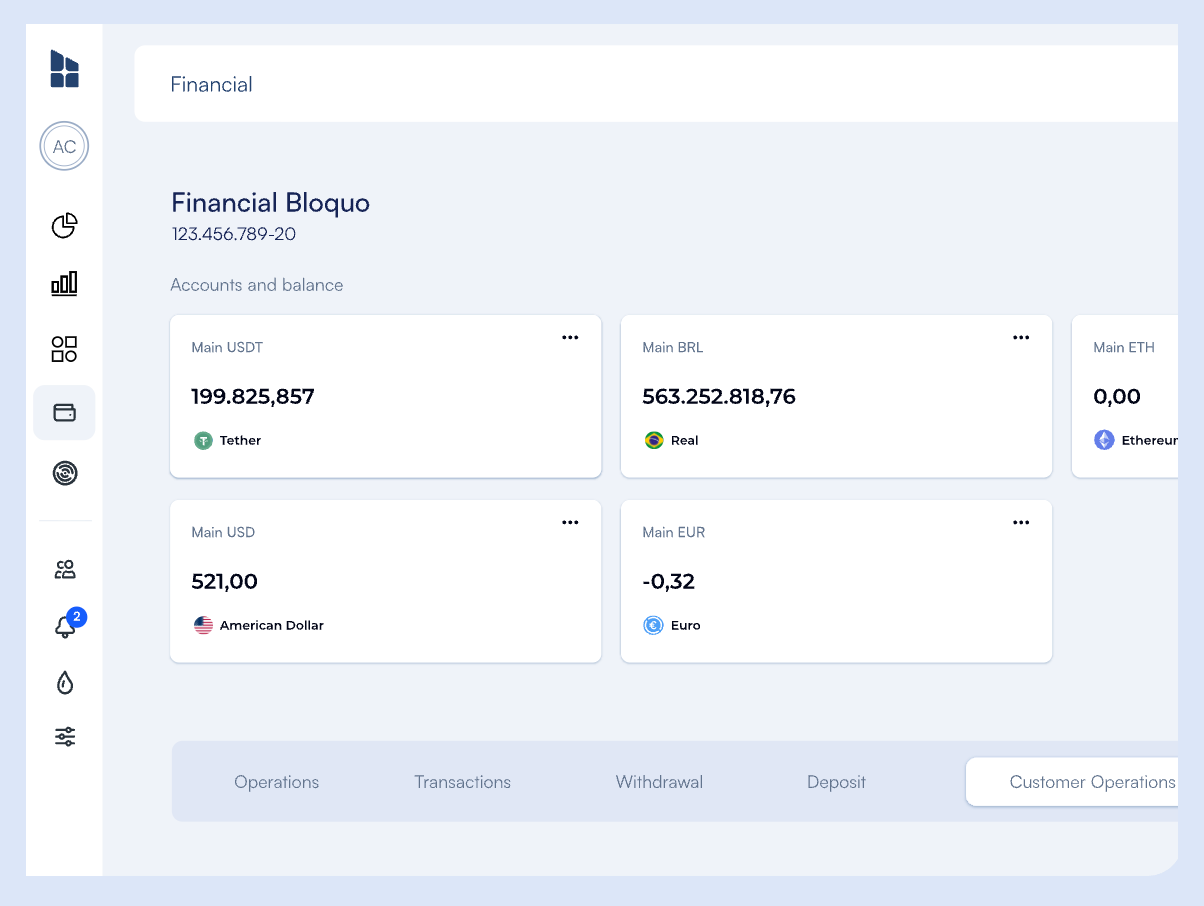
Bloquo is explicit about where it believes real innovation belongs, not at the stablecoin layer itself, but on top of it.
“You don’t need to create more stablecoins. You customize in the third layer (the application layer) and that’s where smart contracts come into place.”
Trade Finance, Fully On-Chain
Bloquo is launching a trade-finance-specific application that will:
- Connect companies seeking trade credit
- With trading firms, banks, and capital providers
- Enable trade finance transactions to occur 100% on-chain
“We’re launching very soon an application specific to trade finance that allows these transactions to happen fully on-chain.”
Solving the Stablecoin Liquidity Trap
There are trillions of dollars in stablecoins globally, but much of it sits idle.
Bloquo’s platform enables stablecoin holders to:
- Deploy capital into real-world trade finance
- Earn yield from productive economic activity
- Move beyond passive holding or speculative DeFi loops
The Bigger Picture
Bloquo is not trying to replace banks or reinvent money.
It is doing something more effective:
- Removing unnecessary intermediaries
- Compressing settlement time
- Turning stablecoins into invisible infrastructure for global trade
The stablecoin sandwich is not a slogan. It is an execution strategy and for global trade finance, it may be exactly what the system has been missing.