
Table of Contents
Finery Markets H1 2025 OTC Review, based on analysis of more than 4.1 million institutional spot trades executed on its technology platform, shows stablecoins at the center of settlement, liquidity management, venue bridging, and hedging across OTC workflows.
The takeaway is market structure driven: stablecoin share is rising fast, secondary market connectivity is becoming the key differentiator, and depegging risk is now inseparable from liquidity depth and fragmentation.
Key Takeaways
- OTC stablecoin spot volume grew +121% YoY in H1 2025
- Stablecoin transactions reached 75% of total trades, up from 46% in H1 2024
- Stablecoin transaction count grew +154% YoY, signaling broad workflow adoption
- Stablecoins share of OTC transaction volume hit 74.6% in H1 2025, up from 23% in 2023
- Secondary market depth is positioned as a shock absorber for confidence events and depeg risk

Methodology And What The Dataset Captures
This stablecoin focused edition is built from aggregated institutional spot trading activity across H1 2025.
For this review, Finery Markets analyzed more than 4.1 million institutional spot crypto trades executed on its technology platform. The dataset reflects activity from market makers, payment providers, brokers, OTC desks, hedge funds, and custodians.
The findings are based on this sample and reflect aggregated trading behavior, volume distribution, and market trends, with specific attention to stablecoin adoption, secondary markets, and the risk dynamics around potential depegging events.
H1 2025 Key Stablecoin Metrics In Crypto OTC
The headline is straightforward: stablecoins became the default unit of account for institutional OTC spot flows.
Core Growth Signals
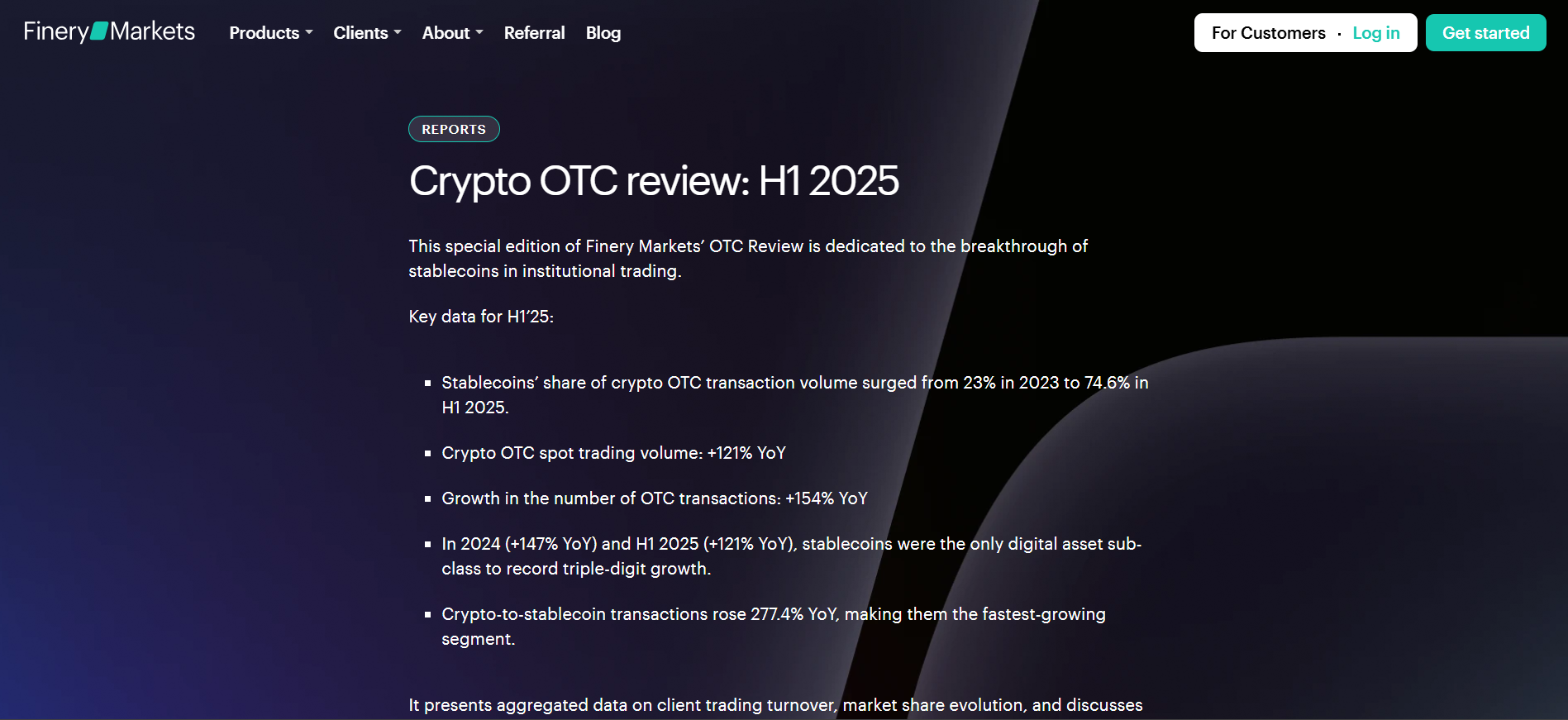
- OTC spot trading volume for stablecoin flows rose +121% YoY
- Stablecoin transactions represented 75% of total trades, up from 46% in H1 2024
- The number of stablecoin transactions increased +154% YoY
This points to more than volume growth. It indicates higher usage frequency, which usually reflects operational use for settlement, hedging, and cross venue bridging.
Stablecoins And Institutional Adoption
Finery Markets frames H1 2025 as the period when stablecoins became mainstream.
The institutional flow analysis supports that claim: stablecoins share in crypto OTC transaction volume rose from 23% in 2023 to 74.6% in H1 2025.
Why Institutions Lean Into Stablecoins
Institutions optimize for predictable settlement, deep liquidity access, strong risk controls, and efficient post trade workflows.
Stablecoins meet these requirements better than many alternatives in a fragmented multi venue market, particularly when firms need to manage exposure while minimizing operational friction.
Market Expansion Through M&A And Investment
The report also notes rising M&A activity and funding around stablecoin infrastructure and adjacent rails.
Examples highlighted include Stripe acquisition of Bridge, Anchorage acquisition of Mountain Protocol, and Gnosis acquisition of HQ.xyz. It also references venture and fund activity such as stablecoin clearing startup Ubyx raising $10 million and Galaxy Digital securing $175 million for a new fund focused on DeFi and stablecoin investments.
The combined signal is that institutions and infrastructure providers are building the stablecoin stack across issuance, settlement, compliance, liquidity, and interoperability.
Stablecoins As Financial Rail Infrastructure
The report describes stablecoins current dominance as a reflection of demand for a bridge between fiat systems and blockchain based settlement.
Bridge Mode Is Already Material At Scale
In this bridge role, the report states that Circle's USDC helped move $850 billion between fiat and blockchains.
Finery Markets expects this volume to expand as more USD pegged and non USD stablecoins emerge for FX, local capital markets, and regional remittances.
Examples Of Non USD Bridge Models
The report points to Monerium's EURe as a regulated euro denominated e money token that facilitates compliant flows between traditional IBAN accounts and Web3 wallets. It also references BRLA Digital as a Brazilian Real pegged stablecoin offering users an entry point into crypto based activity.
Across these models, the advantages are consistent: lower costs, faster processing, and broader access, provided the secondary market infrastructure supports liquidity and confidence.
Bridging With Secondary Markets
Finery Markets argues that the full utility of stablecoins depends on connecting issuance with active, deep secondary markets.
For stablecoins to maintain institutional confidence, they must be highly liquid, easily tradable, and legally sound across diverse liquidity pools and venues.
What Institutional Grade Secondary Market Connectivity Includes
The report outlines several essential components:
- Trading venues offering a wide range of stablecoin pairs
- Dedicated liquidity providers and market makers supporting stablecoin to crypto and stablecoin to fiat markets
- Centralized and DeFi infrastructure with robust collateral management and efficient cross chain swaps
- Custodians and compliance platforms that protect institutions as they enter sophisticated stablecoin flows
Beyond Payments: Capital Markets And Embedded Finance
This evolution extends past payments into broader financial operations. The report describes how it can support banks optimizing FX and inter fund transfers, technology firms embedding closed loop stablecoins into apps, corporates minting stablecoins for loyalty or ecosystem strategies, and asset managers innovating with tokenized money markets.
Without strong connectivity to secondary markets, the report suggests stablecoins will not reach their full utility, liquidity, and confidence profile for modern capital markets integration.
OTC Market Perspective: Why Institutions Prefer Private Rooms
As a technology provider for $2 billion in monthly turnover, Finery Markets observes growing institutional interest in private rooms trading and OTC design patterns.
The report suggests institutions are likely seeking tailored solutions that enable:
- Direct bilateral trading relationships
- Access to aggregated liquidity
- Trading design governed by best execution principles
- Private trading terms
The report contrasts this with centralized exchanges, where a large share of volume can be high frequency, algorithmic, or arbitrage driven.
On institutional OTC platforms, stablecoin flows are framed as more hedging driven.
Hedging And Settlement Create Organic Liquidity
The report notes that retail brokers and payment providers use stablecoins for settlement and FX hedging.
That produces more organic liquidity in stablecoin markets and reinforces stablecoins role as the institutional settlement layer.
Regulation And Market Structure: MiCA As A Liquidity Catalyst
The report highlights how regulation can restructure trading volume allocation.
It cites MiCA implementation as prompting a reallocation of volume, contributing to subdued growth for USDT due to delistings while USDC posted 29x year over year growth in H1 2025 within the observed sample.
For market structure, the implication is clear: when regulated venues change what is permitted, liquidity can move quickly, especially if secondary markets support efficient migration.
Can Secondary Markets Buffer Depegging Events
Finery Markets directly addresses depeg risk in the context of issuer proliferation and multi chain fragmentation. As more issuers emerge, fragmentation increases and risk can escalate.
The report suggests that a depegging event for one stablecoin could trigger broader confidence shocks and increase systemic risk, especially when redemption expectations and recovery outcomes diverge across venues.
Quote From The Author
Konstantin Shulga, CEO and Co founder at Finery Markets, summarizes the role of liquidity depth as a stabilizing factor in confidence events:
"While confidence crises are inevitable with increasing issuers, secondary market depth can buffer these events to contain depegging."
This aligns with the report’s broader thesis that deep, connected secondary markets can help stabilize pricing and reduce the impact of sudden confidence shifts.
Crypto OTC Trading Trends In H1 2025: The Market Backdrop
Stablecoin growth occurred within a broader OTC market expansion.
The report states that in H1 2025 the number of executed deals increased by 57.6% year over year and overall volume grew 112.6% compared to H1 2024.
Monthly Growth Pattern
The report describes triple digit year over year growth through Q1, peaking at +164% in January, then moderating to +137% in February and +129% in March. Growth remained strong in Q2 with +92% in April, +85% in May, and +89% in June.
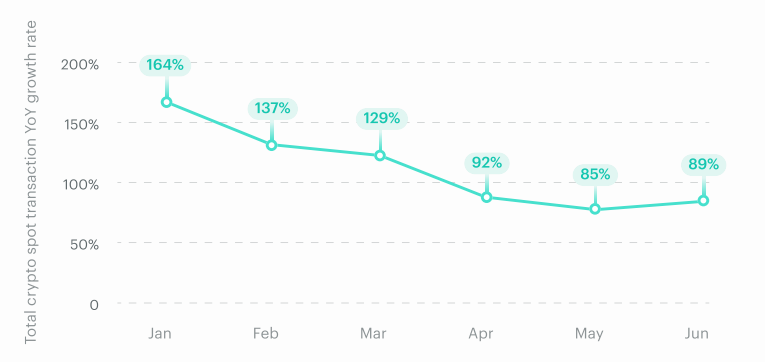
This backdrop matters because stablecoin adoption is accelerating inside a market that is also expanding in absolute terms.
Institutional Preference Shifts Toward Stablecoin Based Trading
A defining feature of H1 2025 was growing institutional preference for stablecoin denominated trading and settlement.
Stablecoin Transaction Mix
- Crypto to stablecoin transactions rose 277.4% YoY, the fastest growing segment
- Stablecoins were involved in 74.6% of all OTC trades
- Stablecoin related trades represented 23% in 2023 and 46.3% in 2024
Among individual stablecoins, USDC posted a standout performance with a 29x year over year increase in H1 2025 within the report sample.
Meanwhile, crypto to crypto trades rose 147.7% year over year, while crypto to fiat grew 48.5%, consistent with a shift toward stablecoin settlement over fiat rails.
Altcoin OTC Activity Expanded, But Stayed Secondary
The report notes that altcoin activity expanded beyond its historical niche but remained a minority share of institutional OTC spot flows.
Altcoins represented 16.7% of combined crypto OTC volumes in H1 2025.
The most consistently traded altcoins outside the majors were SOL, LTC, XRP, TRX, and ADA.
The report also notes that despite media attention, TRUMP coin did not generate comparable interest in OTC markets, ranking outside the top 10 altcoins by volume in both Q1 and Q2.
About Finery Markets
Finery Markets is an ICT solutions provider for institutional digital asset trading, offering a non custodial crypto ECN and trading SaaS.
The company states its infrastructure is designed for institutional clients across more than 35 countries and supports trading via an order book, RFQ, or quote streams.
Since launching in 2019, Finery Markets reports it has expanded to over 150 digital asset clients, including payment providers, brokers, OTC desks, hedge funds, and custodians.
The report also notes Finery Markets recognition as a top 50 rising star in Deloitte Technology Fast 50 in 2024, inclusion among the Top 300 Fintech Companies by CNBC, and that it is the first crypto ECN to receive SOC 2 Type 1 certification.
It also hosts The Flow, a C level institutional crypto podcast focused on digital asset market structure.
Conclusion
Finery Markets H1 2025 Crypto OTC Review, Stablecoin Edition, shows a market structure reality: stablecoins now dominate institutional OTC trading activity, driven by settlement efficiency, hedging demand, and the need to bridge venues.
The next phase of adoption depends less on issuance alone and more on institutional grade secondary market connectivity, including deep liquidity, resilient venue links, efficient collateral and cross chain infrastructure, and compliance ready custody and execution.
As issuers multiply and fragmentation rises, the report’s core risk message becomes more important:
Secondary market depth can help buffer confidence shocks and reduce the impact of depegging events.
Read Next:
- Building Stablecoin Insider: The Case for Going Niche
- 50 Fintech Statistics That Matter in 2026
- 2025 Stablecoin Year-End Report
FAQs:
1. What Is Driving Stablecoins Growth In Institutional OTC Trading
Stablecoins reduce settlement friction and improve venue interoperability, giving institutions a liquid unit of account for hedging and operational workflows across markets.
2. Why Do Secondary Markets Matter For Stablecoin Confidence
Secondary markets provide liquidity, tradability, and reliable price discovery across venues. Without that, stablecoins can struggle to behave like money under institutional stress scenarios.
3. How Large Was Stablecoins Share Of OTC Trades In H1 2025
In the report sample, stablecoins were involved in 74.6% of all OTC trades in H1 2025, up from 46.3% in 2024 and 23% in 2023.
4. How Did MiCA Affect Stablecoin Trading Dynamics
The report cites MiCA as driving volume reallocation, with subdued USDT growth linked to delistings and a 29x YoY increase for USDC in H1 2025 within the observed sample.
5. Can Deep Secondary Liquidity Reduce The Impact Of A Depegging
The report’s position is that deep and connected secondary markets can buffer confidence shocks by improving price discovery and enabling more orderly liquidity flows during stress.
Disclaimer:
This content is provided for informational and educational purposes only and does not constitute financial, investment, legal, or tax advice; no material herein should be interpreted as a recommendation, endorsement, or solicitation to buy or sell any financial instrument, and readers should conduct their own independent research or consult a qualified professional.