Table of Contents
The euro stablecoin market in Q1 2026 is not primarily a story about size. As of 2025, euro-denominated stablecoins held a market capitalization of less than €350 million, representing less than 1% of the global stablecoin market dominated by USD-pegged tokens.
By any raw market cap comparison, EURC is a footnote next to USDT and USDC. But market cap tells you almost nothing about what EURC actually represents in Q1 2026.
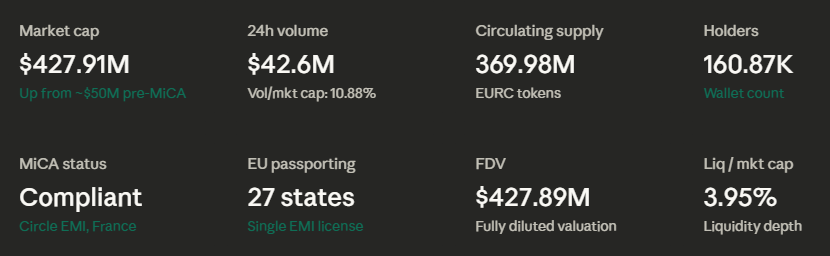
EURC is the clearest beneficiary of the most consequential regulatory event in crypto's history: MiCA's full enforcement across the European Union. Circle's EURC has emerged as the dominant euro stablecoin, holding approximately 41% of total euro stablecoin market capitalization, a surge from 17% market share over the past 12 months.
The growth correlates directly with MiCA enforcement: as non-compliant stablecoins were delisted from major exchanges, EURC captured the resulting market vacuum.
This is not a report about a stablecoin that won on merit alone. It is a report about a stablecoin that won because regulation cleared the field, and what it is doing with that advantage in Q1 2026.
Key Takeaways
- EURC holds ~$427M market cap and 41–50% of the euro stablecoin market, a position built by MiCA compliance, not product superiority.
- MiCA delisted USDT and forced EURT's withdrawal from EU exchanges, handing EURC the dominant position by regulatory default.
- Circle's single French EMI license passports EURC across all 27 EU member states — a structural moat competitors cannot easily replicate.
- Three Q1 2026 integrations, Ingenico's 40M POS terminals, Wirex/Visa Stellar settlement, and Morpho yield vaults, mark EURC's shift from compliance instrument to real payments infrastructure.
- 58% of European institutions are already integrating stablecoins into payment flows; EURC's regulatory head start positions it to capture that demand before competitors can qualify.
Market Cap and Supply
EURC's market cap stood at approximately $460.8M as of March 1, 2026, with over 50% share of the euro stablecoin market. Coinbase reports a current market cap of $449.8M with a circulating supply of approximately 390 million EURC.
The price tracks 1:1 with the euro, which means dollar-denominated market cap figures fluctuate with EUR/USD exchange rate movements rather than supply changes.
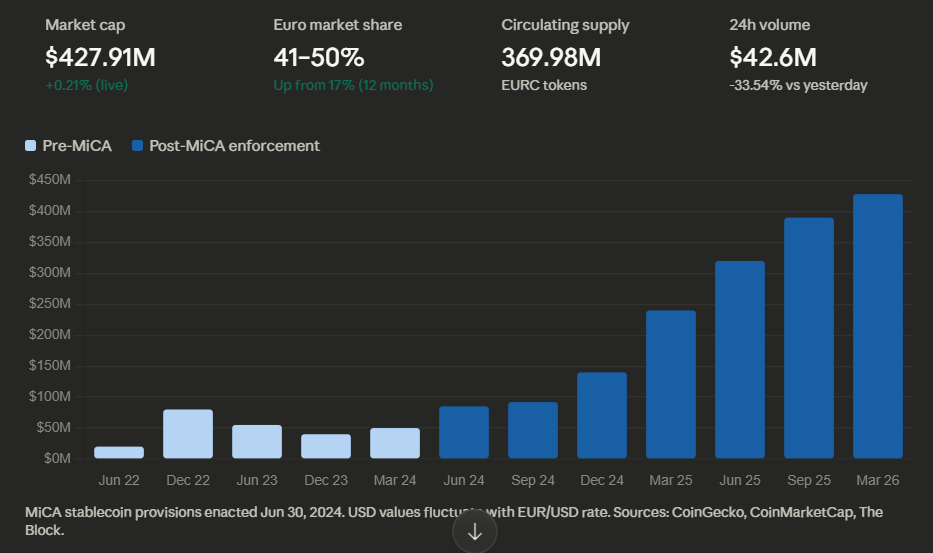
The darker bars mark the post-MiCA period. The inflection is visible and direct: supply growth from June 2024 onward correlates almost perfectly with regulatory enforcement rather than organic market demand.
MiCA: The Regulation That Built EURC
No single event shaped EURC's position in Q1 2026 more than the EU's MiCA regulation. Understanding EURC in 2026 requires understanding exactly what MiCA did to the competitive landscape.
Under MiCA's framework, e-money tokens must be issued by authorized credit institutions or electronic money institutions, maintain full liquid asset backing, provide redemption rights at par value, and submit to supervision by relevant national competent authorities.
The transitional period has concluded. Crypto asset service providers operating trading platforms stopped making non-MiCA compliant stablecoins available for trading, with full compliance required by Q1 2025.
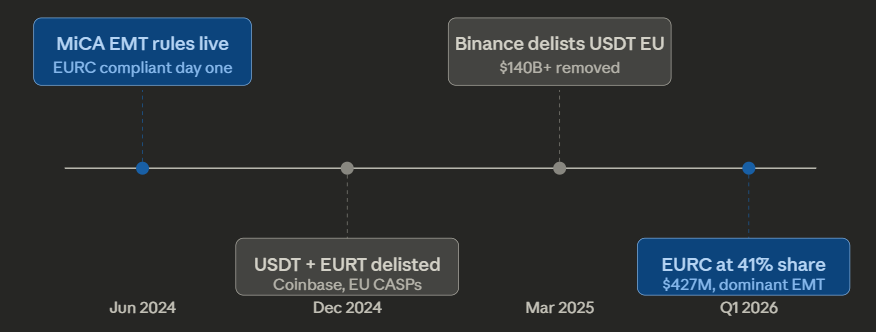
Following MiCA's full implementation on December 30, 2024, European exchanges delisted over $140 billion worth of non-compliant stablecoins, primarily Tether's USDT, creating significant market disruption.
Coinbase Europe removed USDT in December 2024, followed by Crypto.com in January 2025 and Binance in March 2025.
Tether discontinued support for its euro-backed stablecoin EURT, citing objections to specific MiCA provisions. With EURT gone and USDT delisted for EU trading, the field was wide open.
Circle secured authorization as an Electronic Money Institution in France before MiCA's enforcement date, positioning EURC as MiCA-compliant from day one.
This regulatory preparation proved crucial: as non-compliant stablecoins exited the market, EURC captured the resulting vacuum, growing from 17% to 41% market share in 12 months.
The passporting advantage that MiCA grants Circle is significant. Under MiCA, stablecoin issuers can obtain a single license in one EU country and legally operate across all 27 EU member states and the wider European Economic Area.
This concept is referred to as passporting rights. Circle's EMI authorization in France effectively covers the entire EU, a structural moat that smaller issuers pursuing national licenses cannot match.
Reserve Structure and Regulatory Standing
EURC is MiCA-compliant and redeemable 1:1 for euro. Euro reserves are transparently held at regulated financial institutions in the EEA with published monthly attestations.
Monthly attestation reports confirm that euro reserves equal or exceed circulating EURC. These reports detail reserve composition and are verified by Grant Thornton, providing the transparency MiCA requires.
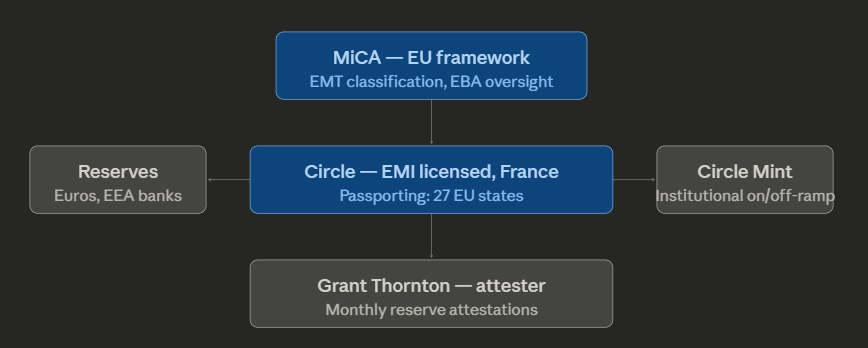
EURC reserves are bankruptcy remote and monthly attestation reports are conducted by a Big Four accounting firm. EURC is supported by Circle Mint, an institutional 1:1 on/off-ramp service offered directly from Circle at no additional cost.
Key Q1 2026 Developments
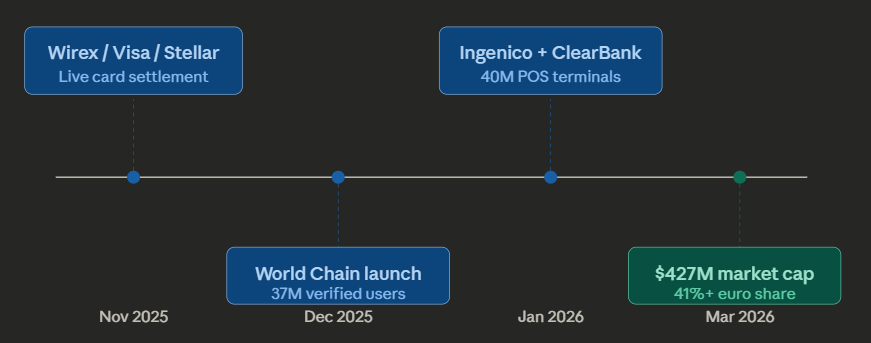
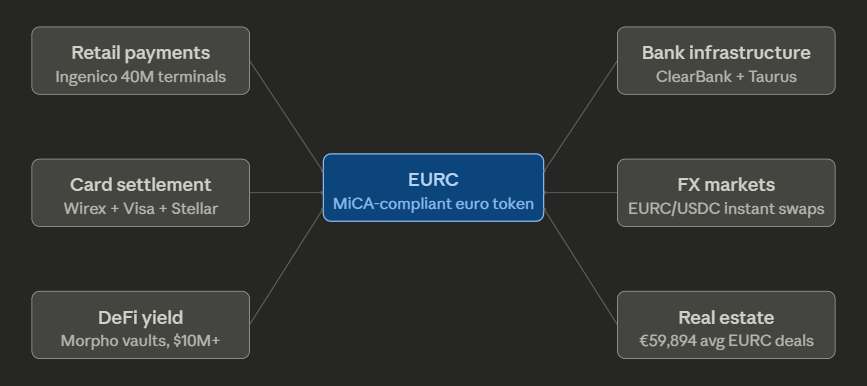
Three integrations in Q1 2026 mark EURC's transition from a compliance instrument into operational payments infrastructure.
1. Ingenico - 40 million POS terminals:
On January 13, 2026, EURC became spendable at 40 million+ global stores via Ingenico through WalletConnect Pay.
This is the most significant physical-world distribution event in EURC's history. It moves euro stablecoin payments from exchange environments into everyday retail.
2. ClearBank / Taurus bank infrastructure:
Also on January 13, 2026, ClearBank's Taurus partnership targeted MiCA-compliant EURC services for banks.
This is the institutional layer, connecting EURC to bank-grade custody and settlement infrastructure, which is a prerequisite for any major European financial institution integrating EURC into treasury operations.
3. Visa Stellar settlement - live since November 2025:
Wirex, a principal member of Visa, launched dual-stablecoin settlement using USDC and EURC on the Stellar blockchain in November 2025, enabling on-chain settlement of card payments in near real-time.
Wirex also integrated Morpho Vaults, automatically converting EUR corporate deposits into EURC for yield generation. Over $10 million in corporate funds has already earned yield through this integration.
Multi-Chain Footprint
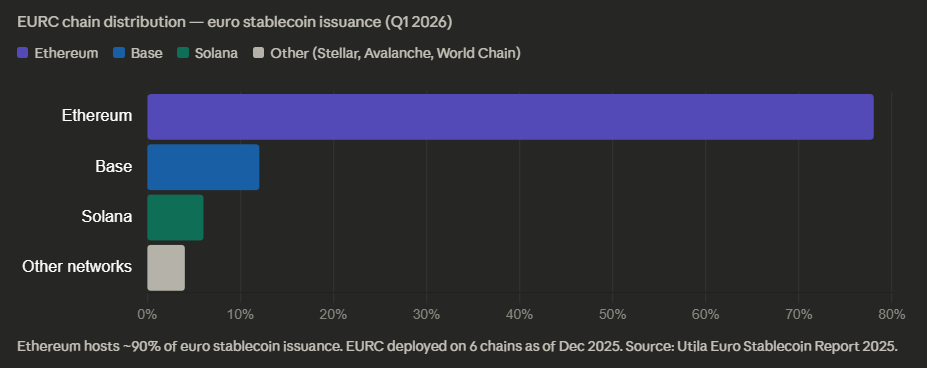
EURC is a euro-backed stablecoin accessible globally on Avalanche, Base, Ethereum, Solana, and Stellar. It is deployed across 6 major blockchains including Ethereum, Solana, Base, and World Chain as of December 2025.
Despite competition from alternative Layer 1 blockchains and Layer 2 solutions, Ethereum remains the primary settlement layer for euro stablecoins, hosting 90.1% of total issuance. Secondary deployments are growing on Solana, Base, and Avalanche, but Ethereum's dominance persists.
EURC vs. The Euro Stablecoin Competitive Field
EURC does not compete with USDT or USDC, it competes within the euro stablecoin niche. That niche is small but consolidating rapidly around MiCA-compliant issuers.
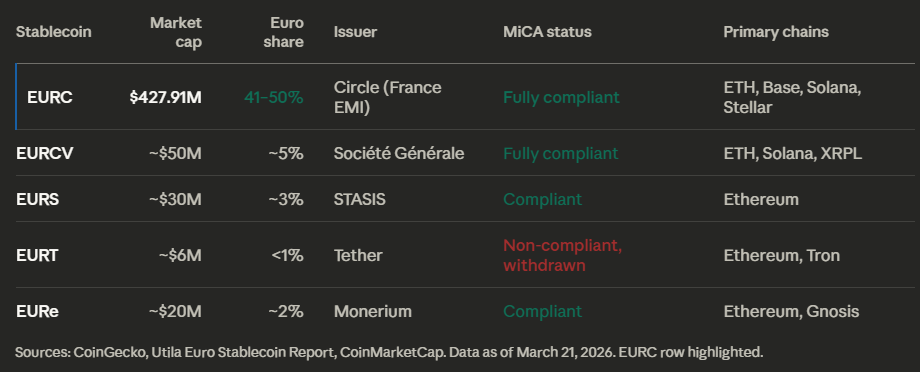
EURC's market position means broader liquidity, wider acceptance, and reduced counterparty risk compared to smaller issuers. The concentration also raises questions about market diversity and the viability of alternative euro stablecoin offerings.
EURCV from Société Générale is the most credible institutional challenger, with a DeFi-native growth strategy via Morpho protocol integrations.
The Institutional Opportunity: Why Size Understates Significance
The euro stablecoin market looks small when you compare $428M to USDT's $143B. That comparison misses the point. The relevant comparison is what share of European institutional payment flows EURC could realistically address, and what the regulatory infrastructure now permits.
With 58% of European institutions already integrating or preparing to integrate stablecoins into payment flows, and with 53 MiCA licenses now issued across the EU, the region is consolidating its stablecoin market around compliant euro tokens.
The euro-pegged stablecoin market is expected to continue evolving through 2026 as regulatory clarity, institutional adoption, and cross-border payment use cases develop across the European Union.
MiCA's full enforcement establishes a consistent framework for reserve management, issuer supervision, and operational standards.
Key Risks
1. Dollar dominance:
The fundamental challenge for all euro stablecoins is that crypto markets operate in dollars. USDT and USDC are the settlement rails that DeFi protocols, exchanges, and traders default to globally.
EURC competes in a niche that is structurally subordinate to USD stablecoins by design, and MiCA's restrictions on non-euro stablecoins in the EU have provoked criticism that the regulation limits rather than empowers European crypto users.
2. Dual licensing complexity:
From March 2026, Electronic Money Token custody and transfer services may require both MiCA authorization and separate payment services licenses under PSD2, potentially doubling compliance costs.
Providers in the market are concerned that this overlap undermines euro stablecoin competitiveness and innovation.
3. MiCA fragmentation:
Despite MiCA's harmonization goals, its implementation reveals fragmentation across member states. Transitional periods have varied dramatically, with the Netherlands requiring compliance by July 2025, Italy by December 2025, and others extending to July 2026.
Each competent authority interprets requirements differently, processes applications at different speeds, and enforces compliance with varying intensity.
4. Digital euro competition:
The European Central Bank continues its digital euro project. The ECB's Governing Council decision was expected by year-end 2025, with 70 market participants testing conditional payments and use cases.
A fully launched digital euro, projected for 2028–2029, would compete directly with EURC for euro-denominated digital payments.
EURC Summary Scorecard
Outlook
EURC's position in Q1 2026 is stronger than at any point in its history, but it has been built primarily by regulatory tailwinds rather than organic demand.
The MiCA moat is real and durable, Circle's EMI authorization in France, passporting rights across all 27 EU states, and bankruptcy-remote reserve architecture set a compliance bar that most competitors will struggle to clear.
The more important question for Q2 and beyond is whether the Q1 infrastructure buildout: Ingenico's 40 million terminals, Visa/Stellar settlement, Morpho yield — translates into actual usage.
Euro stablecoins remain a tiny fraction of global stablecoin activity. The regulatory infrastructure is now in place. The distribution channels are opening. What has not yet materialized is the consumer and institutional demand that would give EURC a growth story independent of regulatory enforcement.
When it does, if it does, the payoff for being the first, most compliant, and most broadly distributed euro stablecoin will be substantial. For now, EURC is the best-positioned stablecoin in a market that has not yet fully decided it needs a euro stablecoin.
Read Next:
- FDUSD Q1 2026 Stablecoin Report
- PYUSD Q1 2026 Stablecoin Report
- WLFI's USD1 Q1 2026 Stablecoin Report
- Ethena's USDe Q1 2026 Report
FAQs:
1. What is EURC and who issues it?
EURC is a 1:1 euro-backed stablecoin issued by Circle under its Electronic Money Institution authorization in France. It is fully MiCA-compliant, backed by euro reserves held at EEA-regulated financial institutions, and subject to monthly attestations by Grant Thornton.
2. How does EURC differ from USDC and USDT?
EURC differs from USDC and USDT by being euro-denominated rather than dollar-denominated. USDC is Circle's dollar stablecoin; EURC is its euro equivalent, built on the same reserve model and compliance infrastructure. USDT is non-compliant with MiCA and has been delisted from major EU exchanges. EURC operates in the EU-regulated space that USDT has vacated.
3. Why is MiCA so important for EURC?
MiCA is important for EURC because it eliminated the competition. When MiCA's stablecoin provisions took full effect in late 2024 and early 2025, major exchanges were forced to delist non-compliant stablecoins including USDT and Tether's euro stablecoin EURT. EURC was already fully compliant from day one, capturing the market vacuum left behind. Its share of the euro stablecoin market grew from 17% to 41% in twelve months as a direct result.
4. What blockchains does EURC operate on?
EURC operates on six blockchains: Ethereum, Base, Solana, Stellar, Avalanche, and World Chain. Ethereum hosts the majority of euro stablecoin issuance at approximately 90% of total supply. Stellar is notable as the chain powering Wirex's Visa card settlement integration.
5. What are the biggest risks to EURC?
EURC's biggest risks are dollar dominance in global crypto markets, dual licensing requirements under both MiCA and PSD2 that may increase compliance costs, fragmented MiCA implementation across EU member states, and longer-term competition from the European Central Bank's digital euro project expected around 2028–2029.
Disclaimer:
This content is provided for informational and educational purposes only and does not constitute financial, investment, legal, or tax advice; no material herein should be interpreted as a recommendation, endorsement, or solicitation to buy or sell any financial instrument, and readers should conduct their own independent research or consult a qualified professional.