
Table of Contents
If you're looking for a way to earn a consistent return in the crypto world without waking up to a 30% price drop overnight, you’ve come to the right place. Earning passive income with stablecoins is a solid strategy for generating yield without the extreme volatility of assets like Bitcoin or Ethereum.
The main idea is simple: instead of letting your digital dollars sit idle, you put them to work. You can do this by lending them out for interest, providing liquidity to trading pools, or staking them in different protocols to earn rewards.
Your Gateway to Stablecoin Passive Income

Let's be honest, the wild price swings of most cryptocurrencies can be exhausting. Stablecoins offer a fantastic middle ground. They bridge the stability of traditional money with the powerful earning opportunities of crypto. Since they are pegged 1:1 to a fiat currency like the U.S. dollar, they take a lot of the guesswork and anxiety out of the equation.
This guide is built to cut through the jargon and show you exactly how to make your stablecoins work for you. This isn't a get-rich-quick scheme; it's about building a steady, lower-risk income stream using proven methods that people in the space use every day.
What to Expect From This Guide
My goal is to give you a realistic and practical look at how these yield strategies actually function. By the end, you should feel confident enough to get started on your own.
Here’s what we’ll cover:
- Core Income Strategies: We'll break down the go-to methods for earning yield—lending, providing liquidity, and staking.
- Choosing Your Playground: Understanding the difference between centralized (CeFi) and decentralized (DeFi) platforms is key to managing risk and finding what fits your comfort level.
- Realistic Returns: We'll look at the typical Annual Percentage Yields (APYs) you can expect, so you can set achievable goals.
- Staying Safe: Protecting your capital is rule number one. We'll go over the main risks and what you can do to manage them.
Think of it as a high-yield savings account for the digital age. Your funds aren't just sitting there; they're actively earning for you, but with a unique set of opportunities and rules that you need to understand.
Before you jump in, you’ll need to know how to move these assets around. If you’re just starting, getting comfortable with how to swap stablecoins is a must-have skill for almost every strategy we’ll discuss.
For those who want a more personalized roadmap, getting advice from an Onchain Investor Consultancy like Yieldschool can be a huge help. They can offer tailored guidance to help you navigate the on-chain world.
Ready? Let’s get into it.
How You'll Actually Make Money: The Core Strategies
Putting your stablecoins to work isn't about day trading or trying to time the market. It’s much simpler. You’re essentially plugging your digital dollars into the core machinery that powers decentralized finance. Let's walk through the three main ways you can start generating a real, consistent yield.
Think of these strategies—lending, providing liquidity, and staking—as the foundational pillars of earning with stablecoins. Each one has its own feel, its own set of risks, and its own potential payoff. Your job is to find the one (or the mix) that feels right for you.
Become the Bank: Lending Out Your Stablecoins
The most straightforward path to earning is simply lending your stablecoins. You’re essentially acting like a bank, but without the stuffy suits and overhead. You deposit your stablecoins into a lending protocol, and borrowers pay you interest to use them, securing their loans with their own crypto collateral.
Giants in this space like Aave and Compound are basically massive, automated money markets. When you deposit your USDC, it gets pooled with everyone else's. Borrowers then draw from that pool, and the interest they pay gets split among all the lenders—you included. The rates aren't fixed; they move up and down based on simple supply and demand. When borrowing is hot, your earnings go up.
I’ve found this method is a great starting point because it’s so easy to grasp. You deposit your funds and can see the interest start trickling in almost right away. To really get into the weeds on how this works and what to watch out for, our deep dive on stablecoin lending platforms is the perfect next step.
My Two Cents: Don't get mesmerized by a high APY number. Always check the utilization rate on the platform. If you see a rate over 80%, it’s a good sign that demand is strong and yields are high. But it can also mean withdrawals might be a bit sluggish if the pool gets tight on cash.
Powering the Market: Providing Liquidity
Another fantastic way to earn is by becoming a liquidity provider (LP) for a decentralized exchange (DEX) like Uniswap or Curve. For a DEX to work, it needs big pools of assets so people can trade instantly. As an LP, you're the one who fills those pools, usually by depositing a pair of assets, like DAI and USDC.
What's in it for you? Every time someone swaps between the two stablecoins in your pool, you get a cut of the trading fee. It might be a tiny fraction of a percent, but on a busy trading pair, those fees add up incredibly fast.
This can often be more lucrative than just lending, especially in high-volume markets. The main risk you'll hear about is impermanent loss, but honestly, when you're providing liquidity for two stablecoins that are both pegged to the dollar, that risk is pretty minimal.
Here’s a quick breakdown of how these two core methods stack up:
| Feature | Stablecoin Lending | Liquidity Providing |
|---|---|---|
| How You Earn | Interest from borrowers | Trading fees from swaps |
| Where to Go | Aave, Compound, Morpho | Uniswap, Curve, Balancer |
| What to Watch For | Platform/smart contract risk | Impermanent loss, smart contract risk |
| Complexity Level | Pretty straightforward | A bit more involved |
Earning Your Share: Stablecoin Staking
Last but not least, let's talk about staking. Now, when people say "staking," they often mean locking up tokens to help secure a blockchain network (like with Ethereum). With stablecoins, it’s usually a bit different. Most of the time, "staking" just means locking up your stablecoins in a specific protocol to earn rewards.
Where do these rewards come from? A few places:
- Sharing the Profits: Some protocols share a slice of their revenue with people who stake.
- Early Bird Bonuses: A new project might offer juicy yields to attract its first wave of users and build up a solid foundation of liquidity.
- A Say in the Future: Sometimes, staking gives you voting power on the protocol's direction, and the rewards are a thank-you for participating.
Staking can be a solid income stream, with yields often falling somewhere between 2% and 10%. The returns really depend on the platform you choose. Centralized services tend to offer lower but more predictable yields, whereas the DeFi world can offer higher returns that might fluctuate more.
Each of these pillars—lending, providing liquidity, and staking—gives you a unique way to turn your idle stablecoins into an active source of passive income. From my experience, the smartest approach is rarely to go all-in on one. Spreading your capital across different strategies and platforms is the best way to manage risk and give yourself the best shot at great returns.
Choosing Your Arena: CeFi vs. DeFi Platforms
Once you’ve got your strategy in mind, the next big question is where to put your stablecoins to work. This isn't a minor detail; it's a fundamental choice that shapes your entire experience. In the crypto world, you have two main arenas: Centralized Finance (CeFi) and Decentralized Finance (DeFi).
Think of it like this: CeFi is like using a modern online bank or brokerage. It’s familiar, user-friendly, and has a customer support team. DeFi, on the other hand, is like being your own bank. You have total control, but you're also the one responsible for everything. Each path offers ways to earn passive income with stablecoins, but they operate on completely different principles of trust, control, and risk.
This decision tree infographic helps visualize the choice between a lower-risk or higher-reward approach when planning your stablecoin strategy.
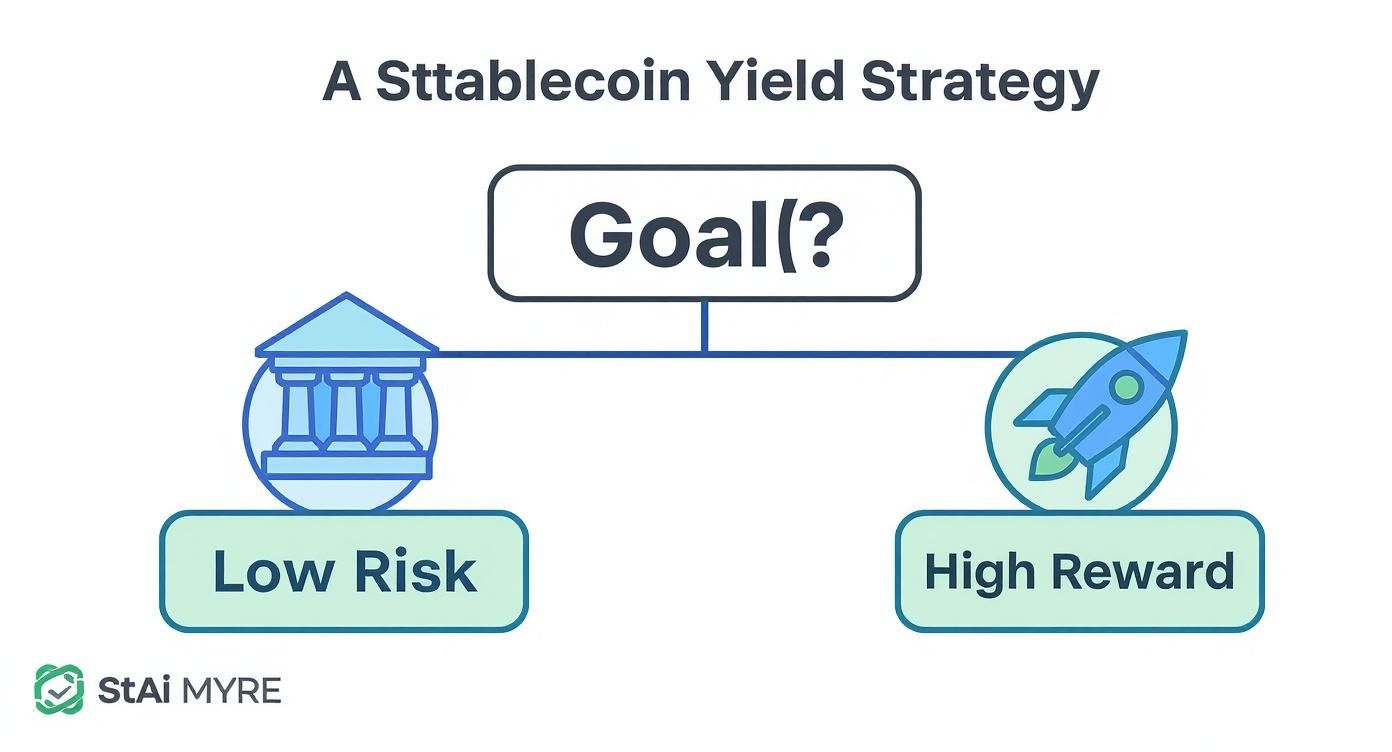
Ultimately, your own comfort level and goals—whether you’re focused on protecting your capital or chasing the highest possible returns—will point you in the right direction.
The Comfort of Centralized Finance (CeFi)
For anyone just dipping their toes into crypto, CeFi platforms are usually the first stop. They're designed to feel a lot like the financial apps you already use. Companies like Nexo or Ledn have slick mobile apps, straightforward interfaces, and actual customer service teams you can contact.
The biggest draw is simplicity. You can get started in minutes: sign up, complete an identity check, and deposit your stablecoins. But this convenience comes with a major trade-off: custody. When you use a CeFi platform, you're handing over your private keys. You are trusting that company to safeguard your assets.
This introduces custodial risk. If the platform goes bankrupt, gets hacked, or freezes withdrawals, your funds could be at risk. While yields are often quite good, they can be a bit lower than in DeFi because the company is taking a cut for providing the service and managing the complexity for you.
Embracing Control with Decentralized Finance (DeFi)
If CeFi is the guided tour, DeFi is the off-the-grid adventure. It's a parallel financial system built on open-source code running on blockchains. There are no intermediaries here. You are always in control.
With a self-custodial wallet like MetaMask, you interact directly with protocols like Aave or Curve. Your funds never leave your wallet until you personally sign a transaction, giving you complete authority over your assets.
The advantages are compelling: full self-custody, transparent on-chain operations, and often higher potential yields. But this freedom comes with its own set of responsibilities and risks. The primary one is smart contract risk—a bug or vulnerability in a protocol's code could be exploited, leading to a loss of funds. And if you send your crypto to the wrong address or fall for a scam, there's no 1-800 number to call for help.
The opportunities in both CeFi and DeFi are fueled by a massive, liquid market. With a combined market cap often exceeding $300 billion, stablecoins are a cornerstone of the digital economy. In the first half of a recent year alone, they powered an incredible $8.9 trillion in on-chain transaction volume. Daily trading for USDT alone frequently tops $100 billion, providing plenty of liquidity for these income strategies to function. For a deeper dive into these numbers, you can explore detailed USDT staking statistics.
Pro Tip: You don't have to go all-in on one or the other. I've found a hybrid approach works best for many people. Keep a portion of your stablecoins in a reputable CeFi platform for ease and reliability, and use a smaller portion to explore the higher-yield, self-custody world of DeFi. It's a great way to balance risk and reward.
To make the choice clearer, here’s a head-to-head comparison of what to expect from each.
CeFi vs. DeFi Platforms for Stablecoin Income
| Feature | CeFi (e.g., Nexo, Ledn) | DeFi (e.g., Aave, Curve) |
|---|---|---|
| Custody | The company holds your private keys for you (Custodial). | You hold your own private keys in your wallet (Self-custodial). |
| Ease of Use | Very high. Feels like a modern fintech app. Simple sign-up. | Moderate to high learning curve. Requires a crypto wallet and understanding of gas fees. |
| Key Risk | Platform Risk: The company could fail, get hacked, or freeze assets. | Smart Contract Risk: A bug in the protocol's code could be exploited by hackers. |
| Support | Centralized customer support teams (email, chat, phone). | Community-driven support, typically through forums like Discord or Telegram. |
In the end, your decision boils down to a personal trade-off between convenience and control. Do you prefer a managed, user-friendly service, or are you comfortable taking on the full responsibility that comes with being your own bank? Answering that question is the key to choosing the right arena for your stablecoin journey.
Advanced Yield Strategies and Emerging Trends
Once you’ve gotten your feet wet with the basics of lending and providing liquidity, you can start looking at more sophisticated ways to put your stablecoins to work. These advanced methods can offer much higher returns, but they also bring a new level of complexity and their own unique set of risks. This is really the cutting edge of stablecoin yield, where financial engineering and blockchain tech collide.
Jumping into this arena means you need a solid grasp of how things work under the hood. It’s not as simple as depositing into a pool; these strategies involve assets built specifically to generate yield or use complex derivatives to squeeze out returns.
The Rise of Yield-Bearing Stablecoins
One of the most exciting developments has been the growth of yield-bearing stablecoins. Think about it: a stablecoin that earns interest right there in your wallet, no staking or lending required on your part. That’s the magic behind assets like sDAI (Savings DAI) or Ondo's USDY.
These aren't your typical stablecoins. They're more like receipt tokens that prove you've deposited a standard stablecoin into a yield-generating protocol. For example, when you lock up DAI in the MakerDAO DSR (DAI Savings Rate), you get sDAI in return, which automatically accrues interest.
This simple idea has fueled incredible growth. In just 18 months, the market for yield-bearing stablecoins exploded from $1.5 billion to $11 billion. With some experts estimating the potential market opportunity at over $84 billion, this is definitely a space to keep an eye on. You can find more detail on the market trends of yield-bearing stablecoins on AntierSolutions.com.
So where does the yield actually come from? It's pretty diverse:
- On-Chain Lending: Some, like sDAI, get their yield from the stability fees that borrowers pay within the MakerDAO ecosystem.
- Tokenized Real-World Assets (RWAs): Others, like USDY, are backed by safe, traditional assets like short-term U.S. Treasury bills. The yield from these government bonds is then passed on to token holders.
- Delta-Neutral Strategies: The most complex versions, like Ethena's USDe, use sophisticated trading strategies with derivatives to capture yield from crypto market funding rates.
Key Takeaway: Yield-bearing stablecoins are all about convenience. The yield is built right into the token, giving you a powerful "set it and forget it" way to earn.
If the idea of tokenizing real-world assets caught your attention, it’s a rabbit hole worth going down. Our guide on how to use real-world assets to generate yield on stablecoins takes a much deeper look into this fascinating field.
Exploring Structured Products
For those with a higher appetite for risk and a knack for complex finance, structured products open up another world of possibilities. These are basically pre-packaged investment strategies, often using derivatives like options, to create very specific outcomes for your capital.
You can think of them as the DeFi equivalent of the exotic products investment banks offer. They can be engineered to do all sorts of things, like boost your yield, protect your principal from losses, or pay out only if certain market conditions are met. A common example is a "principal-protected" product that uses a small slice of your stablecoins to buy options, giving you a shot at big gains while ensuring you get your initial investment back.
Let's be clear: this is not beginner-friendly territory. These strategies demand a deep understanding of financial derivatives and come with significant risks, from smart contract bugs to counterparty risk. But for the seasoned investor, they offer an incredible toolkit for customizing a portfolio and finding new ways to generate income far beyond standard DeFi strategies.
Managing Your Risks and Protecting Your Assets

Sure, the yields look great, but let’s get one thing straight: the first rule of this game is not to lose your money. When you earn passive income with stablecoins, protecting your principal is every bit as important as the yield you’re chasing. This space has its own unique minefield of hazards, and knowing how to spot them is what keeps you in the game for the long haul.
Ignoring these risks is a fast track to getting wiped out. From platforms imploding overnight to hidden bugs in code, being paranoid about security isn't optional—it's essential. Let's dig into the real threats you need to watch out for and what you can actually do to protect your hard-earned capital.
The Unseen Dangers: Smart Contract and Platform Risks
In the world of DeFi, the biggest monster under the bed is smart contract risk. Every protocol you use is just a piece of code. A single, overlooked vulnerability can be a golden ticket for a hacker to drain every last dollar locked in that contract. It can happen in minutes.
Over on the CeFi side, the threat is platform risk, sometimes called counterparty risk. When you send your funds to a centralized exchange or lender, you're trusting them to be a good steward of your money. If that company goes under, mismanages funds, or gets hacked, your assets could vanish along with them.
Protecting your capital isn’t about avoiding all risk—that's impossible. It's about understanding the risks you're taking, minimizing them where you can, and ensuring no single point of failure can wipe out your portfolio.
To shield yourself, you need a defense-in-depth strategy.
- Hunt for Audits: Serious DeFi protocols pay top-tier security firms to pick their code apart. Before you deposit a dime, look for audit reports from respected names like Trail of Bits, OpenZeppelin, or CertiK. No audit? That's a massive red flag.
- Check for Insurance Funds: Some platforms maintain an insurance fund to make users whole after a hack. It’s not a silver bullet, but it shows they’re thinking seriously about security.
- Buy Your Own Insurance: For an extra layer of protection in DeFi, you can use protocols like Nexus Mutual to buy specific "cover" against smart contract failures on major platforms like Aave or Curve. Think of it as FDIC insurance you purchase yourself.
The Dreaded De-Peg: When a Dollar Isn't a Dollar
This is the big one. The most fundamental threat is de-peg risk—when a stablecoin breaks its 1:1 promise with the U.S. dollar. An algorithmic stablecoin might spiral out of control, or a fiat-backed one could suffer a crisis of confidence in its reserves. Either way, your "stable" asset suddenly isn't so stable anymore.
Doing your homework on a stablecoin’s backing is non-negotiable. For giants like USDC or USDT, look for their regular "attestations" or reserve reports. These are documents from accounting firms that offer a window into the actual assets backing the coin. Read them.
Your Personal Security Playbook
At the end of the day, you are the last line of defense. Strong personal security habits are what separate the survivors from the statistics.
- Get a Hardware Wallet: Any funds not actively deployed in a strategy should live on a hardware wallet like a Ledger or Trezor. This keeps your private keys completely offline, far away from online threats.
- Diversify Everything: This is crucial. Never go all-in on one thing. Spread your capital across different stablecoins (USDC, DAI, USDT), different platforms (a mix of CeFi and DeFi), and even different blockchains (Ethereum, Solana, Arbitrum). If one part of your setup fails, the rest of your portfolio stays intact.
- Bookmark Official Sites: Phishing attacks are everywhere and getting smarter. Always navigate to platforms using your saved bookmarks. Never, ever click on links from unsolicited emails, DMs, or random search results.
- Read Before You Sign: Before you approve any transaction with your wallet, slow down and actually read what you’re signing. Scammers are experts at tricking you into signing away permission to drain your wallet.
Staying on top of these risks is work, but it’s the work that matters. For anyone moving assets between chains, the risks multiply. It pays to understand the security trade-offs, and you can learn more by reviewing the risks and speed of stablecoin bridging to stay ahead of the curve.
Putting It All Together: Your Stablecoin Income Plan
So, where do you go from here? The path to earning a steady income from stablecoins isn't about finding a single "best" platform; it's about building a strategy that fits you—your financial goals, your timeline, and what lets you sleep at night.
The best way to start is small. Get your feet wet with a manageable amount of capital. This lets you learn the ropes of lending or providing liquidity without the stress of risking a significant sum. You'll quickly get a feel for how these systems work.
Striking the Right Balance
You’ve got two main paths: the simplicity of CeFi or the higher potential of DeFi. Neither is inherently better—they just serve different purposes.
- CeFi platforms are your straightforward, lower-risk option. Think of them as the bedrock of your portfolio, delivering reliable, albeit lower, yields.
- DeFi protocols offer much juicier returns but come with a steeper learning curve and require you to be your own bank.
For many, the sweet spot is a mix of both. You could anchor your portfolio with a 70-80% allocation in a trusted CeFi lender for predictable income. Then, you can explore the DeFi world with the remaining 20-30%, chasing those higher yields with a portion you're comfortable experimenting with. This blended approach gives you stability and upside.
The real aim here isn’t just to chase the highest percentage. It's about building a resilient, sustainable income stream. That means truly understanding the risks you’re taking and diversifying enough that market swings don’t keep you up at night.
As you get more comfortable, you'll want to optimize your returns without spending hours hunting for the best rates. This is where aggregators come in. To save yourself a ton of time, check out our guide to the top stablecoin aggregators; it'll help you spot the best opportunities across the market in minutes.
Frequently Asked Questions
Getting into stablecoin yields brings up a lot of questions. I've been there. Let's tackle some of the most common ones I hear, so you can move forward with a clearer picture.
What Is a Realistic Passive Income I Can Earn with Stablecoins?
This is the big question, right? Let's set some realistic expectations. For most strategies, you're looking at a range between 3% and 12% APY.
On the more conservative side, you'll find centralized platforms offering yields in the 3-7% ballpark. These are generally simpler and feel more familiar. If you're willing to step into the world of DeFi, those yields can climb to the 5-12% range, sometimes even higher. Just remember, that extra percentage point comes with added risk, like potential bugs in smart contracts.
A good, diversified approach across a few different platforms and strategies often lands you in that sweet spot of 5-8% APY. Be very skeptical of anything promising returns of 20% or more—those are almost always unsustainable and carry huge risks.
My personal rule of thumb is simple: If a yield seems too good to be true, it almost certainly is. I'll take a steady, single-digit return from a reputable source over a flashy, high-risk promise any day of the week.
Are My Stablecoins Insured When I Lend or Stake Them?
In a word: no. At least, not like the money in your bank account. Your stablecoins are not covered by government-backed insurance like the FDIC. This is a critical point to understand before you deposit a single dollar.
Some of the big centralized exchanges have set up their own private insurance funds to cover certain types of losses, but this is entirely at their discretion and not a guarantee. In the DeFi space, you can take matters into your own hands by purchasing smart contract coverage from third-party insurance protocols like Nexus Mutual. This lets you buy specific protection against a protocol's code failing, but it's an extra cost you'll have to factor in.
How Is Income from Stablecoins Taxed?
Ah, taxes. You can't avoid them, even in crypto. While tax laws vary from country to country, the income you earn from stablecoin lending, staking, or liquidity pools is generally treated as ordinary income in places like the United States.
This means you'll pay taxes on it at your standard income tax rate. It is absolutely vital that you track everything—every reward, every deposit, every withdrawal. Crypto tax rules are a moving target and can get complicated fast. I always recommend working with a tax professional who genuinely understands digital assets to make sure you're staying on the right side of the law.
At Stablecoin Insider, our goal is to give you the clarity and insights you need to navigate the world of digital assets. For the latest news and deep dives into stablecoins and DeFi, check us out at https://stablecoininsider.com.