
Table of Contents
Imagine digital asset custody solutions as the modern-day Fort Knox for things like Bitcoin, stablecoins, and tokenized real estate. They are specialized, high-security services designed to protect these unique digital assets. For any serious institution or project, this isn't just a nice-to-have; it's absolutely essential. Unlike a stock certificate you can replace, digital assets are controlled by cryptographic keys—lose the keys, and the asset is gone for good.
Why Digital Asset Custody Is a Cornerstone of the Digital Economy
At its heart, professional custody solves one giant problem: it protects the private keys that control your assets from theft, loss, and simple human error. Think about it—if your company's entire treasury was tied to a single, incredibly complex password, would you just write it on a sticky note? A custodian acts like a fortified, digital bank, using layers of advanced security to protect that "password" so it's never compromised, but you can still get to your funds when you need them. In an industry where mistakes are often irreversible, this is a game-changer.
You really can't overstate how important this is. For the digital asset world to grow up and connect with traditional finance, it has to build trust. Custodians are the bedrock of that trust. They provide a secure, regulated, and auditable home for managing massive amounts of digital value. This is especially true for projects like stablecoin issuers, which absolutely depend on secure, verifiable reserves to keep their token stable and maintain the confidence of their users. You can get a deeper dive into how these assets work in our guide that explains digital currency.
The Problem Custody Solves
Without solid custody solutions, the market would be stuck as a playground for tech experts and high-risk traders. Big-money players—pension funds, corporations, and asset managers—need a level of security and operational polish that managing keys on your own just can't offer.
They're looking for answers to some serious questions:
- How do we stop hackers? They need protection from sophisticated external attacks.
- How do we prevent internal mistakes? They need operational security to avoid accidental loss from human error.
- How do we stay compliant? They need to meet strict legal and regulatory rules for keeping client assets safe.
The real value of a digital asset custodian is turning the abstract danger of managing crypto keys into a concrete, insurable business process. It professionalizes security and opens the door for institutional money to safely enter the space.
Market Growth and Institutional Demand
This demand for professional-grade security is lighting a fire under the industry. The digital asset custody market is seeing explosive growth, projected to jump from $600.28 billion to $708.09 billion in just a single year. That's a compound annual growth rate (CAGR) of 17.7%, with forecasts pointing toward a $1.35 trillion market by 2028 as more institutions demand compliant ways to hold digital assets.
To better understand the role of these guardians, let's break down their core responsibilities.
Core Functions of a Digital Asset Custodian
The table below gives a quick summary of what a digital asset custodian actually does and why each function is so critical for institutional players.
| Function | Description | Importance for Institutions |
|---|---|---|
| Secure Key Management | Generating, storing, and managing private keys in highly secure environments like Hardware Security Modules (HSMs) or Multi-Party Computation (MPC). | Prevents the single point of failure that leads to catastrophic asset loss from theft or operational mistakes. |
| Transaction Signing & Validation | Implementing multi-signature or policy-based controls to authorize and verify all outgoing transactions, ensuring they are legitimate. | Guards against unauthorized withdrawals, internal fraud, and human error by requiring multiple approvals. |
| Asset Segregation | Keeping client assets in separate, distinct wallets or accounts, completely isolated from the custodian's own operational funds. | Provides legal and financial protection for client assets in case the custodian faces bankruptcy or other issues. |
| Reporting & Auditing | Providing regular, detailed statements of holdings and transaction histories, and facilitating independent third-party audits. | Delivers the transparency and verifiability required for financial reporting, compliance, and building investor trust. |
| Regulatory Compliance | Adhering to relevant financial regulations, such as KYC/AML laws, and often securing licenses like a Qualified Custodian status. | Ensures the institution is meeting its legal obligations and reduces the risk of regulatory penalties. |
These functions work together to create a secure and trustworthy foundation, enabling institutions to operate with confidence.
Grasping the fundamentals of digital asset custody starts with knowing who the players are, from dedicated custody providers to services offered by South Africa Cryptocurrency Exchange Platforms. This secure layer is what allows the rest of the financial world to plug into the digital economy.
Comparing the Key Custody Models
Choosing how to secure your digital assets is a lot like deciding where to keep your money. Do you stash it under the mattress, lock it away in a high-security bank vault, or use a mix of strategies for different purposes? Each option comes with its own set of trade-offs in terms of control, convenience, security, and cost. Getting a handle on these models is the first step to building a custody strategy that actually fits what you’re trying to achieve.
At the heart of it, custody models fall into two main camps, with a third, newer approach emerging to blend the best of both. The core difference really just boils down to one simple question: who holds the private keys? The answer to that question changes everything, from your level of personal responsibility to your daily operational workflows and even your regulatory standing.
This concept map breaks down the core pillars that every custody model has to juggle: security, access, and trust.
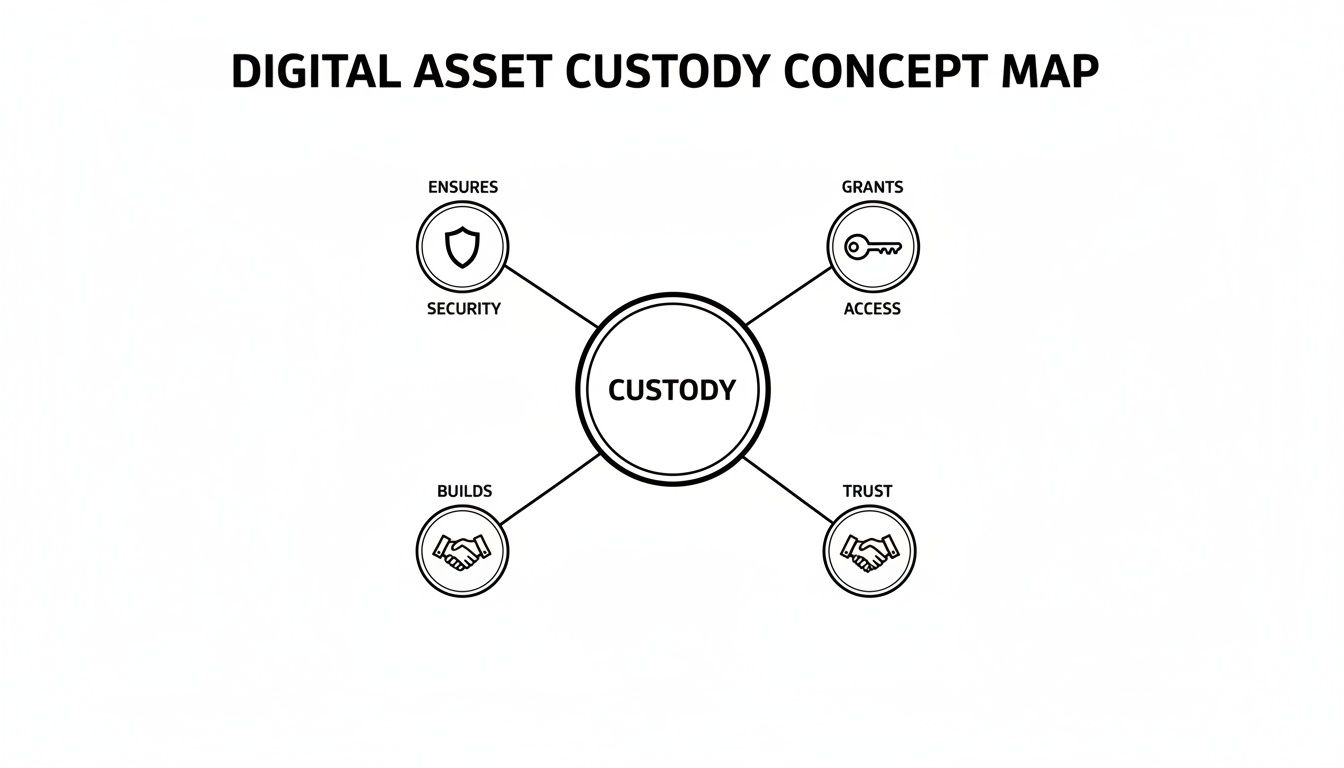
As you can see, a solid custody strategy isn't just about locking assets up tight; it's about building a system you can trust to provide secure access exactly when you need it.
Self-Custody: The "Be Your Own Bank" Approach
Self-custody is exactly what it sounds like: you, and only you, control the private keys to your digital assets. This is the original ethos of crypto, giving you complete and total sovereignty over your funds. No intermediaries, no asking for permission to send a transaction, and no third party who can freeze or seize your assets.
This model is a favorite among long-time crypto users and certain decentralized organizations (DAOs) where absolute control is non-negotiable. But all that freedom comes with a heavy dose of responsibility. If you lose your keys—whether through a hardware wallet failure, a simple accident, or theft—your assets are gone forever. There’s no customer support line to call for a password reset. You can learn more about this in our guide on storing stablecoins securely.
Third-Party Custody: The Institutional Standard
Third-party custody is the gold standard for institutions, much like using a bank or a specialized financial services firm in traditional finance. In this model, you entrust a regulated, expert entity to secure your private keys and manage your assets on your behalf. These providers are purpose-built to handle institutional-grade security, complex operational procedures, and demanding compliance requirements.
For hedge funds, stablecoin issuers, corporations, and asset managers, this is often the only practical path forward. Here’s why:
- Regulatory Compliance: Many jurisdictions legally require institutional investors to use a qualified custodian to safeguard client assets.
- Operational Security: It eliminates the enormous risk of a single employee making a catastrophic mistake or, worse, acting maliciously.
- Insurance and Audits: Top-tier custodians offer insurance policies and undergo regular, rigorous security audits (like SOC reports), giving institutions and their investors crucial peace of mind.
A qualified custodian transforms digital asset security from a daunting technical challenge into a manageable business risk. It provides the legal and operational framework necessary for institutions to engage with digital assets confidently and at scale.
The main trade-off, of course, is that you give up direct, instant control; you're trusting the custodian to execute your instructions. This model also comes with fees, which typically vary based on the value of assets under custody and the specific services you need.
Hybrid Models: The Best of Both Worlds?
A new wave of hybrid models is emerging to combine the fortress-like security of third-party custody with the operational flexibility of self-custody. These solutions often rely on technologies like Multi-Party Computation (MPC), which ingeniously splits a single private key into multiple encrypted "shards."
In a typical MPC setup, the institution might hold one key shard, their custodian another, and perhaps a third-party law firm holds another. A transaction can only be approved if a predetermined number of those shards are brought together to sign it. This structure brilliantly eliminates any single point of failure.
If the custodian gets compromised, the assets are still safe. If the institution misplaces its shard, the assets are still recoverable. This approach offers a powerful balance of shared responsibility, robust security, and operational agility, making it an increasingly popular choice for businesses that need both ironclad protection and the ability to actively manage their assets.
The Technology Behind Secure Custody
Behind every solid digital asset custody solution, you'll find a carefully engineered mix of hardware, software, and advanced cryptography. It's crucial to get your head around this tech because it's the very engine that keeps your assets safe yet accessible. These aren't just abstract ideas; they are the tools that dictate how well a custodian can fend off attacks and how smoothly you can run your operations.
The most basic principle here is sorting assets by how quickly you need to access them. This usually falls into three buckets, which a simple banking analogy can help clarify.
Hot, Cold, and Warm Wallets
Think of hot wallets as your everyday checking account. They’re always connected to the internet, which makes them perfect for quick, frequent transactions. Of course, that constant connectivity is a double-edged sword—it’s convenient for operations but leaves the door open for online attacks.
Cold storage, on the other hand, is like a bank’s vault. The private keys are created and stored on devices that are never connected to the internet. This technique, known as creating an "air gap," makes them incredibly secure against remote hacks but also makes them slow and clunky for day-to-day transactions.
Warm wallets are the middle ground, kind of like a brokerage account. They strike a compromise, using secure, policy-driven environments to manage keys. This gives you faster access than cold storage but with much better security than a typical hot wallet. Most institutions use a blend of all three to balance airtight security with operational demands.
Hardware Security Modules (HSMs)
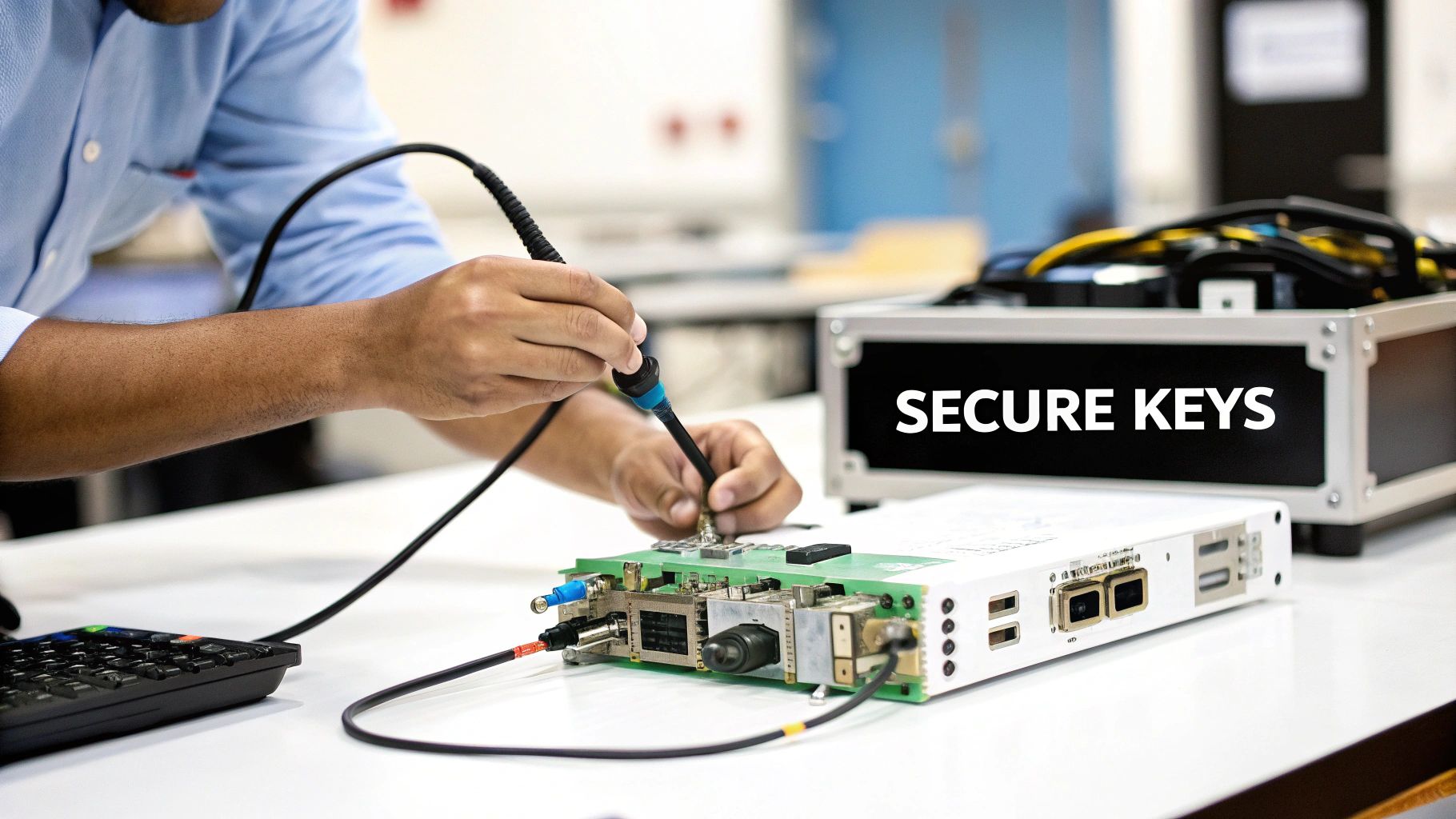
To physically guard the private keys in cold or warm setups, many top-tier custodians turn to Hardware Security Modules (HSMs). These are specialized, tamper-resistant devices built for one job and one job only: managing cryptographic keys.
Picture an HSM as a digital fortress. It's designed from the ground up to resist both physical and logical attacks, guaranteeing that keys are generated, stored, and used entirely within its secure walls. Even if a hacker managed to get into the server running the HSM, the keys themselves would remain out of reach.
HSMs enforce rigid access rules and can even be programmed to self-destruct the keys if they detect tampering, adding a powerful layer of physical security that software just can't replicate.
Multi-Party Computation (MPC)
While HSMs are about fortifying the physical storage of keys, Multi-Party Computation (MPC) is a game-changer for how keys are managed in the first place. Instead of having a single private key sitting in one location, MPC technology shatters it into multiple encrypted "key shares."
These individual shares are then distributed across different parties or secure locations. To sign off on a transaction, a specific number of these parties have to bring their shares together. Here’s the cryptographic magic: the full key is never actually pieced back together in one place, not even for a millisecond. This approach is absolutely critical for building resilient, modern stablecoin infrastructure where a single point of failure just isn't an option.
MPC essentially gets rid of the very concept of a single, stealable private key. A thief would have to compromise multiple, independent systems at the exact same time to get control—a task that's exponentially harder than snatching one key from one spot.
This technology completely changes the game for digital asset custody. It doesn't just ramp up security; it also makes operations far more flexible. An institution, for example, could set up a complex approval rule requiring signatures from two executives and one lawyer to authorize a transfer.
MPC enables these secure, policy-driven workflows without ever putting a complete private key at risk. It beautifully merges the Fort Knox-level security of cold storage with the speed of warmer systems, making it a cornerstone technology for any institution needing both ironclad protection and business agility.
Understanding Security Compliance and Insurance
Let's be clear: fancy technology is only half the battle. For any serious institution, the real bedrock of trust in a digital asset custodian is built on regulation, compliance, and insurance. These aren't just add-ons; they are what elevate a tech platform into a financial-grade service. This framework provides the legal and operational backbone needed to manage other people's money.
Without this layer of trust, even the most secure vault is just a black box. Compliance and insurance are what make the technology auditable, accountable, and resilient when things inevitably go wrong. Think of them as the essential guardrails that protect investor assets and ensure the custodian can withstand intense scrutiny.
The Importance of a Qualified Custodian
In institutional finance, the term "qualified custodian" is a big deal. It's not just a fancy title; it’s a specific regulatory designation. This usually means a bank, trust company, or broker-dealer that meets very strict legal standards for protecting client assets, covering everything from net capital requirements to regular audits and strong internal controls.
For investment advisers and large funds, using a qualified custodian is often a legal mandate. It guarantees assets are kept separate and safe, acting as a crucial line of defense for the end-investor. This oversight is precisely what gives institutions the green light to dive into the digital asset space.
And the demand is surging. Over 72% of institutional investors are now active in digital assets, which has created a massive need for regulated custody. The market is projected to reach an incredible $3.24 trillion, a growth powered by clearer regulatory frameworks.
For a deeper dive into the compliance frameworks that build this trust, it’s helpful to understand certifications like SOC 2. This guide on What is SOC 2 compliance is a great starting point, as it shows a custodian's commitment to high security and data protection standards.
Demystifying Insurance Coverage
Insurance is the other critical pillar, but you have to look closely at the details. It’s absolutely vital to understand what is—and isn’t—covered. Not all policies are created equal, and the fine print can make or break you.
Most top-tier custodians will have a mix of policies to cover different types of risk:
- Crime Insurance: This is your protection against internal threats, like theft or collusion by the custodian's own employees—a major operational risk for any financial firm.
- Specie Insurance: This is a more specialized policy. It typically covers the physical loss or damage of private keys held in cold storage, like someone breaking into a high-security vault.
A common mistake is assuming a custodian's insurance covers every possible loss. Most policies explicitly exclude losses from things like smart contract bugs, protocol failures, or wild market swings. The coverage is there for the custodian's direct security failures, not the risks inherent to the assets themselves.
When you're vetting a provider, you need to ask pointed questions about their insurance. Find out the policy limits, who the underwriters are, and exactly what events trigger a payout. This is a non-negotiable part of due diligence.
This is especially true as the legal ground keeps shifting. Understanding the nuances of stablecoin regulation can directly affect how assets are treated and protected. A solid insurance policy, paired with a robust compliance program, is the clearest sign that a custodian truly understands its fiduciary duty.
How to Choose the Right Custody Partner
Choosing a partner to secure your digital assets is one of the most consequential decisions your firm will ever make. This isn't just a theoretical exercise; it's a practical choice that demands a serious, structured evaluation. Get it right, and you protect your assets, enable your business operations, and build unshakable confidence with stakeholders.
The process boils down to diligent, in-depth research covering technology, security, regulatory standing, and the quality of their service. Not everyone's priorities are the same. A venture capital fund might be hunting for a custodian that supports a wide array of new, more obscure tokens. On the other hand, a stablecoin issuer will be laser-focused on seamless API integration for minting and burning, a critical function for any project involving banks with stablecoins.

Core Evaluation Criteria
Your evaluation has to start with the absolute fundamentals—the non-negotiable pillars of any custody provider worth their salt. Think of these as the foundation of a secure and compliant partnership.
Your first-pass checklist must include:
- Technological Infrastructure: What's under the hood? Do they rely on Multi-Party Computation (MPC), Hardware Security Modules (HSMs), or some combination? You need to understand their wallet architecture (hot, warm, and cold storage) and see how it maps to your own needs for immediate liquidity versus Fort Knox-level security.
- Security Audits and Certifications: Don't just take their word for it. Look for proof from independent, third-party auditors. Certifications like SOC 1, SOC 2, and ISO 27001 are powerful signals that they have a mature, well-documented security program in place.
- Regulatory Licensing and Compliance: Is this provider a regulated entity, like a qualified trust company or a bank? You need to verify their licenses and confirm they adhere to strict KYC/AML rules in the jurisdictions that matter to you.
This initial screening is your filter. It quickly weeds out any providers who don't meet the baseline for institutional-grade security and compliance. A custodian's regulatory status is particularly vital, as it directly impacts how your assets are protected under the law.
Asset Support And Service Level Agreements
Once you've vetted the foundational security and compliance, it's time to drill down into the operational details. Does this custodian actually fit your specific needs? A provider can have the most secure tech in the world, but it’s useless if it doesn't support your assets or offer the service level you require.
A critical mistake is choosing a custodian based solely on security technology while overlooking its operational fit. A world-class vault is of little use if it can't hold your specific assets or meet your transaction speed requirements.
Here's where the rubber meets the road. Ask these key operational questions:
- Breadth of Asset Support: Can they handle the specific tokens, blockchains, and protocols you work with? This isn't just about the big names; it includes stablecoins, security tokens, or even NFTs if they're part of your strategy.
- Service Level Agreements (SLAs): What are their guaranteed response times for support tickets and transaction processing? For mission-critical operations, vague promises won't cut it. You need clear, contractually obligated SLAs where delays won't cost you.
- Insurance Coverage: Get into the weeds of their insurance policy. What's the total coverage amount? Who is the underwriter? And most importantly, what specific events—like internal theft or a cold storage breach—are actually covered?
Choosing the right partner is a detailed process, but it's essential for navigating this growing market. To help you organize your due diligence, here is a checklist summarizing the key points to cover with any potential provider.
Custodian Evaluation Checklist
| Evaluation Criterion | What to Look For | Why It Matters |
|---|---|---|
| Technology Stack | MPC, HSMs, or hybrid; wallet architecture (hot, cold, warm); key management protocols. | The core technology determines the security model and the balance between asset accessibility and protection from threats. |
| Regulatory Status | Qualified custodian status (e.g., trust, bank); licenses in relevant jurisdictions (e.g., NYDFS BitLicense). | Ensures legal protection for your assets and compliance with anti-money laundering (AML) and know-your-customer (KYC) laws. |
| Security Certifications | SOC 1/2 Type II, ISO 27001; regular penetration testing and third-party audits. | Independent validation that the custodian's security controls and operational processes meet industry-recognized standards. |
| Insurance Coverage | Policy limits, underwriter reputation, covered risks (theft, loss), and if it covers hot and cold storage. | Provides a financial backstop in the event of a catastrophic loss, but the details of the policy are what truly matter. |
| Asset & Protocol Support | List of supported blockchains, tokens (ERC-20, etc.), and protocols (e.g., staking, DeFi). | The custodian must be able to support the specific assets you hold today and plan to hold in the future. |
| API & Integration | Well-documented APIs, integration support, and compatibility with your existing tech stack. | Crucial for automating workflows like minting, burning, or treasury management, reducing operational risk. |
| Service Level Agreements | Guaranteed uptime, transaction processing times, and support response windows. | Defines the level of service you can expect and provides recourse if the provider fails to meet its commitments. |
This checklist provides a solid framework for comparing providers apples-to-apples. A thorough review of each of these areas will give you a clear picture of which partner is truly the best fit for your organization's unique needs.
The institutional rush into digital assets is fueling explosive market growth. Forecasts for the digital asset custody market are universally bullish, with projections ranging from over $800 billion to more than $7 trillion in assets under custody. This expansion reflects a compound annual growth rate (CAGR) of around 23%, driven by new institutional entrants and the financial integration of assets like stablecoins. This booming market means you have more choices than ever, which makes a structured, disciplined evaluation process absolutely critical.
The Future of Digital Asset Custody
The world of digital asset custody is changing fast. It's no longer just about locking down private keys in a high-tech digital vault. What started as a niche security service is quickly becoming the foundational infrastructure for the next generation of finance on Web3. Custodians are stepping out of the shadows, evolving from passive guardians into active technology partners who are critical for unlocking new markets.
This evolution isn't happening in a vacuum. It's a direct response to a clear demand from institutions. They need more than just storage; they need platforms that can safely put their digital assets to work. The future of digital asset custody solutions is being forged in this shift from static security to active, on-chain enablement.
The Rise of Tokenized Assets
One of the biggest drivers of this change is the tokenization of real-world assets (RWAs). We're seeing everything from real estate and private equity to carbon credits being represented on a blockchain, and this creates a pressing need for a new kind of custody.
The custodian's job suddenly gets a lot more complex. It's not just about holding a token anymore.
- Complex Asset Management: Custodians now have to manage the digital twin of a physical or financial asset, which comes with its own unique legal and compliance baggage.
- Lifecycle Event Support: They also need to handle on-chain events tied to the asset, like distributing dividend payouts from a tokenized stock or collecting rental income from a tokenized property.
This massive influx of RWAs means custodians have to build frameworks that can handle a far more diverse and complicated universe of assets than just Bitcoin or Ethereum.
The evolution is clear: custodians are shifting from being simple crypto vaults to becoming comprehensive digital trust companies. They are building the secure rails needed to connect traditional financial assets with the efficiency and global reach of blockchain technology.
Deep Integration with DeFi and Staking
Another major development is the direct pipeline being built between custody platforms and the worlds of Decentralized Finance (DeFi) and staking. Institutions are done letting their assets sit on the sidelines. They want secure, compliant ways to earn yield and participate in the governance of these new networks.
Modern custodians are answering that call. They're engineering secure gateways that let clients stake assets, vote on protocol upgrades, or supply liquidity to DeFi pools—all without their private keys ever leaving the safety of the regulated, insured custodial environment.
This model truly offers the best of both worlds: access to on-chain activity without ever exposing private keys to the open internet. It's a powerful combination that is turning custodians into the primary, secure on-ramp for institutional money flowing into the broader Web3 economy and enabling a new wave of more sophisticated financial products.
Frequently Asked Questions
When you're digging into the world of digital asset custody, a lot of questions come up around compliance, tech, and security. Let's break down some of the most common ones to give you a clearer picture and help you make the right call for your assets.
What Is the Main Difference Between a Qualified and Non-Qualified Custodian?
The short answer? Regulation.
A qualified custodian is a financial institution—think a state-chartered trust company or a bank—that operates under strict government oversight. They are legally required to do things like maintain specific capital reserves, undergo regular audits, and, most importantly, keep client assets completely segregated from their own. This last point is huge; it means your assets are protected if the custodian ever faces financial trouble.
On the other hand, a non-qualified custodian might have great security tech, but they don't have the same level of regulatory scrutiny. For serious institutional players, investment advisors, or pension funds, this distinction is everything. They often have a fiduciary duty—and sometimes a legal one—to use a qualified custodian to give their investors the highest level of protection.
How Does MPC Improve Security Over Traditional Cold Storage?
Traditional cold storage is all about locking down a single private key on a device that’s kept completely offline. It's a solid defense against online hackers, but it introduces a massive single point of failure. If that one offline device is lost, stolen, or damaged, those assets are permanently gone.
Multi-Party Computation (MPC) brilliantly solves this problem. Instead of putting all your eggs in one basket, MPC cryptographically shatters a single private key into multiple encrypted "shares" and scatters them across different locations.
To sign a transaction, a specific number of these shares are needed to come together. The genius part is that the complete private key is never reconstructed in one place, not even for a split second. An attacker would have to breach multiple, separate systems at the same time to get anywhere, which is exponentially harder than nabbing a single key from one device. This makes MPC a much more resilient and operationally flexible way to secure assets.
Can I Stake My Assets While They Are With a Custodian?
Absolutely. This is becoming a must-have feature for top-tier digital asset custody solutions. Many of the best custodians have built secure systems that let institutions stake, vote on governance proposals, and even provide liquidity to DeFi protocols right from their custody accounts.
This capability is a game-changer for institutions that don't want their assets sitting idle. It allows them to generate yield and actively participate in network governance without ever compromising on security. The custodian handles all the technical heavy lifting behind the scenes, ensuring the underlying private keys remain protected and never touch the open internet.
At Stablecoin Insider, we provide the latest analysis and in-depth coverage to help you stay ahead in the world of digital finance. Explore our resources to deepen your understanding of the technology and regulations shaping the future of digital assets. Learn more at Stablecoin Insider.