Table of Contents
Digital asset compliance is the set of rules and internal processes that allow cryptocurrencies and other tokens to operate within the same standards as the rest of the financial world. It covers everything built to prevent financial crime, protect consumers, and keep the market fair.
Think of it as the bridge connecting the fast-paced world of digital assets with the established frameworks of global finance.
What Digital Asset Compliance Really Means
At its core, compliance isn't about slowing things down. It's about building the trust needed for crypto to go mainstream.
Without any rules, the digital marketplace would be chaotic, risky, and a non-starter for serious institutional investors. Compliance brings the order and predictability that institutions and everyday users need to feel confident.
This framework stands on three core pillars. If one is weak, the entire structure is shaky.

What Are the Three Pillars of Digital Asset Compliance?
1. Anti-Money Laundering (AML):
Covers the procedures that stop bad actors from using crypto to wash dirty money. It means actively monitoring transactions for suspicious activity and reporting it to the relevant authorities.
2. Know Your Customer (KYC):
Is the process of verifying that your customers are who they claim to be. This step is a critical defense against fraud, identity theft, and criminals trying to open anonymous accounts. You cannot run a credible AML program without it.
3. Market integrity rules:
Outlaw practices like wash trading and insider trading, protecting investors and building genuine confidence in an asset's true value.
A strong compliance framework is the engine for institutional investment. It transforms digital assets from a speculative niche into a legitimate asset class, and more than half of traditional hedge funds now hold some form of digital asset exposure, the highest proportion ever recorded.
That institutional momentum is not happening in spite of stricter compliance requirements. It's happening because of them.
Navigating the Global Regulatory Landscape in 2026
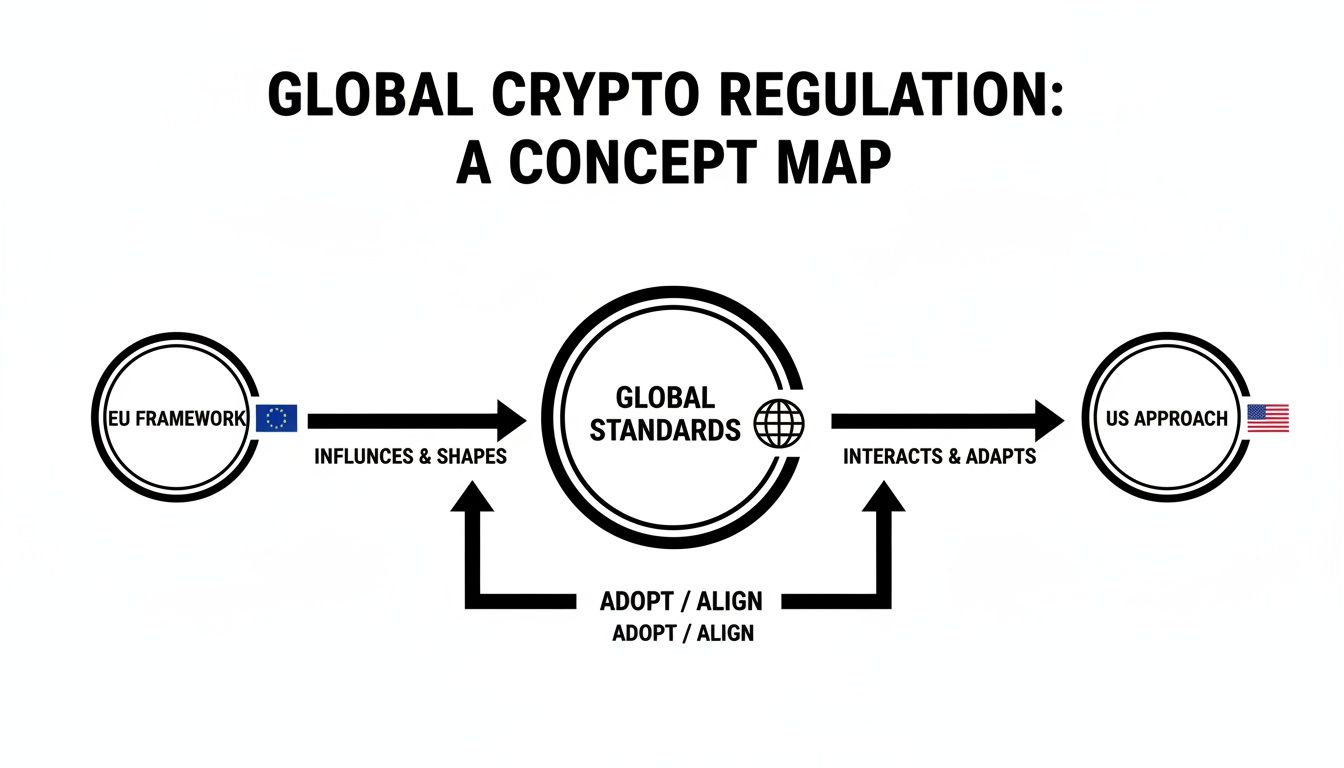
The global regulatory picture looks fundamentally different in 2026 than it did even 18 months ago. The two biggest economies in the world have both moved from ambiguity to legislation, and the ripple effects are reshaping compliance programs everywhere.
Understanding the major frameworks isn't optional anymore. It's the baseline.
MiCA: Now Fully in Force Across the EU
For years, European crypto operators dealt with a patchwork of national rules. The EU's Markets in Crypto-Assets regulation (MiCA) ended that era.
MiCA's stablecoin provisions came into force on June 30, 2024. Full CASP licensing requirements followed on December 30, 2024. As of mid-2026, the grandfathering period for legacy operators expires, there is no further grace period.
The regulation created strict requirements for stablecoin issuers across all 27 member states: mandatory 1:1 reserve backing, comprehensive AML/KYC compliance, market abuse prevention, and regular audits. MiCA also introduced passporting rights, allowing a CASP authorized in one EU country to operate across the entire bloc.
The implementation has not been seamless. Transitional periods varied dramatically by jurisdiction, the Netherlands required compliance by July 2025, while France, Malta, and Estonia extended to July 2026. This fragmentation created regulatory arbitrage opportunities that ESMA is now actively working to close.
One of the most consequential enforcement realities under MiCA: major stablecoins including USDT have been deemed non-compliant, forcing exchanges operating in the EU to delist them and fragmenting liquidity in the process.
Operators should also note the emerging dual-licensing issue. From March 2026, certain EMT custody and transfer services may require both MiCA authorization and a separate license under the Payment Services Directive (PSD2) — effectively doubling compliance overhead for euro stablecoin providers. For a deeper look at how MiCA's stablecoin categories work, see our full guide to stablecoin regulations.
The United States: From Enforcement to Legislation
For years, US crypto regulation was defined by enforcement actions. That era ended in 2025.
Gary Gensler resigned as SEC Chair in January 2025, concluding an era that produced over 100 enforcement actions against crypto firms. Paul Atkins was sworn in as the 34th SEC Chair in April 2025, signaling a decisive shift toward compliance enablement over prosecution.
The landmark development was the GENIUS Act, signed into law on July 18, 2025. It is the first comprehensive federal framework for stablecoins in US history.
Key provisions of the GENIUS Act include:
- 100% reserve backing required, using only high-quality liquid assets including US dollars, short-term Treasuries, and qualifying money market funds
- Monthly public reserve disclosures for all issuers; annual financial filings for large issuers
- Stablecoin issuers classified as financial institutions under the Bank Secrecy Act, making AML, KYC, and OFAC sanctions compliance mandatory
- A dual licensing pathway, federal (OCC) or state-regulated, for permitted payment stablecoin issuers
- Federal regulators must issue implementing regulations by July 18, 2026; the Act fully takes effect by January 2027
The OCC has also reopened channels for national banks to provide digital asset custody and issue stablecoins under supervisory standards. The FDIC followed with proposed rulemaking for insured depository institutions seeking to issue stablecoins through subsidiaries.
The US is no longer a patchwork. It is now a jurisdiction with a clear legislative framework that is actively being implemented.
FATF's Travel Rule: Adoption Accelerating Globally
Even as individual nations develop their own frameworks, the Financial Action Task Force (FATF) continues to set the global floor for fighting financial crime.
The Travel Rule requires Virtual Asset Service Providers (VASPs) to collect and share originator and beneficiary information for qualifying transactions. As of FATF's 2025 sixth update, 85 of 117 jurisdictions have passed or are actively implementing Travel Rule legislation, up from 65 in 2024.
FATF's 2025 update to Recommendation 16 also placed additional pressure on VASPs and compliance teams to close remaining implementation gaps. The direction is clear: the Travel Rule is no longer an emerging standard. It is the expected baseline.
Beyond the Big Three: Asia-Pacific and the Gulf
The regulatory story is no longer just US and EU. Several other jurisdictions made landmark moves in 2025 that compliance teams cannot ignore.
Hong Kong enacted the Stablecoin Ordinance in August 2025, establishing a licensing framework for fiat-referenced stablecoin issuers. The first batch of licenses is expected in early 2026.
Singapore completed its fifth-round FATF Mutual Evaluation in 2025, the first time these peer reviews fully assessed virtual asset AML/CFT effectiveness. South Korea is advancing competing stablecoin bills after its first prosecutions under the Virtual Asset User Protection Act.
In the Gulf, Dubai's VARA released Version 2.0 of its regulatory rulebooks in May 2025, expanding governance and reporting requirements. The UAE was also removed from the EU's high-risk AML watchlist, a significant signal of improved regulatory credibility.
Key Global Regulatory Frameworks at a Glance (2026)
| Framework | Jurisdiction | Primary Focus | Key Impact on Stablecoins |
|---|---|---|---|
| MiCA | European Union (27 member states) | Harmonized licensing and operational rules for crypto-assets and CASPs | 1:1 reserve backing, AML/KYC compliance, audits, passporting rights; USDT non-compliant and delisted by EU exchanges |
| GENIUS Act | United States | First federal framework for payment stablecoins under OCC/state dual licensing | 100% liquid reserve backing, monthly disclosures, full BSA/AML coverage, OFAC sanctions compliance |
| FATF Standards | Global (117+ member countries) | International AML/CFT baseline via Travel Rule and Recommendation 16 | 85 of 117 jurisdictions now implementing Travel Rule; stablecoins flagged as primary vector for on-chain illicit activity |
| Hong Kong Stablecoin Ordinance | Hong Kong SAR | Licensing framework for fiat-referenced stablecoin issuers | Reserve, governance, and redemption requirements; first licenses expected mid-2026 |
Building a Bulletproof Compliance Program
Knowing the rules is one thing. Building a system that can navigate them safely is another.
A robust compliance program is not a policy document on a shelf. It is a living system embedded in your company's operations, updated continuously as rules evolve and your risk profile changes.
Every solid program rests on four pillars: governance, risk assessment, internal controls, and independent testing.
Establishing Strong Governance
Compliance always starts at the top. Without board-level buy-in, no program survives contact with real risk.
Strong governance means documented, board-approved policies covering AML, KYC, and sanctions screening. It means defined accountability at every level, not just a Chief Compliance Officer title. It means ongoing training, not a one-time onboarding module.
When leadership actively champions compliance, it becomes a shared operating standard, not one department's problem.
Conducting a Thorough Risk Assessment
You cannot defend against threats you haven't identified. A risk assessment is your process for systematically mapping the illicit finance risks specific to your business.
This is a continuous exercise. Every new product, new market, or new customer type demands a fresh review.
Your assessment should interrogate three core dimensions: who your customers are (including Politically Exposed Persons), what your products enable (especially cross-border or privacy-adjacent features), and where you operate (jurisdictions with elevated sanctions or AML risk).
The output is a risk heat map that tells you exactly where to deploy your defenses.
Implementing Essential Internal Controls
Policies define what you need to do. Internal controls define how you do it every day.
Your controls must cover at minimum: a Customer Identification Program (CIP) for rigorous KYC verification, transaction monitoring using blockchain analytics tools to flag suspicious patterns, continuous sanctions screening against lists like OFAC's SDN, and a documented process for filing Suspicious Activity Reports (SARs) and maintaining records for at least five years.
For operators subject to MiCA, DORA (the EU's Digital Operational Resilience Act) adds another layer, significantly raising expectations around cybersecurity and operational resilience. This is now a compliance requirement, not a best practice.
Independent Testing and Audits
No program is bulletproof without regular external stress-testing. Independent audits identify the gaps your internal teams miss and demonstrate to regulators, investors, and partners that your compliance posture is genuine.
Third-party attestations, particularly for stablecoin reserve verification, are now a regulatory requirement in both the EU and the US under MiCA and the GENIUS Act respectively.
The Technology Powering Modern Compliance
Smart compliance in digital assets is not just about the right policies. It requires the right technology to enforce them at scale.
Regulatory Technology (RegTech) is the central nervous system of any serious compliance program. It turns abstract rules into real-time actions.
Blockchain Analytics
At the core of any digital asset compliance setup is blockchain analytics. Platforms like Chainalysis and TRM Labs trace the flow of funds across public ledgers and automatically flag suspicious activity.
Core capabilities include real-time screening of transactions against databases of sanctioned and illicit addresses, wallet risk scoring based on full transaction history, and source-of-funds tracing to determine whether inbound assets originate from regulated exchanges or high-risk unhosted wallets.
This technology is essential for meeting AML obligations and producing the audit trails that regulators now expect as a baseline.
Proof-of-Reserves and Attestations
Regulators in both the EU and the US now require stablecoin issuers to prove their reserve holdings — not just claim them.
This requires secure, tamper-resistant record-keeping systems and third-party attestations, typically conducted by major accounting firms using cryptographic verification methods.
MiCA mandates independently verified reserve data for all ART and EMT issuers. The GENIUS Act requires monthly public reserve disclosures for all US-permitted issuers and annual financials for large ones. The standard is converging globally: claims without proof are no longer acceptable.
For a detailed look at how custody architecture supports these requirements, see our overview of digital asset custody solutions.

What Compliance Means for Your Role
Digital asset compliance looks entirely different depending on where you sit. A developer architecting a new protocol has a different set of obligations than an investor or a FinTech executive.
The key is understanding your specific slice of the responsibility, and acting on it before regulators force the issue.
Guidance for Investors
For investors, compliance due diligence is one of the most powerful risk management tools available.
A project cavalier about its regulatory obligations is signaling that it doesn't care about long-term stability. That is a material risk factor.
Your due diligence should go beyond tokenomics. Look for a documented AML/KYC policy that isn't just marketing copy. Verify where the project is legally domiciled, an entity operating under MiCA or the GENIUS Act carries materially less regulatory risk than one in an unregulated jurisdiction. Demand evidence of independent audits for both code and reserves.
A project's stance on compliance is a direct proxy for its maturity. Serious operators treat compliance as infrastructure. Short-term operators treat it as an obstacle.
Guidance for Developers
Developers are the first line of defense. The code you write either bakes compliance in or creates a costly retrofit problem later.
Compliance-by-design means integrating KYC hooks and identity verification APIs from the initial architecture, not bolting them on post-launch. It means building immutable, auditable transaction logs from day one, knowing regulators require records for at least five years. It means hardcoding sanctions screening against OFAC's SDN list directly into your transaction flow.
Building with compliance in mind is not about constraining creativity. It's about future-proofing your work so it can plug into the regulated global financial system.
Guidance for FinTech Leaders
For established FinTechs and banks entering digital assets, regulators will apply the same standard of discipline to crypto as to any other regulated product. No concessions will be made for novelty.
Your existing compliance framework needs to extend, not just adapt, to cover crypto-specific risks. This includes cryptographic key management, tracing funds from unhosted wallets, and smart contract exploit risk in your counterparty assessments.
Three priorities stand out for 2026:
- First, if you're partnering with crypto sub-custodians or liquidity providers, your vendor due diligence must be exhaustive, their failures become your regulatory problem.
- Second, if you're operating any EMT-related services in the EU, audit your exposure to the MiCA/PSD2 dual licensing requirement before March 2026.
- Third, update your risk models to cover DORA's operational resilience requirements, which now apply to CASPs alongside their existing MiCA obligations.
What's Next for Digital Asset Compliance?
The regulatory trajectory is clear: more coverage, more enforcement, more cross-border coordination. The open questions are now about implementation quality, not whether regulation is coming.
DeFi Compliance Is No Longer Optional
Regulators worldwide are applying time-tested financial rules to DeFi protocols. The debate about whether AML and KYC apply to decentralized systems is effectively over.
The more interesting development is in the solutions. On-chain identity tools using verifiable credentials and non-transferable soulbound tokens are now in active deployment, linking wallet addresses to real-world verified identities without centralized data storage. Permissioned liquidity pools give institutions a compliant entry point to DeFi. Zero-knowledge proofs allow users to attest compliance, proving they are not on a sanctions list, without revealing the underlying personal data.
These are not experimental concepts. They are production infrastructure being used right now by protocols that need to maintain both compliance and decentralized architecture.
Smarter Enforcement and Global Coordination
Regulators are significantly more capable than they were two years ago. Sophisticated blockchain analytics tools allow global enforcement agencies to trace illicit funds across chains and jurisdictions with precision that would have been impossible in 2022.
Cross-border coordination has also intensified. The US, South Korea, and Japan have issued joint warnings about North Korean crypto theft operations. The US, UK, and EU have coordinated targeted sanctions against Russian sanctions evasion via crypto.
The blockchain's permanent record is no longer an advantage for bad actors. It is the primary tool regulators use against them.
The Regulatory Frontiers to Watch
Several issues will define the compliance landscape through 2027 and beyond.
AMLA, the EU's new Anti-Money Laundering Authority, has identified crypto-assets as an early supervisory priority and is expected to directly oversee CASPs from 2028. This represents a shift to more centralized, data-driven AML enforcement at the EU level.
Self-custodial wallets remain a major open debate. FinCEN has proposed reducing the de minimis Travel Rule threshold for cross-border transactions from $3,000 to $250, which would bring a dramatically larger volume of transactions into scope.
Privacy-enhancing technologies including mixers and privacy coins remain under active regulatory scrutiny. Regulators are trying to draw a workable line between legitimate privacy use cases and tools purpose-built for obfuscating illicit flows.
Stablecoin oversight will intensify in every major jurisdiction. The future of stablecoins as a payment infrastructure is now a central concern for financial watchdogs globally, not a peripheral one.
The projects that will survive and scale are the ones that treat compliance as product infrastructure rather than legal paperwork. That mindset is the difference between building for the next cycle and building for the next decade.
FAQs:
1. What Is the Difference Between AML and KYC?
KYC (Know Your Customer) is one of the most critical tools within your AML (Anti-Money Laundering) strategy. AML is the complete playbook. It is the full system of policies, controls, and technology a firm deploys to prevent financial crime.
2. What Is the GENIUS Act?
The GENIUS Act is the first comprehensive federal law regulating stablecoins in the United States, signed on July 18, 2025. It requires all payment stablecoins to be 100% backed by liquid assets, mandates monthly reserve disclosures, classifies stablecoin issuers as financial institutions under the Bank Secrecy Act, and establishes a dual licensing pathway through either the OCC or state regulators.
3. Does MiCA Apply to My Business Outside the EU?
If you serve EU customers or operate through EU-domiciled entities, MiCA applies to you regardless of where your company is headquartered. Non-EU stablecoin issuers who want their tokens tradeable on EU-licensed exchanges must meet MiCA's reserve, governance, and redemption requirements or face delisting. There is no equivalence regime that allows direct third-country market access.
4. Does Digital Asset Compliance Apply to DeFi?
Yes, and increasingly so. Regulators worldwide have made clear that if a DeFi protocol performs the functions of a traditional financial service, lending, exchange, custody, it is subject to equivalent compliance obligations. The compliance obligation follows the financial activity, not the technology architecture.
5. What Is the Crypto Travel Rule?
The Travel Rule is a FATF global standard requiring VASPs to collect and transmit originator and beneficiary information for qualifying crypto transactions, the crypto equivalent of wire transfer information-sharing requirements in traditional banking. As of FATF's 2025 update, 85 of 117 jurisdictions are now implementing the Travel Rule, up from 65 in 2024. It is the foundation of international AML coordination for virtual assets.
Disclaimer:
This content is provided for informational and educational purposes only and does not constitute financial, investment, legal, or tax advice; no material herein should be interpreted as a recommendation, endorsement, or solicitation to buy or sell any financial instrument, and readers should conduct their own independent research or consult a qualified professional.