


Table of Contents
DOVER, Del. (March 25, 2026).
Delaware lawmakers took a major step toward becoming a national leader in cryptocurrency oversight Monday, introducing Senate Bill 19, the Delaware Payment Stablecoin Act, as part of a broader banking modernization package.
The legislation would create a comprehensive state licensing framework for payment stablecoin issuers and digital asset service providers, filling a regulatory gap while aligning closely with new federal rules.
Key Takeaways
- SB 19 (Delaware Payment Stablecoin Act) creates the state’s first dedicated licensing regime for payment stablecoin issuers and digital asset service providers.
- The bill aligns Delaware law with the federal GENIUS Act, enabling seamless federal-to-state charter conversion.
- Issuers must maintain 1:1 reserves, redeem tokens within two business days, meet capital requirements, and comply with AML and data-privacy rules.
- Companion legislation (SB 16) modernizes broader banking rules, allowing state-chartered banks to hold and manage digital assets in a fiduciary capacity.
- Goal: Position Delaware as a premier U.S. hub for crypto innovation and responsible stablecoin growth.
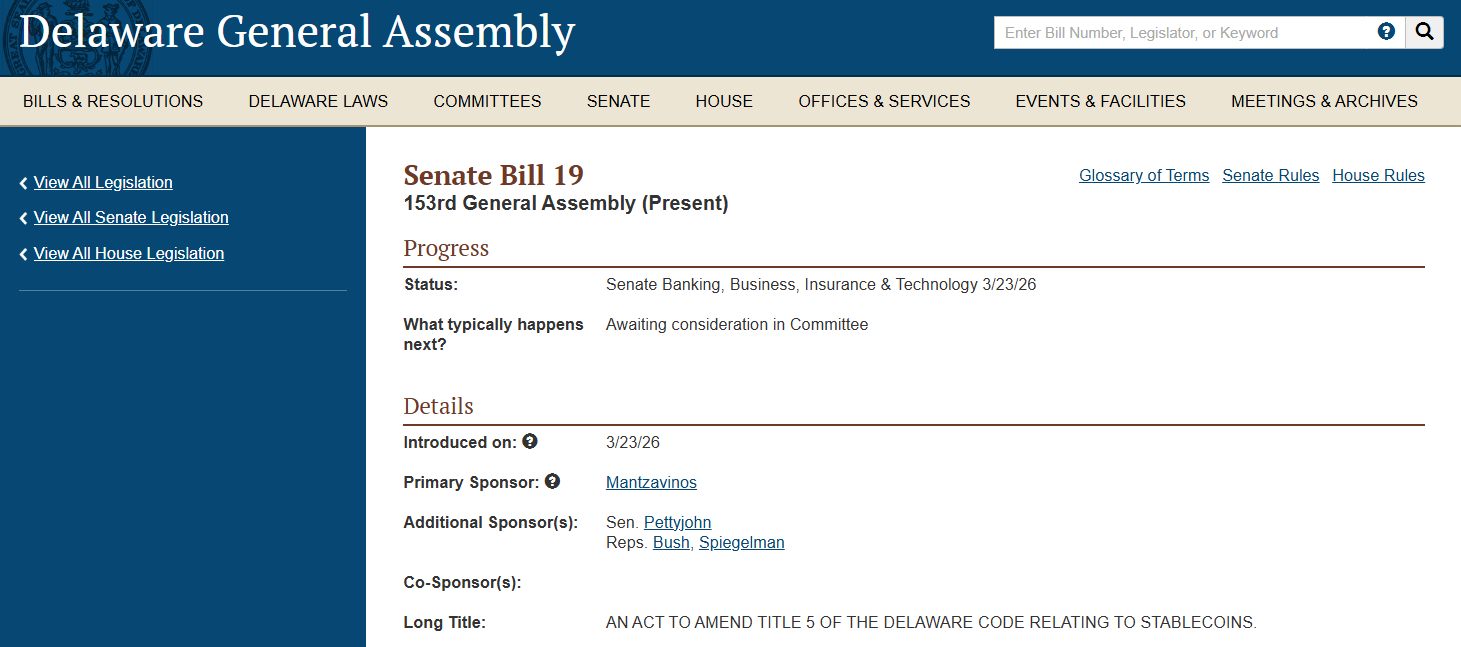
Introduced by Sen. Spiros Mantzavinos (D-Elsmere) and Rep. Bill Bush, SB 19 amends Title 5 of the Delaware Code to regulate “payment stablecoins”, digital assets designed to maintain a stable value pegged to the U.S. dollar.
The bill directly adopts key definitions from the federal Guiding and Establishing National Innovation for U.S. Stablecoins Act (GENIUS Act), signed into law by President Donald Trump in July 2025, and from related Office of the Comptroller of the Currency rulemaking.
Under the proposed framework, companies issuing stablecoins or providing digital asset services to Delaware residents would need a state license from the Office of the State Bank Commissioner. Licensed issuers would face strict consumer-protection and financial-stability requirements, including:
- 1:1 reserve backing with high-quality liquid assets such as U.S. currency, Treasury bills, or insured deposits.
- Mandatory redemption of stablecoins within two business days of a holder’s request.
- Capital and net-worth standards, anti-money laundering (AML) programs, and data-privacy floors.
- Custody safeguards, change-in-control notice procedures, and reserve-shortfall remediation rules.
The bill also creates a pathway for federally qualified stablecoin issuers to convert to Delaware state charters and includes strong preemption provisions to override conflicting local rules.
Payment stablecoins would explicitly not be treated as securities or insured deposits under state law, while preserving existing consumer protections.
Delaware’s move comes as the state, long known as the “corporate capital of America” for its business-friendly laws, seeks to reclaim its edge in fintech and digital assets. Banking statutes have not seen major updates since 1981, and officials view stablecoin regulation as a chance to attract both large and smaller issuers looking for clear, state-level oversight that complements federal rules.

Conclusion
If passed, SB 19 would mark one of the most detailed state-level stablecoin frameworks in the country, giving Delaware a competitive advantage in the race among states and the federal government for digital-asset business.
By blending consumer safeguards with regulatory clarity, the legislation aims to foster innovation while mitigating risks associated with one of the fastest-growing segments of the crypto economy.
The bills now head to the Senate Banking, Business, Insurance & Technology Committee for further review.
Read Next:
- Tether's First Full Independent Audit of USDT Reserves
- Deloitte Canada and Stablecorp Announce Strategic Partnership
- Who Is Adding Stablecoins to Payroll and Why It's No Longer Optional in 2026
FAQs:
1. What is Delaware’s SB 19 stablecoin bill?
SB 19, titled the Delaware Payment Stablecoin Act, establishes a licensing and regulatory framework for companies that issue payment stablecoins or provide digital asset services in the state. It was introduced March 23, 2026.
2. How does Delaware’s stablecoin law align with the federal GENIUS Act?
The bill adopts definitions and standards directly from the federal GENIUS Act (signed July 2025) and OCC rulemaking, creating harmony between state and federal oversight while offering a state-charter conversion pathway.
3. What requirements must stablecoin issuers meet under SB 19?
Issuers must maintain 1:1 reserves in high-quality assets, redeem tokens within two business days, hold adequate capital, implement AML programs, protect customer data, and follow strict custody and change-in-control rules.
4. Why is Delaware pursuing stablecoin regulation now?
Lawmakers want to modernize banking laws unchanged since 1981 and attract crypto firms seeking clear, business-friendly regulation. The goal is to make Delaware the go-to state for responsible stablecoin innovation.
5. When could SB 19 take effect?
The bill is in the early legislative stage. If approved, the State Bank Commissioner would issue implementing regulations within set timeframes to align with federal standards.
Disclaimer:
This content is provided for informational and educational purposes only and does not constitute financial, investment, legal, or tax advice; no material herein should be interpreted as a recommendation, endorsement, or solicitation to buy or sell any financial instrument, and readers should conduct their own independent research or consult a qualified professional.